Return to Real Quotes
by Ryan Levesque
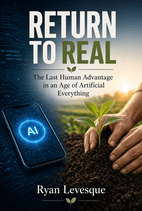
This page collects lines from Return to Real about attention, trust, nature, and the hidden cost of living on autopilot. You will find sharp observations, practical reminders, and questions worth sitting with. These are the kind of lines that stay with you because they name a vague cultural unease in plain language.
The book is quotable because it moves from big ideas to concrete choices. It asks what happens when convenience replaces presence, when speed replaces judgment, and when polish replaces honesty. Some lines may make you pause. Others may make you want to step outside, call someone you love, or put the phone down.
Top Quotes from Return to Real
“The reality is if you are not analog by design, you will become digital by default.”
The author describes how attention gets pulled into the digital vortex.
It distills the chapter’s warning into a single portable principle. It is easy to remember and hard to dismiss.
“In other words: Slop is cheap. Real is rare.”
The author contrasts AI-generated content with what cannot be faked.
It turns the book’s economic argument into a punchy, memorable phrase. It also sets up why authenticity can command a premium.
“One of the simplest acts of rebellion in this growing revolution is also one of the smallest: Touch earth before touching a screen.”
The author introduces the practice that became a phrase in the Return to Real movement.
It turns a tiny daily habit into an accessible act of resistance. The line is memorable because it is concrete, immediate, and quietly defiant.
“Heart, Humor, Humanity are the ingredients. Oxytocin is the mechanism. And in a world where everything can be faked, trusted relationships are the competitive moat that increasingly matters most.”
The author summarizes the strategic case for building around trust rather than attention.
It connects warm human qualities to a hard-nosed business advantage in a world of fakery. The line makes trust feel both personal and competitively urgent.
“Dopamine can be triggered by something as shallow as the right shade of red showing up as an alert on your phone. Oxytocin is harder to come by. It comes through a hug. Eye contact. A warm, meaningful conversation. You cannot get an oxytocin hit from a push notification.”
The author contrasts dopamine-driven tech triggers with oxytocin-rich human connection.
It gives readers a vivid, practical contrast between cheap stimulation and real bonding. The final sentence is especially quotable and easy to remember.
“The bear I'd been running from for seven years? Facing it didn't destroy me. It set me free.”
He reflects on finally confessing that his emails had not been written by him for years.
It turns vulnerability into liberation and makes facing truth feel hopeful.
“The path to what's real for you is not a safe one. It's one that requires you to shed your former self in order to meet the future self that's calling you.”
He explains what the upward path demands after the vision quest.
It reframes transformation as an unsafe but necessary shedding of the former self to become who one is meant to be.
Themes Behind the Quotes
The quotes keep circling a central tension: modern systems make life faster, smoother, and more automated, yet they can pull people away from presence, judgment, and genuine connection. A recurring answer is deliberate reentry into the physical world through attention, nature, slowness, and small daily practices that remind you that you live in a body and a real community.
Another major thread is trust and self-honesty. Real relationships require vulnerability without performance, and real influence comes from showing up as a person rather than a polished brand. The book also treats courage as necessary for alignment: facing what you have avoided, leaving a former version of yourself behind, and choosing what is true even when it is inconvenient. The overall message is that a grounded life is built through conscious choices, not default settings.
Quotes by Chapter
Chapter 1: The Wake-Up Call
“Shivering, she looked up at me and cried. “I think you just saved my life.””
After the Texas winter storm, Ryan finds Clara alone in a frozen closet.
It makes the chapter’s wake-up call visceral and human, not abstract. The line lands as both relief and accusation.
“It shouldn't have taken a total infrastructure collapse and a near-death experience to remind me what it felt like to be alive. But it did.”
The author reflects after the blackout and the night around the fireplace.
It captures the regret of needing a crisis to notice what was missing. The blunt final sentence gives it memorable force.
Chapter 2: Three Colliding Forces
“The real problem of humanity is the following: We have Paleolithic emotions, medieval institutions and godlike technology. And it is terrifically dangerous, and it is now approaching a point of crisis overall.”
The chapter opens with this epigraph.
It frames the chapter’s core tension in a single, memorable triad and warns that the stakes are civilizational.
“With everything changing this fast, how do you build something that actually lasts?”
The author distills the campfire unease into a single question.
It states the book’s central problem in plain, memorable terms.
“The cycle recurs because hardship builds discipline. Discipline creates prosperity. Prosperity erodes that discipline. And the cycle repeats.”
The author describes the recurring pattern of hardship, discipline, prosperity, and decline.
It distills the rise-and-decline pattern into a simple, almost proverbial rhythm.
“What happens when we're no longer the smartest beings in the room? What happens when intelligence itself becomes a commodity? What happens when the technology we've created gains dominion over us?”
The author asks what happens as AI encroaches on human uniqueness and expertise.
It turns abstract AI anxiety into a sequence of personal, existential questions.
Chapter 3: The Return to Real Revolution
“It's a way of reminding yourself first thing each morning before the demands of the day, before you're pulled into dashboards and dopamine loops and digital noise, that you live in a body, on a planet, inside a real life.”
The author explains why touching earth before a screen is more than a wellness habit.
It names the fragmentation of modern attention and calls readers back to embodied reality. The rhythm makes the return to the real feel both personal and urgent.
“Return to Real is the deliberate choice to anchor your life, work, and business around what can’t be faked, automated, or abdicated to an artificial proxy, especially in an age that pushes us to do exactly that.”
The author defines Return to Real after describing its practical promise.
It captures the chapter’s central thesis in one sentence. It resonates because it links personal authenticity with a strategic response to automation and artificiality.
“Each movement names something broken and walks away from it. The Return to Real names what we're opting back into: the real world, real connection, and real truth.”
The author distinguishes Return to Real from earlier opting-out movements.
It reframes resistance as reclamation rather than mere rejection. The contrast makes the movement feel hopeful and constructive.
Chapter 4: Shift #1 — Hands in the Dirt
“Markets want to consolidate. Like water flowing downhill, the trend from fragmentation to consolidation is a force that eventually manifests itself in every industry.”
Levesque distills the lesson he saw in the goldenrod and aster into a market principle.
It reframes competition as a natural force and suggests survival comes through collaboration, not grinding rivals down.
“The competitor insight didn't arrive because I was thinking harder. It arrived because I stopped thinking altogether and let the natural world do what screens and spreadsheets can’t: slow you down long enough to see what was right in front of you.”
He reflects on the meadow insight that led him to call his biggest competitor, Daniel Priestley.
It captures the counterintuitive source of strategic clarity: stopping analysis and letting the natural world slow perception down.
“We treat time in nature as rest, as recovery from the so-called real work. But that walk in the meadow was the most strategically valuable hour I’d spent in years—and in dollar terms, maybe my entire life.”
After the meadow walk sparked his collaboration with Daniel Priestley, Levesque reassesses the value of time in nature.
It challenges the habit of treating nature as mere recovery and recasts it as potentially the highest-return strategic time.
“When you reimmerse yourself in the natural, physical world, you don't just feel better. You see patterns that are invisible from behind a screen. You think on longer time scales. You make connections that would never surface in a conference room.”
Levesque explains the first face of the Analog Advantage after describing the competitor insight.
It makes a concrete promise about what nature does for perception and connection-making that screens cannot replicate.
Chapter 5: Shift #2 — Heart, Humor, Humanity
“For people to trust you they need to see three things: They need to see your heart, your humor, and your humanity.”
The author names the three qualities that build trust in the chapter on Heart, Humor, Humanity.
It distills the chapter's core argument into a simple, memorable checklist. Readers can immediately apply it to leadership and relationships.
“The key distinction is sharing scars, not wounds: Sharing scars is vulnerability; sharing wounds is bleeding on your audience.”
The author explains how to practice humanity without making an audience carry your unresolved pain.
It offers a crisp rule for authentic sharing that protects both speaker and audience. The metaphor is sticky and immediately useful.
Chapter 6: Shift #3 — Seek & Speak Truth
“But the truth doesn’t disappear when you ignore it. It comes back. And the longer you wait to face it, the more damage it can do.”
After the bear destroys the beehives he had hoped would stay safe.
It captures the chapter’s core warning that avoided truth compounds damage.
“The contrarian voice doesn’t shout. It whispers. It’s the signal that persists even when it contradicts the data, the experts, and the conventional path.”
He defines the Contrarian Voice of Your Heart.
It reframes inner truth as quiet but persistent, not noisy contrarianism.
“This is how you stay connected to what's real, because the voice your spirit is starving to speak is the same voice your audience is starving to hear.”
He explains the daily practice of creating before consuming.
It connects personal authenticity with serving an audience hungry for a real voice.
Chapter 7: Returning to What’s Real for You
“Between death and danger is the path up the mountain. Between death and danger is the path to real.”
The author receives this insight while watching a pocket mouse navigate between a cactus and a burned bush during a vision quest.
It captures the chapter’s central paradox: growth and authenticity lie between danger and the death of an old identity.
“I wasn’t running toward anything. I was running from something: myself.”
Reflecting on the failed seventy-million-dollar deal, the author names his real motive.
It exposes achievement as a way to outrun the self, a recognition many readers will feel.
“That's what misalignment actually costs. Not just migraines and sleepless nights, though there were plenty of those. The real cost is what it does to the people most precious to you.”
After harshly criticizing his younger son, the author reflects on what his misalignment truly cost.
It turns burnout into a relational warning: the deepest damage is done to those we love.