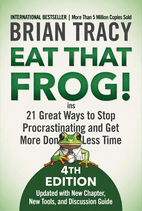
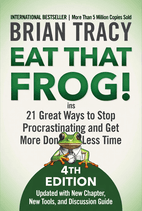
What is the book Eat That Frog!, Fourth Edition about?
Brian Tracy's Eat That Frog!, Fourth Edition delivers 21 practical methods for overcoming procrastination and prioritizing the most important tasks first, targeting professionals overwhelmed by their workload who want to achieve more without working longer hours.
Feature
Insta.Page
Blinkist
Shortform
Summary Depth
Full Chapter-by-Chapter
15-min overview
Section-by-section guides
Audio Narration
✓
✓
✓
Visual Mindmaps
✓
✕
✕
AI Q&A
✓
✕
✕
Quizzes
✓
✕
✕
PDF Downloads
✓
✕
✓
Price
$89.99/yr
$146/yr (PRO)
$199/yr
*Competitor data last verified July 2026.
1 Page Summary
This book, now in its fourth edition, presents a straightforward and powerful productivity system built around its central metaphor: if you have to eat a live frog (your most challenging task), do it first thing in the morning. Author Brian Tracy argues that the single most valuable skill for success is the ability to identify your most important task and execute it immediately, rather than getting bogged down in planning or less significant busywork. The core message is that you will never finish everything on your to-do list, so the key differentiator is not how much you do, but which tasks you choose to prioritize and complete.
Tracy’s approach is distinctive for its blend of practical, actionable techniques and psychological insights. He offers a comprehensive toolkit of 21 methods, including the 80/20 Rule (focusing on the 20% of tasks that produce 80% of results), the ABCDE Method (a simple letter-based prioritization system), and creative procrastination (deliberately delaying low-value work). The book emphasizes the importance of clarity (setting specific, written goals), thorough preparation, identifying key constraints, and developing a sense of urgency. It also addresses modern challenges, such as managing technology and resisting the dopamine-driven trap of constant distractions, to protect focused work time.
The intended audience is anyone who feels overwhelmed by their workload, struggles with procrastination, or wants to get more done without simply working longer hours. Readers will gain a systematic framework for taking control of their time and energy, learning not only how to be more productive but also how to make better decisions about where to invest their efforts. Ultimately, the book teaches that true productivity is less about cramming in more tasks and more about the discipline of consistently choosing and completing the few tasks that truly make a difference in your work and life.
Introduction: Eat That Frog
Overview
Modern life presents endless opportunities, constant demands, and never enough time. The central metaphor—eating a live frog—is introduced as a vivid reminder that tackling your biggest, most important task first thing each day transforms your productivity and your mindset. Tracy argues that the ability to select the right task and execute it immediately is more valuable than raw talent or endless planning. The introduction lays out the core habits, psychological drivers, and practical rules that will be expanded throughout the book, all centered on the simple but profound idea that the most difficult task of your day is also the one that yields the greatest payoff.
The Need to Be Selective
You will never finish everything. That’s the uncomfortable truth Tracy presents right away. Because new responsibilities keep rolling in like waves, the key differentiator among successful people is not how much they get done, but which tasks they choose to get done. The average person who develops the discipline to set clear priorities and complete critical tasks quickly will far outpace a brilliant procrastinator. The ability to decide what matters most at any given moment—and then act on that decision—is the single most impactful skill you can cultivate.
The Truth about Frogs
The “frog” is your biggest, most important task—the one you’re most likely to put off. It’s also the one that, once completed, provides the greatest positive momentum. Tracy offers two rules for frog eating:
Eat the ugliest frog first. If you have two important tasks, start with the hardest, most unpleasant one. Resist the temptation to do the easier thing first. This is a test of personal discipline.
If you have to eat a live frog, don’t sit and look at it. Don’t overthink it. Launch into your major task immediately, without delay. The longer you hesitate, the harder it becomes to start.
These rules aren’t just clever sayings—they form a daily habit that separates high performers from everyone else.
Take Action Immediately
The most consistent quality Tracy found in people who get promoted and paid more is an action orientation. They launch directly into their main tasks and work single-mindedly until done. Many people confuse activity—meetings, planning, talking—with accomplishment. But execution is what produces results. Failure to act is the biggest bottleneck in most organizations and lives. The antidote is simple: stop deliberating and start doing.
Develop the Habits of Success
Habits are learnable skills. The habit of setting priorities, overcoming procrastination, and completing important tasks can be developed through practice and repetition. Once it locks into your subconscious, it becomes automatic and easy. Task completion triggers a positive neurological reward: your brain releases endorphins and dopamine, making you feel energized, confident, and happy. This “natural high” reinforces the behavior, creating a virtuous cycle.
Develop a Positive Addiction
Tracy introduces the idea of becoming addicted to endorphins and the feeling of accomplishment. When you deliberately cultivate the habit of starting and finishing important tasks, you unconsciously begin to organize your life around doing more of what gives you that reward. You develop a positive addiction—to success, contribution, and the clarity that comes from getting the right things done. Over time, completing important jobs becomes easier than avoiding them.
No Shortcuts
Like the musician asked how to get to Carnegie Hall, the answer is practice. Your mind grows stronger with use, and any desirable behavior can be learned through repetition. There is no magic trick; the only path to mastery is consistent practice.
The Three Ds of New Habit Formation
To lock in the habits of focus and concentration, Tracy recommends three learnable qualities:
Decision – Make a firm decision to develop the habit of task completion.
Discipline – Practice the principles repeatedly until they become automatic.
Determination – Back everything with determination until the habit becomes permanent.
Visualize Yourself as You Want to Be
Activity is not accomplishment—mixing them up is a trap. To accelerate progress, continually think about the rewards of being action-oriented and focused. Visualize yourself as the person who consistently gets important jobs done quickly and well. Your self-image drives your performance. All external improvements begin with internal shifts in your mental picture. By training yourself through repetition to overcome procrastination, you put yourself on the fast track and step on the accelerator of your potential.
Key Takeaways
You will never do everything; your ability to choose the most important task is the critical determinant of success.
Your “frog” is your biggest, most important task—eat it first thing each morning without hesitation.
Action orientation (launching into and completing major tasks) is the most observable quality of high performers.
Task completion triggers a positive chemical reward in your brain; you can become addicted to accomplishment.
New habits require decision, discipline, and determination—and there are no shortcuts.
Visualize yourself as a focused, productive person to align your self-image with your desired behavior.
Key concepts: Introduction: Eat That Frog
1. Introduction: Eat That Frog
The Core Metaphor: Eat That Frog
Your frog is your biggest, most important task
Eat the ugliest frog first each morning
Don't sit and look at it—start immediately
Completing it gives the greatest positive momentum
The Need to Be Selective
You will never finish everything
Success depends on which tasks you choose
Clear priorities beat brilliant procrastination
Deciding what matters most is the key skill
Take Action Immediately
Action orientation defines high performers
Execution produces results, not activity
Stop deliberating and start doing
Failure to act is the biggest bottleneck
Develop the Habits of Success
Habits are learnable through practice
Task completion releases endorphins and dopamine
Positive reward creates a virtuous cycle
No shortcuts—only consistent practice
The Three Ds and Visualization
Decision: commit to task completion habit
Discipline: practice principles repeatedly
Determination: persist until habit is permanent
Visualize yourself as focused and productive
💡 Try clicking the AI chat button to ask questions about this book!
1. Set the Table
Overview
Before you can tackle your biggest, most important task—your "frog"—you must first achieve crystal clarity about what you truly want. Clarity isn't just a nice-to-have; it's the engine that drives motivation, kills procrastination, and turns fuzzy wishes into concrete accomplishments. The core premise is simple: the more precise you are about your goals and the steps needed to reach them, the easier it becomes to stop delaying and start doing. To help you get there, the author introduces a seven-part formula for setting and achieving goals—a system that, when followed, can dramatically transform your output and your life.
The Seven Steps to Goal Achievement
Decide exactly what you want. This sounds obvious, but most people never do it. Whether you're working for yourself or for a boss, get absolute clarity on your objectives. Too many people invest hours in low-value tasks simply because they never had the conversation to define what truly matters. Remember: doing a great job on the wrong thing is still wasted effort.
Write it down. A goal that lives only in your head is just a wish. Writing it down gives it form, energy, and reality. Unwritten goals lead to confusion and misdirection; written goals create a tangible target you can aim at every day.
Set a deadline. Without a deadline, there’s no urgency. You’ll naturally drift and procrastinate. Break big deadlines into smaller subdeadlines to create a rhythm of progress and accountability.
Make a list of everything needed. Brainstorm every action you can think of that will move you toward your goal. Add to it as new ideas arise. This list becomes the raw material for your plan and gives you a visual map of the road ahead.
Organize the list into a plan. Prioritize and sequence your tasks. Determine what must be done first, what comes next, and what can wait. Even better, sketch out a flowchart showing how each task connects to the others. Breaking a large goal into small, ordered steps makes it far less overwhelming and far more achievable.
Take action immediately. Do something—anything—right away. A so-so plan that gets executed beats a brilliant plan that never leaves the drawing board. Execution is the difference between dreamers and achievers.
Do something every single day. Consistency is the secret weapon. Commit to one daily action that moves you toward your major goal, no matter how small. This discipline builds momentum, reinforces your commitment, and compounds into massive progress over time.
The Power of Written Goals
Clear, written goals aren't just helpful—they're transformative. They fire up your creativity, release your energy, and give you a reason to push through resistance. The bigger and clearer the goal, the more it fuels your inner drive. Review your goals every morning and immediately take action on the most important task that will bring you closer to them. That daily ritual, combined with the seven steps, is a proven recipe for overcoming procrastination and achieving far more than you thought possible.
Key Takeaways
Clarity is the antidote to procrastination. Vagueness kills motivation; precision fuels it.
Write down your top goals. Only 3% of adults do this—and they accomplish 5–10 times more.
The seven-step formula (decide, write, set deadlines, list tasks, organize, act immediately, do something daily) is a proven system for turning goals into reality.
Execution beats perfection every time. Start moving, and keep moving.
Key concepts: 1. Set the Table
2. 1. Set the Table
Clarity as the Foundation
Clarity kills procrastination and fuels motivation
Precision turns fuzzy wishes into concrete accomplishments
Vagueness drains energy and leads to wasted effort
Seven-Step Goal Achievement Formula
Decide exactly what you want
Write it down to make it real
Set deadlines and subdeadlines for urgency
List all tasks and organize into a plan
Immediate and Consistent Action
Take action immediately, even with an imperfect plan
Do something every day to build momentum
Consistency compounds into massive progress
Power of Written Goals
Written goals fire up creativity and energy
Only 3% of adults write goals—they achieve 5-10x more
Review goals daily and act on top priorities
Execution Over Perfection
A so-so plan executed beats a brilliant plan idle
Doing the wrong thing well is still wasted effort
Start moving and keep moving to overcome resistance
2. Plan Every Day in Advance
Overview
Most people know they should plan, but few do it daily. This chapter makes the case that planning isn't just a nice idea – it's your single most powerful tool for overcoming procrastination and getting real results. The core insight is elegantly simple: every minute you spend planning saves ten minutes in execution. That's a 10-to-1 return on your mental energy. The author reframes planning as "bringing the future into the present," so you can tackle your biggest, ugliest frog one bite at a time. Instead of feeling overwhelmed by the whole elephant, you break it down into small, actionable steps – and then just do the first one.
The Six-P Formula and Your Return on Energy
The chapter introduces the classic Six-P Formula: "Proper prior planning prevents poor performance." This isn't just a catchy saying; it's a practical truth. When you sit down with a sheet of paper (or a simple app) and list everything you need to do, you unlock your brain's creative and energetic potential. Your mind starts working on problems before you even touch them. Conversely, jumping into action without a plan is a prime source of confusion and half-done work. The goal is to get the highest possible return on your investment of time and energy, and planning is the lever that makes that happen. Just 10–12 minutes of planning in the morning can save you up to two hours of wasted effort later – a productivity boost of 25% or more.
Different Lists for Different Horizons
One list won't cut it. The author recommends a layered system:
Master list: A catch-all for every idea, task, or responsibility you think of in the future. Think of it as your "parking lot" for random thoughts.
Monthly list: Made at the end of each month, incorporating items from your master list that need attention in the coming weeks.
Weekly list: A detailed plan for the week ahead, built over the current week. Many people find that a two-hour planning session at the end of the week transforms their entire productivity.
Daily list: The most important list of all. Transfer items from your monthly and weekly lists onto your daily list. Work through it, ticking items off as you go. That little checkmark creates a powerful visual sense of accomplishment that fuels motivation and self-esteem.
Planning Projects and Building Momentum
When you face a multi-step project, the method is the same but scaled up. Write down every single step from start to finish. Then organize by priority (what matters most) and sequence (what must come first). Seeing the entire project laid out – on paper or in a digital planner – makes it manageable. Then you simply take one step at a time. As you work through your lists, you develop forward momentum. This feeling of progress is addictive; it gives you energy and keeps procrastination at bay. The chapter highlights the 10 Percent Principle: spending the first 10% of your time planning and organizing saves you up to 90% of the total time required to get the job done. Try it once, and you'll believe it.
Key Takeaways
Plan every day, week, and month in advance – use paper or a digital tool.
Always work from a list; add new items immediately.
Create a master list, monthly list, weekly list, and daily list.
For projects, list every step, then prioritize and sequence before starting.
Remember every minute of planning saves ten minutes of execution – the 10 Percent Principle is real.
Develop forward momentum by ticking off completed tasks; it fuels motivation and self-confidence.
Key concepts: 2. Plan Every Day in Advance
3. 2. Plan Every Day in Advance
The Power of Planning
Every minute planning saves ten minutes execution
Planning brings the future into the present
Overcomes procrastination and gets real results
10-to-1 return on mental energy investment
The Six-P Formula
Proper prior planning prevents poor performance
Unlocks brain's creative and energetic potential
10-12 minutes morning planning saves two hours
Boosts productivity by 25% or more
Layered List System
Master list: catch-all for future ideas and tasks
Monthly list: items from master for coming weeks
Weekly list: detailed plan built over current week
Daily list: most important, tick off for motivation
Planning Projects
Write every single step from start to finish
Organize by priority and sequence
Makes multi-step projects manageable
Take one step at a time
Building Momentum
Ticking tasks creates visual sense of accomplishment
Forward momentum is addictive and energizing
10 Percent Principle: 10% planning saves 90% time
Fuels motivation and self-confidence
3. Apply the 80/20 Rule to Everything
Overview
The 80/20 Rule, also known as the Pareto Principle, reveals a powerful asymmetry in effort and results: roughly 20 percent of your activities produce 80 percent of your outcomes. Originally observed by economist Vilfredo Pareto in the distribution of wealth, this principle applies just as forcefully to your daily to‑do list. If you have ten tasks, two of them will be worth more than the other eight combined—and often one single task outweighs all the rest. The challenge is that most people instinctively avoid those high‑value tasks because they are harder or more complex. Instead, they fill their time with the trivial many, the low‑value 80 percent that feels productive but delivers little.
The Real Cost of Clearing Small Things First
There is a natural temptation to “clear your desk” by knocking off quick, easy items. But small tasks multiply like rabbits—the more you do, the more appear. Worse, starting your day with low‑value work builds a habit of procrastination on the vital few. The time required to complete an important task is often the same as the time needed for an unimportant one, yet the rewards are vastly different. Completing a significant job gives you genuine pride and forward momentum; finishing a trivial one leaves you with little more than a sense of busyness.
Motivate Yourself by Choosing the Frog
The hardest part of any important task is simply beginning. Once you start, your mind naturally engages and wants to continue. This is why you must discipline yourself to ask, before every task: “Is this in the top 20 percent or the bottom 80 percent?” Refuse to work on low‑value items while high‑value ones remain. Time management is ultimately life management—it’s the sequence of choices you make about what to do next. The people who consistently achieve the most are those who force themselves to eat that frog first, tackling the most significant task before anything else.
Key Takeaways
Identify the top 20 percent of your goals, projects, and responsibilities—these drive 80 to 90 percent of your results.
Develop the habit of starting your day with the highest‑value task, and resist the urge to clear small items first.
Remember: the time spent on a high‑value task equals that on a low‑value task, but the payoff and satisfaction are incomparably greater.
Key concepts: 3. Apply the 80/20 Rule to Everything
4. 3. Apply the 80/20 Rule to Everything
The 80/20 Principle
20% of activities produce 80% of outcomes
Originally observed by economist Vilfredo Pareto
One task often outweighs all others combined
Cost of Clearing Small Tasks First
Small tasks multiply like rabbits
Builds habit of procrastination on vital few
Same time cost, vastly different rewards
Motivate by Choosing the Frog
Hardest part is simply beginning
Ask: top 20% or bottom 80% before each task
Refuse low-value work when high-value remains
Time Management Is Life Management
Sequence of choices about what to do next
Eat that frog first—tackle most significant task
Consistent achievers force this habit
Key Takeaways
Identify top 20% driving 80-90% of results
Start day with highest-value task
High-value payoff incomparably greater than low-value
You've reached the end of the free chapters
Next chapter: “Consider the Consequences” is locked
Keep reading Eat That Frog!, Fourth Edition — and unlock all 600+ book summaries with audio, mindmaps and AI Q&A.
$0.00 due today · 7 days free, then $89.99/year ($7.49/mo) · Cancel anytime before day 7
plus sales tax where applicable
More ways to explore Eat That Frog!, Fourth Edition
Brian Tracy is a Canadian-American author and motivational speaker, best known for his expertise in personal and business success. He has written over 80 books, including *Eat That Frog!* and *The Psychology of Achievement*, which focus on goal setting, time management, and leadership. Tracy began his career in sales and real estate, drawing on those experiences to build a global reputation as a self-development authority.
Frequently Asked Questions about Eat That Frog!, Fourth Edition
What is Eat That Frog!, Fourth Edition about?
This book centers on the metaphor of 'eating a live frog'—tackling your biggest, most important task first thing each day to boost productivity and overcome procrastination. It provides a step-by-step system including goal setting, daily planning, the 80/20 rule, the ABCDE method, and techniques for managing technology and creating focused work blocks. The core message is that success comes from selecting the right priorities and executing them immediately, rather than trying to do everything.
Who is the author of Eat That Frog!, Fourth Edition?
The author is Brian Tracy, a well-known speaker and writer on personal and professional development. He draws on his own experiences, such as crossing the Sahara Desert, to illustrate the principles of focus and perseverance. The book is built on his research and practical advice for achieving high performance.
Is Eat That Frog!, Fourth Edition worth reading?
Yes, this book is highly worth reading for anyone who struggles with procrastination or wants to dramatically increase their productivity. It offers a clear, actionable framework—not just theory—with concrete techniques like the ABCDE method and creative procrastination that you can apply immediately. The insights are practical and backed by real-world examples, making it a guide that can transform how you approach your work and life.
What are the key lessons from Eat That Frog!, Fourth Edition?
The most important lesson is to identify your most valuable task—your 'frog'—and do it first each day using the 80/20 rule and ABCDE prioritization. Other key lessons include planning every day in advance, practicing creative procrastination by saying no to low-value activities, and developing a sense of urgency to enter a flow state. Additionally, you must build the habit of single-handling tasks without interruption, as constant task-switching can increase completion time by 500%.
📚 Explore Our Book Summary Library
Discover more insightful book summaries from our collection