Eat That Frog!, Fourth Edition Quotes
by Brian Tracy
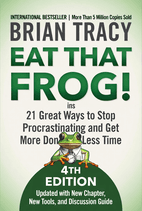
Welcome to our collection of quotes from Brian Tracy's "Eat That Frog!, Fourth Edition." This page gathers the most striking lines from a book that has helped countless people stop procrastinating and start getting things done. The quotes here are direct, practical, and often witty, using the memorable frog metaphor to talk about tackling your hardest task first thing in the morning.
What makes this book so quotable is that every line feels like a clear, usable insight. Tracy doesn't waste words. He gives you rules, laws, and one-liners that stick with you long after you've closed the book. Whether you're looking for motivation, a new perspective on time management, or just a smart way to think about your to-do list, these quotes deliver.
Top Quotes from Eat That Frog!, Fourth Edition
“It has been said that if the first thing you do each morning is to eat a live frog, you can go through the day with the satisfaction of knowing that that is probably the worst thing that is going to happen to you all day long.”
The author introduces the central metaphor of the book.
This vivid analogy makes the concept of tackling your hardest task first both memorable and motivating, giving readers a simple mental image to start their day.
“The first rule of frog eating is this: If you have to eat two frogs, eat the ugliest one first.”
The author explains the first rule of prioritizing tasks.
This rule is a concise, actionable principle that teaches readers to tackle the most difficult task first, which can have the greatest positive impact.
“One of the very worst uses of time is to do something very well that need not be done at all.”
In step one, the author warns against working on low-value tasks without clear priorities.
It delivers a sharp, counterintuitive truth that reframes productivity and prompts readers to evaluate their task choices.
“An average plan vigorously executed is far better than a brilliant plan of which nothing is done.”
In step six, the author urges immediate action over perfection.
This powerfully reinforces the value of execution over endless planning, a common barrier to progress.
“The things that matter most must never be at the mercy of the things that matter least.”
The author quotes Goethe to reinforce the need to prioritize high-value activities.
This timeless wisdom elegantly urges readers to protect their top priorities from less important distractions.
“One of the most powerful of all words in time management is the word no!”
The author emphasizes the importance of setting boundaries to focus on high-value activities.
It captures a simple yet profound truth about time management, reminding readers that saying 'no' is essential for protecting their most important work.
“You should never do a B task when an A task is left undone. You should never be distracted by a tadpole when a big frog is sitting there waiting to be eaten.”
The author's rule for applying the ABCDE priority system.
The metaphor of 'tadpoles' and 'big frogs' makes the priority principle instantly visual and easy to remember, reinforcing the idea of not letting minor tasks derail critical ones.
Themes Behind the Quotes
A dominant theme is the power of prioritization and starting with the most important, most difficult task first. The book repeatedly urges readers to identify their "big frog" and tackle it before anything else. This approach prevents busywork from crowding out what truly matters and builds momentum for the rest of the day.
Another core idea is that clarity and planning are essential to productivity. Many quotes stress that investing time upfront to think, set goals, and organize tasks pays back many times over. The themes also include discipline, focus, and the willingness to say no to distractions. Ultimately, the book teaches that success comes from consistent action on your highest priorities, even when those actions are uncomfortable.
Quotes by Chapter
Introduction: Eat That Frog
“Successful, effective people are those who launch directly into their major tasks and then discipline themselves to work steadily and single-mindedly until those tasks are complete.”
The author describes the action orientation of high achievers.
This sentence provides a clear model of behavior that readers can aspire to, emphasizing the importance of immediate action and sustained focus.
“Your self-image, the way you see yourself on the inside, largely determines your performance on the outside.”
The author discusses the power of visualization and self-perception.
This line encapsulates the idea that internal mindset shapes external results, encouraging readers to cultivate a positive self-image to improve their productivity.
1. Set the Table
“Clarity is perhaps the most important concept in personal productivity.”
The author discusses the importance of clarity in achieving goals and overcoming procrastination.
This succinctly captures the core principle of the chapter, making it a memorable anchor for readers.
“Goals are the fuel in the furnace of achievement.”
In the section 'The Power of Written Goals', the author describes how goals energize action.
The vivid metaphor makes the concept instantly relatable and motivating, sticking in the reader's mind.
2. Plan Every Day in Advance
“Planning is bringing the future into the present so that you can do something about it now.”
Opening quote by Alan Lakein at the beginning of the chapter.
This line succinctly defines the essence of planning and empowers readers to take immediate action.
“Every minute spent planning saves as many as ten minutes in execution.”
The author explains the time-saving benefit of planning.
It provides a compelling, quantifiable reason to invest time in planning, motivating readers to change their habits.
“The first 10 percent of time that you spend planning and organizing your work before you begin will save you as much as 90 percent of the time in getting the job done once you get started.”
The author introduces the 10 Percent Principle for personal effectiveness.
This memorable rule highlights the disproportionate return on the small upfront investment of planning, encouraging readers to prioritize it.
“Steady, visible progress propels you forward and helps you overcome procrastination.”
The author describes the motivational effect of ticking off items on a list.
It captures the psychological boost of seeing progress, a key antidote to procrastination.
3. Apply the 80/20 Rule to Everything
“Your ability to choose between the important and the unimportant is the key determinant of your success in life and work.”
From the author's advice on applying the 80/20 Rule to prioritize tasks.
This line encapsulates the core decision-making principle of the chapter, reminding readers that success hinges on conscious prioritization rather than mere busyness.
“Effective, productive people discipline themselves to start on the most important task that is before them.”
From the author's description of how high achievers handle their daily work.
It offers a clear, actionable behavior model—self-discipline to tackle the most important task first—that readers can directly apply to overcome procrastination.
“The hardest part of any important task is getting started on it in the first place.”
From the author's explanation of why procrastination occurs on high-value tasks.
This simple truth resonates with anyone who has struggled to begin, normalizing the difficulty and encouraging a focus on the first step.
“Resist the temptation to clear up small things first.”
From the author's rule for avoiding low-value work that multiplies.
It is a memorable, direct command that challenges a common counterproductive habit, making it easy to recall in moments of decision.
4. Consider the Consequences
“Long-term thinking improves short-term decision-making.”
The author presents this as a rule after discussing the importance of a long time perspective.
This concise principle encapsulates how future-focused planning directly enhances daily choices, making it a memorable guide for productivity.
“Successful people are those who are willing to delay gratification and make sacrifices in the short term so that they can enjoy far greater rewards in the long term.”
The author contrasts the habits of successful versus unsuccessful people in the chapter.
It captures the essence of discipline and foresight, resonating with anyone striving for long-term achievement over immediate pleasure.
“The Law of Forced Efficiency says, “There is never enough time to do everything, but there is always enough time to do the most important thing.””
The author introduces this law to explain forced prioritization under time constraints.
This quote is a powerful reminder that perfectionism is impossible, but focusing on what truly matters is always achievable.
5. Practice Creative Procrastination
“The difference between high performers and low performers is largely determined by what they choose to procrastinate on.”
The author explains that everyone procrastinates, but successful people deliberately procrastinate on low-value tasks.
This line reframes procrastination from a weakness into a strategic tool, empowering readers to take control of their priorities.
“Simple. I just say no to everything that is not absolutely vital to me at the moment.”
Warren Buffett, one of the richest men in the world, reveals his secret of success.
This quote from a legendary figure provides a clear, actionable principle for prioritizing what truly matters, making it highly memorable and credible.
“Creative procrastination is the act of thoughtfully and deliberately deciding on the exact things you are not going to do right now, if ever.”
The author defines the key concept of the chapter.
It transforms procrastination from a passive, guilt-ridden habit into an active, intentional strategy, giving readers permission to drop low-value tasks.
6. Use the ABCDE Method Continually
“The first law of success is concentration— to bend all the energies to one point, and to go directly to that point, looking neither to the right nor to the left.”
Opening epigraph attributed to William Mathews.
This quote encapsulates the core philosophy of the chapter—focusing all energy on a single priority—and it is memorable because it uses vivid imagery of unwavering direction.
“Eat the whole frog and don’t stop until it’s finished completely.”
The author's instruction for tackling the most important task (A-1).
This concise, action-oriented phrase has become a self-help mantra, urging readers to overcome procrastination by completing the hardest task without interruption.
“When you develop the habit of concentrating on your A-1, most important task, you can actually double your productivity immediately.”
The author's concluding benefit of mastering the ABCDE method.
This promise of doubling productivity is highly motivating and gives readers a tangible, measurable reason to adopt the habit of single-tasking on their top priority.
7. Focus on Key Result Areas
“Your weakest key result area sets the height at which you can use all your other skills and abilities.”
This rule is presented in the chapter discussing how weaknesses limit overall performance.
It powerfully illustrates that a single weak area can cap the effectiveness of all other strengths, motivating readers to identify and improve their shortcomings.
“What one skill, if I developed and did it in an excellent fashion, would have the greatest positive impact on my career?”
The author calls this 'The Great Question' and encourages readers to ask it repeatedly throughout their careers.
This question forces focused self-reflection, helping readers prioritize the single most important skill to develop for maximum career growth.