Eat That Frog!, Fourth Edition Key Takeaways
by Brian Tracy
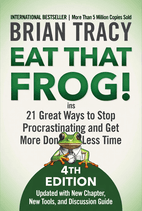
5 Main Takeaways from Eat That Frog!, Fourth Edition
Eat Your Biggest Frog First Every Morning
Your 'frog' is your most important, high-value task—the one you're most likely to procrastinate on. Brian Tracy insists you must tackle it first thing each day before doing anything else. This single habit builds momentum, triggers a positive chemical reward in your brain, and makes you an action-oriented high performer.
Apply the 80/20 Rule to Everything You Do
Twenty percent of your tasks will produce 80 to 90 percent of your results. Tracy urges you to identify that critical 20% and start every day working on them, resisting the urge to clear small items first. The time spent on a high-value task equals that on a low-value one, but the payoff is incomparably greater.
Plan Every Day in Advance to Save 10 Minutes for Every Minute You Invest
A few minutes of planning before you begin can save ten minutes of execution. Tracy recommends creating master lists, monthly lists, weekly lists, and daily lists, then prioritizing and sequencing each step. Working from a list and ticking off completed tasks builds forward momentum and fuels self-confidence.
Develop a Bias for Action and a Sense of Urgency
High performers don't wait for perfect conditions—they start where they stand and move quickly. Tracy teaches you to internalize the phrase 'Do it now,' cultivate a reputation for speed and quality, and use the momentum principle: the hardest part is starting, and once you're moving, energy follows motion.
Continuously Upgrade Your Key Skills to Close Procrastination Gaps
Skill gaps are a primary source of procrastination; closing them builds confidence and momentum. Tracy emphasizes that every important skill is learnable and that mastery comes from daily practices like reading, attending training, and using commute time wisely. The only limit is your willingness to invest the time.
Executive Analysis
These five takeaways form the backbone of Brian Tracy's productivity philosophy: overcome procrastination not by willpower alone, but by a systematic method of prioritization, planning, and immediate action. By eating the most important task first, applying the 80/20 rule, and planning daily, you create a self-reinforcing cycle of accomplishment. Adding a sense of urgency and continuous skill improvement ensures you stay relevant and capable of handling bigger frogs. The book's central thesis is that high performance is a set of learnable habits, not a personality trait—anyone can become addicted to accomplishment by deliberately choosing what to do and when to do it.
"Eat That Frog!" matters because it's relentlessly practical. Unlike abstract productivity theories, Tracy gives you concrete techniques—ABCDE method, salami slicing, zero-based thinking, and the 10 Percent Principle—that you can apply immediately. It sits firmly in the time-management and self-help genre, but stands out for its no-nonsense focus on action over perfection. For anyone feeling overwhelmed by their to-do list, this book offers a clear path from paralysis to productivity, making it a staple for executives, entrepreneurs, and anyone who wants to reclaim control of their day.
Chapter-by-Chapter Key Takeaways
Eat That Frog (Introduction)
You will never do everything; your ability to choose the most important task is the critical determinant of success.
Your “frog” is your biggest, most important task—eat it first thing each morning without hesitation.
Action orientation (launching into and completing major tasks) is the most observable quality of high performers.
Task completion triggers a positive chemical reward in your brain; you can become addicted to accomplishment.
New habits require decision, discipline, and determination—and there are no shortcuts.
Visualize yourself as a focused, productive person to align your self-image with your desired behavior.
Try this: Each morning, identify your single most important task—your frog—and complete it before checking email or doing anything else.
1. Set the Table (Chapter 1)
Clarity is the antidote to procrastination. Vagueness kills motivation; precision fuels it.
Write down your top goals. Only 3% of adults do this—and they accomplish 5–10 times more.
The seven-step formula (decide, write, set deadlines, list tasks, organize, act immediately, do something daily) is a proven system for turning goals into reality.
Execution beats perfection every time. Start moving, and keep moving.
Try this: Write down your top three goals using the seven-step formula: decide, write, set deadlines, list tasks, organize, act immediately, and do something daily.
2. Plan Every Day in Advance (Chapter 2)
Plan every day, week, and month in advance – use paper or a digital tool.
Always work from a list; add new items immediately.
Create a master list, monthly list, weekly list, and daily list.
For projects, list every step, then prioritize and sequence before starting.
Remember every minute of planning saves ten minutes of execution – the 10 Percent Principle is real.
Develop forward momentum by ticking off completed tasks; it fuels motivation and self-confidence.
Try this: Plan your entire day in advance on paper or digitally: create a master list, monthly list, weekly list, and daily list, and prioritize each item.
3. Apply the 80/20 Rule to Everything (Chapter 3)
Identify the top 20 percent of your goals, projects, and responsibilities—these drive 80 to 90 percent of your results.
Develop the habit of starting your day with the highest‑value task, and resist the urge to clear small items first.
Remember: the time spent on a high‑value task equals that on a low‑value task, but the payoff and satisfaction are incomparably greater.
Try this: Identify the 20% of your tasks that will produce 80–90% of your results and start your day with that highest-value task, ignoring low-value items until it's done.
4. Consider the Consequences (Chapter 4)
Importance equals consequences. The bigger the potential impact (positive or negative), the higher the priority. Let that guide your daily choices.
Long-term perspective improves short-term decisions. Think years ahead, and today’s trade‑offs become clearer.
You’ll never catch up, and that’s okay. Focus on the most important task, not the longest list.
Deadlines don’t make you better; they make you sloppier. Plan ahead, add buffer time, and aim to finish early.
Ask the three questions daily. They cut through noise and keep you working on what truly counts.
Try this: Ask yourself three questions daily: 'What are my highest-value activities?', 'What can I do that only I can do?', and 'What is the most valuable use of my time right now?'
5. Practice Creative Procrastination (Chapter 5)
Everyone procrastinates; the question is what you choose to delay. Top performers deliberately put off low-value tasks to free up time for high-impact work.
Master posteriorities. A priority without a posteriority is incomplete. Actively decide what to stop or postpone.
Say no early and often. Use the word politely but firmly. Every yes to a new thing requires a no to something else.
Practice zero-based thinking. Regularly ask, “If I weren’t already doing this, would I start today?” If not, abandon or creatively procrastinate on it.
Cut time-consuming, low-value activities. Reassess hobbies, habits, and work tasks. Eliminate or reduce those that no longer serve your current priorities.
Try this: Deliberately procrastinate on low-value tasks by saying 'no' early and often, and use zero-based thinking to stop activities you wouldn't start today.
6. Use the ABCDE Method Continually (Chapter 6)
The ABCDE method forces you to think on paper and make priority decisions before you start working.
Never do a B or C task when an A task remains unfinished—that’s how frogs grow cold.
Delegate everything you can, eliminate everything you can, and pour your energy into your A-1 task.
Practice this every day for a month, and you’ll rewire your brain to focus on high-impact work automatically.
Try this: Label every task on your list with A (must do), B (should do), or C (nice to do), then never work on a B or C while an A remains unfinished.
7. Focus on Key Result Areas (Chapter 7)
Define your key result areas with precision and get agreement from your boss and colleagues. This clarity is the foundation of high performance.
Grade yourself honestly in each area. Your weakest skill is the bottleneck that limits your overall contribution.
Don’t avoid your weaknesses—attack them. Set a goal to become excellent in the one skill that would make the biggest difference to your career.
All key result skills are learnable. If someone else is great at it, you can be too. The decision to improve is the only step that matters.
Use the Great Question regularly to stay on track. It will keep you focused on what truly moves the needle.
Try this: Define your key result areas with your boss, grade yourself honestly, and commit to becoming excellent in your weakest skill—it's the bottleneck limiting your career.
8. Apply the Law of Three (Chapter 8)
Identify your top three tasks—they contain roughly 90% of your value to your organization. Focus on them exclusively.
Use the thirty-second rule to uncover your most important goals in each life area; the answers will reveal what you truly prioritize.
Work efficiently during work hours so you can spend generous, uninterrupted time at home. The goal is a long, happy, healthy life balanced across all dimensions.
Try this: Identify your top three tasks that contain 90% of your value to your organization, and focus on them exclusively during work hours.
9. Prepare Thoroughly Before You Begin (Chapter 9)
Preparation is the driver of speed – having everything within arm’s reach removes the small excuses that trigger procrastination.
Your workspace is a psychological lever – a clean, comfortable environment increases confidence and productivity more than willpower ever could.
Don’t wait for perfection – shoot for 80% readiness, then start. You can refine as you go.
The first action creates momentum – adopt the posture and language of high performance, take the first step, and keep going until completion.
Clean your desk today – it’s a simple, concrete way to signal to yourself that you’re serious about the work ahead.
Try this: Prepare your workspace completely before starting a task—clean desk, all materials at hand—to remove small excuses that trigger procrastination.
10. Take It One Oil Barrel at a Time (Chapter 10)
Break big projects into tiny, visible steps. Focus only on the step immediately ahead.
Overcome paralysis by starting—take one action, any action, right now.
Trust that clarity for the next step will come once you’ve completed the current one.
Apply the “oil barrel” mentality to any area: saving money, getting fit, or finishing a long‑overdue task.
Try this: Break a big, overwhelming project into tiny, visible steps and focus only on completing the one immediately ahead, like taking one oil barrel at a time.
11. Form New Habits, Become a New Person (Chapter 11)
All habits are learned and can be replaced; you are not a victim of your past patterns.
The twelve-step sequence provides a clear roadmap from desire to permanent habit formation.
“Just for today” makes change manageable; one slip doesn’t mean failure—just return to the daily commitment.
Visualize, act the role, and reward yourself to lock in new behaviors faster.
Old habits must be replaced, not erased—give yourself at least three weeks of consistent practice.
Work on yourself every day, but keep your new habits private until they’re firmly established.
Try this: Replace an old habit by deciding exactly what new behavior you want, practicing it 'just for today,' and rewarding yourself consistently for at least three weeks.
12. Upgrade Your Key Skills (Chapter 12)
Skill gaps fuel procrastination; closing them builds confidence and momentum.
Continuous learning isn’t optional—it’s the baseline for staying relevant.
Mastery comes from three daily practices: reading, attending training, and using commute time wisely.
Every important skill is learnable; your only limit is your willingness to invest the time.
Try this: Spend at least 30 minutes each day reading in your field, attend regular training, and use your commute time to listen to educational audio to close skill gaps.
13. Identify Your Key Constraints (Chapter 13)
Every goal has one limiting factor that sets the speed of achievement. Find it.
80% of constraints are internal (within you or your organization). Look there first.
Misidentifying the constraint leads to wasted effort. Be precise.
Removing the top bottleneck creates momentum and makes everything else easier.
Keep asking: What is holding me back? What one change would have the greatest impact?
Try this: Identify the one limiting factor that sets the speed of your most important goal—80% of constraints are internal—and remove it first to create momentum.
14. Put the Pressure on Yourself (Chapter 14)
Only about 2% of people can work without external supervision—be one of them by putting pressure on yourself.
Your self-esteem is the reputation you have with yourself; every time you push past where others quit, you build it.
Use imaginary deadlines (e.g., emergency leave town tomorrow) to create urgency and overcome procrastination.
Write out every step of a project, estimate time per step, add a buffer, and race against your own clock.
Set firm deadlines and subdeadlines for every task—beat them as a game.
Try this: Put pressure on yourself by setting firm deadlines and subdeadlines, imagining you had to leave town tomorrow, and racing against your own clock.
15. Motivate Yourself into Action (Chapter 15)
Your emotions are driven by your interpretation of events, not the events themselves. Choose your story wisely.
Replace negative self-talk with positive affirmations like “I can do it!” and “I feel terrific!” to build self-esteem.
Adopt the four optimist behaviors: look for the good, seek the lesson, focus on solutions, and think about your goals.
Refuse to complain, blame, or criticize. Accept full responsibility and channel your energy into what you can do right now.
Visualize your desired future and talk about it often—this keeps your mind motivated and your actions aligned.
Try this: Replace negative self-talk with positive affirmations like 'I can do it!' and adopt the four optimist behaviors: look for good, seek lessons, focus on solutions, think about goals.
16. Make Technology Work for You (Chapter 16)
Unplug regularly to recover memory, relationships, sleep, and decision-making ability.
Apply the 80/20 Rule to your inbox—delete, unsubscribe, and defer non-urgent messages.
Treat technology as a servant: close distractions, block notifications, and arrange only what you need for the task at hand.
Control your calendar by never auto-accepting invitations; schedule large blocks for your frogs.
Master your emotions around tech—fear of learning is the only real barrier. All skills are learnable.
Use social media for accountability by publicly posting your goals and daily progress; turn work into a game.
Try this: Unplug from technology regularly, apply the 80/20 rule to your inbox, turn off notifications, and treat technology as a servant rather than a master.
17. Focus Your Attention (Chapter 17)
Attention is your most valuable resource; where it goes, your life follows.
The dopamine reward from notifications creates an addiction to distraction, not productivity.
“Multitasking” is a myth—it’s actually task-shifting, costing you 17 minutes to refocus per interruption.
To break the cycle: don’t check email in the morning, turn off notifications, and check only twice a day.
Work in 90-minute focused blocks to double your daily productivity and regain control of your time.
Try this: Work in 90-minute focused blocks without interruptions—turn off phone and notifications—and avoid checking email first thing in the morning to protect your attention.
18. Slice and Dice the Task (Chapter 18)
Break large, overwhelming tasks into sequential steps using the "salami slice" method. Do one slice at a time.
Use the "Swiss cheese" method when you're stuck: work for just 5-10 minutes to punch a hole in the task, then stop.
Leverage your brain's compulsion to closure—each small completion triggers motivation to continue.
High performers act on good ideas immediately. Don't delay—try one of these techniques today on a task you've been putting off.
Try this: When a task feels overwhelming, use the 'Swiss cheese' method: work for just five minutes to punch a hole in it, then stop; the small completion will trigger motivation.
19. Create Large Chunks of Time (Chapter 19)
Schedule, don’t wait: Deliberately carve out 30- to 90-minute blocks in your calendar for your most important tasks, and treat them as non-negotiable appointments.
Protect your focus: During these blocks, eliminate all distractions—turn off your phone, close your door, and work without interruption.
Leverage early mornings: Consider working from home for two to three hours in the morning to gain three times the output of a typical office environment.
Use travel as work time: Turn flights and other transition periods into productive work sessions by preparing in advance.
Make every minute count: Actively look for ways to save, schedule, and consolidate large chunks of time, and then use them purposefully for tasks with the greatest long-term consequences.
Try this: Schedule 30- to 90-minute non-negotiable blocks on your calendar for your most important tasks, protect them from interruptions, and consider early morning work from home.
20. Develop a Sense of Urgency (Chapter 20)
Action triggers flow. Moving quickly and steadily is the on-ramp to your highest state of productivity and creativity.
Cultivate a bias for action. Stop waiting for perfect conditions. Start where you stand with what you have.
Use the Momentum Principle. The hardest part is starting; once you're moving, keep going. Energy follows motion.
Internalize the phrase "Do it now." Use it as a mental cue to break procrastination and maintain focus.
Build your reputation on speed and quality. Being known as the person who delivers important work fast and well sets you apart in any field.
Try this: Develop a sense of urgency by telling yourself 'Do it now' and starting immediately—motion creates momentum, and a bias for action builds a reputation for speed and quality.
21. Single Handle Every Task (Chapter 21)
Single handling can reduce task time by 50% or more, while starting and stopping can increase it by as much as 500%.
Self-discipline is the foundational skill: it's the ability to do what you should do, whether you feel like it or not.
Persistence creates a virtuous cycle: each completed task raises your self-esteem, making it easier to persist on the next one.
Implement the four accelerators (Calendar, Productivity, Self-Discipline, and Task Completion) to make single handling a daily habit.
End every day with a written list of tomorrow's priorities, then start the next day on your most important task without delay.
Try this: Single-handle every task by not starting and stopping: pick one task, work until it's complete, then move on; end each day with a written list of tomorrow's priorities.
Continue Exploring
- Read the full chapter-by-chapter summary →
- Best quotes from Eat That Frog!, Fourth Edition → (coming soon)
- Explore more book summaries →