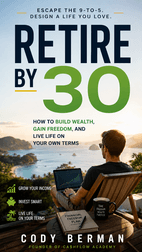
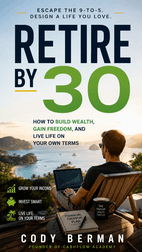
Cody Berman's Retire by 30 provides a tactical roadmap to financial independence through the FIRE movement, covering the Big 3 expenses, side hustles, and investment strategies like index funds and real estate. Written for ambitious professionals feeling trapped by the 9-to-5 grind, the book delivers actionable steps to buy back your time and freedom.
Feature
Insta.Page
Blinkist
Shortform
Retire by 30
✓
✕
✕
Summary Depth
Full Chapter-by-Chapter
15-min overview
Section-by-section guides
Audio Narration
✓
✓
✓
Visual Mindmaps
✓
✕
✕
AI Q&A
✓
✕
✕
Quizzes
✓
✕
✕
PDF Downloads
✓
✕
✓
Price
$89.99/yr
$146/yr (PRO)
$199/yr
*Competitor data last verified July 2026.
1 Page Summary
Cody Berman’s Retire by 30 argues that the traditional path of working for forty years for a comfortable retirement is a trap—what he calls the "American Nightmare." The book's central thesis is that financial independence is not about accumulating luxury, but about purchasing your time and freedom. Berman flips the script on conventional finance, introducing readers to the FIRE (Financial Independence, Retire Early) movement and its core math: your savings rate matters far more than your income. He calls the gap between what you earn and what you spend your "personal launchpad," and the book is essentially a detailed manual on how to widen that gap as quickly as possible.
Berman’s approach is highly tactical and personal, distinguishing this book from generic financial advice. He walks readers through specific, actionable strategies gleaned from his own journey to financial independence by age 25. The chapters cover the "Big 3" expenses (housing, transportation, food), top 20 money-saving hacks, the mechanics of side hustles, and how to maximize your day job rather than simply endure it. The book also dives deep into investment mechanics—covering stock market index funds, real estate house hacking and rentals, and even alternative investments like buying small online businesses—all with the goal of building cash-flowing assets. A unique emphasis is placed on tax optimization, detailing how to use retirement accounts, real estate depreciation, and income engineering to legally minimize taxes and accelerate the path to freedom.
The intended audience is anyone who feels trapped by the 9-to-5 grind and suspects there might be a better way, particularly younger professionals or ambitious individuals willing to challenge social norms. Readers will gain a clear, step-by-step roadmap, from tracking expenses and managing debt to building a portfolio that generates enough passive income to cover their living costs. More than just a financial plan, the book addresses the psychological shift of early retirement, urging readers to "practice retirement" by embedding their ideal activities into their current lives. It is a practical, no-nonsense toolkit for those ready to stop trading time for money and start living life entirely on their own terms.
Get Your Free Gift!
Overview
This short chapter serves as a practical gateway for readers, pointing them toward a centralized resource hub before the book’s main content even begins. It acknowledges that a wealth of websites, calculators, and tools are referenced throughout the text, and rather than forcing readers to flip back and forth, the author has organized everything in one place at retireby30book.com/resources. But the chapter also does something more personal: it transitions into a dedication that reveals the deeply human motivation behind the financial philosophy, and then lays out the full book structure so you know exactly what’s coming.
A Toolkit for Your Early Retirement Journey
The core promise here is convenience and support. By directing you to a single URL, the author eliminates the frustration of hunting down external links or forgetting a key calculator mid‑chapter. This resource page is framed as “your toolkit for early retirement” — a living collection of the exact tools and sites that helped the author reach financial independence. It’s an invitation to treat the book not as a static read, but as a launchpad for your own action plan.
The People Behind the Mission
The dedication is far from an afterthought — it grounds the entire book in real relationships and vulnerability. The author honors his late father, Alan, who doubted early retirement was possible, and expresses gratitude for being proven wrong. His mother, Ruth, is celebrated as his biggest fan. His wife, Lauren, receives a special thank‑you for standing by him through every phase — from the wild idea to quitting his job and beyond. His brother, Sam, is acknowledged as a sounding board, and a broader circle of family and friends is credited for unwavering support. This section makes clear that the journey to early retirement wasn’t a solo feat; it was sustained by a network of believers.
Mapping the Road Ahead
Finally, the Table of Contents gives you a bird’s‑eye view of the book’s architecture. It’s divided into five sections:
The Basics (FIRE, The Gap)
Expenses (Tracking, Debt, The “Big 3,” 20 Ways to Save)
Income (Side Hustles, Maximizing Your Day Job, Networking)
Investing (Why Invest, Stock Market, Real Estate, Alternatives, Tax Optimization)
Early Retirement (Are We There Yet?, Withdrawal Strategies, Life in Retirement)
Notice the logical progression from understanding the core concept, to slashing expenses, boosting income, investing wisely, and finally living the retired life. It’s a roadmap that mirrors the author’s own ten‑year journey.
Key Takeaways
Centralized resources save time: Everything from calculators to websites is available at one URL, so you never lose track of a useful tool.
The dedication proves early retirement is personal: The author’s success was fueled by love, doubt, and a desire to prove the impossible possible.
The book is built like a step‑by‑step plan: Each section builds on the last, starting with mindset and ending with real‑world retirement strategies.
Key concepts: Get Your Free Gift!
1. Get Your Free Gift!
Centralized Resource Hub
One URL for all tools and calculators
Eliminates hunting for external links
Living collection of author's own resources
Treats book as a launchpad for action
Personal Dedication & Motivation
Honors late father who doubted early retirement
Mother celebrated as biggest fan
Wife supported from idea to quitting job
Success fueled by a network of believers
Book Structure Overview
Five sections: Basics, Expenses, Income, Investing, Retirement
Mirrors author's own ten-year journey
Logical progression from mindset to real-world strategies
Section 1-2: Basics & Expenses
FIRE concept and The Gap explained
Tracking debt and the Big 3 expenses
20 ways to save money
Section 3-5: Income to Retirement
Side hustles and maximizing day job
Investing in stocks, real estate, alternatives
Withdrawal strategies and life in retirement
💡 Try clicking the AI chat button to ask questions about this book!
Foreword
Overview
Grant Sabatier opens by sharing a tense moment from his cross-country book tour with Cody: a wrong turn near Mobile, Alabama led to a car chase that had Grant heart-pounding and convinced they were about to be robbed. Through it all, Cody sat in the passenger seat laughing—not nervously, but with a pure, unfazed calm. That moment captures who Cody is: someone with a joy for living that refuses to let fear or convention dictate his choices. He wasn't built for a cubicle, and he wasn't going to trade decades of his life for a paycheck just because that's what you're "supposed" to do.
Grant met Cody about a month before that trip. He saw a young man who was curious, hungry to learn, and willing to work. So Grant offered him a role coordinating the Financial Freedom book tour across the U.S. and Canada. Cody quit his job and joined Grant on the road for three months, doing over 80 events. During those long drives between cities, Cody asked relentless questions: How did you negotiate this? Why invest that way? What would you do differently? Grant answered without holding back. What he didn't expect was how fast Cody would take those lessons and achieve financial independence himself.
The Real Goal: Freedom, Not Status
Most people say they want to be rich, Grant observes, but what they actually want is control over their time. They want to wake up without an alarm, take a Tuesday off without asking permission, spend more time with family, and choose the work they do and who they do it with. That's financial independence. It's not a flashy lifestyle or a specific number in a bank account—it's the ability to choose your life instead of having it chosen for you.
The System: Simple Math, Consistent Execution
This book lays out a practical system with no fluff. The math is straightforward: increase the gap between what you earn and what you spend, invest the difference, repeat, let compounding work, avoid catastrophic mistakes, and stay consistent long enough for the math to do its job. Simple doesn't mean easy—but it does mean possible.
Cody engineered his freedom. He understood that retirement isn't an age—it's a number and a strategy. He optimized the big levers: housing, transportation, income. He widened the gap. He resisted lifestyle inflation as his earnings grew, and he built systems instead of relying on motivation.
Financial Independence Is the Starting Line
Grant emphasizes that reaching financial independence isn't the finish line—it's the starting line. He reached it in five years, from age 25 to 30, and that bought him 50-plus years of freedom. A 900% return on investment. The ability to spend unlimited time with his daughter at 40 without money worries is the greatest gift he could have given himself. The experiences and expansion that come from having options are remarkable.
Many people today are underprepared and burned out. Hope is not a strategy. This book gives you one. It challenges you to confront your spending honestly, increase your income instead of obsessing over minor expenses, treat debt as math (not shame), and focus on the few big decisions that actually change your trajectory. You only need to execute a few of the tactics to get 80% of the results.
The path isn't glamorous. You might drive an older car, share housing, and choose long-term freedom over short-term validation. But those decisions compound quickly. Eventually, work becomes optional. And when that day comes, you realize the real reward wasn't the money—it was time. You can make more money. You cannot make more time.
Key Takeaways
Cody's story proves that financial independence is achievable through deliberate choices—not luck or inheritance. He started from zero and engineered his freedom by focusing on the big levers.
The real goal isn't wealth; it's optionality and control over your time. Don't confuse wanting to be rich with wanting autonomy.
The math is simple: widen the gap between earning and spending, invest the difference, and let compounding work. Consistency beats intensity.
Financial independence is a starting line, not a destination. The point isn't to retire early—it's to unlock a life of freedom and choice.
Hope is not a strategy. This book provides clear tactics and systems to move from aspiration to action.
Key concepts: Foreword
2. Foreword
Cody's Story: A Case Study in FI
Cody's unfazed calm during a car chase shows his fearless mindset
He quit his job to coordinate Grant's book tour
He asked relentless questions and learned fast
He achieved financial independence quickly by applying lessons
The Real Goal: Freedom Over Status
People want control over time, not just wealth
Financial independence means choosing your life
It's not a specific number but optionality
Avoid confusing riches with autonomy
The System: Simple Math, Consistent Execution
Increase gap between earnings and spending
Invest the difference and let compounding work
Optimize big levers: housing, transport, income
Resist lifestyle inflation and build systems
FI Is the Starting Line, Not the Finish
Reaching FI buys decades of freedom
Grant's 900% ROI: 5 years work for 50+ years freedom
Time with family is the greatest reward
Money can be remade; time cannot
From Hope to Action: Practical Tactics
Hope is not a strategy; this book provides one
Focus on a few big decisions for 80% of results
Treat debt as math, not shame
Choose long-term freedom over short-term validation
The American Nightmare
Overview
The opening chapter doesn't ease you into the conversation. It drops you straight onto a 6:30 a.m. train, staring out the window of a life that looks successful from the outside but feels hollow from the inside. The author paints an uncomfortably familiar picture: an $80,000 salary, a college degree, a clear career path, and a deep, creeping exhaustion that makes you wonder if this is really all there is. That moment of disconnect—when you're "crushing it" by every external metric but feel like you're sprinting toward a finish line you never wanted—is the heart of what he calls the American Nightmare. The setup isn't meant to be depressing. It's meant to be honest. And from that honesty, the rest of the book becomes possible.
The Moment Everything Shifted
The turning point didn't come from a dramatic failure. It came from two seemingly small discoveries: The 4-Hour Workweek and the Mr. Money Mustache blog. These weren't just books or websites; they were permission slips to think differently about work, money, and time. The author describes this as a complete rewiring of his beliefs. He'd always assumed success meant climbing the corporate ladder, trading time for money, and waiting until his sixties to enjoy life. But the math behind early retirement showed him something radical: retirement isn't an age, it's a number. If you can save 50% of your income, you can retire in 17 years. Save 70%, and it's closer to 8 or 9. That single insight turned a vague hope into a measurable goal. It also planted the seed that would eventually grow into an obsession.
The Strategy Behind the Grind
Here's where the author gets refreshingly honest. He didn't take the high-paying corporate job in commercial real estate because he loved it. He took it because it was strategic. It was the fastest way to generate the capital he needed to buy his freedom. The plan was simple: work the 9-to-5 for 7 to 10 years, save aggressively, invest everything, and use his side hustles to accelerate the timeline. On paper, it made perfect sense. But what the spreadsheets didn't account for was the daily toll of doing work that drained him. The commute, the stress, the feeling of counting down the minutes—it all chipped away at his motivation. He realized he wasn't willing to spend his twenties waiting for his thirties to begin. So he made the hardest decision: he quit.
The Leap That Changed Everything
That decision wasn't reckless, but it was terrifying. The author had built a $35,000 cushion, enough to cover years of his minimalist lifestyle, and he had side hustles generating income. Still, walking into his boss's office and hearing he was a "waste of time and resources" stung. It also fueled him. What followed was a three-month book tour, the launch of a digital products business, and a complete reimagining of what his life could look like. The numbers tell the rest of the story: income doubling every year ($96,000 to $198,000 to $403,000), expenses staying flat at $2,000 a month, and a savings rate above 80%. By age 25, he had $500,000 invested, $3,700 a month in rental income, and passive income from digital products exceeding $10,000 a month. Work became optional. The escape plan became a life design.
Key Takeaways
The American Dream can be a trap. Following the traditional script of college, career, and retirement at 65 can leave you feeling burned out and disconnected from what you actually want.
Retirement is a number, not an age. The math of financial independence is simple: the more you save, the faster you reach freedom. High savings rates dramatically compress the timeline.
Strategic discomfort pays off. The author chose a job he didn't love because it served a bigger purpose. Short-term sacrifice can be the foundation for long-term freedom.
The leap is the hardest and most important part. Building a cushion, finding income streams, and taking the risk to leave a situation that drains you is often the moment everything changes.
FI is about design, not escape. The goal isn't just to retire early; it's to build a life you actually want to live. The tools in this book are meant to help you create options, not just an exit strategy.
Key concepts: The American Nightmare
3. The American Nightmare
The American Nightmare Defined
External success masks internal emptiness
$80k salary and degree still feel hollow
Sprinting toward a finish line you never wanted
Honest recognition of the trap is the starting point
The Shift in Perspective
Two discoveries rewired beliefs about work and money
Retirement is a number, not an age
High savings rates compress the timeline dramatically
Permission to think differently about success
Strategic Sacrifice for Freedom
Took a draining corporate job for capital, not passion
Plan: work 7-10 years, save aggressively, invest
Spreadsheets ignored the daily toll of draining work
Quit when waiting for life to begin became unbearable
The Leap and Its Results
$35k cushion and side hustles made quitting possible
Boss called him a waste; it fueled his determination
Income doubled yearly while expenses stayed flat
By 25: $500k invested, $10k monthly passive income
Key Takeaways for Life Design
American Dream can be a trap of burnout
Strategic discomfort pays off for long-term freedom
The leap is the hardest and most important part
FI is about designing a life you want, not escaping
FIRE
Overview
The core philosophy behind financial independence flips the script on what it means to be truly rich. It’s not about the Lamborghinis or the mansions—it’s about having the freedom to spend your time how you want, when you want. Money is just a tool to buy back your life. The author walks through the origins of the FIRE movement (Financial Independence, Retire Early), from ancient philosophers to modern bloggers like Mr. Money Mustache, and then breaks down the actual math that makes early retirement possible. Spoiler: it’s simpler than you think. You’ll come away understanding that retirement isn’t an age; it’s a number. And that number depends on your savings rate more than your income.
The Two Main Paths to Financial Independence
There are two primary ways to reach FIRE, and you don’t have to pick just one. Most people end up using a hybrid approach.
1. Nest Egg Method – This is the classic route: save up a big investment portfolio and live off a small percentage of it each year. Your FI number equals your annual expenses multiplied by 25 (or monthly expenses times 300). This is based on the 4% rule, backed by the Trinity Study, which showed that withdrawing 4% of your portfolio annually (adjusted for inflation) should make your money last at least 30 years—and often much longer. It’s not about market timing; it’s about trusting long-term historical averages.
2. Cash Flow Method – Instead of relying on a giant portfolio, you build passive income streams that cover your monthly expenses. Think rental properties, digital products, small businesses, or dividend stocks. This method can be faster—some people hit FI in just a couple of years with real estate—but it’s usually more hands-on. The author himself used a mix of both: a $500k+ stock portfolio plus over $10k/month in passive income from digital products and rentals.
Retirement Is a Number, Not an Age
We’ve been brainwashed into thinking retirement means 65. But the math doesn’t care how old you are. Your savings rate—what you save as a percentage of what you earn—determines how long until you’re free. A 20% savings rate means about 37 years of work; an 80% savings rate means under six years. That’s the shockingly simple math. And once you reach FI, you don’t have to stop working. You just get to choose what you do—because you want to, not because you need a paycheck.
Why Traditional Retirement Is Falling Apart
The old model of company pensions and generous Social Security checks is mostly gone. Nearly half of Americans have zero retirement savings. The average Social Security benefit is only about $24,000 a year. Fewer than 15% of private-sector workers still have a pension. People are living longer, costs are rising, and the burden of retirement has shifted entirely onto individuals. The good news: with the tools in this book, you can take control.
Customizing Your FI Plan
There’s no one-size-fits-all. Some people love the simplicity of index funds; others thrive on building cash-flowing businesses. Your approach should match your personality, risk tolerance, and timeline. And it’s okay to change your plan as life happens. The author originally mapped a seven-year path to FI, quit his job after seven months, and pivoted to entrepreneurship—but because he already had momentum, the shift was smooth. A moving ship is easier to steer.
This Isn’t Just About Money
Financial independence is about freedom, not hoarding cash. It’s about waking up and spending your time on what matters most to you—whether that’s family, travel, passion projects, or simply not stressing over bills. Money can’t buy happiness, but it can buy options. And options create a rich life, on your own terms.
Key Takeaways
FIRE stands for Financial Independence, Retire Early, and it’s about freedom, not luxury.
Two main paths: build a nest egg (4% rule) or generate passive cash flow—or combine both.
Your savings rate determines your timeline, not your income or age.
Traditional retirement (pensions, Social Security) is broken—you must take responsibility.
Your FI plan should fit your personality, and it’s fine to adjust it as you go.
The real goal isn’t the money; it’s having the option to spend your time how you want.
Key concepts: FIRE
4. FIRE
Core Philosophy of FIRE
Freedom to spend time how you want
Money is a tool to buy back your life
Retirement is a number, not an age
Savings rate determines timeline, not income
Two Main Paths to FI
Nest Egg Method: 4% rule from Trinity Study
FI number = annual expenses × 25
Cash Flow Method: passive income streams
Hybrid approach combines both methods
Why Traditional Retirement Is Broken
Nearly half of Americans have zero savings
Average Social Security only $24,000/year
Fewer than 15% have pensions anymore
Burden shifted entirely to individuals
Customizing Your FI Plan
Match approach to personality and risk tolerance
Index funds for simplicity, businesses for control
It's okay to change plans as life happens
A moving ship is easier to steer
The Real Goal: Freedom, Not Hoarding
Money buys options, not happiness directly
Work because you want to, not need paycheck
Spend time on family, travel, or passion projects
Options create a rich life on your terms
You've reached the end of the free chapters
Next chapter: “The Gap” is locked
Keep reading Retire by 30 — and unlock all 600+ book summaries with audio, mindmaps and AI Q&A.
$0.00 due today · 7 days free, then $89.99/year ($7.49/mo) · Cancel anytime before day 7
Cody Berman is an entrepreneur, real estate investor, personal finance educator, and author of Retire by 30. He reached financial independence at 25 through online business, strategic investing, and intentional living, and now helps others achieve freedom on their own terms. He’s the creator of an award-winning personal finance podcast and has built multiple seven-figure businesses.
Frequently Asked Questions about Retire by 30
What is Retire by 30 about?
This book presents a practical, step-by-step blueprint for achieving financial independence and retiring by age 30. It challenges the conventional career path, which the author calls the 'American Nightmare,' and introduces the FIRE (Financial Independence, Retire Early) philosophy. The book covers how to track expenses, manage debt, cut the biggest spending categories like housing and transportation, boost income through side hustles and career moves, and invest in stocks, real estate, and alternative assets. It also addresses tax optimization, withdrawal strategies, and how to build a fulfilling life after reaching financial freedom, all backed by the author's own journey to FI at 25.
Who is the author of Retire by 30?
Cody Berman is the author, who reached financial independence at age 25 through a combination of online businesses, real estate investments, and intentional lifestyle choices. He has built multiple seven-figure passive-income streams and hosts an award-winning finance podcast. The foreword, written by Grant Sabatier, portrays Cody as someone with a fearless joy for living who constantly asks questions and learns, making his advice both credible and relatable.
Is Retire by 30 worth reading?
Yes, this book is a compelling and actionable guide for anyone serious about escaping the 9-to-5 grind early. It demystifies the math and strategies behind early retirement with clear, real-world examples—like how a simple choice between saving and investing can create a million-dollar gap. The author's own success story proves that the methods are attainable, and the book's practical tips on cutting expenses, side hustling, and optimizing taxes give readers a concrete roadmap to follow.
What are the key lessons from Retire by 30?
The most powerful lesson is that your savings rate—the gap between income and expenses—matters far more than your income level for reaching financial independence. Focusing on the 'Big 3' expenses (housing, transportation, and food) offers the greatest leverage for saving thousands each year. Investing consistently in low-cost index funds and leveraging real estate's tax advantages can dramatically accelerate wealth building. Finally, retirement isn't an age but a number, and planning a meaningful post-work life—by practicing your ideal activities now—is just as important as hitting your financial target.
📚 Explore Our Book Summary Library
Discover more insightful book summaries from our collection