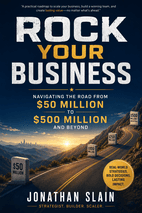
Jonathan Slain's Rock Your Business provides a Custom Built System for CEOs of companies already exceeding standard frameworks like EOS, guiding them to formalize their unique culture and processes for scaling from $50 million to $500 million and beyond.
Feature
Insta.Page
Blinkist
Shortform
Summary Depth
Full Chapter-by-Chapter
15-min overview
Section-by-section guides
Audio Narration
✓
✓
✓
Visual Mindmaps
✓
✕
✕
AI Q&A
✓
✕
✕
Quizzes
✓
✕
✕
PDF Downloads
✓
✕
✓
Price
$89.99/yr
$146/yr (PRO)
$199/yr
*Competitor data last verified July 2026.
1 Page Summary
For leaders of companies that have already outpaced standard business frameworks like EOS or the Rockefeller Habits, this book offers a guide for building a Custom Built System™—a proprietary operating system that captures a company’s unique culture and scales with it. Jonathan Slain, founder of Autobahn Consultants, argues that the advice designed for the 99.7% of businesses that never reach $10 million is useless for those navigating growth from $50 million to $500 million and beyond. Instead of selling a prefabricated "playbook," the book focuses on helping leaders discover and formalize the language, processes, and tribal knowledge already latent within their organizations.
The book's approach is distinctive, blending hard-won lessons from the author’s consulting practice with vivid, real-world analogies—from life-or-death decision-making in a pediatric ICU to the sensory instinct of smelling a bad batch of fish food. Core concepts include leading with focus on the few tasks only you can perform, maximizing your company’s valuation for a generational "American Dream exit," and building a sales strategy around a precise Ideal Client Profile to avoid leaking revenue. The author also emphasizes marketing as a function of culture and relationships, treating company values and behavioral profiles (like DiSC) as the engine of a high-performing team, and evolving KPIs as a business grows, from launch metrics to sustaining momentum.
Intended for CEOs and executive teams of high-velocity, fast-growing companies, readers will gain a framework to reclaim their time and strategic focus, systematically increase their company’s value, and build a repeatable system that captures their organization’s unique DNA. The book also addresses the urgent need to make AI a constant, visible partner in daily work and concludes with a call to consciously plan one’s life, integrating work and personal goals to ensure that energy is invested in what truly matters.
Introduction
Overview
If you’ve already built a business that’s hit $10 million, $50 million, or even $100 million, you’re breathing some seriously thin air. Only 0.3 percent of companies ever cross the $10 million mark. Most business advice is designed for the 99.7 percent that never get there. So what do you do when you’ve outgrown the standard playbooks—EOS, Rockefeller Habits, and the rest—and no one in your executive team has run a company at your new size? That’s exactly the gap this book aims to fill. It’s not a step-by-step franchise system. It’s a guide for building your own Custom Built System™, one that captures the unique DNA of your culture and scales with you.
The author, Jonathan Slain, heads a consultancy called Autobahn Consultants that only works with high-velocity, fast-growing companies. He’s upfront about rejecting the easy path of selling “The Autobahn Way.” Instead, his team helps companies develop their own proprietary system—whether you call it a flight plan, a playbook, or something else entirely. The value isn’t in copying someone else’s framework; it’s in discovering the language and processes that are already latent in your organization and making them repeatable.
The Right People on the Road Trip
The biggest lever at this level isn’t strategy—it’s people. Slain makes a blunt point: even the best strategy fails without the right team, and the people you need at $10 million may not be the ones who will take you to $100 million. He doesn’t just preach this; he models it. Every chapter in the book is written by a different member of the Autobahn team—specialists who have led product strategy at Nike, run pediatric ICUs, coded operational systems for premier hospitals, and built cultures across continents. The book itself is a demonstration of what happens when you put insanely smart, wildly different people in the room and let them contribute from their own expertise. You get more than one perspective. You get the collective horsepower of a team that’s already walked through fires most founders haven’t even seen.
If you’re in a YPO, EO, or Vistage group, you’ve already raised your hand to say you don’t have all the answers. That’s exactly the posture this book rewards. It’s written for leaders who know that the answer isn’t always in the room—and are willing to find it by learning across industries, contexts, and disciplines.
How to Engage With This Book
You don’t have to read it cover to cover. Pick the chapter that matches your biggest headache right now, or give each team member a different chapter to report back on. That said, Slain recommends starting with Chapter One (“Lead Like Lives Depend On It”) if you’re in the C-suite, because it lays the leadership foundation that makes everything else possible. The book is designed to be used as a tool, not a linear lecture—which is exactly how fast-growing, adaptive companies operate in practice.
Key Takeaways
Businesses at $10M+ revenue have outgrown standard operating systems like EOS and need a custom-built framework rooted in their own culture.
The single biggest growth multiplier at this stage is the right people—and they will change as the company scales.
Autobahn’s approach is to model the behavior they teach: a team of specialists writes the book together, showcasing how collective expertise outperforms a single “guru” voice.
You can use the book flexibly—jump to the chapter that addresses your current challenge, or assign chapters across your team.
Start with leadership (Chapter One) if you’re in the executive suite; it sets the tone for everything that follows.
Key concepts: Introduction
1. Introduction
The Scaling Gap
Only 0.3% of companies reach $10M+ revenue
Standard playbooks like EOS don't work at this level
Need a Custom Built System™, not a franchise model
Custom Built System™ Philosophy
Capture your unique culture and DNA
Discover latent language and processes
Make repeatable what already works for you
People as the Growth Multiplier
Right people matter more than strategy
Team needed at $10M differs from $100M team
Collective expertise beats a single guru voice
How to Use This Book
Read non-linearly, pick your biggest challenge
Assign different chapters across your team
Start with Chapter One for leadership foundation
Target Audience
Leaders of high-velocity, fast-growing companies
Those in YPO, EO, or Vistage peer groups
Leaders willing to learn across industries
💡 Try clicking the AI chat button to ask questions about this book!
1. Lead Like Lives Depend on It
Overview
The relentless pressure of running a pediatric ICU for seven years taught Dr. Katherine Slain a brutal truth: when every hour brings life‑or‑death decisions, you cannot be everywhere. She learned to protect her attention for the handful of tasks only you can make, and let everything else go. That same discipline translates directly into business leadership—the cost of misallocated time may not show up in a cardiac arrest, but it quietly destroys systems and culture over years. The first step is deciding what truly matters: create your own list of non‑negotiable items, then assign a regular cadence to check on them, just as Slain scheduled ventilator verifications at 7 a.m., noon, and 4 p.m. This forces you to stop mixing medications in the back room when your company has outgrown that role, and instead ask what could be life‑or‑death for your organization down the road.
To reclaim that time, you have to measure how you’re actually spending it. A week of thirty‑minute time studies, sorted into buckets of value, reveals at least ten percent of tasks you can eliminate outright. The FROG PAD and color‑coded calendars help you prioritize the highest‑impact work. But even the best schedule collapses if you cannot delegate effectively—and the biggest obstacle is confusing confidence with competence. A junior physician who sounded sure could misdiagnose a patient in minutes; a confident CFO might wreck a CRM integration over months. Slain’s Panes provides a simple two‑by‑two grid to match the importance of a task with how well you know the person’s track record. High‑stakes work with an unknown colleague demands direct oversight; low‑stakes work with a trusted teammate can be handed off completely. The framework eliminates guesswork and builds team trust because everyone sees the logic.
Standardizing communication is just as critical. Whether it’s a five‑minute morning huddle in the ICU, a safety stand‑up on a construction site, or an asynchronous chat protocol for remote teams, having a repeatable method keeps chaos at bay as the company scales. The specific format matters far less than the commitment to consistency. Once you free up hours through delegation, elimination, and streamlined communication, you can shift from hands‑on operator to thought leader—the pharmacist who grew his business while still compounding his own drugs finally stepped back to keynote on AI and earn real influence. That’s the payoff: not just a smoother day‑to‑day, but the ability to lead at a higher level, build your own credibility, and ultimately step toward your dream exit. The boosters are ready; now it’s time to move.
Only You
Dr. Katherine Slain spent seven years running a twenty-bed pediatric ICU. The stakes were literal life and death, and the sheer volume of decisions forced her to get brutally honest about where her attention belonged. The lesson she carried into business leadership is this: as your company grows, you can’t keep doing everything yourself. You have to figure out which decisions only you can make, and protect your time for those.
She learned this the hard way. A five-year-old girl arrived in cardiac arrest, was resuscitated, but never woke up. Declared brain dead. Her family refused to let the hospital take her. Katherine spent an entire week navigating that relationship while nineteen other kids needed her desperately. She couldn’t be everywhere. She called a colleague to cover a post-op patient, who recovered fully, but the experience forced her to rethink everything.
She created a list of ten things she had to do every day because she could do them better than anyone else. Exam every patient. Check every ventilator. Verify every life-or-death medication pump. She operationalized her day into a cadence: 7 a.m., noon, 4 p.m. Only after covering those items could she let her staff handle the rest.
That same principle applies in business. The decisions executives face may not carry the visible urgency of a crashing patient, but the cost of misallocated time is just as real—it just takes longer to show up. Jonathan spent years booking his own travel down to the exact seat on a Boeing 737. He loved it, and he was good at it. But once the team grew, that hour spent booking flights was an hour not spent on sales, vision, or culture. Five years down the road, systems collapse because the leader never prioritized scaling them.
Deciding What to Decide
A pharmacist who grew his pharmacy from $7 million to $30 million still mixed medications in the back room. He loved the work and felt he should keep an eye on it. But as long as he was filling prescriptions, no one was doing the leadership work only he could do. The leaders of $100 million companies aren’t working ten times harder—they’re working completely differently. And this isn’t some innate trait. It’s a skill you can learn.
The first step is to ask: what could be life-or-death for my company, now or in five years? Then make your list. Assign a regular cadence to check on those items. Paul Belair, going through a divorce, artificially capped his workday to 8 a.m. to 3 p.m. to spend time with his kids. He became ruthlessly efficient—cutting meetings without agendas, dropping off calls that weren’t worth his time, ending interviews as soon as he knew it wasn’t a fit. He guarded his time like the ICU physician guarded the ventilator checks.
Time Management Tune-Up
You can’t manage what you don’t measure. Run a time study: for one week, set a timer every thirty minutes and jot down what you’re doing. Sort each activity into four buckets: A (most value added), B (enjoy and are good at), C (have to do), D (don’t like or aren’t good at). The goal is to spend as much time as possible in bucket A. For Jonathan, that’s working with clients, creating new IP, and selling. Everything else, try to delegate, automate, or eliminate. You can probably eliminate at least 10% of your weekly tasks—no delegation required. The FROG PAD helps you focus on the most important work first. And for overachievers: color-code your calendar as green (money-making), yellow (time off), red (admin), and blue (working on the business). It’s a quick visual of where your time is actually going.
The Competence to Confidence Ratio
Delegating properly is a pain. It takes time to explain, teach, watch, answer questions, follow up, and give feedback. So instead, most leaders abdicate—hand off the task and hope for the best. Then they’re frustrated when it’s not done right.
Autobahn’s traveling road shows require sixty-pound suitcases with fidget toys, frog candy, and personalized agendas. Jonathan held all the packing knowledge in his head for years. Delegating that to his sister Wendy took six months. But getting that complex knowledge out of the leader’s head is vital—not just to free up time, but to ensure it isn’t lost.
The biggest reason leaders resist delegation? They’ve been burned. They hired a confident CFO who swore he could integrate a new CRM, then checked in months later to find a catastrophe. The key is judging a person’s competence separately from their confidence. Katherine once sent a junior physician to “tuck in” a new patient during morning rounds. Two and a half hours later, she opened the curtain on a teenage boy who needed three hours of resuscitation. He survived, but she learned: confidence is not competence. Always examine the patient yourself. Always verify the critical work.
Slain’s Panes: A Framework for Confident Delegation
You can’t delegate effectively unless you can size up both the task and the person. That’s where Slain’s Panes comes in—a simple two-by-two grid that helps you decide in seconds. On one axis: the importance of the task. On the other: how well you know the person’s competence and history.
The story from the ICU illustrates the cost of getting it wrong. I mistakenly placed a patient admission—a high-stakes, high-importance task—into the wrong pane when a junior colleague was involved. Patient admitting is a “consult me first” task: the most senior physician must be in the loop. But low-importance tasks, especially with people you don’t yet trust, are perfect teaching moments. Let them handle it, watch the outcome, and build your confidence in them.
When the task is low importance and you already know they’re solid, let them run with it. When it’s high importance but you have history, use a “trust but verify” approach—let them proceed, but ask them to circle back when done. The real leverage comes from accurately evaluating the who, not just the what. Using a framework like Slain’s Panes gives your team clarity on how you decide which tasks you’ll oversee and which you’ll hand off. That transparency builds trust and saves everyone time.
Scripts and Huddles: Standardize to Scale Communication
Good communication isn’t about following a particular guru’s method. It’s about having a method and sticking to it. In the ICU, a five-minute daily huddle at 8 a.m. worked wonders: we covered admissions, discharges, the sick
Key concepts: 1. Lead Like Lives Depend on It
2. 1. Lead Like Lives Depend on It
Protect Your Attention
Focus only on tasks only you can do
Create a list of non-negotiable items
Schedule regular cadence to check them
Let everything else go
Decide What Truly Matters
Ask what could be life-or-death for company
Assign regular cadence to key items
Guard time like ICU ventilator checks
Stop mixing medications in back room
Measure How You Spend Time
Do week-long thirty-minute time studies
Sort tasks into value buckets
Eliminate at least 10% of tasks
Use FROG PAD and color-coded calendars
Delegate Without Guesswork
Don't confuse confidence with competence
Use Slain's Panes two-by-two grid
Match task importance to track record
High-stakes work needs direct oversight
Standardize Communication
Create repeatable communication methods
Use morning huddles or safety stand-ups
Consistency matters more than format
Keep chaos at bay as company scales
Shift from Operator to Thought Leader
Free up hours through delegation
Step back from hands-on work
Focus on higher-level leadership
Build credibility for dream exit
Guard Time Ruthlessly
Cut meetings without agendas
Drop off calls not worth your time
End interviews when not a fit
Artificially cap workday if needed
2. Maximize Your Multiple to Achieve Your “American Dream” Exit
Overview
For most owners, selling a business is a once-in-a-lifetime event—their “baby”—and without a roadmap, the outcome can determine their net worth forever. Paul Belair emphasizes the value of a trusted coach who has operator credibility and understands that emotional weight, as George Hohman learned when he sold Turfscape after years of ignoring offers. The goal of what Paul calls the American Dream exit is maximizing the multiple applied to annual earnings, generating generational wealth that changes your family’s trajectory. Jonathan Slain adds that preparing for sale isn’t just about the exit—it’s a framework that makes the business healthier by eliminating waste, proving growth, and defending your unique position. Paul’s self-assessment tool lets owners grade themselves on strategic planning, customer diversification, recurring revenue, and technology integration, revealing all the levers that increase company value. George’s own readiness came after a traumatic visa crisis forced him to fire over half his workforce; by fixing systems and growing back larger, he became psychologically ready to sell.
The process unfolds in phases. Phase One: Assessing Your Company takes about three months, where Paul does preliminary due diligence, estimates EBITDA, and provides a realistic sale range plus a roadmap to improve value—sometimes even talking owners out of selling if they’d leave money on the table. George saw this mindset in action when Paul noticed a pile of leaves inside his office and asked for a broom; that attention to detail sparked a company-wide streamlining effort that paid off later. Phase Two: Preparing for Sale is compared to preparing for a colonoscopy—unpleasant but necessary. Companies need documented strategic plans, integrated technology, recurring revenue, and strong safety cultures. A sell-side Quality of Earnings report shows buyers the seller is sophisticated and can’t be taken advantage of. The hardest part is confidentiality; Paul advises keeping the circle tight. George’s preparation meant his equipment audit at the largest yard finished in fifteen minutes because everything was organized. Phase Three: Going to Market starts from a position of strength. Paul works with over seventy private equity funds and narrows the field methodically: forty potential buyers receive teasers on a no-name basis, fifteen sign NDAs and enter a limited virtual data room, seven are invited for half-day meetings and dinners, and finally three to five buyers submit letters of intent. At that stage, the owner’s focus shifts from numbers to personal chemistry—especially if an earnout ties them to the buyer for a year or two. George’s story illustrates that price vs. fit matters deeply: he rejected the highest bidder from a strategic buyer who would absorb his company and sidelined his people, choosing instead a private equity firm that kept the name, culture, and team intact, giving his employees better opportunities. His number one advice is to get representation—someone who speaks your language and has your back. After the sale, a fourth phase—transition—determines long-term satisfaction. Knowing what you want post-sale (immediate exit or phased transition) shapes the entire process, and updating your life plan before starting helps connect the dots. George’s final message is simple: after years of missed vacations and sacrifices, it’s okay to reap the rewards. You’ve earned the right to sell, make the best deal you can, and enjoy your American Dream exit—just get the right person riding shotgun to help you get there.
Your Baby
For most owners, selling a business is a once-in-a-lifetime event. They pour decades into building what Paul Belair calls "their baby," yet have no roadmap for the process—no sense of what buyers will demand, how to evaluate offers, or even who the buyers are. That lack of experience can be devastating when the outcome determines your net worth for the rest of your life. Paul emphasizes the value of a trusted coach who has been through it before, especially one who has run and sold a similar blue-collar company. George Hohman knows this intimately. He started Turfscape from his parents' garage with a single mower, grew it into a multi-location industry leader, and fielded weekly offers from strangers. He ignored them until he met Paul—someone with operator credibility who understood the emotional weight of selling a life's work.
What Is an “American Dream” Exit?
Paul defines the American Dream exit as maximizing the multiple—the number of times a buyer is willing to pay for your annual earnings. It's about achieving generational wealth, the kind that means your kids' kids don't have to worry about money. He points out that the US creates more millionaires and billionaires than any other country because of the potential for exponential growth. For George, that dream became real when he sold his landscaping company for an incredible 10x EBITDA. He and his wife had grown the business together, and when their sons chose their own paths, it freed them to think about selling.
Jonathan Says
Jonathan Slain draws on his investment banking background to emphasize that preparing a business for sale isn't just about an exit—it's a powerful framework for making the business healthier. All the actions that increase sale value—eliminating unnecessary costs, proving a growth thesis, defending your unique selling proposition, and putting a moat around clients—are exactly the things that strengthen the company.
Are You Ready?
Paul developed a self-assessment tool that lets owners grade themselves on everything from strategic planning and customer diversification to recurring revenue margins and technology integration. It shows all the levers available to increase a company's value. George's readiness came after a traumatic period when government changes to H-2B visas forced him to fire over half his workforce. But by applying the principles from Rock the Recession, he and Paul fixed the systems and grew back even larger. Once the ship was righted and their sons weren't coming into the business, George was psychologically ready to let go.
Phase One: Assessing Your Company
Paul's expertise is in contracting, and he believes there's huge value in hiring a consultant who knows your industry inside out. The assessment phase takes about three months: Paul meets with owners, does preliminary due diligence, and gets a feel for the EBITDA. At the end, he gives a realistic sale range and a roadmap: "If you do this and this and wait a year, you could sell for X more." He also vets psychological readiness. Sometimes Paul talks owners out of selling because they'd leave too much money on the table. George saw the assessment mindset in action when Paul first visited his office, noticed a pile of leaves that had blown inside, and asked for a broom. That comment sparked a company-wide streamlining effort that paid off later.
Phase Two: Preparing for Sale
Paul compares preparing to sell a company to preparing for a colonoscopy—unpleasant but necessary. Companies that are ready have a documented strategic plan, integrated technology, recurring revenue models, and strong safety cultures. A sell-side Quality of Earnings report is critical. It shows a potential buyer that the seller is sophisticated and can't be taken advantage of. The hardest part for many owners is confidentiality; Paul advises keeping the circle of trust very tight until just before closing. George's preparation paid off during the buyer's equipment audit—at his largest yard with thirty-five trucks and trailers, they finished in fifteen minutes because everything was organized.
Phase Three: Going to Market
The key to going to market is doing so from a position of strength. Paul works with over seventy private equity funds interested in the contracting industry. By that point, the business is cleaned up, documented, and ready to command the highest possible multiple.
The Art of Narrowing the Field
From forty potential buyers, the real work of selection begins. We send out teasers on a no-name basis. Those who bite sign an NDA and enter a limited virtual data room. That usually whittles the pool to about fifteen. Video calls let the ownership team meet the prospects. Then we ask for letters of interest with a valuation range. Now we’re down to maybe seven, and we schedule half-day meetings and dinners. By the letter-of-intent phase, we want three to five serious buyers. This is where the owner shifts focus from numbers to connection. If you’re stuck working alongside the buyer for a year or two—especially with an earnout on the line—a bad fit can make the payout feel like a prison sentence.
George’s Story: Price vs. Fit
George was hyperconscious of confidentiality. He worked with a shortlist of eight or nine buyers, received seven offers, and then had to choose. The highest bidder wasn’t the winner. He saw two camps: strategic buyers who would absorb his company and potentially sideline his people, and private equity firms who wanted to keep the name, the culture, and the team intact. George chose the private equity buyer. His employees ended up with better opportunities. His number one piece of advice: get representation. Don’t try to negotiate your own deal. You need someone who speaks your language, has your back, and genuinely cares about the outcome.
After the Sale: The Transition Phase
The sale closing isn’t the finish line. There’s a fourth phase—transition—that often determines the owner’s long-term satisfaction. Knowing what you want post-sale shapes how the whole process feels. George reflects on the surreal moment when the deal closed. After years of missed vacations and sacrificed baseball games, his message to owners is simple: It’s okay to reap the rewards. You’ve earned the right to sell, make the best deal you can, and enjoy your American Dream exit. Just get the right person riding shotgun to
Key concepts: 2. Maximize Your Multiple to Achieve Your “American Dream” Exit
3. 2. Maximize Your Multiple to Achieve Your “American Dream” Exit
The American Dream Exit
Maximize the multiple on annual earnings
Achieve generational wealth for family
US creates millionaires through exponential growth
George sold landscaping at 10x EBITDA
Your Baby: Emotional Weight
Selling is a once-in-a-lifetime event
No roadmap for process or buyers
Need trusted coach with operator credibility
George ignored offers until meeting Paul
Jonathan's Framework: Healthier Business
Preparing for sale strengthens the company
Eliminate waste and prove growth thesis
Defend unique selling proposition
Build a moat around clients
Phase One: Assessing Your Company
Three months of preliminary due diligence
Estimate EBITDA and realistic sale range
Provide roadmap to improve value
May talk owners out of selling too early
Phase Two: Preparing for Sale
Document strategic plans and integrated tech
Build recurring revenue and safety culture
Get sell-side Quality of Earnings report
Keep confidentiality circle tight
Phase Three: Going to Market
Start from position of strength
Narrow buyers: 40 teasers to 3-5 LOIs
Focus shifts from numbers to personal chemistry
Price vs. fit: George rejected highest bidder
After the Sale: Transition & Life Plan
Fourth phase determines long-term satisfaction
Know if you want immediate exit or phased
Update life plan before starting process
It's okay to reap rewards after sacrifices
3. What We Learned Selling Fish Food and Nike Shoes
Overview
The most powerful strategies aren't found in textbooks—they emerge from an organization's hidden, intuitive knowledge. Jim learned this firsthand in his fish food manufacturing days, where he could follow his nose and smell a bad batch before any test confirmed it. That same instinct applies to business: the unwritten rules, the tribal knowledge, and the cultural practices that make a company unique. The challenge is that when you're inside the jar, you can't read the label. That's why an outside perspective is so valuable—it reveals what you've become blind to. Rafa experienced this from a different angle at Nike Mexico, where a top-down vision left teams disengaged. By flipping the process and bringing everyone into the room to build the how together, the teams set higher targets than leadership would have dared and crushed them. The lesson: define the North Star at the top, but let the team decide the route.
Most companies have a strategic plan on paper, but it's useless—a bloated PowerPoint or a collection of departmental wish lists. Real strategy isn't a one-time event; it's a flywheel: a three-to-five-year vision broken into one-year goals, then three-to-four-month priorities, and finally translated into daily work for every person. The real magic doesn't happen during the planning retreat. It happens before—through self-awareness and getting the right people—and after—through cascading, communication, and accountability. Leaders must ask: Do I know what I want? Who's on my team? What's actually holding us back? The breakthrough is identifying the top five things that really move the needle. Rafa adds an external layer: know your real customer, your target market, and your competitive advantage. Only then can you gather the team to build the plan—and afterward, ensure every department and individual knows how their daily actions connect to the North Star.
A concrete example from Nike By You shows what happens when you get the mission right. The team was obsessed with revenue growth, but it wasn't clicking. When they stepped back and asked what the business was really about, they realized it was about consumer connection, not revenue. They flipped the strategy to prioritize customer experience and engagement, and the revenue followed naturally, exceeding expectations. Don't chase metrics directly—get the mission right, and the numbers catch up.
Jim and Rafa distilled their combined experience into four essential elements that make a strategic plan come alive: People (first who, then what—the right team defines what's possible), Destination (start with the end in mind, even if it's a best guess), Engine (the mission, culture, and driving force that makes people want to show up), and Focus (out of everything you could do, the few things you will actually do). These four elements turn a static document into a living, breathing guide.
An outside advisor serves as a blind-spot mirror for the company, uncovering what insiders can't or won't say. Long-timers don't want to rock the boat; newer hires lack clout or fear retaliation. Critical issues stay hidden while everyone has opinions on trivial matters—the bicycle shed fallacy (people comment freely on low-stakes decisions but defer on high-stakes ones). Autobahn helps companies separate the bicycle sheds from the nuclear reactors, forcing honest conversations about what actually matters.
Lack of focus is the silent killer. One team created a fifteen-page plan with sixty action items, spinning furiously on a hamster wheel. The fix? Agree that it's better to crush three big goals than to half-ass fifty. Another company had every department with its own eighty-page PowerPoint deck. By engaging not just executives but also managers and frontline workers, they compressed eighty pages into a single-page plan. That clarity transformed collaboration and cultural alignment—a nearly century-old company finally achieved escape velocity.
Executives often claim the team lacks accountability, but the root cause is usually communication failure. Leaders assume everyone knows the plan because they say it every day, while the team feels lost. They throw up a bunch of unowned KPIs and lean harder when targets aren't met, sliding into a dystopian culture of blame. The real solution is to first align on a shared vision, then build a culture of winning around it. The same tools work, but only after communication is fixed.
At the core is the philosophy that the right people are your most valuable asset. With that team, you must iteratively agree on where to focus. Strategy can't be set and forgotten. Autobahn stays in the box with clients—like the 13th doughnut in a baker's dozen—in the mix, not dropping in twice a year. The framework scales from a family unit to a giant like Nike. If you have a strategy but keep it in a drawer, it's dead. The sweet spot between no plan and a hamster wheel is people and culture—a culture of winning where everyone knows what can and should be accomplished.
Key Takeaways
Outside advisors serve as a blind-spot mirror to uncover what insiders won't say.
Distinguish bicycle sheds (trivial) from nuclear reactors (critical) to focus energy.
Overly complex plans crush momentum—simplify to a single page and aim for three big wins.
Most accountability problems are actually communication failures; align on the goal before deploying KPIs.
Strategy is iterative, not static. Keep the right people in the room regularly.
The same principles work for companies of any size—even families and solo entrepreneurs.
Key concepts: 3. What We Learned Selling Fish Food and Nike Shoes
4. 3. What We Learned Selling Fish Food and Nike Shoes
Hidden Knowledge & Outside Perspective
Powerful strategies emerge from intuitive tribal knowledge
Inside the jar, you can't read the label
Outside advisors serve as blind-spot mirrors
Distinguish bicycle sheds from nuclear reactors
Strategy as a Living Flywheel
Real strategy is a flywheel, not a one-time event
Break vision into yearly goals and quarterly priorities
Magic happens before and after the planning retreat
Identify top five things that truly move the needle
Four Essential Elements: People, Destination, Engine, Focus
First who, then what—right team defines possibilities
Start with the end in mind, even if it's a guess
Mission and culture are the driving engine
Focus on the few things you will actually do
Simplicity Over Complexity
Crush three big goals instead of half-assing fifty
Compress eighty-page decks into a single-page plan
Overly complex plans create a hamster wheel effect
Clarity transforms collaboration and cultural alignment
Communication, Accountability & Culture of Winning
Most accountability problems are communication failures
Align on shared vision before deploying KPIs
Don't chase metrics—get the mission right first
Strategy is iterative; keep right people in the room
You've reached the end of the free chapters
Next chapter: “Every Day Without a Real Sales Strategy Is a Donation to Your Competition” is locked
Keep reading Rock Your Business — and unlock all 600+ book summaries with audio, mindmaps and AI Q&A.
$0.00 due today · 7 days free, then $89.99/year ($7.49/mo) · Cancel anytime before day 7
Jonathan Slain is a technology and business writer specializing in product management, software development, and startup strategy. He is best known for his work as a contributing author to the *Lean Enterprise* and as a co-author of resources on agile practices, drawing on his experience as a product manager at companies like Pivotal Labs. His writing focuses on practical frameworks for building user-centered digital products and scaling engineering teams.
Frequently Asked Questions about Rock Your Business
What is Rock Your Business about?
Rock Your Business is a guide for leaders of high-growth companies that have outgrown standard frameworks like EOS and Rockefeller Habits. It teaches how to build a Custom Built System that captures your company's unique DNA and scales with you. The book covers leadership, sales strategy, marketing, talent, KPIs, AI, and personal life planning, drawing on real stories from the author's consultancy experience and from leaders in high-stakes environments like pediatric ICU.
Who is the author of Rock Your Business?
Jonathan Slain heads Autobahn Consultants, a firm that works exclusively with high-velocity, fast-growing companies. Rather than selling a proprietary system, his team helps organizations develop their own custom playbook. The book draws on his experience coaching companies through scaling challenges and preparing them for successful exits.
Is Rock Your Business worth reading?
Yes, this book fills a critical gap for companies that have outgrown cookie-cutter advice. It offers actionable insights on building a scalable system unique to your culture, with real-world examples from leaders in pediatric ICU, Nike, and other high-stakes environments. The focus on both business metrics and personal fulfillment makes it valuable for any CEO navigating rapid growth.
What are the key lessons from Rock Your Business?
Protect your attention for only-you tasks and use time studies to eliminate low-value work. Maximize your company's valuation by preparing for an American Dream exit through strategic planning and eliminating waste. Evolve your KPIs as you grow, and ensure you're tracking leading indicators, not just rearview mirror numbers. Embrace AI as a constant partner, and create a written life plan to ensure you're spending your limited time on what truly matters.
📚 Explore Our Book Summary Library
Discover more insightful book summaries from our collection