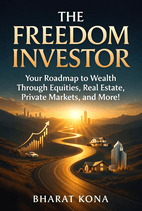
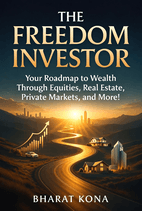
Bharat Kona's The Freedom Investor provides a practical system for everyday investors to build wealth through disciplined diversification across public and private markets, emphasizing that financial success is 80 percent psychology and 20 percent mechanics. Written for those ready to move beyond conventional advice and adopt strategies modeled on how the wealthy actually allocate capital.
Feature
Insta.Page
Blinkist
Shortform
Summary Depth
Full Chapter-by-Chapter
15-min overview
Section-by-section guides
Audio Narration
✓
✓
✓
Visual Mindmaps
✓
✕
✕
AI Q&A
✓
✕
✕
Quizzes
✓
✕
✕
PDF Downloads
✓
✕
✓
Price
$89.99/yr
$146/yr (PRO)
$199/yr
*Competitor data last verified July 2026.
1 Page Summary
You already stand apart if you are reading this book—that is the opening message from Rod Khleif, and it sets the tone for everything that follows. The book addresses the rare group of people who refuse to drift through life hoping things will work out, the ones who decide to take control. The author begins by sharing his own final morning as a corporate employee, quitting a high-paying tech job on Halloween morning, a day when people wear masks so he could finally take his own off. That personal awakening leads into the book's central argument: most of us follow a script that was never designed to make us truly free, and true wealth begins in the mind, not in a portfolio.
The book's distinctive approach combines mindset work with practical mechanics, arguing that financial success is 80 percent psychology and 20 percent mechanics. The author introduces the two main arenas for investing—public markets (stocks, mutual funds) and private markets (real estate, private equity)—and argues that the real opportunity lies in understanding the trade-offs between liquidity, transparency, and potential returns. The wealthy don't guard their investment playbook as a secret; they follow a disciplined framework centered on genuine diversification across asset classes that behave differently under various economic conditions. The framework covers equities, private commercial real estate, 401(k)s and IRAs, college savings, and the critical role of insurance as the defensive backbone of a disciplined plan.
This book is for the person who is curious, willing to take control, and ready to build wealth on their own terms. The intended audience is everyday investors who want to go beyond the typical advice of "just buy the haystack" and adopt strategies modeled on how the wealthy actually allocate capital, while also understanding that generosity and protecting what you build are essential to a fulfilling financial life. Readers will walk away with a practical, repeatable system for staying disciplined, a clear-eyed action plan, and the gentle but firm push to stop reading and start doing.
Foreword
Overview
You're already different if you're holding this book—that's the opening message from Rod Khleif, and it sets the tone for everything that follows. He speaks directly to the rare group of people who refuse to drift through life hoping things will work out, the ones who decide to take control. Khleif knows this territory intimately, having built a massive real estate portfolio, lost $50 million in 2008, and rebuilt from scratch. That hard-earned wisdom shapes his belief that wealth isn't just about what you invest in—it's about how you think, how you handle fear, and how you protect what you build.
Khleif explains why he was eager to write this foreword for Bharat's book. He'd watched Bharat go through the same awakening many of his own students experience: realizing that relying solely on public markets and a single career won't deliver the freedom you want. Instead of staying stuck, Bharat educated himself and took action. The result is this practical playbook, not some fluffy "think positive and get rich" fantasy.
What sets this book apart for Khleif is the mindset piece. He's fond of saying success is 80 percent psychology and 20 percent mechanics, and he sees that balance reflected here. The mechanics—building a foundation with simple strategies, adding private investments like real estate for cash flow and tax advantages, thinking about risk like sophisticated investors, and protecting what you build with entities and insurance—are all solid. But the real power comes from how the book invites you to think. Bharat talks about compounding honestly, acknowledging how hard it is to push that first $50K or $100K of net worth uphill. He also shows you how to align your money with the life you actually want, not the one someone else expects you to live.
The message is clear: this isn't entertainment. Treat it as a working session for your future. If you pair the lessons with massive action, a year or five years from now you might look back and recognize this as the moment you stopped drifting and started designing your financial life.
Key Takeaways
Success is 80 percent psychology, 20 percent mechanics—mindset matters more than any single investment strategy.
The early phase of building wealth (the first $50K–$100K) is genuinely difficult, but staying in the game and making intelligent moves eventually turns the wheel in your favor.
True wealth isn't about money for its own sake—it's about freedom, options, and the ability to live a life that lights you up.
Key concepts: Foreword
1. Foreword
The Reader's Mindset
You're already different for seeking this book
Refuse to drift through life hoping things work out
Wealth is 80% psychology, 20% mechanics
Author's Credibility
Built massive real estate portfolio, lost $50M, rebuilt
Hard-earned wisdom on thinking, fear, and protection
Watched Bharat's awakening from reliance on public markets
What Sets This Book Apart
Practical playbook, not fluffy positive thinking
Balances mindset with solid mechanics
Honest about difficulty of first $50K–$100K net worth
Core Wealth Strategies
Build foundation with simple strategies
Add private investments like real estate for cash flow
Think about risk like sophisticated investors
Protect assets with entities and insurance
Call to Action
Treat this as a working session for your future
Pair lessons with massive action
Stop drifting and start designing your financial life
💡 Try clicking the AI chat button to ask questions about this book!
Introduction
Overview
You know those moments when everything clicks into place, even though the path ahead is still blurry? That’s exactly the energy of this opening chapter. The author takes us right into his final morning as a corporate employee—Halloween morning, no less—driving along the same freeway he’d traveled for years, but this time with a mix of excitement and uncertainty. He’s quitting a high-paying tech job, and the symbolism isn’t lost on him: he chose a day when people wear masks to finally take his own off. What follows isn’t just a goodbye to a career; it’s the beginning of a much bigger conversation about what it means to build wealth on your own terms, and why most of us are following a script that was never designed to make us truly free.
The Last Day and the Decision
The chapter opens with a vivid, almost cinematic scene. The author packs his laptop and monitor, makes the familiar drive, and spends his last day saying goodbye to colleagues who (he suspects) hoped he’d change his mind. Handing in the badge and equipment feels heavier than expected. But the real weight is in the backstory: after twenty-five years in tech and nearly a decade at a prestigious company, the work had become soul-crushing. He’d lost the sense of purpose that once made him thrive. For two years, he wrestled with what to do next, until two minor eye surgeries forced him to pause. That break became a crucible for reflection. He realized he no longer wanted to trade his time for a paycheck. He wanted a life supported by passive income, not just a salary.
The Traditional Path and Its Pitfalls
The author then pulls back the lens to show how he ended up on this conventional treadmill. Growing up middle-class in India, success meant academic achievement, a stable job, and hard work. He followed the blueprint: engineering degree, graduate studies in the U.S., a Silicon Valley career, marriage, kids, a suburban home. For two decades, he did everything right—maxed out his 401(k), consulted wealth advisors, earned bonuses and stock options. Yet, he never felt financially secure. The fear of job loss was a constant companion, and it became real more than once.
He walks us through two brutal market crashes: the dot-com bust in 2000, which wiped out 95% of his stock portfolio, and the 2008 subprime crisis, which left his home worth less than his mortgage. Both events shattered his confidence in stocks and real estate as reliable paths to security. Still, he kept climbing the corporate ladder, earning more, and accumulating stock grants. But the anxiety of having all his wealth tied to the stock market never left. Annual meetings with his wealth advisor produced nothing but excuses for why his retirement accounts lagged the market. He accepted it, because he didn’t know any better.
The Awakening and Multifamily Real Estate
That changed in late 2017. The author decided to take action rather than passively accept mediocrity. He dove into books, podcasts, and seminars on personal finance and investing. What he discovered was eye-opening: his mutual funds were underperforming, and hidden fees were silently eating away his returns—while his wealth advisor profited regardless. He fired the advisor, moved everything to a low-cost brokerage, and invested entirely in index funds. He’d learned that index funds beat actively managed funds and individual stock picks 95% of the time.
But even after taking control, something still felt missing. He wanted exposure to a lower-risk asset class with solid growth potential. That’s when friends introduced him to multifamily real estate. The allure was clear: cash flow, appreciation, and tax benefits. He attended webinars, joined meetups, and eventually enrolled in a boot camp. That boot camp gave him the confidence to invest, and soon after, fellow attendees asked him to help raise capital for a deal. He contributed his own money and gathered funds from a close friend. That was the start of his journey as both an investor and a general partner in multifamily real estate.
A New Path Forward
From that first deal, the author participated in many more—sometimes as a general partner, sometimes as a limited partner. He learned to focus on demographics, asset potential, and most importantly, the credibility of the sponsor. He diversified across different teams, markets, and asset classes: value-add multifamily, ground-up developments, land entitlement projects, even a real estate technology startup and an independent film. Each investment taught him something new about wealth building.
Throughout this process, he absorbed lessons from high-net-worth investors about how they build and protect wealth. The single most important insight? Long-term investing and diversification are the true cornerstones of sustainable wealth. He emphasizes that this book isn’t about quick wins; it’s about patient, strategic investing across multiple asset classes over decades. It’s the product of years of learning and real-world action, written to show that financial security should mean more than a paycheck and a 401(k).
The Freedom Investor Path
At this point, the author coins a term that captures his new identity: a freedom investor. He no longer depended on the stock market or a single income stream. Instead, he built a diversified portfolio of unrelated assets that generated cash flow and long-term growth. This shift didn’t just improve his returns—it gave him freedom: the ability to choose how he spends his time, pursue meaningful work, and explore new experiences without worrying about market fluctuations or losing a job. Investing stopped being about money alone and became about living life on his own terms.
How to Use This Book
The final part of the introduction is a practical guide to reading the book itself. The author wanted to avoid regurgitating basic financial advice. He encourages readers to read with a purpose, actively engaging with the ideas and applying them to their own situation. Focus on the “why” first—the mindset shifts that make diversification possible. Later chapters will dive into practical details like Net Operating Income (NOI), Cash-on-Cash Return, and the tax benefits of private real estate. He advises creating an action plan, highlighting key terms, and writing down questions. Most importantly, he reminds readers that his path is not a prescription, but a framework. The goal is to cut through the noise and start building truly diversified, lasting wealth.
Key Takeaways
The traditional career-and-savings path often fails to deliver real financial security, especially when your net worth is tied to a single asset class like stocks or your home.
Hidden fees and underperforming mutual funds can silently erode retirement savings; taking control of your portfolio (e.g., switching to low-cost index funds) is a critical first step.
Multifamily real estate offers a compelling alternative: cash flow, appreciation, and significant tax advantages, especially when invested with credible sponsors.
Becoming a “freedom investor” means diversifying across unrelated asset classes (private equity, real estate, even film) to reduce risk and increase cash flow, so your lifestyle isn’t dependent on a paycheck.
This book is a practical guide, not a get-rich-quick scheme—read actively, focus on mindset first, then implement the strategies over years.
Key concepts: Introduction
2. Introduction
The Last Day and the Decision
Quits high-paying tech job on Halloween morning
Twenty-five year career had become soul-crushing
Eye surgeries forced a pause for reflection
Wanted passive income, not a paycheck
The Traditional Path and Its Pitfalls
Followed blueprint: degree, job, marriage, home
Maxed 401(k) but never felt financially secure
Dot-com crash wiped 95% of stock portfolio
2008 crisis left home worth less than mortgage
The Awakening to Index Funds
Discovered mutual funds underperformed with hidden fees
Fired wealth advisor in late 2017
Moved everything to low-cost index funds
Index funds beat active management 95% of time
Multifamily Real Estate Discovery
Wanted lower-risk asset with solid growth potential
Attended boot camp and learned the ropes
First deal as both investor and general partner
Focused on demographics and sponsor credibility
Diversification Across Asset Classes
Invested in value-add, developments, and land
Also backed a tech startup and independent film
Each investment taught new wealth-building lessons
Learned from high-net-worth investors' strategies
The Freedom Investor Identity
No longer dependent on stock market or single income
Built diversified portfolio of unrelated assets
Investing became about living life on own terms
Freedom to choose time and pursue meaningful work
Core Philosophy of the Book
Not about quick wins or get-rich schemes
Patient, strategic investing over decades
Financial security beyond paycheck and 401(k)
Long-term diversification is sustainable wealth
Chapter 1
Overview
Your mindset is the single most important factor in investing success. Financial strategies and market knowledge are useless without the mental framework to apply them with discipline and clarity. The author makes a compelling case that true wealth begins in the mind, not in a portfolio. A growth mindset—the belief that abilities and intelligence can be developed through effort—is what separates investors who thrive from those who panic and sell at the worst possible moments.
Financial success is as much psychological as it is mathematical. Resilience, patience, and the ability to think long-term when others react emotionally are skills that can be cultivated. The author shares a personal story from 2020, when the pandemic caused a market crash. Instead of selling in fear, they saw the downturn as a buying opportunity—a direct application of growth mindset thinking. That shift in perspective turned a scary moment into the most profitable decision of the year.
The Fixed vs. Growth Mindset in Finance
The core distinction is simple but profound. A fixed mindset assumes your intelligence and talent are static—you either have it or you don't. In investing, this leads to giving up after a loss, avoiding challenges, and taking feedback personally. A growth mindset, on the other hand, treats setbacks as learning opportunities. Market downturns become data, not disasters. A poor investment becomes a lesson that sharpens your strategy. The author cites Harvard Business School research, emphasizing that this isn't blind optimism—it's a disciplined belief that effort and learning can improve outcomes.
Practical Tips to Build a Growth Mindset
The chapter offers ten actionable strategies for developing this mindset, framed as habits rather than abstract concepts. Key among them:
Adopt a learning mindset with every financial decision, reflecting on what you can improve.
Embrace feedback from CPAs or mentors, using it to question assumptions (not as personal criticism).
Reframe failure by conducting post-mortems on investments that didn't work out.
Network with growth-minded people and seek mentors who have achieved what you want—this compresses years of trial and error.
Visualize success regularly, but also focus on the process (like increasing savings rate) rather than just the end result.
Stay adaptive, adjusting strategies when life throws curveballs like job loss or unexpected expenses.
These tips are designed to turn mindset from a vague concept into daily practice. The chapter emphasizes that discipline and effort, not just talent, drive financial growth.
Key Takeaways
A growth mindset is the operating system for your financial life—without it, knowledge and strategies fail.
Setbacks and losses are not failures; they are lessons and data that improve future decisions.
Developing this mindset is intentional: use feedback, mentors, visualization, and process-oriented goals to strengthen it.
True wealth starts with how you think, not just what you invest in.
Key concepts: Chapter 1
3. Chapter 1
Mindset as the Foundation of Investing Success
Mindset is the single most important factor in investing
True wealth begins in the mind, not in a portfolio
Growth mindset separates thriving investors from panicked sellers
Financial success is as psychological as it is mathematical
Fixed vs. Growth Mindset in Finance
Fixed mindset assumes static intelligence, leading to giving up after loss
Growth mindset treats setbacks as learning opportunities
Market downturns become data, not disasters
Effort and learning can improve financial outcomes
Practical Habits to Build a Growth Mindset
Adopt a learning mindset with every financial decision
Embrace feedback from mentors to question assumptions
Reframe failure by conducting post-mortems on investments
Network with growth-minded people to compress learning
Key Strategies for Daily Practice
Visualize success but focus on process goals like savings rate
Stay adaptive when life throws curveballs like job loss
Discipline and effort drive financial growth, not just talent
Turn mindset from concept into daily practice
Core Takeaways for Financial Growth
Growth mindset is the operating system for financial life
Setbacks are lessons and data, not failures
Developing mindset is intentional through feedback and mentors
True wealth starts with how you think, not what you invest in
Chapter 2
Overview
Most of us want to grow our money, but knowing where to start can feel paralyzing. The author introduces the two main arenas for investing—public markets (stocks, mutual funds) and private markets (real estate, private equity)—and argues that while public markets are comfortable and efficient, they only tell part of the story. The real opportunity lies in understanding the trade-offs between liquidity, transparency, and potential returns, and then building a strategy that uses both worlds.
The Core Distinction: Public vs. Private Markets
Investing in public markets is like shopping at a well-lit, organized supermarket. Information is abundant, prices adjust quickly, and you can buy or sell almost anything in seconds. Stocks represent ownership in companies, mutual funds offer instant diversification, and the system is highly regulated. This efficiency, however, means that truly undervalued opportunities are rare. Returns are generally reliable but modest, often hovering in the 6–7% annual range.
Private markets are the opposite—think of a farmer's market where you have to haggle, inspect goods yourself, and accept that you can't easily return something. These markets include investments in private companies, local businesses, and real estate ventures that aren't traded on public exchanges. They’re less transparent, more complex, and come with higher risk (including illiquidity). But that complexity is precisely why they can offer significantly higher returns. The author cites data showing that private equity has historically outperformed public markets by several percentage points annually, with long-term net returns around 10–11% compared to 6–7% for public benchmarks. Over a decade, that 3–5% annual edge can turn $100,000 into $311,000 versus just $197,000—a 50% higher ending value from the same starting capital.
Why We Invest and How to Think About Risk
The author quickly dismisses the idea of relying on savings accounts. Inflation slowly eats away at purchasing power, making investing non-negotiable for long-term goals like retirement or education. He then emphasizes that the biggest mistake isn't choosing public over private, but putting all your eggs in one basket. Investing solely in individual stocks magnifies company-specific risk, while relying only on mutual funds can cap your upside. The solution is diversification—a balanced diet, not a steady diet of chocolate. Combining public equities, index funds, real estate, and selective private opportunities helps smooth out volatility and capture growth from different sources.
The First $100,000: The Hardest Milestone
One of the most memorable concepts in the chapter is the idea that reaching a net worth of $100,000 is the most challenging—and most critical—step. The author illustrates this with the classic penny-doubling example: a single penny that doubles every day is worth only a few dollars after 10 days, but after 30 days it explodes to over $5 million. Wealth building works the same way. The early phase feels painfully slow, requiring discipline and sacrifice. But once you cross that $100,000 threshold, something shifts. At a 10% annual return, your money starts generating $10,000 per year on its own, and those returns compound further. The author shares a personal reflection: getting to six figures came from steady saving, but reaching seven figures felt like a marathon where compounding became unmistakable. Annual portfolio growth began outpacing personal contributions, marking the moment money started working for the investor rather than the other way around.
Key Takeaways
Public markets are efficient but limited; private markets offer higher potential returns with greater complexity and risk. The historical data supports a 3–5% annual outperformance for private equity, which compounds into significant wealth differences over time.
Diversification is non-negotiable. A blend of stocks, index funds, real estate, and private investments creates a stronger, more resilient portfolio than any single asset class alone.
The first $100,000 is the toughest to reach. This milestone is where compounding becomes visible and self-reinforcing, making it the critical inflection point on the path to long-term wealth.
Consistency and patience beat shortcuts. Regular investing, reinvesting cash flow, and maintaining a long-term perspective are the fundamental principles that lead to sustained growth. There are no gimmicks—just discipline.
Key concepts: Chapter 2
4. Chapter 2
Public vs. Private Markets
Public markets are efficient but offer modest returns (6-7%)
Private markets offer higher returns (10-11%) with more risk
Private equity historically outperforms public by 3-5% annually
Illiquidity and complexity are trade-offs for higher potential
Why Investing Is Necessary
Savings accounts lose value to inflation over time
Investing is essential for long-term goals like retirement
Biggest mistake is lack of diversification across assets
Diversification Strategy
Combine stocks, index funds, real estate, and private investments
Avoid putting all eggs in one basket or asset class
Balanced portfolio smooths volatility and captures growth
The First $100,000 Milestone
Reaching $100,000 is the hardest but most critical step
Compounding accelerates dramatically after this threshold
At 10% return, money generates $10,000 annually on its own
Portfolio growth eventually outpaces personal contributions
Key Principles for Success
Consistency and patience beat shortcuts and gimmicks
Regular investing and reinvesting cash flow are essential
Maintain a long-term perspective for sustained growth
You've reached the end of the free chapters
Next chapter: “Chapter 3” is locked
Keep reading The Freedom Investor — and unlock all 600+ book summaries with audio, mindmaps and AI Q&A.
$0.00 due today · 7 days free, then $89.99/year ($7.49/mo) · Cancel anytime before day 7
Bharat Kona is an Indian author and marketing strategist, best known for his book "The Moonwalker's Dance," a blend of fiction and self-help. His expertise lies in branding and storytelling, drawing from years of experience in the technology and marketing sectors. Kona's work often explores themes of personal growth and unconventional leadership, informed by his background in engineering and business management.
Frequently Asked Questions about The Freedom Investor
What is The Freedom Investor about?
The book is a practical guide to building wealth on your own terms, moving beyond the traditional reliance on public markets and a single career. It covers the critical importance of mindset (80% psychology, 20% mechanics), the distinctions between public and private markets, and how to construct a truly diversified portfolio across equities, real estate, private credit, and alternatives. You'll learn actionable strategies for tax-advantaged accounts, commercial real estate investing, avoiding common behavioral traps, and protecting your wealth through proper structures and insurance. The book also explores retirement planning as lifestyle design, the power of generosity, and a clear action plan to start building financial freedom.
Who is the author of The Freedom Investor?
Bharat Kona is the author, whose journey from a corporate tech employee to a freedom-focused investor forms the backbone of the book. He made the bold decision to quit his high-paying job after 25 years, using his own experiences with market crashes, real estate deals, and wealth-building to craft this playbook. The foreword is written by Rod Khleif, a real estate investor who lost and rebuilt a $50 million portfolio, underscoring the credibility of the mindset and strategies shared.
Is The Freedom Investor worth reading?
Absolutely—this book is a rare blend of mindset mastery and practical mechanics, grounded in real-world lessons from both the author's successes and failures. It goes beyond generic advice to show you exactly how the wealthy diversify across public and private markets, and how to replicate those strategies on your own scale. If you're tired of drifting and ready to take control of your financial future with a clear, actionable plan, this book is your launchpad.
What are the key lessons from The Freedom Investor?
The single most important factor in investing success is your mindset—a growth mindset separates those who panic and sell from those who see downturns as buying opportunities. True wealth comes from diversifying across asset classes that behave differently under various conditions (public stocks, private real estate, private equity, credit, and alternatives), not just buying more stocks. In commercial real estate, due diligence on the sponsor, asset, and market is non-negotiable; skipping homework can cost you everything. Finally, wealth is not just about accumulation—protect it with proper legal structures and insurance, and consider that the richest lives are built on what you give away, not what you keep.
📚 Explore Our Book Summary Library
Discover more insightful book summaries from our collection