The Freedom Investor Mindmap: Visual Summary of All Chapters | Insta.Page

The Freedom Investor — Interactive Mindmaps

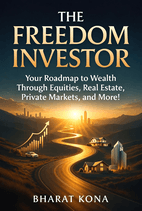
The Freedom Investor by Bharat Kona Book Cover

by Bharat Kona

Bharat Kona's The Freedom Investor provides a practical system for everyday investors to build wealth through disciplined diversification across public and private markets, emphasizing that financial success is 80 percent psychology and 20 percent mechanics. Written for those ready to move beyond conventional advice and adopt strategies modeled on how the wealthy actually allocate capital.

On Insta.page you also get an Apply This Book tool that lets you combine insights from up to 3 books to solve your specific situation.
Chapter mindmaps

Free preview: chapters 1–4 are fully interactive. Click any node to expand or collapse. Subscribe to unlock the rest.

Chapter 1: Foreword

Key concepts: Foreword

1. Foreword

The Reader's Mindset

  • You're already different for seeking this book
  • Refuse to drift through life hoping things work out
  • Wealth is 80% psychology, 20% mechanics

Author's Credibility

  • Built massive real estate portfolio, lost $50M, rebuilt
  • Hard-earned wisdom on thinking, fear, and protection
  • Watched Bharat's awakening from reliance on public markets

What Sets This Book Apart

  • Practical playbook, not fluffy positive thinking
  • Balances mindset with solid mechanics
  • Honest about difficulty of first $50K–$100K net worth

Core Wealth Strategies

  • Build foundation with simple strategies
  • Add private investments like real estate for cash flow
  • Think about risk like sophisticated investors
  • Protect assets with entities and insurance

Call to Action

  • Treat this as a working session for your future
  • Pair lessons with massive action
  • Stop drifting and start designing your financial life

Chapter 2: Introduction

Key concepts: Introduction

2. Introduction

The Last Day and the Decision

  • Quits high-paying tech job on Halloween morning
  • Twenty-five year career had become soul-crushing
  • Eye surgeries forced a pause for reflection
  • Wanted passive income, not a paycheck

The Traditional Path and Its Pitfalls

  • Followed blueprint: degree, job, marriage, home
  • Maxed 401(k) but never felt financially secure
  • Dot-com crash wiped 95% of stock portfolio
  • 2008 crisis left home worth less than mortgage

The Awakening to Index Funds

  • Discovered mutual funds underperformed with hidden fees
  • Fired wealth advisor in late 2017
  • Moved everything to low-cost index funds
  • Index funds beat active management 95% of time

Multifamily Real Estate Discovery

  • Wanted lower-risk asset with solid growth potential
  • Attended boot camp and learned the ropes
  • First deal as both investor and general partner
  • Focused on demographics and sponsor credibility

Diversification Across Asset Classes

  • Invested in value-add, developments, and land
  • Also backed a tech startup and independent film
  • Each investment taught new wealth-building lessons
  • Learned from high-net-worth investors' strategies

The Freedom Investor Identity

  • No longer dependent on stock market or single income
  • Built diversified portfolio of unrelated assets
  • Investing became about living life on own terms
  • Freedom to choose time and pursue meaningful work

Core Philosophy of the Book

  • Not about quick wins or get-rich schemes
  • Patient, strategic investing over decades
  • Financial security beyond paycheck and 401(k)
  • Long-term diversification is sustainable wealth

Chapter 3: Chapter 1

Key concepts: Chapter 1

3. Chapter 1

Mindset as the Foundation of Investing Success

  • Mindset is the single most important factor in investing
  • True wealth begins in the mind, not in a portfolio
  • Growth mindset separates thriving investors from panicked sellers
  • Financial success is as psychological as it is mathematical

Fixed vs. Growth Mindset in Finance

  • Fixed mindset assumes static intelligence, leading to giving up after loss
  • Growth mindset treats setbacks as learning opportunities
  • Market downturns become data, not disasters
  • Effort and learning can improve financial outcomes

Practical Habits to Build a Growth Mindset

  • Adopt a learning mindset with every financial decision
  • Embrace feedback from mentors to question assumptions
  • Reframe failure by conducting post-mortems on investments
  • Network with growth-minded people to compress learning

Key Strategies for Daily Practice

  • Visualize success but focus on process goals like savings rate
  • Stay adaptive when life throws curveballs like job loss
  • Discipline and effort drive financial growth, not just talent
  • Turn mindset from concept into daily practice

Core Takeaways for Financial Growth

  • Growth mindset is the operating system for financial life
  • Setbacks are lessons and data, not failures
  • Developing mindset is intentional through feedback and mentors
  • True wealth starts with how you think, not what you invest in

Chapter 4: Chapter 2

Key concepts: Chapter 2

4. Chapter 2

Public vs. Private Markets

  • Public markets are efficient but offer modest returns (6-7%)
  • Private markets offer higher returns (10-11%) with more risk
  • Private equity historically outperforms public by 3-5% annually
  • Illiquidity and complexity are trade-offs for higher potential

Why Investing Is Necessary

  • Savings accounts lose value to inflation over time
  • Investing is essential for long-term goals like retirement
  • Biggest mistake is lack of diversification across assets

Diversification Strategy

  • Combine stocks, index funds, real estate, and private investments
  • Avoid putting all eggs in one basket or asset class
  • Balanced portfolio smooths volatility and captures growth

The First $100,000 Milestone

  • Reaching $100,000 is the hardest but most critical step
  • Compounding accelerates dramatically after this threshold
  • At 10% return, money generates $10,000 annually on its own
  • Portfolio growth eventually outpaces personal contributions

Key Principles for Success

  • Consistency and patience beat shortcuts and gimmicks
  • Regular investing and reinvesting cash flow are essential
  • Maintain a long-term perspective for sustained growth
You've reached the end of the free mindmaps

Next chapter: “Chapter 3” is locked

See every chapter of The Freedom Investor as an interactive mindmap — and unlock all 450+ book summaries with audio and AI Q&A.

$0.00 due today · 7 days free, then $59.99/year ($4.99/mo) · Cancel anytime before day 7

Continue exploring The Freedom Investor