The Freedom Investor Quotes
by Bharat Kona
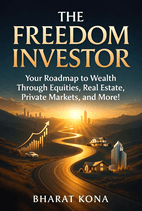
Inside these pages you will find the sharpest lines from a book that cuts through the noise of personal finance. Each quote was chosen for its ability to reframe your thinking or inspire action. The author has a gift for distilling complex ideas into memorable phrases that you will want to share with others.
What makes this book so quotable is its balance of psychology and practicality. It does not just tell you what to do. It challenges how you see risk, time, and your own potential. These quotes stay with you because they are rooted in real experience and a deep understanding of what actually creates lasting freedom.
Top Quotes from The Freedom Investor
“Most people drift through life. They work hard, they throw some money in a 401(k), and they hope it all somehow works out.”
Rod Khleif describing the common passive approach to finances.
It vividly captures the default mindset that many readers will recognize in themselves, making them feel seen and ready for a change.
“Wealth isn’t just about what you invest in. It's about how you think, how you push through fear, how you diversify, and how you protect what you build.”
Rod Khleif sharing a hard-earned lesson from his own financial journey.
This reframes wealth-building as a holistic discipline—mental fortitude and strategy matter as much as the assets themselves, which is empowering for readers.
“Not money for money's sake. Freedom. Options. The ability to take care of the people you love and live a life that lights you up.”
Rod Khleif summarizing the true purpose of wealth at the end of the foreword.
This emotional, concise statement redefines success in human terms, making the pursuit of financial independence deeply personal and meaningful.
“Long-term investing and diversification are the true cornerstones of sustainable wealth.”
Lesson the author learned from high-net-worth and ultra-high-net-worth investors.
This sentence distills the book's core investment philosophy into a clear, authoritative principle that resonates with readers seeking stability.
“Your mindset is the operating system for your financial life.”
The author uses a technology metaphor to explain how mindset controls financial decisions.
The analogy is vivid and relatable, helping readers understand that mindset underpins all financial actions and outcomes.
“The hardest part of wealth building is reaching the first $100,000.”
The author explains the importance of this financial milestone for compounding.
It is a relatable and motivating truth that acknowledges the initial struggle while promising exponential growth once the threshold is crossed.
“Becoming wealthy does not require a high income, risky speculation, or complex strategies.”
The opening of the chapter's summary, which recaps the main lessons for building lasting wealth.
It empowers readers by debunking common myths about wealth creation, making financial success feel accessible. The direct, declarative tone inspires confidence and action.
Themes Behind the Quotes
The central theme is that wealth is first a mental game before it is a numbers game. Your beliefs about money, risk, and your own ability drive every financial decision. Until you master that inner operating system, no strategy will save you. The book repeatedly emphasizes that discipline matters more than access, and that consistency beats luck every time.
Another key theme is the structural approach to building a resilient portfolio. True diversification goes far beyond owning a few stocks. It means allocating across asset classes that react differently to economic cycles. The author also stresses the power of time, low costs, and the strategic use of debt. These principles together create a system that protects and grows wealth through any market condition.
Quotes by Chapter
Foreword
“I like to say that success is 80 percent psychology and 20 percent mechanics.”
Rod Khleif presenting his core philosophy on what drives achievement.
It is a memorable, quotable ratio that instantly shifts focus from tactics to mindset, reminding readers that inner work is the foundation of financial freedom.
Introduction
“I had chosen Halloween—a day when people put on masks—and I was finally taking mine off.”
Author describing his last day at his corporate job on Halloween.
This metaphor powerfully captures the liberation of leaving behind a false corporate identity and embracing one's true self.
“I wanted to stop trading my time for a paycheck. I wanted to pursue a path where passive income would support my lifestyle.”
Author's realization during a period of deep reflection after eye surgeries.
It succinctly expresses the universal desire to escape the time-for-money trap and achieve financial independence.
“It was the turning point where investing stopped being just about money and became about living life on my own terms.”
Author describing his transformation into a 'freedom investor'.
It encapsulates the emotional shift from mere wealth accumulation to genuine personal freedom, a goal many readers aspire to.
Chapter 1
“Financial success is as much mental as it is mathematical.”
The author states this early in the chapter to emphasize that investing requires mental strength alongside financial knowledge.
This line succinctly captures the book’s core premise that mindset is equally important as numbers, making it a memorable and motivating takeaway for investors.
“It is not blind optimism but the belief that every setback contains a lesson.”
The author defines a growth mindset in investing.
It reframes failure as learning, which resonates with investors who face losses and need a constructive perspective.
“True wealth begins with how you think, not just what you invest in.”
In the chapter summary, the author reinforces the central theme.
This quote ties together the entire chapter, reminding readers that mental framing precedes financial results, making it a powerful closing thought.
Chapter 2
“After all, you can’t live in your stock portfolio if things go south.”
The author is discussing the tangible benefits of real estate compared to stocks.
This line is humorous and memorable, driving home the idea that real estate offers a safety net that paper assets cannot.
“It's like eating a balanced diet, where you need a mix of proteins, carbohydrates, and vegetables to stay healthy—not just a steady diet of chocolate and cookies, as tempting as that may be.”
The author uses an analogy to explain the importance of diversification across asset classes.
The vivid and relatable metaphor makes the concept of diversification easy to understand and remember, contrasting discipline with indulgence.
Chapter 3
“Rue diversification goes far beyond owning a few stocks or funds. It is the intentional allocation of capital across asset classes that respond differently to economic conditions, reducing single-point risk and creating a portfolio that can endure full market cycles.”
From the section explaining diversification as the wealthy's not-so-secret weapon.
It clarifies that true diversification is a strategic, multi-asset approach rather than a simple mix, giving readers a concrete definition to apply.
“What truly separates wealthy investors is not access but discipline.”
From the discussion of how wealthy individuals allocate capital.
This line reframes the advantage of the wealthy as a mindset and habit, making success feel attainable to ordinary investors who can emulate discipline.
“They do not chase hype or gamble on fads. They follow a playbook that protects, grows, and stabilizes their wealth. They keep costs low, avoid emotional decisions, take advantage of downturns, and automate their savings. They use debt as a strategic tool rather than something to fear. They let compounding do its work.”
From the section 'Where Do the Wealthy Actually Invest?' describing their principles.
This passage distills the wealthy's investment philosophy into clear, actionable habits, offering readers a memorable checklist for building long-term wealth.
Chapter 4
“The difference between 2 percent and 0.02 percent fees can cost hundreds of thousands of dollars over time.”
This appears in the 'Key Insights' section on index funds, emphasizing the long-term impact of expense ratios.
It delivers a stark, concrete warning about the hidden cost of high fees, motivating readers to prioritize low-cost funds. The dramatic financial difference makes the point unforgettable.
“Wealth grows through steady contributions and the power of compounding, not by timing the market.”
Another 'Key Insight' under index funds, contrasting disciplined investing with market timing.
This succinctly distills the fundamental truth of wealth building into an actionable principle. It counters the allure of speculation with a simple, proven strategy.
Chapter 5
“Paying off a credit card charging 20 percent interest, however, is a guaranteed, tax-free 20 percent return. Nothing in the market can consistently beat that.”
The author explains why eliminating high-interest debt is a critical step before investing.
It reframes debt repayment as the safest and highest-return investment, a perspective that shocks readers into prioritizing debt over speculation.
“It is the closest thing to a guaranteed win in personal finance and a critical step before you begin investing seriously.”
The author concludes his argument for paying off high-interest debt.
This line provides a memorable, actionable takeaway that feels empowering and definitive, making the case for financial discipline.
“If the world's greatest investor prefers index funds, they're probably a smart choice for the average investor.”
After discussing Warren Buffett's famous bet that an S&P 500 index fund would beat a hedge fund.
The appeal to authority is simple and convincing, reassuring readers that low-cost index funds are not just safe but wise.
“The world is a book, and those who do not invest internationally read only one page.”
The author introduces the concept of international equity diversification.
This poetic analogy expands readers' horizons, urging them to see global investing as essential for a complete financial education.
Chapter 6
“Think of it this way: Every dollar you contribute is working harder, both by reducing your current tax burden and by compounding for your future.”
The author explains the dual benefit of tax-advantaged retirement accounts.
This sentence crystallizes the core advantage of retirement accounts—immediate tax savings plus long-term compounding—in a simple, memorable image that motivates action.
“Time is your greatest asset. Get started, stay disciplined, be patient, and let compound interest do the heavy lifting.”
The author summarizes the key takeaway for building a million‑dollar retirement nest egg.
It distills the entire chapter into a four‑part action plan, reinforcing that time and consistency beat market timing and luck.
“The path to financial freedom is paved with consistency, not luck.”
The author closes the chapter's summary paragraph.
This pithy statement strips away the myth of quick riches and empowers readers to focus on steady, repeatable habits—the true drivers of long‑term wealth.
Introduction to Private (Commercial) Real Estate
“Lasting financial security doesn't come from chasing the latest trend. It comes from anchoring your portfolio in assets that provide both stability and growth.”
The author's personal insight after experiencing turbulence in tech and stock markets.
It reframes investing from speculation to disciplined asset allocation, resonating with readers who seek reliable long-term strategies over short-lived fads.
“That's the true power of leverage—using borrowed capital to amplify returns and build wealth faster.”
Explanation of leverage in commercial real estate, using the example of a $3 million property purchase.
This line crystallizes a core financial concept in accessible, memorable language, empowering readers to understand how real estate can accelerate wealth building.