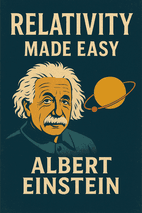
Albert Einstein's Relativity guides readers from the foundational principles of special relativity to the geometric interpretation of gravity in general relativity. Written with remarkable clarity, it is a masterful popular exposition for the intellectually curious non-specialist.
Feature
Insta.Page
Blinkist
Shortform
Summary Depth
Full Chapter-by-Chapter
15-min overview
Section-by-section guides
Audio Narration
✓
✓
✓
Visual Mindmaps
✓
✕
✕
AI Q&A
✓
✕
✕
Quizzes
✓
✕
✕
PDF Downloads
✓
✕
✓
Price
$89.99/yr
$146/yr (PRO)
$199/yr
*Competitor data last verified July 2026.
1 Page Summary
Relativity: The Special and the General Theory is Albert Einstein's own masterful, popular exposition of his revolutionary theories. Published in 1916, the book guides the reader from the foundational principles of the special theory of relativity—such as the constancy of the speed of light and the relativity of simultaneity—to the mind-bending conclusions of time dilation and length contraction. Einstein famously uses thought experiments involving trains and elevators to illustrate how these concepts dismantle Newton's absolute concepts of space and time, unifying them into a single spacetime continuum.
The work then progresses to the general theory of relativity, which recasts gravity not as a force, but as a curvature of spacetime caused by the presence of mass and energy. Einstein explains this geometric interpretation of gravity, where planets follow orbits not because they are pulled by a force, but because they are moving along the straightest possible paths (geodesics) in a warped spatial geometry. This conceptual leap was necessary to reconcile his earlier work with the principle of equivalence, which states that gravitational and inertial mass are indistinguishable.
Written with remarkable clarity for a non-specialist audience, the book's lasting impact is immeasurable. It fundamentally reshaped our understanding of the universe, providing the theoretical basis for phenomena like gravitational lensing and the expansion of the cosmos, and its predictions have been confirmed with extraordinary precision. Relativity stands not only as a cornerstone of modern physics but also as a testament to the power of human thought to uncover the deepest workings of nature.
1. Physical Meaning of Geometrical Propositions
Overview
Overview
We begin by reflecting on our early education in Euclidean geometry, where we learned to navigate its logical structure with a mix of respect and perhaps some frustration. Einstein invites us to question the very foundation of what we consider "true" in geometry, challenging the blind acceptance of its propositions. This chapter explores how geometrical truths are not about correspondence with real-world objects but are derived from axioms through logical deduction, and it examines the intriguing shift when we connect these abstract ideas to physical reality.
Questioning the Foundations of Truth
When someone asks what it means for a geometrical proposition to be "true," it forces us to reconsider our assumptions. Geometry starts with basic concepts like points, lines, and planes, along with axioms that we accept as self-evident. From these, all other propositions are logically proven. However, the truth of these axioms isn't something we can verify empirically—it's a matter of definition within the system. For instance, the idea that only one straight line passes through two points isn't a statement about reality but a property defined within Euclidean geometry. This highlights that geometry, in its pure form, is concerned solely with the logical relationships between ideas, not their alignment with experiential objects.
The Link Between Abstract Ideas and Physical Objects
Despite geometry's abstract nature, we naturally associate its concepts with objects in the physical world. Think about how we measure distance between two points on a rigid body or judge three points to be in a straight line based on visual alignment. These habits of thought bridge the gap between theory and practice. By adding a simple proposition—that the distance between two points on a rigid body remains constant regardless of movement—we transform Euclidean geometry into something applicable to real-world scenarios. This supplementation allows geometry to describe the possible relative positions of rigid bodies, making it a tool for understanding physical phenomena.
Geometry as an Empirical Science
Once we tie geometrical ideas to physical objects, we can legitimately ask about their "truth" in an empirical sense. For example, we test geometrical propositions through constructions with tools like rulers and compasses, assessing their validity based on real-world observations. However, this empirical truth is built on incomplete experiences and has its limitations. Einstein hints that this perspective will be crucial later in the general theory of relativity, where we'll explore the boundaries of geometrical truths in describing the universe. For now, we operate under the assumption that these propositions hold, recognizing that our confidence stems from practical, though imperfect, applications.
Key Takeaways
Geometrical propositions are "true" only within their logical system, based on axioms, not necessarily through correspondence with reality.
We instinctively connect abstract geometrical concepts to physical objects, such as using rigid bodies to define distances and lines.
By supplementing geometry with physical assumptions, it becomes a branch of physics, allowing empirical validation.
The empirical truth of geometry is provisional and limited, rooted in everyday experiences that may not hold in all contexts, as later theories will reveal.
Key concepts: 1. Physical Meaning of Geometrical Propositions
1. Physical Meaning of Geometrical Propositions
Questioning Geometrical Truth
Geometrical truth is derived from axioms through logical deduction, not empirical verification
Basic concepts like points and lines are defined within the system, not based on real-world correspondence
The 'truth' of axioms is a matter of definition within the logical system
Pure geometry concerns logical relationships between ideas, not alignment with experiential objects
Bridging Abstract Geometry with Physical Reality
We instinctively associate geometrical concepts with physical objects like rigid bodies
Measuring distance between points on rigid bodies connects theory to practice
Supplementing geometry with physical assumptions makes it applicable to real-world scenarios
This transformation allows geometry to describe relative positions of rigid bodies
Geometry as Empirical Science
When tied to physical objects, geometry becomes subject to empirical validation
Geometrical propositions are tested through constructions with rulers and compasses
Empirical truth is built on incomplete experiences and has limitations
This perspective becomes crucial in general relativity for exploring boundaries of geometrical truth
Fundamental Insights
Geometrical truth is system-dependent rather than reality-corresponding
Physical supplementation transforms pure geometry into a branch of physics
Empirical validation is provisional and context-dependent
Everyday applications provide confidence but may not hold universally
💡 Try clicking the AI chat button to ask questions about this book!
2. The System of Co-ordinates
Overview
Overview
We begin by exploring the foundational concepts of measuring distance and specifying positions in space, starting with the simple yet profound idea of using a standard measuring rod to determine lengths. This method forms the basis for all spatial descriptions, whether in daily life or scientific contexts, and gradually evolves into more refined systems like Cartesian coordinates, which allow us to pinpoint events with numerical precision. Throughout this progression, the reliance on rigid bodies and Euclidean geometry remains central, ensuring that our physical interpretations stay clear and consistent.
Measuring Distance with a Standard Rod
At the heart of spatial measurement lies the use of a rigid body and a standard measuring rod, denoted as S. By repeatedly applying this rod along the line between two points, such as A and B on a rigid object, we count the number of operations needed to cover the distance. This straightforward process gives us a numerical value for length, embodying the essence of distance measurement. It's a practical approach that underpins everything from constructing geometric lines to everyday assessments, highlighting how fundamental tools shape our understanding of space.
Specifying Position Relative to Rigid Bodies
When describing where an event occurs or an object is located, we always refer to a point on a rigid body, known as the body of reference. For instance, naming "Times Square, New York" implicitly uses the Earth as this rigid frame, with the square serving as a distinguishable point. This method, while intuitive, is initially limited to surfaces with named landmarks. However, it reveals a deeper truth: all place specifications, no matter how casual, depend on this relationship between events and fixed reference points, weaving our experiences into a coherent spatial framework.
Refining Position with Numerical Measures
To overcome the constraints of surface-based specifications, we can enhance our approach. Imagine determining the position of a cloud above Times Square by erecting a pole perpendicular to the ground; the pole's length, measured with our standard rod, combined with the base's location, provides a complete description. This illustrates a key refinement: using numbers instead of named points. Even without physically placing the pole, optical observations and light propagation allow us to calculate the required length, demonstrating how indirect methods can achieve the same goal. This shift empowers us to describe positions independently of pre-marked spots, paving the way for more abstract systems.
Introducing the Cartesian Coordinate System
The culmination of these ideas is the Cartesian system of coordinates, which elegantly simplifies position specification. It consists of three mutually perpendicular planes attached to a rigid body, from which we drop perpendiculars—coordinates x, y, and z—to any event's location. These distances are determined through manipulations with rigid rods, following Euclidean geometry's rules. In practice, we often use indirect means rather than physical surfaces, but the core principle remains: this system allows for precise, numerical localization that frees us from reliance on distinctive landmarks, making it indispensable in advanced physics and astronomy.
Ensuring Physical Meaning in Measurements
Ultimately, every spatial description hinges on the assumption that Euclidean geometry governs distances, represented physically by marks on rigid bodies. Whether through direct rod measurements or indirect calculations, the goal is to maintain clarity in scientific results. For example, handling fractional distances with divided rods shows how we adapt methods without altering fundamental principles. This reinforces that our interpretations of position must always align with the physical reality of rigid references, ensuring that concepts like height or depth retain their intuitive meaning across applications.
Key Takeaways
Distance measurement relies on a standard rod applied repeatedly between points, forming the basis for all length assessments.
Positions are specified relative to rigid bodies, using distinguishable points or numerical measures to describe events in space.
Refinements allow independence from landmarks by employing numerical values and indirect methods, such as optical observations.
Cartesian coordinates use three perpendicular planes to define positions via x, y, z coordinates, streamlining spatial descriptions.
Euclidean geometry underpins physical interpretations, ensuring that distance and position maintain clear, consistent meanings in science.
Key concepts: 2. The System of Co-ordinates
2. The System of Co-ordinates
Measuring Distance with a Standard Rod
Uses a rigid body and standard measuring rod (S) for length determination
Involves repeated application of rod between two points to count operations
Provides numerical value for distance through practical measurement process
Forms fundamental basis for all spatial descriptions and geometric constructions
Specifying Position Relative to Rigid Bodies
All position descriptions refer to points on rigid bodies (body of reference)
Everyday examples like 'Times Square' implicitly use Earth as reference frame
Initially limited to surfaces with named landmarks and distinguishable points
Reveals dependence on relationship between events and fixed reference points
Refining Position with Numerical Measures
Overcomes surface-based limitations using numerical values instead of names
Example: Using pole length and base location to describe cloud position
Enables indirect methods through optical observations and light propagation
Allows position description independent of pre-marked or distinctive spots
Cartesian Coordinate System
Uses three mutually perpendicular planes attached to rigid body
Defines position through perpendicular coordinates x, y, z to event location
Distances determined using rigid rods following Euclidean geometry rules
Enables precise numerical localization without reliance on landmarks
Essential for advanced applications in physics and astronomy
Physical Meaning in Measurements
Assumes Euclidean geometry governs distances represented by rigid body marks
Maintains clarity through both direct rod measurements and indirect calculations
Adapts methods for fractional distances without altering fundamental principles
Ensures interpretations align with physical reality of rigid references
Preserves intuitive meaning of spatial concepts across all applications
3. Space and Time in Classical Mechanics
Overview
Einstein opens this chapter by candidly admitting a "sin against the sacred spirit of lucidity"—the careless use of terms like 'position' and 'space' in classical mechanics. He argues that these concepts are inherently vague and meaningless without a concrete reference point. Through a vivid thought experiment involving a stone dropped from a moving train, he demonstrates that motion is not absolute but relative to the observer's frame of reference. This sets the stage for a deeper exploration of how we define and measure space and time, urging us to move beyond abstract notions to practical, observable realities.
The Relativity of Motion
Imagine standing at the window of a uniformly moving train and dropping a stone straight down. To you, it falls in a vertical line, but to a pedestrian on the embankment, it traces a parabolic arc. This simple scenario reveals a profound truth: there is no such thing as an "absolute" trajectory. The path an object takes depends entirely on the reference body—whether it's the train or the ground. Einstein emphasizes that we must abandon the vague idea of 'space' and instead focus on 'motion relative to a practically rigid body of reference.' By attaching systems of coordinates to these reference bodies, we can describe positions mathematically, making it clear that every description of motion is inherently relative.
Defining Time in Classical Mechanics
To fully capture motion, we need more than just positions—we must specify how those positions change over time. Einstein introduces the idea of time as a measurable quantity, using the example of two identical clocks held by the observer on the train and the one on the footpath. Each records the stone's position at every tick, illustrating that time-values are tied to observable events within a reference frame. In classical mechanics, this approach works seamlessly, allowing us to synchronize measurements and describe motion comprehensively without invoking ambiguous concepts.
Key Takeaways
Motion is always relative to a chosen reference body or coordinate system, not absolute space.
The trajectory of an object varies depending on the observer's frame, as shown in the stone-dropping experiment.
Replacing vague notions of 'space' with concrete reference frames clarifies physical descriptions.
Time must be defined in terms of observable, measurable events to complete the description of motion.
Classical mechanics relies on this relative framework, setting the foundation for later challenges in relativity theory.
Key concepts: 3. Space and Time in Classical Mechanics
3. Space and Time in Classical Mechanics
Critique of Classical Mechanics Concepts
Terms like 'position' and 'space' are vague without concrete reference points
Einstein admits to 'sin against the sacred spirit of lucidity' in careless terminology
Motion must be understood through practical, observable realities rather than abstract notions
Classical mechanics often uses spatial concepts without proper definition
Relativity of Motion and Reference Frames
Motion is not absolute but relative to the observer's frame of reference
The stone-dropping experiment demonstrates different trajectories from different perspectives
No such thing as 'absolute' trajectory - path depends entirely on reference body
Must replace vague 'space' with 'motion relative to a practically rigid body of reference'
Coordinate systems attached to reference bodies enable mathematical description of positions
Definition and Measurement of Time
Time must be defined as a measurable quantity tied to observable events
Identical clocks in different reference frames record positions at each tick
Time-values are connected to specific events within a reference frame
Classical mechanics synchronizes time measurements across reference frames
Time completes the description of motion when combined with positional data
Foundational Principles of Classical Framework
Every description of motion is inherently relative to a chosen coordinate system
Trajectory varies depending on observer's frame of reference
Classical mechanics relies on this relative framework for comprehensive motion description
Sets foundation for later challenges addressed in relativity theory
5. The Principle of Relativity
Overview
This section explores the core idea that the laws of nature remain consistent across all uniformly moving, non-rotating frames of reference, using relatable examples and logical reasoning to build a compelling case for its validity. It bridges everyday observations with profound implications for physics, highlighting why this principle withstands scrutiny despite challenges from newer scientific domains.
Understanding Uniform Motion
Imagine watching a raven fly in a straight line at a steady pace from the vantage point of a railway embankment. Now, picture observing the same raven from inside a train carriage moving uniformly alongside—the bird's speed and direction might appear different, but its motion still follows a uniform, straight path. This thought experiment illustrates a key insight: when one coordinate system (like the embankment) is Galileian (where Newton's laws hold perfectly), any other system moving uniformly without rotation relative to it (like the train) will also be Galileian. In such cases, mechanical laws operate identically, setting the stage for a broader principle.
Generalizing the Concept
Expanding on this, the principle of relativity asserts that all natural phenomena—not just mechanical ones—unfold according to the same fundamental laws in any coordinate system undergoing uniform translational motion. Initially, this seemed unquestionable under classical mechanics, but as electrodynamics and optics advanced, doubts emerged. Could this principle truly apply universally? The text argues that abandoning it would imply that certain frames are "privileged," leading to complexities—like expecting the Earth's orbital motion to affect physical laws in detectable ways, such as altering the sound of an organ-pipe based on its orientation. Yet, no such directional dependencies have ever been observed in experiments, reinforcing the principle's robustness.
Strengthening the Case
Two compelling arguments bolster the principle's credibility. First, classical mechanics' astonishing accuracy in predicting celestial motions suggests that the principle applies with high precision in that realm, making it unlikely to fail elsewhere. Second, if the principle were invalid, we'd anticipate anisotropic effects—physical behaviors varying with direction—due to Earth's constant velocity changes in space. However, meticulous observations reveal no such irregularities, solidifying the principle as a foundational truth. This alignment between theory and empirical evidence underscores its power to simplify our understanding of the universe.
Key Takeaways
The principle of relativity ensures that natural laws are identical in all uniformly moving, non-rotating frames of reference.
Everyday analogies, like observing motion from a moving train, help visualize how this principle operates in practice.
Historical doubts from electrodynamics and optics are counterbalanced by the principle's consistency with classical mechanics and lack of observed directional effects in nature.
The absence of anisotropic properties in physical space, despite Earth's motion, serves as a strong empirical validation of the principle.
Key concepts: 5. The Principle of Relativity
4. 5. The Principle of Relativity
Core Principle of Relativity
Natural laws remain identical across all uniformly moving, non-rotating frames of reference
Bridges everyday observations with profound implications for physics
Withstands scrutiny despite challenges from newer scientific domains
Uniform Motion and Galileian Frames
Motion appears different but follows same uniform path in different reference frames
If one coordinate system is Galileian, any uniformly moving system relative to it is also Galileian
Mechanical laws operate identically in all such frames
Illustrated through thought experiments like observing raven from embankment vs moving train
Universal Application Beyond Mechanics
Principle extends to all natural phenomena, not just mechanical laws
Classical mechanics initially supported the principle unquestionably
Electrodynamics and optics raised doubts about universal applicability
Abandoning principle would imply privileged frames of reference
Empirical Validation and Arguments
No observed directional dependencies in physical experiments
Classical mechanics' accuracy in celestial motions supports principle
Absence of anisotropic effects despite Earth's orbital motion
Lack of expected variations like organ-pipe sound changes with orientation
Foundational Significance
Principle simplifies understanding of the universe
Alignment between theory and empirical evidence reinforces validity
Serves as robust foundation for physical laws
Counterbalances historical doubts with consistent observational support
You've reached the end of the free chapters
Next chapter: “The Apparent Incompatibility of the Law of Propagation of Light with the Principle of Relativity” is locked
Keep reading Relativity — and unlock all 600+ book summaries with audio, mindmaps and AI Q&A.
$0.00 due today · 7 days free, then $89.99/year ($7.49/mo) · Cancel anytime before day 7
Albert Einstein was a preeminent theoretical physicist whose revolutionary ideas reshaped our understanding of the universe. He is best known for his theory of relativity and the world-famous equation E=mc², for which he was awarded the Nobel Prize in Physics. His profound contributions to quantum mechanics and the photoelectric effect laid the groundwork for modern physics. Einstein's insightful writings, including "Relativity: The Special and the General Theory," make his complex ideas accessible to a broad audience. His published works, available on Amazon, continue to inspire scientists, philosophers, and curious minds worldwide, cementing his legacy as one of history's greatest intellects.
📚 Explore Our Book Summary Library
Discover more insightful book summaries from our collection