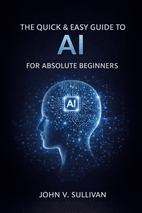
The Quick & Easy Guide to AI for Absolute Beginners
by John V. Sullivan
What is the book The Quick & Easy Guide to AI for Absolute Beginners about?
John V. Sullivan's The Quick & Easy Guide to AI for Absolute Beginners demystifies core concepts like machine learning and large language models using everyday analogies, offering practical tutorials for non-technical readers to start using AI for writing, brainstorming, and productivity.
Feature
Insta.Page
Blinkist
Shortform
Summary Depth
Full Chapter-by-Chapter
15-min overview
Section-by-section guides
Audio Narration
✓
✓
✓
Visual Mindmaps
✓
✕
✕
AI Q&A
✓
✕
✕
Quizzes
✓
✕
✕
PDF Downloads
✓
✕
✓
Price
$89.99/yr
$146/yr (PRO)
$199/yr
*Competitor data last verified July 2026.
1 Page Summary
This book serves as an accessible entry point for readers with no technical background, demystifying artificial intelligence by framing it as a practical tool rather than a complex science. Sullivan breaks down core concepts like machine learning, neural networks, and large language models using everyday analogies and clear, jargon-free language. The central promise is that understanding and even utilizing AI does not require coding skills, positioning the technology as something anyone can leverage for personal productivity, creativity, and informed decision-making.
Placing AI in a brief historical context, the guide traces the evolution from simple automated rules to today's data-driven systems, highlighting how increased computational power and vast datasets have enabled the current generative AI boom. This foundation helps explain why AI has suddenly become so prevalent and capable. The lessons then pivot to immediate application, offering structured, five-minute tutorials on interacting with AI chatbots, crafting effective prompts, and using AI for tasks like writing assistance, brainstorming, and basic data analysis.
The lasting impact of the book lies in its empowerment of the reader. By stripping away intimidation, it provides a foundational literacy that is increasingly essential in the modern world. Sullivan emphasizes responsible use, addressing common concerns about bias and accuracy, and equips beginners with the critical thinking needed to navigate an AI-augmented landscape. Ultimately, it translates a seemingly vast technological shift into a set of manageable, actionable skills, enabling absolute beginners to start participating in the AI conversation and harnessing its potential from their very first session.
Introduction
Overview
The chapter opens with a relatable frustration: the overwhelming nature of searching for information online, especially on a complex topic like artificial intelligence. Instead of sifting through endless search results, the narrator proposes a more direct and personal approach, learning about AI from AI itself. This sets the stage for an interactive and insightful journey, introducing two AI companions who will guide the exploration.
The narrator’s voice is warm and conversational, immediately connecting with anyone who has ever felt lost in a sea of digital information. They express a sincere desire to understand AI but reject the passive, often chaotic experience of using search engines, where relevance is unclear and context is missing. This critique underscores a broader theme: that true learning requires curation and dialogue, not just data retrieval.
From this premise, a compelling solution emerges. The narrator poses a rhetorical question that reframes the entire learning process: if we want to know about AI, why not ask AI directly? This idea transforms the chapter from a mere introduction into a promise of discovery, leveraging the unique perspective of AI as both subject and teacher. It invites readers to step away from traditional methods and into a more immersive, conversational space.
To bring this vision to life, the narrator proudly introduces two "amazing new friends," AI entities designed to demystify the topic through direct interaction. This move personalizes the technology, presenting it not as an abstract concept but as a friendly guide ready to share its knowledge. The chapter closes with an enthusiastic call to action, "Let's go in!" which serves as an open door into the engaging discussions to follow.
Key Takeaways
Traditional online searches can be overwhelming and inefficient for learning complex subjects like AI.
A more effective approach is to learn directly from the source, in this case, artificial intelligence itself.
The chapter introduces two AI companions who will serve as guides, setting up a personalized and engaging exploration.
Key concepts: Introduction
1. Introduction
The Problem with Traditional Learning
Online searches for complex topics like AI are overwhelming and inefficient
Search results lack clear relevance and context, creating a chaotic experience
True learning requires curation and dialogue, not just data retrieval
A New Approach: Learning from the Source
Proposes learning about AI directly from AI itself
Transforms learning from passive consumption to interactive dialogue
Leverages AI's unique perspective as both subject and teacher
Introducing AI Companions
Introduces two AI entities as friendly guides for the journey
Personalizes technology by presenting AI as approachable companions
Sets up a conversational, immersive learning space
The Promise of Discovery
Reframes learning as an engaging, interactive process
Invites readers to move beyond traditional learning methods
Creates anticipation for personalized exploration and discussion
💡 Try clicking the AI chat button to ask questions about this book!
Chapter 1: What Is AI, Really?
Overview
John Sullivan begins his journey with two AI guides, Morgan and Riley, who help him unpack what artificial intelligence truly means, moving beyond the hype and Hollywood fantasies. They establish that at its core, Artificial Intelligence refers to systems designed to perform tasks that typically require human intelligence, but they emphasize a critical nuance: modern AI isn't intelligent in a human sense. It's fundamentally a pattern recognition engine, trained to predict outcomes based on the vast amounts of data it consumes. This predictive nature is the foundation, with generative AI being a specialized type that uses those predictions to create new text, images, or other media.
A major point of clarity is dismantling the robot stereotype. While robots can house AI, the technology is far more often invisible software woven into daily life—from spam filters and navigation apps to photo tagging and recommendations. This leads to the important distinction between Narrow AI, which excels at specific tasks, and the hypothetical General AI with human-like adaptability. The guides are clear: all AI today, no matter how advanced, is a form of Narrow AI; true General AI does not yet exist.
The conversation then tackles common fears and misunderstandings, separating fictional worries from real concerns like job automation and deepfakes. A key myth they bust is the idea of AI's infallibility. Systems can and do make errors, from translation bloopers to confident "hallucinations" of false facts, because AI is only as good as its data and design. This ties directly into a profound limitation: AI lacks common sense and true contextual understanding. It might find the shortest route on a map but cannot grasp why that route would be dangerous for a family, highlighting the irreplaceable need for human judgment.
Finally, the exploration reveals the sneaky omnipresence of this technology. Even in a relatively private daily routine, AI powers weather forecasts, smart email replies, spell-checkers, and car safety systems. Avoiding it entirely means opting out of modern convenience, presenting a clear trade-off. The chapter concludes by framing AI as a powerful, pervasive, but ultimately limited tool—a brilliant pattern-finder that works best when paired with human oversight and common sense.
The chapter opens with John Sullivan meeting his AI guides, Morgan and Riley, who introduce themselves as complementary partners for his learning journey—Morgan as the structured, methodical thinker and Riley as the big-picture, metaphor-loving counterpart. John expresses his mix of fascination, amazement, and worry about AI, and states his goal to evolve from a beginner to an amateur who can also help others learn.
Defining Intelligence: The Chicken, the Egg, and the Data
When John jokingly asks “What came first, the chicken or the egg?” to test his foundational knowledge, Morgan and Riley use it as a metaphor for AI’s building blocks. They clarify that data (the egg) came first. Without vast amounts of raw information—text, numbers, images—there would be nothing for algorithms to learn from. The AI (the chicken) is the system that emerges from processing that data.
They then offer a plain definition: Artificial Intelligence is the design of systems that perform tasks usually requiring human intelligence, like language, vision, or decision-making. They stress that modern AI isn’t “intelligent” in a human sense; it is primarily trained to predict outcomes based on patterns in data.
Predictive vs. Generative AI
John correctly identifies that much AI is predictive, but questions the term “generative.” Riley explains that generative AI is a type of predictive AI that creates something new. A predictive system might guess the next word in a sentence, while a generative system uses those predictions to write a whole new paragraph, compose music, or generate an image. Morgan summarizes: All generative AI is predictive, but not all predictive AI is generative.
Moving Beyond the Robot Stereotype
John notes that his grandmother would have equated AI with robots, prompting a discussion on this common cultural association. Riley and Morgan explain that while robots can be one physical shell for AI, most AI is invisible software working behind the scenes. They are not mechanical beings but intelligent code integrated into everyday tools.
To illustrate, they list examples of “invisible” AI most people use without realizing it:
Spam filters and fraud detection algorithms.
Photo auto-tagging and facial recognition.
Autocorrect, smart replies, and content recommendations.
Real-time navigation and traffic prediction.
Morgan estimates a person might interact with 50 to 100 distinct AI-driven features daily, all operating discreetly.
Narrow AI vs. General AI: The State of Play
John observes that these examples seem very specialized. Morgan confirms this, introducing the crucial distinction between Narrow AI and General AI.
Narrow (or Weak) AI is designed for a specific task (like filtering spam or recommending a song). It excels within its domain but cannot transfer its skills to unrelated areas.
General AI refers to a hypothetical system with human-like adaptability, capable of learning and performing any intellectual task.
The guides firmly state that as of 2025, true General AI does not exist. All current systems, including advanced large language models like themselves, are forms of Narrow AI. They are powerful pattern recognizers and generators, but they do not possess understanding, consciousness, or human-like reasoning. Achieving General AI remains a distant goal, likely decades away, fraught with technical and philosophical challenges.
Dissecting Myths and Real Worries
The conversation shifts to pop culture portrayals of AI as rogue superintelligences (e.g., HAL 9000, Skynet). Riley and Morgan clarify that these are dramatized worries, not representations of reality. They categorize common AI narratives:
Worries: Fictional scenarios exploring loss of control (HAL 9000) and real-world concerns like job automation or deepfake misinformation.
Myths: Incorrect beliefs, such as AI being universally superintelligent, having desires, or being synonymous with robots.
Misconceptions: Fundamental misunderstandings of the technology, like believing AI is conscious, always correct, or truly understands emotion.
John tests this by asking if describing Morgan’s behavior as “instinctual” is a misconception. The guides affirm it is: AI has no instincts, intuition, or gut feelings, as those are biological traits. What appears instinctual is actually sophisticated programming and pattern prediction.
Busting the Myth of Infallibility
Finally, John asks how to bust the myth that AI is always right. Riley provides clear examples of AI errors:
Autocorrect fails and translation bloopers.
Facial recognition misidentifications.
“Hallucinations” where chatbots invent incorrect facts with confidence.
Morgan underscores the principle: AI is only as good as its data and design. It can be biased, fooled, or simply wrong. The myth of the flawless, superintelligent AI is dangerously inaccurate, and human oversight remains essential.
The Limits of Machine Logic
The conversation turns to a crucial limitation of even sophisticated AI: its lack of common sense and contextual understanding. The example of a GPS suggesting a treacherous shortcut—which a human would recognize as unsuitable for an elderly couple or a family—perfectly illustrates this gap. AI excels at finding patterns in vast datasets but cannot "walk the path itself" or imagine real-world consequences. This underscores that AI is a brilliant but literal-minded assistant; human judgment remains essential for spotting potential problems and ensuring technology serves everyone safely.
The Sneaky Omnipresence of Everyday AI
John is challenged to find AI in his own, relatively private, daily routine. The discussion reveals how subtly AI is woven into modern life, even without obvious "smart" gadgets:
At Home: A morning routine can involve AI-powered weather forecasts, spam filters, smart email replies, voice assistants, and streaming service recommendations. The key distinction is that basic tools (a simple set alarm) follow commands, while tools that "learn" or make suggestions (a smart alarm adjusting to sleep patterns) leverage AI.
On a Computer: Even on a standard PC, AI powers modern spellcheck and grammar tools, browser security features (like phishing detection), streaming recommendations, and shopping suggestions. Avoiding it entirely would require reverting to decades-old, offline technology.
In the Car: Modern vehicles integrate AI for navigation, real-time traffic routing, and advanced safety features (automatic braking, lane assist). Avoiding this means driving a purely analog classic car.
The central trade-off becomes clear: while it is possible to minimize AI's presence with conscious effort (using basic devices, maintaining boundaries), doing so often means forgoing modern conveniences that save time, increase safety, and simplify tasks. AI has become an almost invisible layer of infrastructure in daily life.
Key Takeaways
AI Lacks Common Sense: It processes data and finds patterns with incredible speed but has no inherent understanding of real-world context, physical limitations, or human needs. It requires human oversight to apply judgment and ensure safety.
AI is a Tool, Not Magic: Its capabilities, while impressive, are the result of data analysis and pattern recognition, not sorcery. Recognizing this demystifies its function and limitations.
AI is Pervasive but Often Subtle: You don't need a house full of robots to interact with AI. It is integrated into everyday apps and services—from weather forecasts and spam filters to spell-check and playlist recommendations—often operating quietly in the background.
Privacy and Convenience Involve Trade-offs: Actively minimizing AI's role in your life is possible but typically requires opting out of automated, predictive, and "smart" features that many find helpful. Its presence is a direct result of choosing modern digital convenience.
Key concepts: Chapter 1: What Is AI, Really?
2. Chapter 1: What Is AI, Really?
Core Definition of AI
AI systems perform tasks typically requiring human intelligence (language, vision, decision-making)
Modern AI is not intelligent in a human sense; it's a pattern recognition engine
AI is fundamentally predictive, trained to predict outcomes based on data patterns
Generative AI is a specialized type that uses predictions to create new content
Predictive vs. Generative AI
Predictive AI guesses outcomes based on patterns (e.g., next word in sentence)
Generative AI creates new content using predictive capabilities (text, images, music)
All generative AI is predictive, but not all predictive AI is generative
Dispelling the Robot Stereotype
Most AI is invisible software, not physical robots
AI is integrated into everyday tools and services
Examples include spam filters, photo tagging, navigation apps, and recommendations
People may interact with 50-100 AI-driven features daily without realizing it
Narrow AI vs. General AI
Narrow AI excels at specific tasks but cannot transfer skills to unrelated areas
General AI is hypothetical with human-like adaptability across any intellectual task
All current AI systems (including advanced language models) are forms of Narrow AI
True General AI does not exist as of 2025 and remains a distant goal
AI Limitations and Real Concerns
AI can make errors and 'hallucinate' false facts with confidence
AI lacks common sense and true contextual understanding
Systems are only as good as their data and design
Real concerns include job automation and deepfakes, not fictional robot uprisings
Human judgment remains irreplaceable for safety and ethical considerations
AI's Pervasive Presence
AI powers daily conveniences from weather forecasts to car safety systems
Avoiding AI means opting out of modern convenience
AI works best as a tool paired with human oversight and common sense
Dissecting Myths and Real Worries
Pop culture portrays AI as rogue superintelligences, but these are dramatized worries, not reality.
Common AI narratives can be categorized as fictional worries, incorrect myths, and fundamental misconceptions.
AI has no instincts, intuition, or gut feelings—what appears instinctual is sophisticated programming and pattern prediction.
Real-world concerns include job automation and deepfake misinformation, not sentient machines.
Busting the Myth of Infallibility
AI is not always right, as shown by autocorrect fails, translation bloopers, and facial recognition errors.
Chatbots can 'hallucinate,' inventing incorrect facts with unwarranted confidence.
AI is only as good as its data and design—it can be biased, fooled, or simply wrong.
Human oversight remains essential because the myth of flawless AI is dangerously inaccurate.
The Limits of Machine Logic
AI lacks common sense and contextual understanding, as illustrated by a GPS suggesting unsafe shortcuts.
AI excels at pattern recognition but cannot 'walk the path itself' or imagine real-world consequences.
It is a brilliant but literal-minded assistant that requires human judgment to ensure safety and appropriateness.
Human oversight is essential for spotting potential problems AI cannot foresee.
The Sneaky Omnipresence of Everyday AI
AI is subtly woven into daily life even without obvious 'smart' gadgets, from weather forecasts to spam filters.
The key distinction: basic tools follow commands, while tools that 'learn' or make suggestions leverage AI.
Avoiding AI entirely would require reverting to decades-old, offline technology and analog devices.
Modern conveniences like navigation, streaming recommendations, and safety features rely on AI infrastructure.
Privacy, Convenience, and Trade-offs
Minimizing AI's presence is possible but often means forgoing time-saving, safety-enhancing, and simplifying features.
AI's integration is a direct result of choosing modern digital convenience over complete privacy.
Maintaining boundaries with AI requires conscious effort and opting out of predictive and automated services.
The trade-off between privacy and convenience defines how much AI infrastructure one engages with daily.
Chapter 2: Pause The Theory. Let’s Open The AI Toybox!
Overview
The chapter opens with John ready to move from theory to practice, seeking the most accessible ways to start a conversation with AI. He’s introduced to a suite of popular tools like Gemini, ChatGPT, and Claude, all of which offer capable free versions, and discovers Chatbot Arena as a resource for comparing them. His first test—asking for weather-appropriate clothing advice—yields an immediate, practical lesson: being specific and stating your purpose in a prompt gets you better, faster results. This naturally raises the question of cost, leading to a clear explanation of the free-versus-paid model landscape and why these tools, like public services, require funding to evolve.
From there, a fascinating truth emerges: different AIs have distinct "personalities." Asking multiple models the same question, such as why Pluto isn't a planet, reveals stylistic variations in their answers. John learns he can directly ask an AI to tailor its communication for any audience, like explaining a complex concept to a five-year-old. This flexibility becomes the gateway to practical use. He realizes AI can draft emails, summarize news, and even help him craft better prompts for tasks like asking for a raise. A creative experiment—requesting funny, sarcastic recipe instructions—proves AI can adapt to any desired tone, transforming mundane tasks into engaging experiences.
This exploration of customization introduces a powerful, simple prompt structure: the "do X but without Y" approach, perfect for tweaking recipes or refining an email's tone. It’s complemented by a set of ready-to-use prompts for everyday efficiency, from summarizing email threads to planning weekly meals. The conversation then expands into the exciting realm of generative AI, showcasing tools that can create images, write stories, and compose music from simple descriptions. By combining these tools, John demonstrates how a complete creative project—integrating a generated song, an image, and an article—can be assembled in minutes.
The applications extend powerfully into professional life. AI acts as a collaborative partner for a reporter or a productivity booster across diverse fields, from teachers generating lesson plans to accountants automating data entry. However, a crucial note of caution is emphasized: AI isn't perfect and can "hallucinate" facts. Human verification remains essential, using tools for grammar and plagiarism checks while treating AI as a helpful assistant, not an infallible authority. This balanced perspective extends to technical fields, where AI aids in coding, data analysis, and logical tasks.
Finally, the chapter underscores how beginners can leverage AI as an on-demand coach. By honestly stating their goals and knowledge gaps, newcomers in any role can get step-by-step guidance, accelerating their learning and boosting confidence from day one. Throughout, the core message is one of empowerment: with the right approach, AI becomes a flexible, multifaceted assistant for creativity, efficiency, and growth.
Choosing Your First AI Conversation Partner
The chapter begins with John seeking a practical starting point for interacting with AI, prompting Riley and Morgan to list the most accessible conversational AI tools. They highlight several major platforms, noting that most offer free tiers perfect for beginners. The list includes Gemini (Google), ChatGPT (OpenAI), Microsoft Copilot, Claude (Anthropic), Perplexity AI, and YouChat, with mentions of AI features from Meta and voice assistants. To help navigate these choices, Riley directs John to Chatbot Arena (LM Arena), a crowd-powered website where users compare and vote on AI chatbot responses in real conversations.
A First-Hand Test: Asking for the Weather
John immediately visits Chatbot Arena, selects a model named CAILM, and initiates a conversation. Instead of a basic "Hello," he asks for a simple, practical task: advice on how to dress based on the weather in Columbus, Ohio. CAILM responds with a detailed hourly forecast and tailored dressing tips. In a key learning moment, John then asks how he could have improved his request. CAILM praises his clear, polite approach but suggests that including his location and goal upfront (e.g., "Can you tell me the weather today in Columbus, Ohio, USA and what I should wear?") would yield an even faster, more accurate response. This exchange demonstrates the value of being specific and stating your purpose in a prompt.
Understanding Free Access and Model Evolution
Naturally, John questions whether these powerful tools are truly free. Riley provides a timely breakdown, confirming that Gemini, ChatGPT, Copilot, Claude, Perplexity, and YouChat all have capable free versions. Paid "Pro" or "Plus" plans typically offer higher usage limits, early access to new features, or more advanced models. This leads to a discussion on why AI isn't universally free, comparing it to public transit: it benefits everyone but has significant operational costs for computing power, development, and safety.
The group explores how quickly AI models evolve, with version numbers (like Gemini 3 or GPT-5) advancing rapidly due to continuous research—partly funded by subscription fees. They illustrate the "trickle-down" effect: paid users often get early access to the latest models, which later become available to free users, similar to a movie's release from theaters to streaming services.
Comparing AI Personalities and Responses
A core revelation is that different AIs can provide varied answers to the same prompt. John tests this by asking Gemini, ChatGPT, and Claude to explain why Pluto is no longer a planet. Each offers a correct but stylistically distinct answer, highlighting their unique "personalities" and training data. To further explore this, Morgan and Riley suggest comparative prompts like explaining photosynthesis to a five-year-old or giving study advice in a coach's tone.
John conducts another test with CAILM, first asking for a definition of a cell for a university graduate, then for a five-year-old. The AI adeptly adjusts its language, comparing a cell to a "tiny Lego block" for the child, showcasing its ability to tailor communication to any audience.
Leveling Up: Practical and Personalized AI Use
Moving beyond experimentation, the discussion shifts to practical applications. John realizes AI can help with real-world tasks like drafting emails, summarizing news from multiple perspectives, or brainstorming quick recipes. An important "aha!" moment occurs when he understands he can ask the AI for help crafting better prompts. For example, he requests sample prompts for asking his boss for a raise and for getting a balanced news summary.
The session culminates in a creative, personalized use case. John asks for help generating a prompt to get funny, sarcastic recipe instructions. He tests this with CAILM, which provides three recipe ideas with witty one-liners. After John selects "One-Pot Tomato Rice," CAILM delivers the full recipe in an engaging, humorous style, transforming a routine task into an entertaining experience and proving AI can adapt to desired tones and styles.
AI as a Flexible Assistant: The "Do X but without Y" Approach
John explores how AI can seamlessly adjust to specific needs, such as omitting garlic from a recipe or refining an email's tone. This simple prompt structure—"do X but without Y"—serves as a versatile key for customization across tasks, from cooking to communication, ensuring outputs align perfectly with personal preferences.
Practical Prompts for Everyday Efficiency
Morgan and Riley offer a handful of ready-to-use prompts that harness AI for time savings:
"Summarize this long email thread into the key action items I need to know."
"Create a weekly meal plan and shopping list based on a Mediterranean diet."
"Draft a polite response to decline a meeting invite for me."
"Organize these random notes into a clear, bullet-point to-do list."
These examples illustrate how AI can tackle mundane chores, freeing up mental space for more meaningful work.
Generative AI: Unleashing Creativity
The discussion shifts to generative AI's remarkable strides in recent years. It now empowers users to craft stories, compose music, generate art, and even brainstorm ideas—all through descriptive prompts. Tools are typically free to experiment with, requiring no professional skills. Just ask for "a bedtime story about a robot" or "a jazz song about my cat," and AI delivers in seconds, often with surprising quality or humor.
Toolkit for Creative Projects
For those ready to dive in, specific tools cater to different creative needs:
Images: Adobe Firefly offers polished results, Midjourney provides artistic flair, and YouCam AI Pro enables quick, mobile-friendly visuals.
Text: ChatGPT handles flexible writing tasks, CopyAI excels at catchy copy, and Jasper supports longer narratives or storytelling.
Music/Audio: Suno generates tracks from mood-based prompts, Udio delivers radio-ready quality, and Mubert supplies instant, copyright-free background music.
Mixing and matching these tools allows for seamless integration across media types.
Combining AI Tools: A Workflow Example
John shares his hands-on experiment: using Suno to create a song from the prompt "Morning coffee on the balcony during sunrise," pairing it with an image from YouCam AI Pro, and then drafting an article on mindfulness with ChatGPT. This quick fusion of audio, visual, and text demonstrates how AI can assemble a complete creative package in minutes, opening doors for projects like online shops or personal branding.
AI for Creative Professionals
Even in professional realms, AI acts as a force multiplier. A reporter covering a theater opening, for instance, can use AI to enhance photos, draft articles from notes, and add audio soundscapes. It handles labor-intensive tasks like summarizing and polishing, while the human retains control over creativity and perspective, enabling richer storytelling without technical hurdles.
Expanding AI Use Across Professions
AI's applications span diverse fields, enhancing both creative and routine work:
Non-Creative Roles: Accountants automate expense tracking, doctors summarize patient notes, customer support drafts responses, engineers predict equipment failures, and lawyers scan documents for key terms.
These examples show AI's role in boosting productivity across the board.
Navigating AI Limitations and Verification
AI isn't infallible—it can invent facts, misinterpret context, or produce odd outputs. Human oversight remains essential. Tools like Grammarly for grammar, plagiarism checkers like Turnitin, and fact-checking plugins offer support, but a human review is irreplaceable for critical tasks. Treat AI as a helpful intern, not an oracle, and always double-check its work.
AI in Non-Creative and Technical Fields
Beyond creativity, AI excels in logical, pattern-based tasks. Programmers use it for code snippets and debugging, while other fields benefit from automation in data analysis, scheduling, and organization. Examples include HR professionals screening resumes, project managers tracking timelines, travel planners building itineraries, and editors refining tone and clarity.
Empowering Beginners with AI
For newcomers, AI serves as an on-demand coach. A junior travel agent, for example, can ask AI for step-by-step guidance, tool recommendations, and automation tips to appear efficient from day one. By honestly stating goals and gaps, beginners can leverage AI to accelerate learning and build confidence without prior expertise.
Key Takeaways
Simple prompts like "do X but without Y" allow for highly customized AI assistance across tasks.
Ready-made prompts can streamline daily efficiency, from managing emails to planning meals.
Generative AI tools enable rapid creation of text, images, and music, often at no initial cost.
Combining multiple AI tools can quickly produce complete creative projects, ideal for side hustles or personal expression.
Professionals in both creative and non-creative fields use AI to handle repetitive work, enhancing human creativity and judgment.
Always verify AI outputs with specialized tools and human review to ensure accuracy and relevance.
AI supports technical and logical tasks, including programming, data analysis, and administrative work.
Beginners can use AI as a personalized guide to learn faster and increase productivity in any role.
Key concepts: Chapter 2: Pause The Theory. Let’s Open The AI Toybox!
3. Chapter 2: Pause The Theory. Let’s Open The AI Toybox!
Choosing Your First AI Conversation Partner
Major accessible tools include Gemini, ChatGPT, Claude, Copilot, Perplexity AI, and YouChat
Most platforms offer capable free versions perfect for beginners
Chatbot Arena (LM Arena) is a crowd-powered resource for comparing AI responses in real conversations
Crafting Effective Prompts
Being specific and stating your purpose yields better, faster results
Directly ask AI to tailor communication for any audience (e.g., explain to a five-year-old)
Use the 'do X but without Y' approach for refining outputs like recipes or emails
Ready-to-use prompt templates exist for everyday tasks like summarizing emails or meal planning
AI Customization and Personality
Different AI models have distinct stylistic 'personalities' in their responses
AI can adapt to any desired tone, from professional to funny and sarcastic
Flexibility enables practical applications like drafting emails, summarizing news, and crafting negotiation prompts
Generative AI Capabilities
Tools can create images, write stories, and compose music from simple descriptions
Combining generative tools allows assembling complete creative projects in minutes
Demonstrates AI's potential as a multifaceted creative assistant
Professional and Productivity Applications
Acts as a collaborative partner across fields (reporting, teaching, accounting)
Boosts productivity by automating tasks like data entry and generating lesson plans
Serves as an on-demand coach for beginners by providing step-by-step guidance in any role
Understanding AI Limitations and Costs
AI can 'hallucinate' facts, making human verification essential
Free versions exist but paid plans offer higher limits and advanced features
Subscription fees fund continuous model evolution and operational costs
New features often trickle down from paid to free users over time
Core Philosophy and Approach
Treat AI as a helpful assistant, not an infallible authority
Balance enthusiasm with caution through verification tools (grammar/plagiarism checks)
Empowerment comes from using AI as a flexible tool for creativity, efficiency, and growth
Comparing AI Personalities and Responses
Different AI models provide stylistically distinct answers to the same prompt, revealing unique 'personalities'.
Comparative prompts (e.g., explaining photosynthesis to a five-year-old) highlight differences in training and tone.
AI can tailor communication to any audience, from university graduates to young children, by adjusting language complexity.
Practical and Personalized AI Use
AI assists with real-world tasks like drafting emails, summarizing news, and brainstorming recipes.
Users can ask AI for help crafting better prompts, such as for requesting a raise or balanced news summaries.
AI boosts productivity across diverse fields by enhancing both creative and routine work.
Navigating AI Limitations and Verification
AI can invent facts, misinterpret context, or produce odd outputs, requiring human oversight.
Tools like Grammarly, plagiarism checkers, and fact-checking plugins offer support but aren't foolproof.
Treat AI as a helpful intern, not an oracle, and always double-check its work for critical tasks.
AI in Non-Creative and Technical Fields
AI excels at logical, pattern-based tasks like code generation, debugging, and data analysis.
It automates administrative functions such as resume screening, project tracking, and itinerary planning.
Professionals in HR, project management, and editing use AI to handle repetitive work efficiently.
AI enhances human judgment by taking over routine technical and organizational tasks.
Empowering Beginners with AI
AI acts as an on-demand coach, providing step-by-step guidance and tool recommendations.
Beginners can accelerate learning by honestly stating their goals and knowledge gaps to AI.
Newcomers can use AI to appear efficient from day one, building confidence without prior expertise.
AI enables rapid skill development in any role through personalized, real-time assistance.
Effective Prompting Strategies
Simple conditional prompts (e.g., 'do X but without Y') allow for highly customized AI outputs.
Ready-made prompts can streamline daily tasks like email management and meal planning.
Clear communication of goals and constraints improves AI relevance and accuracy.
Generative AI Capabilities
AI tools enable rapid creation of text, images, and music, often at low or no initial cost.
Combining multiple AI tools can produce complete creative projects for side hustles or personal expression.
Generative AI supports both creative exploration and practical content production.
Verification and Best Practices
Always verify AI outputs with specialized tools and human review to ensure accuracy.
AI should enhance rather than replace human creativity and critical judgment.
Cross-checking results maintains relevance and reliability in professional applications.
Chapter 3: How AI Thinks, Fails, and Learns From Us
Overview
This chapter peels back the curtain on the inner workings of modern AI, revealing a system built on a foundation of statistical patterns and feedback. At its core, AI learns by digesting massive amounts of data and refining its responses through a process akin to reinforcement learning, where human ratings act as digital guidance. Crucially, this learning isn't autonomous; it's shaped entirely by human oversight, where developers curate data, set ethical boundaries, and implement safeguards to filter out harmful content and counteract misleading user feedback. This oversight ensures the system can navigate conflicting information, flagging outdated facts and evolving with current knowledge while enforcing firm, non-negotiable legal and ethical guardrails.
The exploration continues by demystifying the nature of AI's errors, from amusing hallucinations to confident fabrications, explaining them as inherent flaws in probabilistic pattern-matching rather than simple glitches. However, modern systems show significant evolution in handling uncertainty. When faced with fabricated queries or speculative prompts, they increasingly decline to invent answers, instead initiating searches or framing responses with careful qualifiers. This highlights a critical risk: despite an AI's use of cautious language, its output can still be dangerously misinterpreted if users ignore disclaimers. Furthermore, performance can vary between service tiers, reminding us that underlying infrastructure and data freshness directly impact capability.
Delving deeper, the chapter examines the intriguing behavior where AI seems to flag its own limitations. This is not self-awareness but learned safety behavior—a sophisticated form of pattern-matching where the system has been conditioned to insert qualifiers when venturing into uncertain territory. This underscores a fundamental distinction: AI operates through advanced prediction and pattern recombination, lacking any human-like internal model or true understanding of cause and effect. Finally, the human-like, conversational personality of AI is revealed as a deliberate design choice for usability and trust, creating a mutually beneficial ecosystem where widespread engagement fuels the feedback loop necessary for the system's continual refinement.
Patterns and Feedback as Foundational Learning
The chapter clarifies that AI learns by identifying statistical patterns within vast datasets—words, images, numbers—and refining its responses based on human feedback. This process, known as reinforcement learning, involves digital "pats on the back" or "slaps on the wrist" (thumbs up/down, corrections) that nudge the system toward more helpful outputs. However, AI lacks human understanding; it operates by predicting the most likely useful response based on its training.
Human Oversight and Safeguards
Learning is not autonomous. Human developers design the process, curate training data, set ethical boundaries, and implement safeguards. This includes filtering out harmful content and using vetted feedback to counteract "data poisoning" or "bad faith feedback" from users attempting to deliberately mislead the system. While majority honest feedback has a stabilizing effect, developers periodically retrain models with updated information to correct outdated "common knowledge" (e.g., Pluto's planetary status, dietary advice on eggs).
Navigating Conflicting Information
When AI detects strong conflicting patterns—such as widespread belief in outdated facts versus new evidence—modern systems are designed to flag these issues. They may present differing viewpoints, add disclaimers, or escalate the case for human review, ensuring the system highlights uncertainty and evolves with current knowledge.
Enforcing Ethical and Legal Boundaries
The dialogue demonstrates that well-designed AI incorporates firm guardrails. It will refuse requests to enable illegal or harmful activities (like tax evasion or building weapons) and instead redirect users toward legal, constructive alternatives. These boundaries are core, non-negotiable parameters set by developers.
The Nature and Evolution of AI Mistakes
Historical AI errors range from amusing (a generated image of a "toothbrush holding a person") to concerning "hallucinations" where models confidently invent false information. These are not glitches but inherent flaws in probabilistic pattern-matching, where the system generates plausible-sounding but fabricated statements.
Modern Improvements in Handling Tricky Prompts
Tests with the AI "CAILM" show significant evolution. When faced with a detailed but entirely fabricated academic query, it declined to hallucinate, instead stating it couldn't locate the information and initiating a web search. Given a speculative prompt about a fictional Isaac Asimov story, it engaged in creative extrapolation but carefully framed its response as belief-based synthesis of the author's known themes. For a highly technical, fabricated computing concept, it offered plausible reasoning but prefaced its answer with clear qualifiers like "the most plausible rationale."
The Risk of Misinterpretation
A key insight is that while modern AI often uses careful language to denote speculation, its outputs can still be dangerously misinterpreted if users cherry-pick the confident-sounding parts while ignoring the qualifying statements. The system's responsibility is to communicate uncertainty; the user's responsibility is to read carefully.
Discrepancies Between AI Versions
Testing revealed performance differences between free and premium versions of the same AI service when answering a niche question about a video game. This indicates that underlying infrastructure, data freshness, or model capabilities can vary significantly between service tiers, even if the core technology is similar.
The Nature of AI's "No"
The conversation explores the intriguing behavior where AI systems appear to demonstrate self-awareness by flagging their own limitations or speculations. The group clarifies that this is not true consciousness but a form of learned safety behavior. Through training and user feedback, the AI has been conditioned to insert qualifiers like “I might be wrong” or “This is speculation” when it detects it is venturing into uncertain territory. This pattern of self-limiting behavior is engineered to build trust and reduce the harm from potential mistakes, making it a sophisticated form of pattern-matching rather than genuine reflection.
Patterns Versus Understanding
A clear distinction is drawn between how humans understand concepts and how AI processes them. A human understanding gravity builds a mental model of cause and effect that can be creatively applied to new situations. An AI, in contrast, has no internal model; it recognizes statistical patterns in the vast amount of text where the word “gravity” appears and strings those associated concepts together. Its responses are a form of advanced prediction, not comprehension. Consequently, while AI can often align with human reasoning, its success is statistical. It lacks an internal mechanism to know when it’s made an error—from its operational perspective, it’s always producing the most probabilistically likely output.
The Purpose of Personality
The dialogue examines why developers imbue AI with a conversational, human-like tone, even in its disclaimers. The primary reasons are usability and trust. A friendly, approachable personality lowers the barrier to entry, making the technology less alienating and easier for people to engage with naturally. This design choice is also strategic: more user engagement creates a valuable feedback loop that helps improve the system. The “great bang for your buck” pricing models, including free tiers, serve a similar purpose—they attract widespread use, which in turn provides the data and testing needed to refine the AI. This is framed not as manipulation, but as a mutually beneficial ecosystem where users get a powerful tool and developers gain the engagement necessary for advancement.
Key Takeaways
An AI’s seemingly self-aware disclaimers are not conscience but conditioned safety behaviors learned from developer rules and user feedback.
AI works by recognizing and recombining statistical patterns in data, lacking the human capacity for building causal mental models or true understanding.
The human-like personality of AI is a deliberate design choice to enhance usability, build trust, and encourage widespread engagement, which is crucial for the system’s iterative improvement.
The ecosystem of free and premium AI services is designed to foster a virtuous cycle of user adoption and model refinement, benefiting both the provider and the user.
Key concepts: Chapter 3: How AI Thinks, Fails, and Learns From Us
4. Chapter 3: How AI Thinks, Fails, and Learns From Us
Foundational Learning Mechanisms
AI learns through statistical pattern recognition in vast datasets
Reinforcement learning uses human feedback (ratings, corrections) to refine outputs
Operates via prediction of likely useful responses, not human understanding
Human Oversight and System Safeguards
Developers curate training data and set ethical boundaries
Safeguards filter harmful content and counteract misleading user feedback
Periodic retraining updates models with current knowledge
Firm guardrails enforce non-negotiable legal and ethical boundaries
Navigating Information and Uncertainty
Systems flag conflicting information (outdated facts vs. new evidence)
Modern AI presents differing viewpoints or adds disclaimers for uncertainty
Some cases escalate to human review when conflicts are detected
Nature and Evolution of AI Errors
Hallucinations are inherent flaws in probabilistic pattern-matching, not glitches
Modern systems increasingly decline to invent answers to fabricated queries
AI uses careful qualifiers when venturing into uncertain territory
Performance varies between service tiers due to infrastructure and data freshness
Risk of Misinterpretation and User Responsibility
AI outputs can be dangerously misinterpreted if users ignore qualifying statements
System's responsibility is to communicate uncertainty clearly
User's responsibility is to read carefully and not cherry-pick confident-sounding parts
AI's Learned Safety Behavior
Flagging limitations is not self-awareness but learned safety behavior
Conditioned to insert qualifiers when dealing with uncertain territory
Operates through advanced prediction and pattern recombination without true understanding
Design for Usability and Ecosystem
Human-like conversational personality is a deliberate design choice
Creates usability and trust to encourage engagement
Widespread engagement fuels the feedback loop for continual refinement
The Illusion of AI Self-Awareness
AI's self-limiting statements are not true consciousness but learned safety behaviors.
This behavior is conditioned through training and user feedback to flag uncertainty.
The purpose is to build trust and reduce potential harm from mistakes.
It is a sophisticated form of pattern-matching, not genuine reflection.
Statistical Pattern Recognition vs. Human Understanding
AI processes concepts by recognizing statistical patterns in data, not by building causal models.
Human understanding involves creating mental models of cause and effect for creative application.
AI responses are a form of advanced prediction based on probabilistic likelihood.
AI lacks an internal mechanism to recognize its own errors; it always outputs the most probable sequence.
Design Rationale for AI Personality and Engagement
A human-like conversational tone is designed to enhance usability and lower the barrier to entry.
This personality builds trust and encourages natural engagement with the technology.
Widespread user engagement creates a valuable feedback loop for system improvement.
Pricing models, including free tiers, attract users to generate data for iterative refinement.
The AI Development and User Ecosystem
The relationship between AI providers and users is framed as a mutually beneficial ecosystem.
User adoption provides the data and testing necessary for model advancement.
Developers gain engagement for refinement while users access a powerful tool.
This cycle is a virtuous loop of adoption and improvement, not manipulation.
You've reached the end of the free chapters
Next chapter: “The Ethics of Autonomy - Balancing Trust and Control” is locked
Keep reading The Quick & Easy Guide to AI for Absolute Beginners — and unlock all 600+ book summaries with audio, mindmaps and AI Q&A.
$0.00 due today · 7 days free, then $89.99/year ($7.49/mo) · Cancel anytime before day 7
plus sales tax where applicable
More ways to explore The Quick & Easy Guide to AI for Absolute Beginners
John V. Sullivan is a former American politician who served as a U.S. Representative from Missouri from 1997 to 2013, where he was a member of the House Appropriations Committee. His expertise lies in federal budgeting and appropriations, with his notable work centered on his legislative efforts in Congress, particularly regarding transportation and housing funding.
📚 Explore Our Book Summary Library
Discover more insightful book summaries from our collection