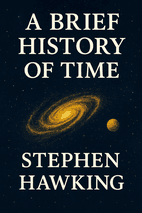
Stephen Hawking's A Brief History of Time distills complex cosmology into an accessible narrative, exploring the Big Bang, black holes, and the search for a unified theory for curious readers without a scientific background.
Feature
Insta.Page
Blinkist
Shortform
Summary Depth
Full Chapter-by-Chapter
15-min overview
Section-by-section guides
Audio Narration
✓
✓
✓
Visual Mindmaps
✓
✕
✕
AI Q&A
✓
✕
✕
Quizzes
✓
✕
✕
PDF Downloads
✓
✕
✓
Price
$89.99/yr
$146/yr (PRO)
$199/yr
*Competitor data last verified July 2026.
1 Page Summary
Stephen Hawking's A Brief History of Time is a landmark work of popular science that distills complex cosmological concepts into an accessible narrative. The book guides the reader through fundamental ideas about the nature of the universe, beginning with historical models from Aristotle and Ptolemy to the revolutionary theories of Copernicus, Galileo, and Newton. Hawking then meticulously builds upon this foundation to explain the two pillars of modern physics: Einstein's general theory of relativity, which describes the force of gravity and the large-scale structure of the cosmos, and quantum mechanics, which governs the behavior of particles on the smallest scales.
The core of the book explores the profound implications of these theories for our understanding of cosmic origins and fate. Hawking delves into the Big Bang theory, black holes, and the elusive search for a unified "Theory of Everything" that would reconcile general relativity with quantum mechanics. He makes these abstract concepts tangible by discussing his own groundbreaking work, such as Hawking radiation, which theorized that black holes are not entirely black but can emit particles and eventually evaporate. This section challenges readers to contemplate the nature of space and time, the possibility of time travel, and the ultimate question of whether the universe requires a creator.
Since its publication in 1988, A Brief History of Time has had a monumental impact, selling millions of copies and demystifying theoretical physics for a global audience. Its lasting legacy lies not just in its explanations, but in its ability to inspire wonder about the universe's deepest mysteries. Hawking succeeded in bringing esoteric questions about the beginning and end of time into the public discourse, cementing the book's status as a classic that continues to ignite curiosity about our place in the cosmos.
Chapter One - Our Picture of the Universe
Overview
The chapter opens with a whimsical story of an old lady insisting the world rests on a giant tortoise, cleverly setting the stage for humanity's enduring quest to unravel the cosmos. It traces how our understanding has evolved from ancient intuitions to sophisticated models, beginning with Aristotle's arguments for a spherical Earth based on lunar eclipses and star positions, though he mistakenly placed Earth at the universe's center. This geocentric view was refined by Ptolemy's geocentric model, which used complex spheres to predict planetary motion but struggled with inconsistencies, eventually giving way to Copernicus and the heliocentric revolution. Galileo's telescopic discoveries and Kepler's elliptical orbits further dismantled old beliefs, paving the way for Newton's universal gravitation, which mathematically explained orbital mechanics but raised new puzzles about a static, infinite universe.
These scientific leaps prompted deeper questions, such as why the night sky isn't blindingly bright if stars are infinite—a dilemma highlighted by Olbers—and sparked early debates on whether the universe had a beginning or was eternal, with thinkers like St. Augustine and Aristotle offering contrasting views. The narrative then shifts to a philosophical conundrum: if a complete unified theory exists, could it dictate how we reason about it, creating a circular problem? To address this, the text turns to Darwin's principle of natural selection, suggesting that our ability to accurately perceive the world evolved because it enhanced survival. However, this evolutionary justification has limits, as modern scientific pursuits, like nuclear physics, might not always offer clear survival benefits and could even pose risks. Ultimately, the chapter argues that humanity's drive for a unified theory isn't solely practical but stems from an innate curiosity—a deep-seated yearning to comprehend our origins and the cosmos's underlying order, reflecting a timeless ambition that transcends mere utility.
The chapter opens with a memorable anecdote where a scientist lecturing on astronomy is challenged by an old lady who claims the world is a flat plate on a giant tortoise, with an infinite stack of turtles beneath it. This story humorously introduces fundamental questions about our cosmic understanding: What is the universe's true nature, its origin, and its fate? It highlights how even seemingly obvious truths, like Earth orbiting the sun, were once contentious, and how new technologies continue to reshape our knowledge.
Aristotle's Case for a Spherical Earth
Aristotle, in 340 B.C., presented two compelling arguments against a flat Earth. First, he noted that lunar eclipses—caused by Earth's shadow on the moon—always showed a circular shadow, which only a spherical object could produce. Second, he observed that the North Star appears lower in the sky when viewed from southern regions compared to northern ones, indicating Earth's curvature. Using differences in the star's position between Egypt and Greece, he estimated Earth's circumference at about 400,000 stadia (roughly twice the modern value). Additionally, the Greeks reasoned that ships appearing first with sails over the horizon supported a round Earth, though Aristotle mistakenly believed Earth was stationary at the universe's center due to mystical preferences for circular motion and Earth's centrality.
Ptolemy's Geocentric Model
Building on Aristotle's ideas, Ptolemy developed a detailed cosmological model in the second century A.D. where Earth stood motionless at the center, surrounded by eight spheres carrying the moon, sun, planets, and fixed stars. To explain planets' irregular paths, he added smaller circles on these spheres. While this model predicted celestial positions reasonably well and was embraced by the Christian church for allowing room beyond the stars for heaven and hell, it had flaws—like incorrectly suggesting the moon's apparent size should vary dramatically during eclipses.
Copernicus and the Heliocentric Revolution
In 1514, Nicholas Copernicus proposed a simpler model with the sun stationary at the center and Earth and planets orbiting around it. Initially shared anonymously to avoid heresy accusations, his idea gained traction a century later through astronomers like Johannes Kepler and Galileo Galilei. Galileo's telescopic observations of Jupiter's moons showed that not all bodies orbit Earth directly, challenging Aristotelian views. Kepler further refined Copernicus's theory by replacing circular orbits with ellipses, which finally aligned predictions with observations, though he saw ellipses as an imperfect compromise.
Newton's Universal Gravitation
Isaac Newton's 1687 work introduced a law of universal gravitation, explaining how bodies attract each other with a force proportional to their mass and inversely proportional to the square of the distance. This theory mathematically justified elliptical orbits for planets and moons, eliminating the need for Ptolemy's spheres. Newton realized that if stars were finite and clustered, gravity would cause them to collapse, but he argued an infinite, uniform distribution might avoid this—a idea later shown flawed, as any finite cluster would still collapse inward.
Challenges to a Static Universe
Newton's gravity raised questions about a static, infinite universe. If gravity is always attractive, an infinite cosmos would be unstable, with stars either collapsing or drifting apart. Heinrich Olbers highlighted another issue in 1823: in an infinite, eternal universe, every line of sight should end on a star, making the night sky as bright as the sun. Absorption of light by intervening matter wouldn't resolve this, as that matter would eventually glow equally bright. This suggested stars haven't shone forever, pointing to a finite beginning.
Early Debates on the Universe's Origin
Discussions on the universe's start date back to ancient traditions, with figures like St. Augustine arguing for a creation around 5000 B.C., citing progress in civilization and the need for a "First Cause." In contrast, Greek philosophers like Aristotle favored an eternal universe to avoid divine intervention. Immanuel Kant later framed this as an antinomy, arguing equally for both a beginning and eternity, but St. Augustine noted that time itself may not exist before the universe's creation, making "before" meaningless.
The Problem of Self-Determining Theories
The chapter raises a profound question: if a complete unified theory of the universe exists, it could potentially dictate our very thought processes and actions, including how we search for and interpret evidence for the theory itself. This creates a circular dilemma—why should such a theory lead us to correct conclusions rather than false ones or no conclusion at all? The text suggests that this isn't just an abstract puzzle; it touches on the reliability of human reasoning when confronting ultimate truths.
Darwin's Principle as a Solution
To address this, the author turns to Darwin's principle of natural selection. In any population, genetic and environmental variations mean some individuals are better equipped to accurately perceive the world and make survival-oriented decisions. Over time, these traits—like intelligence and scientific curiosity—become dominant because they enhance reproductive success. Historically, this evolutionary advantage has driven progress in understanding the universe, from basic survival skills to complex scientific theories.
The Limits of Evolutionary Justification
However, the author cautions that this evolutionary argument has its limits in the modern context. While past scientific discoveries have clearly boosted survival (e.g., through agriculture or medicine), today's advancements, such as nuclear technology, could pose existential threats. A complete unified theory might not offer any practical survival benefits or even alter daily life. Yet, the text notes that similar skepticism was once directed at theories like relativity and quantum mechanics, which later revolutionized technology, underscoring that practical utility isn't always immediately apparent.
Humanity's Innate Drive for Knowledge
Ultimately, the search for a unified theory is justified not by practical needs but by an intrinsic human yearning. Since ancient times, people have sought to uncover the underlying order of the cosmos, driven by questions about our origins and purpose. This deep-seated desire for understanding—to know why we exist and where we come from—provides its own compelling rationale. The quest represents humanity's enduring ambition to achieve a complete description of the universe, transcending mere survival to fulfill a fundamental aspect of our nature.
Key Takeaways
Evolutionary principles suggest our reasoning abilities developed through natural selection, but this may not guarantee correct conclusions in modern scientific pursuits.
Practical survival benefits are not a reliable justification for seeking a unified theory, as history shows such discoveries can have unpredictable impacts.
The primary motivation for this quest stems from humanity's innate curiosity and desire to comprehend the universe's fundamental order.
Key concepts: Chapter One - Our Picture of the Universe
1. Chapter One - Our Picture of the Universe
Ancient Cosmological Models
Aristotle's spherical Earth arguments using lunar eclipses and star positions
Ptolemy's geocentric model with complex spheres and circles
Earth-centered universe with mystical preference for circular motion
Model limitations including incorrect moon size predictions during eclipses
Heliocentric Revolution
Copernicus proposed sun-centered model to simplify planetary motion
Revealed problems with infinite static universe concept
Gravity would cause finite star clusters to collapse inward
Cosmological Paradoxes and Questions
Olbers' paradox: Why night sky isn't bright in infinite universe
Gravitational instability in static infinite cosmos
Debate between eternal universe vs finite beginning
Stars cannot have shone forever based on observational evidence
Philosophical Foundations of Scientific Inquiry
Evolutionary justification for accurate perception (Darwin's principle)
Limits of survival benefits in modern scientific pursuits
Humanity's innate drive for unified theory beyond practical utility
Circular problem of using reason to discover theories that dictate reasoning
Early Debates on the Universe's Origin
St. Augustine argued for creation around 5000 B.C. based on civilization's progress and need for a 'First Cause'
Greek philosophers like Aristotle favored an eternal universe to avoid divine intervention
Immanuel Kant framed this as an antinomy, arguing equally for both beginning and eternity
St. Augustine proposed time may not exist before creation, making 'before' meaningless
The Problem of Self-Determining Theories
A complete unified theory could dictate our thought processes and how we search for evidence
Creates circular dilemma: why should such theory lead to correct rather than false conclusions
Questions reliability of human reasoning when confronting ultimate truths
Highlights fundamental paradox in seeking theories that might determine their own discovery
Darwin's Principle as a Solution
Natural selection favors individuals who accurately perceive the world for survival
Traits like intelligence and scientific curiosity become dominant through reproductive success
Evolutionary advantage has historically driven progress in understanding the universe
From basic survival skills to complex theories, evolution shapes our reasoning capabilities
The Limits of Evolutionary Justification
Modern scientific advancements may not enhance survival (e.g., nuclear threats)
Complete unified theory might offer no practical survival benefits
Historical skepticism about theories like relativity and quantum mechanics proved wrong
Practical utility of fundamental discoveries isn't always immediately apparent
Humanity's Innate Drive for Knowledge
Search for unified theory justified by intrinsic human yearning, not practical needs
Ancient traditions show persistent desire to uncover cosmic order and purpose
Driven by fundamental questions about origins and existence
Represents humanity's enduring ambition to achieve complete cosmic description
💡 Try clicking the AI chat button to ask questions about this book!
Chapter Two - Space and Time
Overview
Galileo's experiments with rolling balls down slopes shattered Aristotle's long-held belief that heavier objects fall faster, revealing that all bodies accelerate at the same rate regardless of mass. This insight showed that force changes speed, not just starts motion, and laid the foundation for Newton's laws. Newton built on this by formulating his laws of motion and universal gravitation, explaining why objects fall equally and introducing the radical idea that motion is relative—there's no absolute standard of rest, as demonstrated by events on a moving train. This relativity of motion challenged earlier notions and set the stage for deeper questions.
The discovery of light's finite speed by Ole Roemer, who observed variations in Jupiter's moon eclipses, hinted at an interconnected space and time. James Clerk Maxwell later unified electricity and magnetism, predicting that light travels at a fixed speed, which puzzled scientists and led to the proposed "ether" medium. However, the Michelson-Morley experiment found no evidence for ether, forcing a rethink of fundamental principles. Einstein resolved this with his special theory of relativity, asserting that all observers measure the same light speed, leading to mind-bending consequences like E=mc² and the relativity of time, where clocks tick differently for moving observers.
This merged space and time into a four-dimensional spacetime, visualized through light cones that define causality. Einstein's general theory of relativity then redefined gravity not as a force but as the curvature of spacetime caused by mass and energy. Objects follow geodesics—the straightest paths in this curved geometry—explaining planetary orbits as natural motions. Predictions like Mercury's orbital precession and the bending of starlight were confirmed, while time dilation in gravitational fields has practical applications, such as in GPS technology. The twins paradox illustrates how time is personal, varying with motion and gravity, and spacetime is dynamic, interacting with matter in a cosmic dance. This framework implies a finite universe with a beginning, reshaping our understanding of cosmology and emphasizing that space and time are inseparable, evolving components of reality.
Galileo's Experimental Breakthrough
Before Galileo, people followed Aristotle's belief that heavier objects fall faster than lighter ones, and that motion required a continuous force. Galileo challenged this by rolling balls of different weights down slopes, showing that all bodies accelerate at the same rate regardless of mass. His experiments revealed that force changes speed, not just initiates motion, laying the groundwork for Newton's laws. The famous Leaning Tower of Pisa story is likely apocryphal, but Galileo's method demonstrated that air resistance, not weight, causes differences in fall rates—proven later by astronauts on the moon.
Newton's Laws and Universal Gravitation
Building on Galileo's work, Newton formulated his laws of motion. The first law states that objects in motion stay in motion unless acted upon by a force, eliminating the idea of a preferred state of rest. The second law defines acceleration as proportional to force and inversely proportional to mass—like a car's acceleration depending on engine power and weight. Newton's law of gravity explains that every mass attracts another with a force proportional to their masses and inversely related to distance. This clarified why all objects fall equally: doubled weight means doubled gravitational force, but also doubled mass, canceling out in acceleration.
The Relativity of Motion
Newton's laws introduced a radical idea: there is no absolute standard of rest. For example, on a moving train, experiments like Ping-Pong obey the same laws as on stationary ground, meaning motion is relative. This challenged Aristotle's belief in absolute position, as events could be described differently depending on the observer's frame—like bounces on a train appearing meters apart to someone on the tracks. Newton struggled with this, as it conflicted with his notion of an absolute God, but it became a cornerstone of modern physics.
The Discovery of Light's Finite Speed
In 1676, astronomer Ole Roemer noticed that eclipses of Jupiter's moons varied with Earth's distance, proving light travels at a finite speed. His estimate was 140,000 miles per second, close to today's 186,000 miles per second. This discovery hinted that time and space might be interconnected, as light's speed became a universal constant to be explained.
Maxwell's Electromagnetic Theory
James Clerk Maxwell's 1865 equations unified electricity and magnetism, predicting electromagnetic waves—including light—traveling at a fixed speed. This raised a puzzle: if light's speed is constant, what is it relative to? Scientists proposed an "ether" filling space, similar to air for sound waves, but this led to contradictions about how light should behave for moving observers.
The Michelson-Morley Experiment
In 1887, Albert Michelson and Edward Morley tested the ether by comparing light speeds in different directions relative to Earth's motion. Surprisingly, they found no difference, contradicting the ether theory. This null result prompted ideas like Lorentz's contractions, but it was Einstein who offered a revolutionary solution by abandoning absolute time.
Einstein's Special Theory of Relativity
Einstein's 1905 paper proposed that all observers measure the same light speed, regardless of their motion. This special theory of relativity had stunning consequences: mass and energy are equivalent (E=mc²), nothing can exceed light speed, and time is relative. For instance, as objects approach light speed, their mass increases, requiring infinite energy to accelerate further. This ended the notion of absolute time, meaning clocks tick differently for moving observers, and events' timing depends on relative velocity.
The Fabric of Space-Time
Relativity merged space and time into a four-dimensional space-time, where events are described by coordinates that blend spatial and temporal dimensions. Light cones illustrate this: the future light cone contains events reachable from a point at or below light speed, while the past cone includes events that could influence it. Events outside these cones are "elsewhere," unaffected by each other—like the sun going out taking eight minutes to affect Earth. Space-time diagrams help visualize these relationships, showing how light paths define causality and the limits of observation across the universe.
Einstein's Breakthrough with General Relativity
After years of grappling with the inconsistencies between Newtonian gravity and special relativity, Einstein introduced the general theory of relativity in 1915. He proposed that gravity isn't a force in the traditional sense but arises from the curvature of spacetime itself. Mass and energy warp the fabric of spacetime, and objects follow the straightest possible paths in this curved geometry, known as geodesics.
Understanding Geodesics in Curved Space
A geodesic is the shortest or longest path between two points in a curved space. For instance, on Earth's surface, a great circle represents a geodesic—this is why airlines use such routes for long-distance flights. In general relativity, planets like Earth move along geodesics in four-dimensional spacetime, which appear as curved orbits in our three-dimensional perception. This is analogous to an airplane's shadow tracing a curved path over hilly terrain while the plane itself moves in a straight line through the air.
Predictions and Early Confirmations
General relativity made precise predictions that diverged from Newtonian physics. For Mercury, the planet closest to the sun, the theory accounted for a slight rotation of its elliptical orbit—about one degree every ten thousand years—which had been observed but unexplained. This served as an early validation. Additionally, the theory forecasted that light rays would bend when passing through gravitational fields. For example, starlight grazing the sun should be deflected, altering the star's apparent position. During a 1919 solar eclipse, a British expedition confirmed this effect, though later analysis revealed measurement errors; subsequent observations have firmly supported the prediction.
Time Dilation and Practical Implications
Another key insight was that time runs slower in stronger gravitational fields. This stems from light losing energy as it moves away from massive bodies, reducing its frequency. In a 1962 experiment, clocks at different heights demonstrated this time dilation, with the lower clock ticking slower. Today, this effect is crucial for technologies like GPS satellites, where ignoring relativity would lead to positioning errors of several miles.
The Twins Paradox and Relativity of Time
The theory dismantled the notion of absolute time, illustrating that time is personal and dependent on motion and gravity. The twins paradox—where one twin traveling at near-light speeds ages slower than the other—highlights this. It's not a true paradox but a consequence of relativity, showing that each individual experiences time uniquely based on their path through spacetime.
Spacetime as a Dynamic Entity
Before general relativity, space and time were seen as static backdrops. Einstein's theory redefined them as dynamic components that interact with matter and energy. Spacetime's curvature influences how objects move, and in turn, those movements reshape spacetime. This interconnectedness implies that discussing space and time independently of the universe is meaningless, leading to a revolutionary view of a dynamic, expanding cosmos with a finite beginning and possibly an end. This framework later inspired work by the author and Roger Penrose, showing that the universe must have originated from a singular point.
Key Takeaways
Gravity emerges from the curvature of spacetime, not as a conventional force.
Objects follow geodesics, the straightest paths in curved spacetime, explaining orbital motions.
Predictions like Mercury's orbital precession and light bending were confirmed experimentally.
Time dilation occurs in gravitational fields, with practical impacts on modern navigation.
Spacetime is dynamic, influenced by and influencing all events in the universe.
General relativity implies a finite universe with a beginning, reshaping cosmological understanding.
Key concepts: Chapter Two - Space and Time
2. Chapter Two - Space and Time
Overview
Galileo's experiments with rolling balls down slopes shattered Aristotle's long-held belief that heavier objects fall faster, revealing that all bodies accelerate at the same rate regardless of mass.
This insight showed that force changes speed, not just starts motion, and laid the foundation for Newton's laws.
Newton built on this by formulating his laws of motion and universal gravitation, explaining why objects fall equally and introducing the radical idea that motion is relative—there's no absolute standard of rest, as demonstrated by events on a moving train.
Special Relativity Foundations
All observers measure identical light speed regardless of their motion
Mass and energy are equivalent (E=mc²) and nothing can exceed light speed
Time is relative - clocks tick differently for moving observers
Mass increases as objects approach light speed, requiring infinite energy for further acceleration
Space-Time Fabric and Light Cones
Relativity merged space and time into four-dimensional space-time
Light cones define causality - future cone contains reachable events, past cone includes influencing events
Events outside light cones are 'elsewhere' and cannot affect each other
Space-time diagrams visualize how light paths define observational limits across the universe
General Relativity Breakthrough
Gravity arises from curvature of spacetime rather than as a traditional force
Mass and energy warp the fabric of spacetime
Objects follow straightest possible paths (geodesics) in curved geometry
Resolved inconsistencies between Newtonian gravity and special relativity
Geodesics in Curved Space
Geodesics represent shortest or longest paths between points in curved space
Planets follow geodesics in four-dimensional spacetime, appearing as curved orbits in 3D
Analogous to airplane shadows tracing curved paths while the plane moves straight through air
Great circle routes on Earth exemplify geodesic principles
Experimental Confirmations
Explained Mercury's orbital precession - about one degree every ten thousand years
Predicted light bending in gravitational fields, confirmed during 1919 solar eclipse
Time is personal and dependent on motion and gravity
Twins paradox shows traveling twin ages slower than stationary twin
Not a true paradox but consequence of relativity principles
Each individual experiences time uniquely based on their spacetime path
Dynamic Spacetime Entity
Space and time are dynamic components interacting with matter and energy
Spacetime curvature influences object movement while movements reshape spacetime
Implies space and time cannot be discussed independently of the universe
Led to revolutionary view of dynamic, expanding cosmos with finite beginning
Chapter Three - The Expanding Universe
Overview
Looking up at a clear night sky, the brightest objects aren't just stars but often planets, with countless sun-like stars scattered across the Milky Way. Early astronomers realized that some stars shift slightly due to parallax, allowing direct distance measurements—like Proxima Centauri at four light-years away. This paved the way for Edwin Hubble to confirm that our galaxy is just one of many, separated by vast emptiness. Hubble tackled the challenge of measuring galactic distances using standard candles, stars with known luminosity, which revealed that galaxies are immense collections of billions of stars, with our own Milky Way spanning about 100,000 light-years.
To study these distant objects, astronomers turned to stellar spectra, the light patterns that reveal a star's temperature and composition. They noticed a consistent red shift in galaxy light, similar to the Doppler effect where receding objects stretch light wavelengths toward red. Hubble connected this to distances, formulating Hubble's Law: the farther a galaxy is, the faster it recedes, proving the universe is expanding. This overturned static universe ideas, even correcting Einstein's earlier assumptions, and aligned with Alexander Friedmann's 1922 models based on cosmic uniformity.
Friedmann's work assumed the universe looks the same in all directions, leading to predictions confirmed by the accidental discovery of cosmic microwave background radiation in 1965. His models outlined three possible fates: a Big Crunch where gravity causes collapse, perpetual expansion, or a critical balance. Current evidence, including dark matter, suggests endless expansion. All models point to a singularity about 10–20 billion years ago—the Big Bang—where density and curvature were infinite, marking the beginning of time.
The steady state theory offered an alternative, proposing continuous matter creation to maintain a constant universe, but it crumbled under evidence. Radio surveys showed galaxy densities change over time, and the cosmic microwave background indicated a hot, dense past, disproving steady state. Challenges to the Big Bang emerged, such as arguments that galaxy motions might avoid a singularity, but these were retracted, reinforcing that singularities fit general relativity. Roger Penrose's insights on collapsing stars inspired Stephen Hawking to reverse the math, proving that an expanding universe must have begun with a singularity. Their joint work in 1970 showed that, given general relativity and observed matter, a Big Bang was inevitable.
This proof faced resistance but gained acceptance, highlighting general relativity's limits and the need for quantum mechanics to explain the universe's origins. From Hubble's expansion discovery to Hawking and Penrose's singularity proof, the chapter traces how evidence solidified that the universe had a dynamic beginning, setting the stage for exploring the quantum realm.
The Night Sky and Galactic Distances
When observing a clear, moonless night, the brightest objects are typically planets like Venus, Mars, Jupiter, and Saturn, alongside countless stars similar to our sun but much farther away. Some of these "fixed" stars actually shift positions slightly as Earth orbits the sun, revealing their relative proximity. This parallax effect allows astronomers to measure stellar distances directly—for instance, Proxima Centauri, the closest star, is about four light-years away. Most visible stars lie within a few hundred light-years, concentrated in the Milky Way band, which early astronomers like Sir William Herschel recognized as part of a disklike spiral galaxy. However, it wasn't until 1924 that Edwin Hubble confirmed ours isn't the only galaxy, unveiling a universe filled with countless galaxies separated by vast empty spaces.
Edwin Hubble's Method for Measuring Distances
Hubble faced the challenge of determining distances to far-off galaxies that appeared fixed unlike nearby stars. He used indirect methods based on stellar luminosity—the total light radiated by a star. By identifying stars with consistent luminosity (standard candles) in other galaxies and measuring their apparent brightness, Hubble calculated distances. For example, he estimated distances to nine galaxies this way, laying the groundwork for understanding that our Milky Way is just one of hundreds of billions of galaxies, each containing billions of stars. Our sun sits modestly in one spiral arm of a galaxy roughly 100,000 light-years across, slowly rotating over hundreds of millions of years.
Stellar Spectra and the Doppler Effect
Stars are too distant to discern size or shape, so astronomers rely on their light spectra—the range of colors emitted—to study them. Passing starlight through a prism reveals a thermal spectrum, indicating temperature, and missing colors correspond to specific elements in the star's atmosphere. In the 1920s, spectra from other galaxies showed a consistent red shift, where light wavelengths stretch toward the red end. This ties into the Doppler effect: just as a car's engine sounds higher-pitched as it approaches and lower as it recedes, light from objects moving away from us red-shifts, while approaching objects blue-shift. Hubble applied this to galaxy observations, finding most were red-shifted, meaning they're receding from us.
Hubble's Law and the Expanding Universe
Hubble's cataloging of galaxy distances and spectra led to a groundbreaking discovery in 1929: the red shift of a galaxy is directly proportional to its distance from us. In other words, the farther away a galaxy is, the faster it's moving away. This implied the universe isn't static but expanding, with galaxies drifting apart over time. This revelation overturned long-held beliefs, including Einstein's introduction of a cosmological constant to force a static universe in his general relativity equations. Instead, Alexander Friedmann had already predicted this expansion in 1922 based on two simple assumptions—that the universe looks identical in every direction and from any location.
Friedmann's Assumptions and Predictive Models
Friedmann's work, though initially overlooked, proposed that the universe's uniformity on large scales (ignoring local variations like the Milky Way) meant it couldn't be static. His models showed that gravity's influence could lead to different expansion outcomes, but it wasn't until 1965 that Arno Penzias and Robert Wilson accidentally confirmed this uniformity. While testing a microwave detector, they discovered constant background noise—now known as the cosmic microwave background radiation—that permeates space equally in all directions. This radiation, a red-shifted remnant of the early universe's hot, dense state, aligned perfectly with predictions by physicists like George Gamow, Jim Peebles, and Bob Dicke, providing strong evidence for Friedmann's first assumption.
Three Types of Universe Expansion
Friedmann's models outline three possible fates for the universe based on expansion rate and density:
Model 1: Expansion slows due to gravity, eventually causing a "Big Crunch" where the universe collapses back to a point. Space is finite and curved, like Earth's surface, but without boundaries.
Model 2: Expansion is too rapid for gravity to halt, leading to perpetual expansion. Space is infinite and curved outward, akin to a saddle shape.
Model 3: Expansion barely avoids recollapse, with galaxies moving apart at a slowing but never-zero rate. Space is flat and infinite.
Current measurements of expansion rates (5–10% per billion years) and density estimates, including dark matter, suggest the universe will likely expand forever, though recollapse isn't ruled out for at least ten billion years.
The Big Bang Singularity
All Friedmann models point to a moment about 10–20 billion years ago when galaxies were infinitely close—the Big Bang. At this singularity, density and space-time curvature were infinite, causing general relativity to break down. This implies time had a beginning, as events before the Big Bang can't influence the present. While this idea challenges notions of an eternal universe and has sparked alternatives like the steady state theory, the evidence strongly supports a finite cosmic timeline starting from this primordial event.
The Steady State Theory and Its Demise
The steady state theory proposed that the universe had no beginning or end, with new matter continuously created to fill the gaps as galaxies moved apart. This required a slight tweak to general relativity, but the creation rate was so minuscule—about one particle per cubic kilometer per year—that it didn't clash with experimental data. As a scientific theory, it was elegant and testable, predicting that the density of galaxies should remain constant across space and time. However, radio wave surveys in the late 1950s and early 1960s, led by Martin Ryle's team at Cambridge, revealed a discrepancy: there were fewer strong radio sources (interpreted as nearby) compared to weak ones (distant), suggesting that sources were more abundant in the past. This contradicted the steady state model. The final blow came in 1965 with Penzias and Wilson's discovery of cosmic microwave radiation, indicating a much denser, hotter early universe. Together, these findings forced astronomers to abandon the steady state theory in favor of models involving a dynamic beginning.
Challenging the Big Bang Idea
In 1963, Russian scientists Evgenii Lifshitz and Isaac Khalatnikov attempted to sidestep the big bang conclusion by arguing that Friedmann's models—which predicted a singularity—were oversimplified. They noted that real galaxies have slight sideways motions, not just direct recession, so they might never have converged exactly at one point. Instead, the universe could have emerged from a prior contracting phase where particles avoided collision. Initially, they claimed that singularities were rare in more realistic models, but by 1970, they recognized a broader class of Friedmann-like models that inevitably led to singularities, regardless of galaxy motions. This retraction reinforced that singularities were a plausible feature under general relativity, though it didn't settle whether our specific universe began with one.
Penrose's Insight and the Singularity Proof
Roger Penrose's 1965 breakthrough used general relativity and gravity's always-attractive nature to show that collapsing stars form singularities—points where density and curvature become infinite, trapped within black holes. This initially applied only to stellar collapse, but a young Stephen Hawking, motivated by personal circumstances (including a recent ALS diagnosis and his engagement to Jane Wilde), saw a way to extend it. By reversing time in Penrose's theorem, Hawking realized that an expanding universe like Friedmann's must have begun with a singularity. Over the next few years, he refined the math to remove technical constraints, such as the requirement for an infinite universe. In 1970, Hawking and Penrose jointly published a proof demonstrating that, assuming general relativity holds and the universe contains observed matter levels, a big bang singularity was inevitable.
Acceptance and Broader Implications
The singularity proof faced resistance, partly from Russian scientists rooted in Marxist determinism and others who found singularities aesthetically unappealing in Einstein's theory. Yet, mathematical rigor prevailed, and the idea gained widespread acceptance. Hawking notes the irony that he later sought to eliminate the singularity concept by incorporating quantum effects. This chapter highlights a profound shift in human understanding: from Hubble's expansion discovery to the 1970 proof, evidence solidified that the universe had a beginning. However, general relativity's breakdown at the singularity reveals its incompleteness, pointing to the need for quantum mechanics to explain the universe's earliest moments. This sets the stage for exploring the interplay between the very large and the very small in subsequent chapters.
Key Takeaways
The steady state theory was disproven by observational data, including radio source surveys and cosmic microwave background radiation.
Initial challenges to the big bang singularity, like those by Lifshitz and Khalatnikov, were ultimately retracted, reinforcing that singularities are consistent with general relativity.
Penrose and Hawking's collaborative work mathematically proved that the universe must have begun with a big bang singularity, based on general relativity and observed matter.
This proof underscores general relativity's limitations, necessitating a turn to quantum mechanics to fully understand the universe's origins.
Key concepts: Chapter Three - The Expanding Universe
3. Chapter Three - The Expanding Universe
Observing the Night Sky and Early Discoveries
Brightest night objects include planets and distant sun-like stars in Milky Way
Parallax effect allows direct distance measurement to nearby stars like Proxima Centauri
Early recognition of Milky Way as disk-like spiral galaxy structure
Hubble's 1924 confirmation that Milky Way is just one of countless galaxies
Hubble's Distance Measurement Methods
Used standard candles - stars with known luminosity - for indirect distance calculation
Applied apparent brightness measurements to estimate galactic distances
Estimated distances to nine galaxies, revealing universe's vast scale
Established Milky Way as one of hundreds of billions of galaxies
Spectral Analysis and Red Shift
Stellar spectra reveal star temperature and atmospheric composition
Consistent red shift observed in galaxy light spectra
Doppler effect explains wavelength stretching for receding objects
Most galaxies show red shift, indicating universal recession
Initially claimed singularities were rare in more realistic models
By 1970, recognized broader class of models inevitably lead to singularities
Reinforced singularity as plausible feature under general relativity
Penrose and Hawking's Singularity Proof
Penrose proved collapsing stars form singularities within black holes
Hawking reversed the theorem to apply to expanding universe
Demonstrated expanding universe must have begun with singularity
1970 joint proof showed big bang singularity inevitable given general relativity and observed matter
Resistance to Singularity Concept
Russian scientists resisted due to Marxist determinism philosophical objections
Many physicists found singularities aesthetically unappealing in Einstein's theory
Mathematical rigor ultimately prevailed over philosophical objections
Hawking later sought to eliminate singularities through quantum mechanics
Shift in Cosmological Understanding
From Hubble's expansion discovery to 1970 singularity proof marked profound change
Evidence solidified that universe had a definite beginning
General relativity breaks down at the singularity point
Revealed incompleteness of general relativity for earliest universe
Theoretical Limitations and Future Directions
Singularity proof demonstrates general relativity's limitations
Quantum mechanics needed to explain universe's earliest moments
Sets stage for exploring interplay between large-scale and quantum physics
Points toward unification of general relativity and quantum theory
Chapter Four - The Uncertainty Principle
Overview
This chapter explores the dramatic shift from a deterministic view of the universe to one governed by quantum uncertainty, tracing the journey from Laplace's bold claims of predictability to the revolutionary insights of Planck and Heisenberg. It reveals how the very act of measurement introduces fundamental limits to our knowledge, reshaping our understanding of reality at the smallest scales and laying the groundwork for modern physics.
The Demise of Determinism
In the early 19th century, the Marquis de Laplace championed the idea that the universe was entirely deterministic, arguing that if we knew the complete state of everything at one moment, we could predict all future events using scientific laws. This view, rooted in Newtonian physics, suggested even human behavior was predetermined. However, this comforting certainty began to crumble when calculations by Rayleigh and Jeans indicated that hot objects like stars should radiate infinite energy—a clear absurdity that pointed to flaws in classical theories.
Planck's Quantum Insight
Max Planck resolved this paradox in 1900 by proposing that energy isn't emitted continuously but in discrete packets called quanta. Each quantum's energy depends on the frequency of the waves, meaning high-frequency emissions require more energy than available, thus preventing infinite radiation. While this hypothesis neatly explained observed phenomena, its deeper implications for indeterminism weren't grasped until decades later.
Heisenberg's Revolutionary Principle
Werner Heisenberg's 1926 uncertainty principle showed that measuring a particle's position and velocity simultaneously is inherently limited. To pinpoint position, you need short-wavelength light, but Planck's quanta mean even a single photon disturbs the particle's velocity unpredictably. The more precisely you measure one property, the less you know about the other, encapsulated in a mathematical limit involving Planck's constant. This isn't a measurement flaw but a fundamental property of nature, ending Laplace's dream of perfect prediction.
The Birth of Quantum Mechanics
Heisenberg, along with Schrödinger and Dirac, developed quantum mechanics based on this principle, replacing definite positions and velocities with a probabilistic quantum state. Particles no longer have clear paths; instead, outcomes are described by probabilities across multiple possibilities. Einstein famously resisted this randomness with his "God does not play dice" quip, but quantum mechanics proved immensely successful, underpinning technologies from transistors to chemistry and biology by accurately predicting experimental results.
Wave-Particle Duality and Interference
Quantum mechanics introduced a duality where light and particles exhibit both wave-like and particle-like behaviors. Light, though wavelike, is emitted in quanta, while particles are "smeared out" with probability distributions. This leads to interference phenomena, where waves or particles can cancel or reinforce each other. A classic example is the colors in soap bubbles, caused by light waves interfering after reflection.
The Enigmatic Two-Slit Experiment
In the two-slit experiment, particles like electrons create interference patterns on a screen, even when sent one at a time. This implies each particle passes through both slits simultaneously, defying classical intuition. If only one slit is open, no pattern forms, but with two, interference emerges, highlighting that particles don't follow single paths but exist in superposed states until measured.
Reshaping Atomic Theory
Niels Bohr's early atomic model proposed electrons orbit at specific distances, preventing collapse into the nucleus. Quantum mechanics refined this by treating electrons as waves: only orbits with whole-number wavelengths are stable, as others cancel out. Richard Feynman's "sum over histories" approach visualized particles taking all possible paths, with probabilities determined by wave interference, elegantly explaining atomic and molecular structures that form the basis of chemistry and life.
Quantum Gaps in Gravity
While quantum mechanics excels at small scales, it hasn't been fully integrated with general relativity, which describes gravity on cosmic scales. In extreme conditions like black holes or the big bang, quantum effects become crucial, suggesting a need for a unified theory. This sets the stage for exploring how these realms might be reconciled in future chapters.
Key Takeaways
The uncertainty principle fundamentally limits how precisely we can know both position and velocity, introducing inherent randomness into physics.
Quantum mechanics replaced deterministic models with probabilistic ones, enabling breakthroughs in technology, chemistry, and biology.
Wave-particle duality and interference experiments reveal that particles behave in non-intuitive ways, existing in multiple states simultaneously.
Despite its success, quantum mechanics remains incomplete without incorporation into gravitational theory, highlighting ongoing challenges in physics.
Key concepts: Chapter Four - The Uncertainty Principle
4. Chapter Four - The Uncertainty Principle
The Demise of Determinism
Laplace championed complete determinism using Newtonian physics
Classical theory predicted infinite radiation from hot objects
Rayleigh-Jeans calculations revealed fundamental flaws in determinism
Human behavior was considered predetermined in this worldview
Planck's Quantum Insight
Energy emitted in discrete packets called quanta
Quantum energy depends on frequency of waves
Prevents infinite radiation paradox
Deeper indeterminism implications not initially recognized
Heisenberg's Uncertainty Principle
Fundamental limit on simultaneous position and velocity measurement
Measurement disturbance from Planck's quanta (even single photons)
Mathematical limit involving Planck's constant
Not measurement flaw but inherent property of nature
Quantum Mechanics Foundations
Replaces definite positions/velocities with probabilistic quantum states
Developed by Heisenberg, Schrödinger, and Dirac
Einstein resisted randomness ('God does not play dice')
Underpins modern technologies and experimental predictions
Wave-Particle Duality
Light and particles exhibit both wave and particle behaviors
Particles 'smeared out' with probability distributions
Interference phenomena cause cancellation or reinforcement
Explains colors in soap bubbles and other optical effects
Two-Slit Experiment
Particles create interference patterns even when sent individually
Implies particles pass through both slits simultaneously
Demonstrates superposition until measurement
Defies classical single-path intuition
Quantum Atomic Theory
Electrons treated as waves with stable whole-number wavelengths
Feynman's 'sum over histories' - particles take all possible paths
Explains atomic and molecular structures
Forms basis of chemistry and biological systems
Quantum-Gravity Integration Challenge
Quantum mechanics not fully integrated with general relativity
Crucial in extreme conditions (black holes, big bang)
Highlights need for unified theory
Sets stage for future theoretical developments
You've reached the end of the free chapters
Next chapter: “Elementary Particles and the Forces of Nature” is locked
Keep reading A Brief History of Time — and unlock all 600+ book summaries with audio, mindmaps and AI Q&A.
$0.00 due today · 7 days free, then $89.99/year ($7.49/mo) · Cancel anytime before day 7
Stephen Hawking was a renowned theoretical physicist and cosmologist whose groundbreaking work reshaped our understanding of the universe. He held the prestigious Lucasian Professor of Mathematics chair at the University of Cambridge for three decades. Hawking is celebrated for his theories on black holes and cosmology, most famously for his prediction that black holes emit radiation, now known as Hawking radiation. His seminal work is detailed in his international bestseller, *A Brief History of Time*, which brought complex scientific concepts to the public. As a bestselling author, his influential books, including *The Universe in a Nutshell* and *The Grand Design*, are available on Amazon. His profound contributions have cemented his legacy as one of the most brilliant scientific minds of the modern era.
📚 Explore Our Book Summary Library
Discover more insightful book summaries from our collection