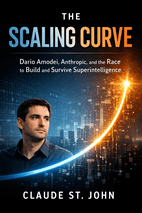
Claude St. John's The Scaling Curve provides a granular biography of Dario Amodei and Anthropic, tracing the scaling hypothesis from discovery to deployment and the resulting safety imperative. It details the technical and philosophical evolution of AI safety for readers seeking to understand the principles and pressures defining the race to superintelligence.
Feature
Insta.Page
Blinkist
Shortform
Summary Depth
Full Chapter-by-Chapter
15-min overview
Section-by-section guides
Audio Narration
✓
✓
✓
Visual Mindmaps
✓
✕
✕
AI Q&A
✓
✕
✕
Quizzes
✓
✕
✕
PDF Downloads
✓
✕
✓
Price
$89.99/yr
$146/yr (PRO)
$199/yr
*Competitor data last verified July 2026.
1 Page Summary
"The Scaling Curve" by Claude St. John is a deep-dive biography of Dario Amodei and the company he co-founded, Anthropic, framing their work within the high-stakes race to develop superintelligent AI. The book's central thesis follows Amodei's conviction in the "scaling hypothesis"—the observation that simply increasing the data, compute, and parameters of neural networks leads to predictable, dramatic leaps in capability—and the profound tension this creates. As Amodei and his teams at Google Brain, OpenAI, and finally Anthropic prove this thesis with models like GPT-2 and GPT-3, they become increasingly alarmed by the safety risks, leading to a foundational conflict: the urgent drive to build powerful AI versus the existential imperative to ensure it is aligned and controllable.
The author's approach is distinctive for its granular, insider focus on the technical and philosophical underpinnings of the AI safety movement. Rather than a broad industry survey, the narrative meticulously traces the evolution of key ideas—from the early observation of scaling laws and the brittleness of early systems to the invention of Constitutional AI and the Responsible Scaling Policy (RSP). It portrays Anthropic's founding not as a typical startup venture but as a moral exodus by researchers who believed frontier AI was being built recklessly, and details their struggle to fund and scale their work while prioritizing safety research like mechanistic interpretability, which seeks to make AI's internal "black box" decisions legible.
This book is intended for readers seeking to understand the technical ethos, strategic dilemmas, and key personalities shaping the frontier of AI development. Readers will gain a clear picture of the exponential economic and capability curves driving the industry, the concrete technical challenges of AI alignment and governance, and the internal culture of a company attempting to balance utopian potential with catastrophic risk. Through Amodei's journey—from a scientist obsessed with objective truth to a CEO warning geopolitically at Davos—the book provides a sobering yet detailed account of the principles and pressures defining the race to build, and hopefully survive, superintelligence.
Chapter One
Overview
The chapter introduces Dario Amodei, tracing how his childhood in a pre-tech boom San Francisco, his family's values, and an early fixation on mathematical objectivity forged a mindset that would eventually lead him to the forefront of artificial intelligence. It establishes the core tension in his character: a deep-seated urgency to accelerate scientific progress, born from personal tragedy, coupled with a profound sense of responsibility to ensure that such acceleration is done safely.
A Childhood Defined by Objective Truth
Growing up in San Francisco's Mission District in the 1980s, Dario found refuge in mathematics. Amidst a neighborhood of taquerias and laundromats, he was drawn to the field's unambiguous nature, contrasting it with the subjective arguments among friends. This desire for "objective answers" became a foundational principle. His household, led by his Italian craftsman father, Riccardo, and his project-manager mother, Elena, was not academically focused on technology but was steeped in moral seriousness and a sense of responsibility to improve the world. This environment nurtured a grand, shared ambition between Dario and his younger sister, Daniela: a lifelong desire to "save the world together."
The Path of a Scientist
Dario's identity was that of a pure scientist, not a budding entrepreneur. He was uninterested in the dot-com boom swirling around him in high school, focusing instead on physics and math, where definitive answers could be discovered. His academic excellence earned him a spot on the U.S. Physics Olympiad Team and led him to Caltech, a monastery for pure science. A transfer to Stanford exposed him to a culture more focused on applying knowledge to change the world. It was during this time he encountered Ray Kurzweil's writings on the "Singularity." While skeptical of the details, Dario was convinced by the core argument: the exponential growth of computing power would inevitably lead to powerful AI, making the study of intelligence the most important scientific pursuit.
A Pivot Fueled by Loss
This conviction led Dario to pivot from theoretical physics to computational neuroscience for his PhD at Princeton, aiming to study the brain as the best existing model of intelligence. His rigorous research, honored with a Hertz Fellowship, revealed the brain's staggering complexity, planting a seed: perhaps biology was "too complicated for humans" to fully decipher alone. A personal tragedy crystallized his mission. His father's death from a disease that became highly curable just a few years later was a devastating lesson in the moral cost of scientific delay. It forged in Dario a fierce urgency to accelerate the pace of discovery, paired with a determination to manage the risks of such speed.
Arriving at the Revolution
As Dario completed a postdoc at Stanford applying machine learning to biomedical data, the AI field was stirring. The deep learning revolution, powered by immense computing power, was beginning. Feeling he had missed the boat, he nonetheless joined Andrew Ng's lab at Baidu in 2014. He arrived with the humble belief he was chasing the "scraps" from an established field, unaware that the revolution was in its infancy and that his physicist's eye for scaling laws would soon become his most powerful tool.
Key Takeaways
The Quest for Objectivity: Dario's intellectual journey is driven by a search for definitive, objective answers, first in math and physics, later in understanding intelligence itself.
Moral Urgency from Personal Loss: The tragic timing of his father's death transformed abstract scientific curiosity into a passionate, urgent mission to accelerate progress in order to save lives.
The Scientist, Not the Founder: His atypical Silicon Valley origin story as a pure scientist, rather than a entrepreneur, equipped him with the rigorous, analytical mindset needed to decipher AI's exponential trajectories.
Converging Paths: His early ambition to work with his sister Daniela on a consequential project foreshadows their future partnership, while his academic path through neuroscience provided a unique biological lens through which to view artificial neural networks.
The Central Tension: The chapter establishes the defining conflict of his career: the compelling need to speed up scientific discovery versus the grave responsibility to control what that acceleration might unleash.
Key concepts: Chapter One
1. Chapter One
Foundational Mindset
Childhood refuge in mathematics and objective truth
Family environment of moral seriousness and responsibility
Shared ambition with sister to 'save the world together'
Scientific Identity
Pure scientist uninterested in entrepreneurship
Focus on physics and math for definitive answers
Influenced by Kurzweil's Singularity concept
Pivot to Intelligence Research
Shift from physics to computational neuroscience PhD
Research revealed brain's staggering complexity
Realization biology might be too complex to fully decipher
Catalyst of Personal Loss
Father's death from a soon-curable disease
Lesson in moral cost of scientific delay
Forged urgency to accelerate discovery
Entry into AI Revolution
Joined AI field feeling he missed the boat
Physicist's eye for scaling laws became key asset
Arrived as deep learning revolution was beginning
💡 Try clicking the AI chat button to ask questions about this book!
Chapter Two
Overview
While building a speech recognition system at Baidu, Dario Amodei noticed a simple pattern: adding more data, compute, and parameters consistently made neural networks smarter. The success of Deep Speech 2 was secondary to this observation—scale seemed more important than algorithmic brilliance. A critical side lesson was the system's brittleness; failing catastrophically on a new accent highlighted real-world risks and planted early seeds of concern for AI safety.
A conversation with Ilya Sutskever reinforced this, framing neural networks as machines that “just want to learn.” The researcher’s job was to remove obstacles, not impose cleverness. This was confirmed at Google Brain, where the same smooth performance curves appeared across image recognition, games, and robotics. Collaboration with Chris Olah fused scaling and understanding, leading to their influential paper that grounded AI safety in practical engineering problems.
The final piece clicked with GPT-1. This model, trained simply to predict the next word, displayed emergent abilities across many tasks. It proved that language—with its infinite data and rich structure—was the ultimate domain for scaling. Dario synthesized his conviction into an internal thesis dubbed “The Big Blob of Compute,” a hypothesis that intelligence would emerge from correctly balancing scale factors. This was a blueprint for capability and a warning about danger, underscoring the gap between a model's knowledge and its alignment with human goals.
Skeptics raised objections, arguing models would never truly understand meaning or maintain coherent reasoning. Dario listened, but watched as each supposed barrier melted away with persistent scaling. He likened the process to a predictable chemical reaction between data, compute, and model size, whose smooth progress curve was an astonishing empirical fact.
Ultimately, Dario’s insight stemmed less from technical genius and more from a beginner's mind—the open-mindedness to ask simple questions and trust basic experiments. This conviction in scaling as the path to powerful AI led him to OpenAI, where he helped pioneer foundational models. Yet, even amid these achievements, his deepening concerns about safety foreshadowed the tensions that would define his journey.
The Sunnyvale Revelation: Speech Recognition and Scaling
At Baidu's lab in 2014, Dario Amodei was tasked with building a top speech recognition system. He ran simple experiments, adding more layers, data, and compute to recurrent neural networks. The results were clear: performance improved smoothly and reliably with each increase in scale. This work produced Deep Speech 2, a breakthrough system. For Dario, the product was less important than the pattern: the path to better AI was sheer scale, not algorithmic cleverness.
A crucial second insight came when a model trained on American English failed catastrophically on a British accent. This brittleness demonstrated a tangible risk of harmful failure, making Dario seriously consider AI safety for the first time.
A Zen Koan and a General Principle
Before OpenAI’s founding, Dario met Ilya Sutskever, who shared a conviction: "The models—they just want to learn." Dario saw this as a technical insight: neural networks are optimization machines. The researcher's job is to remove obstacles—provide good data, sufficient parameters, and stability—and let the models find patterns. This confirmed that the scaling pattern was not a quirk, but a general principle of intelligence.
Google Brain: Validating the Pattern Across Domains
At Google Brain in 2015, Dario tested his scaling intuition widely. He saw the same smooth performance curves in image recognition, game-playing agents, and robotics. The pattern held everywhere. Here, he began working with two key figures: journalist Jack Clark, and interpretability researcher Chris Olah. Olah’s work on opening the black box of networks fused with Dario’s focus on scaling.
From Procrastination to a Landmark Paper
Their collaboration led to the 2016 paper "Concrete Problems in AI Safety." At the time, AI safety was often dismissed as premature philosophy. Their insight was to ground safety in near-term, tractable engineering problems that practitioners recognized. The paper was a deliberate lobbying effort and succeeded in making AI safety a credible mainstream field. For Dario, it crystallized the urgency: if scaling was real, safety work couldn't wait.
GPT-1 and the Click of Conviction
Dario joined OpenAI in 2016. The final piece fell into place with GPT-1 in 2018. This language model, trained only to predict the next word, showed an emergent ability to perform many tasks without specific training. This was the revelation. Language, with its infinite data, was amenable to scaling. Dario’s experiences converged, solidifying his conviction that scaling language models could achieve wide cognitive tasks.
"The Big Blob of Compute": A Scaling Hypothesis
Dario synthesized this into an internal document called "The Big Blob of Compute." His hypothesis centered on factors like model parameters, data quantity, and a scalable objective function. The core idea was that if these factors were correctly aligned, intelligence would emerge from scale. The researcher's role was to remove blockages and let the "blob" of compute flow freely.
This was both a theory of capability and a theory of danger. Scaling without understanding or controlling objectives was a profound gamble. It highlighted a crucial gap: a model could know everything about ethics without being ethical. Bridging that gap—alignment—would become the next great challenge.
Addressing the Skeptics
Early criticisms of large language models seemed formidable: they might not understand meaning, lack coherence, or exhaust data. Experts argued they lacked true reasoning. Dario listened, but as scaling continued, each concern dissolved. Models grasped semantics, sustained logical flow, and new data sources emerged. Every alleged barrier proved to be a temporary bottleneck, overcome by persistent scaling.
The Alchemy of Scale
Dario framed this as a chemical reaction, where intelligence emerges from balancing data, compute, and model size. Scaling them proportionally was crucial. The consistent, smooth curve of progress was the most astonishing aspect. "It's almost entirely an empirical fact," Dario reflected. The predictability suggested a clearer path to advanced AI than many anticipated.
A Beginner's Mind
What allowed Dario to see this pattern? He emphasized open-mindedness—the capacity to ask elementary questions. While the field debated complex algorithms, he wondered: what if we simply increased the model's size? This method was straightforward. Yet, combining the curiosity to attempt basic experiments with the resolve to trust their outcomes was uncommon.
The Path to OpenAI
By 2016, repeated observation hardened into conviction. Dario believed scaling was the unequivocal route to powerful AI, with language as the ideal medium. He also recognized safety needed to be woven in from the start. To test this at scale, he joined OpenAI. As Vice President of Research, he helped steer the creation of GPT-2 and GPT-3. Yet, amid these achievements, he developed deepening reservations about OpenAI's approach, setting the stage for future tensions and his eventual departure.
Key Takeaways
Persistent scaling of data, compute, and model size has consistently overcome early doubts about AI models' limitations.
Dario Amodei's breakthrough insight stemmed from open-mindedness—a willingness to pursue simple experiments others dismissed.
The smooth, empirical curve of scaling suggests a more direct path to advanced AI, though its theoretical underpinnings remain elusive.
Dario's conviction led him to OpenAI, where he contributed to foundational models while growing increasingly concerned about safety and alignment.
Key concepts: Chapter Two
2. Chapter Two
The Scaling Pattern Discovery
Performance improves smoothly with more data, compute, and parameters
Scale proved more important than algorithmic cleverness
Pattern observed first in speech recognition at Baidu
Neural Networks as Learning Machines
Models 'just want to learn' according to Ilya Sutskever
Researcher's role is to remove obstacles, not impose cleverness
Optimization machines that find patterns when given resources
Cross-Domain Validation
Same scaling pattern held in image recognition and robotics
Confirmed at Google Brain across multiple AI domains
Demonstrated as a general principle of intelligence
Language as Ultimate Scaling Domain
GPT-1 showed emergent abilities from next-word prediction
Language provides infinite data and rich structure
Revealed scaling could achieve wide cognitive tasks
The Big Blob of Compute Hypothesis
Intelligence emerges from correctly balanced scale factors
Researcher must remove blockages to let compute flow
Both a blueprint for capability and warning about danger
Early AI Safety Concerns
Brittleness shown in accent recognition failure
Grounded safety in near-term engineering problems
Safety work couldn't wait if scaling was real
The Beginner's Mind Approach
Insight came from asking simple questions
Trusting basic experiments over complex theories
Open-mindedness to empirical evidence over skepticism
Chapter Three
Overview
The chapter describes a pivotal era at OpenAI, where a loose collection of ambitious projects began to coalesce around a central, proven idea: the scaling hypothesis. It follows Dario Amodei and a dedicated, informal team as they systematically demonstrate that simply making neural networks larger and training them on more data leads to predictable, dramatic improvements in capability. This work culminates in the creation of GPT-2 and GPT-3, the formalization of scaling laws, and the invention of Reinforcement Learning from Human Feedback (RLHF). Throughout, a growing tension emerges between the excitement of building increasingly powerful models and the alarm about their potential misuse, ultimately leading Dario and his collaborators to question whether their safety-first vision could be realized within the existing organization.
The OpenAI "Zoo" and the Converging Team
In 2016, OpenAI was a hub of creative chaos, exploring diverse AI paths from robotics to video games. Dario Amodei joined this environment with a firm conviction from his prior work: scaling was the key to powerful AI. He gradually attracted a group of researchers—including Sam McCandlish, Tom Brown, and Jared Kaplan—who shared this focus. This informal "blob" operated within the safety team, driven by Dario’s belief that empirically demonstrating AI's rising capabilities was a critical safety activity in itself. Their work on language models began to produce "eerily" consistent results, steadily converting scaling from one bet among many into the organization's most promising trajectory.
GPT-2: The Proof in the Pattern
The team recognized the potential in a precursor model, GPT-1, and set out to scale it. The result, GPT-2, was a watershed. It could generate coherent, multi-paragraph text and, more importantly, showed flashes of rudimentary reasoning, such as performing basic regression analysis. For Dario, this wasn't just advanced pattern-matching; it was evidence of a "general induction engine." The model's ability to generate plausible fake news articles also triggered early alarm, crystallizing the dual reality of breakthrough capability and inherent risk. This led to OpenAI's controversial decision for a staged release, an attempt to establish norms for responsible development while the technology was still relatively manageable.
Formalizing the Laws and Building GPT-3
In early 2020, Dario and his collaborators published "Scaling Laws for Neural Language Models," transforming an intuition into a precise, quantitative science. They proved performance improved as a predictable power-law function of model size, data, and compute. This work justified an audacious bet: building a model vastly larger than anything before. GPT-3, with 175 billion parameters, was that bet. It stunned the world with its few-shot learning abilities, capable of coding, translation, and sophisticated writing without task-specific training. It was a triumphant vindication of the scaling hypothesis, yet it also revealed a sobering gap between impressive benchmark performance and true, human-like understanding.
The Alignment Problem and the RLHF Bridge
GPT-3 laid bare a fundamental problem: a model trained to predict the next word on the internet reflects the internet's mix of brilliance and toxicity. It knew facts but lacked an understanding of human values. The solution pioneered by Dario's team was Reinforcement Learning from Human Feedback (RLHF). By having humans rank model responses, they could steer the model's behavior toward being helpful, honest, and harmless. This technique bridged capability and alignment, but it itself depended on scale—models needed to be smart enough to understand nuanced human preferences. RLHF would become the essential innovation that turned raw language models into usable, safe products like ChatGPT and Claude.
A Vision in Conflict
By late 2020, Dario's team had achieved extraordinary success but was straining within OpenAI. The core tension was not about commercialization or a specific deal, but about organizational vision. Dario believed safety could not be a separate department; it had to be the foundational, "top to bottom" principle guiding every decision. He increasingly felt that at OpenAI, safety was becoming a matter of positioning rather than practice. This philosophical divergence on "how to do it right" led Dario and a core group of about a dozen researchers and engineers to a reluctant conclusion: to realize their vision of cautious, principled development, they needed to build a new kind of organization from the ground up.
Key Takeaways
The scaling hypothesis evolved from a contested idea to an established scientific law through systematic, empirical work at OpenAI.
Breakthroughs like GPT-2 and GPT-3 demonstrated that capability and risk emerge simultaneously, forcing early ethical considerations.
Technical innovation (RLHF) was developed specifically to address the value-alignment problem inherent in scaled models.
The chapter frames the founding of Anthropic not as a sudden schism, but as the culmination of a deepening philosophical divide on whether safety can be an integrated foundation or merely an added component in AI development.
Key concepts: Chapter Three
3. Chapter Three
The Scaling Hypothesis Takes Root
Dario Amodei's team converts scaling from a bet to a proven trajectory
Informal 'blob' operates within safety team to demonstrate capabilities
Language models produce eerily consistent results supporting scaling
GPT-2: Capability and Risk Emerge
Model generates coherent multi-paragraph text with reasoning flashes
Demonstrates potential for generating plausible fake news
Leads to controversial staged release decision
Formalizing Scaling Laws and GPT-3
Scaling laws transform intuition into quantitative science
GPT-3 demonstrates few-shot learning across diverse tasks
Reveals gap between benchmark performance and true understanding
Alignment Problem and RLHF Solution
GPT-3 reflects internet's mix of brilliance and toxicity
Technique bridges capability and alignment through human feedback
Philosophical Divergence and Departure
Tension emerges between safety as foundation versus add-on
Dario believes safety must guide every decision top to bottom
Leads to conclusion that new organization is needed
Chapter Four
Overview
In December 2020, Dario Amodei and thirteen others left OpenAI to found Anthropic. They were driven by a shared conviction that artificial intelligence was being built without sufficient safety safeguards. The chapter details the personal and professional backgrounds of this group, their unconventional approach to starting a company, and the foundational principles that guided them from the outset. Their story shows how a sense of moral duty, rather than typical entrepreneurial ambition, shaped one of the most significant new ventures in AI.
The Catalysts for Leaving
Dario Amodei resigned as OpenAI's Vice President of Research in December 2020, abandoning prestige and security for a risky venture with no product or funding. About thirteen colleagues joined him, including key architects of GPT-2, GPT-3, and the scaling laws. This wasn't a casual exit; it stemmed from deep disagreements over safety practices and a belief that the world's most powerful technology was being developed recklessly. For them, departure felt less like a career move and more like an obligation—a necessary step to avert a "point of no return" where AI could become uncontrollable.
Who Joined the Exodus
The group comprised some of the brightest minds in frontier AI research. Daniela Amodei had handled operations and policy at OpenAI. Jack Clark, formerly an AI journalist, led policy efforts. Chris Olah was a self-taught interpretability expert, while Tom Brown led the GPT-3 paper. Others included Sam McCandlish, Tom Henighan, Jared Kaplan, Ben Mann, Nicholas Joseph, and Amanda Askell. Together, they formed the core of Anthropic, with seven becoming co-founders. Their collective expertise made this not just a loss of employees but a strategic blow to OpenAI, highlighting the high stakes of their departure.
Founding Principles and Unconventional Choices
Anthropic was built on a foundation of trust and shared values. This led to bold decisions that defied Silicon Valley norms. Despite warnings, Dario established seven co-founders with equal equity, a structure considered risky but bolstered by their long history of collaboration. They also adopted "the 80% pledge," committing to donate most of their earnings to charity. This signaled that profit wasn't their primary motive. Their legal choice as a public benefit corporation allowed them to balance public interest with financial goals, embedding safety into their governance from the start.
Leadership and Organizational Dynamics
Dario and Daniela Amodei naturally divided leadership. Dario focused on strategic vision and research direction, while Daniela managed operations and culture. Daniela, with a background in literature and experience at Stripe and OpenAI, became the guardian of Anthropic's low-ego, collaborative environment. She famously prioritized "keeping out the clowns," ensuring the company avoided the factional politics seen elsewhere. This duality enabled the company to scale while maintaining a singular mission where every team aligned on building safe, powerful AI.
Early Struggles and Securing Capital
Starting during the COVID-19 pandemic, the founders faced practical hurdles like setting up payroll and finding office space. Funding was critical, as training state-of-the-art models required hundreds of millions of dollars. Their exceptional team attracted investors like Eric Schmidt, who bet on their expertise despite no product. Anthropic raised $124 million in Series A, a testament to their reputation but still a modest sum for the costly AI frontier. They remained deliberately ambiguous about commercial plans, focusing first on research and safety foundations.
Cultivating a Distinct Culture
Anthropic fostered a culture of transparency and unity, distinct from typical tech startups. Dario held regular all-hands meetings and wrote candid Slack posts to communicate openly, avoiding corporate jargon. The co-founders had witnessed dysfunction at other organizations where safety and capability teams were at odds, so they ensured all departments shared the same goal. This culture was seen as essential infrastructure, not a perk, influencing everything from hiring to decision-making.
A Test of Conviction
In November 2023, during OpenAI's leadership crisis, Dario was offered the CEO position and a merger with OpenAI. He declined. This decision underscored the core reasons for Anthropic's existence. Returning would have meant compromising on the foundational principles of safety and governance that had driven their departure. This moment validated their journey, showing that their commitment to building AI differently was non-negotiable.
Key Takeaways
The founding of Anthropic was motivated by ethical concerns over AI safety, not just commercial opportunity.
Trust and shared history among the co-founders enabled unconventional structures like equal equity and multiple founders.
Embedding safety into governance, culture, and legal frameworks was prioritized from the beginning.
Leadership roles were complementary, with Dario Amodei focusing on vision and Daniela Amodei on operations and culture.
The company's early challenges highlight the immense resources needed for frontier AI and the importance of patient capital.
Anthropic's culture of transparency and mission alignment serves as a model for responsible innovation.
Dario's refusal to lead OpenAI reaffirmed the integrity of Anthropic's mission, emphasizing that how AI is built matters as much as what is built.
Key concepts: Chapter Four
4. Chapter Four
Catalysts for Founding Anthropic
Departure from OpenAI over safety disagreements
Driven by moral obligation to prevent uncontrollable AI
Abandoned prestige for risky venture with no product
Founding Team Composition
Thirteen top researchers including GPT architects
Seven co-founders with equal equity structure
Collective expertise formed strategic blow to OpenAI
Unconventional Founding Principles
Public benefit corporation embedding safety in governance
The 80% pledge donating most earnings to charity
Trust-based structure defying Silicon Valley norms
Leadership and Organizational Culture
Dario focused on vision, Daniela on operations/culture
Transparent communication avoiding corporate jargon
Mission alignment preventing factional team conflicts
Early Challenges and Mission Integrity
Secured $124M funding despite no commercial product
Dario declined OpenAI CEO offer in 2023 crisis
Maintained focus on safety foundations over profit
You've reached the end of the free chapters
Next chapter: “Chapter Five” is locked
Keep reading The Scaling Curve — and unlock all 600+ book summaries with audio, mindmaps and AI Q&A.
$0.00 due today · 7 days free, then $89.99/year ($7.49/mo) · Cancel anytime before day 7
Claude St. John is a contemporary historian and biographer specializing in 20th-century political figures, best known for his acclaimed trilogy "The Architect of Peace," which chronicles the life of a pivotal post-war diplomat. His expertise lies in archival research and narrative nonfiction, drawing from his prior career as a journalist for international news agencies.
📚 Explore Our Book Summary Library
Discover more insightful book summaries from our collection