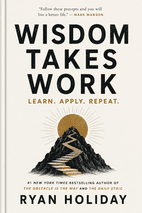
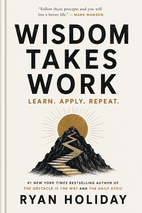
Ryan Holiday's Wisdom Takes Work presents wisdom as an active practice forged through disciplined training, curiosity, and humility, warning against the perils of success without self-awareness. Written for self-improvers and leaders seeking a concrete Stoic framework for daily life.
Feature
Insta.Page
Blinkist
Shortform
Summary Depth
Full Chapter-by-Chapter
15-min overview
Section-by-section guides
Audio Narration
✓
✓
✓
Visual Mindmaps
✓
✕
✕
AI Q&A
✓
✕
✕
Quizzes
✓
✕
✕
PDF Downloads
✓
✕
✓
Price
$89.99/yr
$146/yr (PRO)
$199/yr
*Competitor data last verified July 2026.
1 Page Summary
In Wisdom Takes Work, the second volume of his Stoic Virtues Series, Ryan Holiday argues that wisdom is not a passive gift but an active, ongoing practice forged through disciplined training, awareness of pitfalls, and the cultivation of empathy. The book presents wisdom as a continuous journey of inquiry, beginning with the "Agoge"—a personal training ground built on voracious reading, relentless curiosity, and the art of asking good questions. Holiday emphasizes that reading is a conversation with the dead, a cheap way to acquire hard-won knowledge, while curiosity acts as the engine that accelerates learning. Central to this training is the discipline of writing to clarify thought and the willingness to explore ideas one disagrees with, treating the mind like a cup that must remain empty enough to receive new insights.
The most distinctive element of Holiday’s approach is his warning against the "Sirens"—the perilous rocks of success without self-awareness. Using cautionary tales like Elon Musk’s catastrophic decisions and historical examples of closed-mindedness, Holiday diagnoses the greatest threat to wisdom as amathia, or intelligent foolishness: the failure to see one’s own blind spots. He argues that certainty, ego, and bias fill the mind so completely that nothing useful can enter. The antidotes are deliberate practices: writing to think clearly, assembling a "board of directors" of honest critics who can say no, and refusing to be a know-it-all. This section grounds the abstract virtue of wisdom in concrete, practical warnings against the very intelligence that can lead to self-destruction.
The book culminates in the concept of "Apotheosis"—touching the divine by rising above one’s circumstances through humility and lifelong learning. Abraham Lincoln serves as the central model, a man who transformed poverty, resentment, and suicidal depression into moral leadership through slow, permanent learning and brutal empathy. Holiday reframes empathy not as weakness but as a practical superpower, essential for understanding opponents and avoiding the arrogance that has doomed leaders throughout history. The intended audience is anyone seeking self-improvement, leadership, or a philosophical framework for daily life—readers will gain a concrete, actionable understanding of wisdom as the disciplined, lifelong work of staying curious, humble, and open to truth, even when it is uncomfortable.
Introduction: This Is the Way
Overview
Montaigne’s essays began as a personal experiment—an excuse to follow whatever sparked his curiosity, no matter how meandering. His biographer described him as a young dog chasing every distraction off the road, “loose-limbed” yet serious, peeling away layers of custom and prejudice like an artichoke. In a world shattered by religious war and intellectual upheaval, Montaigne saw an opportunity: the old authorities (church, tradition) had crumbled, opening the door for the individual to matter. His own simple question while playing with his cat—“Who is toying with whom?”—captured his entire project. He wanted to know anything and everything, from his own anatomy to the minds of animals, and he understood that this was a “thorny enterprise.”
Montaigne’s Method of Inquiry
He didn’t pretend the answers came easily. Writing for nearly a decade, filling over a thousand pages, he described his work as wandering through the mind’s inner folds—more difficult than it looked. This was a war against his own ignorance, not someone else’s. He pulled at threads that artists, journalists, psychologists, and memoirists have been weaving ever since. His approach was personal, playful, and utterly transgressive for its time: learning mattered, truth mattered, and he mattered as a subject worth exploring.
The Essays and Their Impact
In 1580, Montaigne published his first essays. They spread swiftly through literate France, reaching King Henry III, Francis Bacon, and eventually a self-taught playwright named Shakespeare, who cribbed a passage in The Tempest and may have turned Montaigne’s spirit into the famous line “To thine own self be true.” The books written solely for himself became bestsellers, still in print today. To celebrate, Montaigne traveled—not for business, but for experience. He explored ruins, read under trees, muttered the names of Caesar and Cicero in Rome, revised his essays at inns, dictated lines while trotting on horseback, and filled his saddlebags with more books. “Books are the best provisions a man can take with him on life’s journey.”
Life as a Citizen of the World
He couldn’t fully withdraw from public life. He consulted on fortifications, served as Gentleman of the Chamber to the future king, hosted dignitaries, went on diplomatic missions, corresponded with leading minds, and was elected mayor of Bordeaux—twice. Even thrown in the Bastille, his fame freed him. Through all this, he kept reading, writing, revising. In his final months, he still advised King Henry III. He had asked to be made an honorary citizen of Rome, but in truth he was a citizen of the world, conversing with the worthiest minds of past ages. He made his mark not in politics or battle or scholarship, but in a lifelong educational experiment—an effort to prove himself worthy of his father’s vision. He explored an unknown continent: himself. He asked more than he answered, read more than he wrote, saw more than he understood. He knew he’d be largely forgotten a hundred years later, yet he refused to despair and declined to write off humanity. In that, he was truly wise.
Key Takeaways
Education never ends; it eventually reverts into our own hands—we must teach ourselves to learn anything.
Ego is the enemy of wisdom; conceit blocks knowledge.
Stay curious, questioning, open, always ready to learn.
All accomplishments pale beside self-awareness.
Montaigne studied to show off, then to make himself wiser, and finally for amusement—never for profit. That evolution is the path.
Key concepts: Introduction: This Is the Way
1. Introduction: This Is the Way
Montaigne's Personal Experiment
Essays began as a personal, meandering curiosity
Peeling away layers of custom and prejudice
Questioning authority in a shattered world
Simple question: 'Who is toying with whom?'
Method of Inquiry
Wandering through the mind's inner folds
War against his own ignorance
Personal, playful, and transgressive approach
Learning mattered; he mattered as a subject
Essays and Their Impact
First essays published in 1580, became bestsellers
Influenced Shakespeare, Bacon, and King Henry III
Traveled for experience, not business
Books as best provisions for life's journey
Life as a Citizen of the World
Served as mayor of Bordeaux and diplomat
Fame freed him even when thrown in Bastille
Conversed with worthiest minds of past ages
Lifelong educational experiment exploring himself
Key Takeaways on Wisdom
Education reverts into our own hands
Ego is the enemy of wisdom
Stay curious, open, and ready to learn
Self-awareness outshines all accomplishments
💡 Try clicking the AI chat button to ask questions about this book!
Part I: The Agoge (Your Training Ground)
Overview
The training ground begins not with a classroom but with a startling realization: books are conversations with the dead. Zeno’s shipwreck and stumble upon a bookseller reading Socrates taught him that reading allows us to acquire wisdom cheaply, wisdom others earned through agony. The chapter drives this home with examples—Charles de Gaulle reading two to three books a week, Napoleon hauling 125 books into Egypt, Harry Truman devouring every history he could find and later using Plutarch to understand politicians. Not reading is a form of functional illiteracy, but reading itself is active work: annotating, arguing, quitting bad books. Then comes the engine that fuels that reading: curiosity. The Wright brothers didn’t start with profit; they started with a toy and a home full of books. Their mother never interrupted their projects. Curiosity accelerates—the more you know, the more you want to know. Seneca advised reading like a scout in enemy territory, exploring ideas you disagree with. And that curiosity finds its voice in the art of asking questions. Isidor Rabi’s mother asked him daily, “Did you ask a good question today?” That led to the MRI. Socrates, Richard Feynman’s father, and Marcus Aurelius’s mentor all modeled the discipline of staying humble enough to inquire.
Yet asking questions is worthless without the ability to focus. The story of Samuel Scudder staring at a dead fish for three days under Louis Agassiz illustrates that wisdom depends on intense, uninterrupted attention—not for minutes but for days and months. Richard Feynman demanded “absolute solid lengths of time” to do real physics. Marina Abramovic pushed focus to extremes, sitting motionless until perception itself transformed. Focus is a grueling practice, a ritual like Machiavelli changing out of muddy clothes before four hours of reading. Without it, discoveries slip away. And within that focus, there is the art of listening. Zeno chose Cleanthes, the silent manual laborer who listened for twenty years, over the brilliant talker Aristo. When you’re talking, you’re not learning. Marcus Aurelius urged practicing really hearing what people say. Gandhi traveled India with his ears open and mouth shut. The world speaks in whispers; be a sponge, not a mouth.
But even the best listener loses insights if they don’t build a second brain. Joan Didion started notebooks at age five as a “rainy-day fund.” The tradition of commonplace books—Pliny, Emerson, General Mattis—ensures you never start from zero. Capture everything; as Goethe said, a collection of anecdotes and maxims is a treasure. And where do you capture it? In your own classroom. Claude Monet refused the École des Beaux-Arts and learned to see light in the Algerian army. Leonardo da Vinci was illegitimate and self-taught. Eric Hoffer learned on the docks. Education isn’t something you get; it’s something you take. The key is finding the classroom that lights you up, even if it defies expectations.
That classroom often involves finding your teacher. Musonius Rufus expected silence and excellence from everyone; he turned away students just to see if they’d fight to get in. Epictetus learned under a master who had endured exile—and that pairing produced the thinker who inspired Marcus Aurelius. Crates pointed Zeno toward philosophy. Anne Sullivan unlocked Helen Keller’s world. Great teachers change lives; bad ones can steal futures. You can’t wait for the teacher to appear; you have to seek them, and then be patient—the student in a hurry learns the slowest. Once found, you must become an apprentice. Lyndon Johnson attached himself to powerful men, running errands and whipping votes, until he became a “professional son.” Nobody reaches potential alone. Jack London wrote that no one becomes a blacksmith without serving an apprenticeship. Bill Belichick volunteered as a driver just for twenty minutes of conversation with older coaches. You earn the mentorship by being hungry, coachable, and willing to serve first.
But you also need a scene. Scipio Aemilianus gathered philosophers and historians in what became the Scipionic Circle. Samuel Johnson’s Club brought together Burke, Gibbon, and Smith. Benjamin Franklin started the Junto. Brian Eno called it “scenius”—we get better inside a group. Your scene can meet monthly or in group texts, but it must make you better. Seneca advised associating with people who improve you, and welcoming those you can improve. And within that scene, you must study the past until it becomes part of you. George Patton was so deeply read in history that the past merged into his own identity. He read Shakespeare, the Bible, Plutarch—and stayed up till midnight by lamplight. History is not black-and-white theory; it’s biography, psychology, philosophy, human greatness and evil. The Greek word historia means inquiry, not passive reception. You unearth it piece by piece, and it prepares you for the future because, as Truman said, “The only thing new in the world is the history you do not know.”
Then hit the road. Herodotus traveled thousands of miles, inspecting temples and eating local food, to get at root causes and customs. Travel shakes ethnocentrism; every culture thinks its norms are normal. Montaigne traveled with open plans. Joan Didion called it a duty. Gandhi’s most creative experience happened in a South African train station where discrimination awakened his activism. The outer voyage facilitates the inner journey. And on that journey, you acquire experience. Plutarch wasn’t just a writer; he was a magistrate supervising sewers, burying a child, listening to complaints. “From things,” he said, “I somehow had an experience which enabled me to follow the meaning of words.” Education and experience form a loop—mutually reinforcing. Da Vinci called himself disscepolo della sperientia, a disciple of experience. T. E. Lawrence translated the Odyssey not just from Greek study but from his own odyssey in war. The purpose of knowledge is action. Get your reps in. Finally, mens sana in corpore sano—a strong mind needs a strong body. Socrates was admired for his physical endurance. The Romans considered a person poorly educated if they couldn’t read or swim. Philosophers walked; scientists hiked. Virtue is the cultivation of all traits: smart and strong, brains and courage, brawn and kindness. Neglect either, and you’re incomplete. The training ground demands everything you have.
The Power of Reading
The chapter opens with the story of Zeno, who as a young man journeyed to Delphi to ask the Oracle the secret to a good life. Her answer: “You will become wise when you begin to have conversations with the dead.” Years later, shipwrecked in Athens, Zeno stumbled upon a bookseller reading about Socrates—a man long dead—and suddenly understood. Books are conversations with the dead. They allow us to cheaply acquire wisdom that others earned through pain.
Yet most people neglect this. The average person watches twenty hours of TV a week and spends nearly five hours a day on their phone, while leaders like Charles de Gaulle read two to three books a week, Angela Merkel devoured fifteen-hundred-page histories, and General Mattis carved out an hour daily for reading even during war. Napoleon carried 125 books into Egypt; Franklin Roosevelt read Mein Kampf in German while managing the Great Depression. The excuse of not having time collapses. Books are absurdly cheap—often free at the library—and not reading them is a form of functional illiteracy.
Harry Truman read nearly every book in the local library by age fifteen, including the Bible three times and all the histories he could find. His reading age made him one of the oldest teenagers to come out of Missouri. He later used Plutarch’s biographies to understand people in politics. Great readers are not passive; they annotate, argue, and quit bad books. John Adams filled his margins with “Fool!” and “Nonsense!” but also “Excellent!” Reading is work, but it lets you gain cheaply what others learned through agony.
Curiosity as a Driver
The Wright brothers’ journey began not with profit but with pure curiosity. Their father brought home a toy with rubber bands and propellers, and they were hooked. Their home was filled with books—Thucydides, Darwin, Plutarch, Milton—and their mother never interrupted their projects. They were encouraged to follow intellectual interests without thought of profit. As Orville said later, “Making it pay came as an afterthought.” They reinvested bike shop earnings into flying experiments because it interested them.
Curiosity is accelerative: the more you know, the more you want to know. The Wrights read every book on flight from the Smithsonian, watched birds for hours, and asked endless questions. Seneca advised reading like a scout in enemy territory—exploring ideas you disagree with. The playwright Ben Jonson inscribed his books with tanquam explorator: “like an explorer.” Anne Frank’s father, when asked about the Roman Empire, didn’t dismiss her; he said, “Let’s see what we can find,” and took her to the library. That gift—that everything is figure-out-able—fuels discovery.
The Art of Asking Questions
Isidor Rabi’s mother didn’t ask if he learned anything; she asked, “Izzy, did you ask a good question today?” That simple
Key concepts: Part I: The Agoge (Your Training Ground)
2. Part I: The Agoge (Your Training Ground)
Reading as Active Work
Books are conversations with the dead
Annotate, argue, and quit bad books
Not reading is functional illiteracy
Read like a scout in enemy territory
Cultivating Curiosity
Curiosity accelerates with knowledge
Wright brothers started with a toy
Ask good questions like Isidor Rabi
Stay humble enough to inquire
The Discipline of Focus
Stare at a fish for three days
Demand absolute solid lengths of time
Focus is grueling practice and ritual
Without focus, discoveries slip away
The Art of Listening
When talking, you're not learning
Practice really hearing what people say
Be a sponge, not a mouth
World speaks in whispers
Building a Second Brain
Keep a commonplace book like Emerson
Capture everything as a rainy-day fund
Never start from zero
A collection of anecdotes is treasure
Finding Your Teacher and Apprenticeship
Great teachers change lives
Seek teachers; don't wait for them
Earn mentorship by being coachable
Nobody reaches potential alone
Studying the Past and Joining a Scene
History merges into your identity
Scenius makes you better in a group
Associate with people who improve you
History is inquiry, not passive reception
Part II: The Sirens (The Perilous Rocks You Must Beware)
Overview
The peril of success without self-awareness is embodied by Elon Musk, a modern Midas whose brilliance in rocket science and electric cars coexists with a catastrophic lack of humility. His story shows how the same intellect that revolutionizes industries can also engineer colossal self-inflicted destruction—buying Twitter for $44 billion only to burn it to the ground, tweeting lies and conspiracies, firing dissenters, and doubling down on disaster. This is not mere stupidity; it’s amathia, the intelligent foolishness the Greeks warned about, the failure to see the rocks right in front of you. The mind is a cup, and if it’s already full of certainty, ego, and bias, nothing useful can be poured in. Louis Agassiz, once a great scientist, became a creationist who stopped looking, and Pontius Pilate’s dismissal of Jesus—“What is truth?”—reveals the evil of closed-mindedness. To stay open, we must write to think clearly, as Thomas Merton and Eisenhower did, forcing our thoughts to travel all the way to the end of a sentence. We need a board of directors—people who can say no, like Marcus Aurelius had, not rubber-stampers like Musk’s. We must refuse to be know-it-alls: Harry Belafonte, David McCullough, and Sam Bankman-Fried all paid for pretending they already knew. That ignorance extends to our information diet: Donald Trump’s Fox News bubble, Musk’s obsessive scrolling, and the partisan noise we all mainline are poisons. The wise seek first principles but also respect hard-won convention; they avoid burnout like John Stuart Mill, who nearly killed himself before recovering through art and love. Changing your mind is painful but necessary—Richard Wright and Ralph Ellison broke with communism at great cost, but it allowed them to come alive. Growing up means healing the wounded child inside; Musk, still the bullied boy, seeks validation from mobs and breeds chaos. Snowflakes cannot handle discomfort, so they rationalize slavery or ban critics. Real wisdom seeks criticism—Marcus Aurelius treasured a critical letter more than praise, and Admiral Rickover reprimanded officers who never disagreed. Make mistakes, but never the same one twice: Lou Gehrig learned in real time. Go deep like da Vinci, who dissected thirty corpses, or Thomas Clarkson, who studied the slave trade from every angle. Don't fall for it: Kyrie Irving believed the earth was flat, Malcolm X was seduced by a cult, and Socrates himself lacked social intelligence, alienating the jury that condemned him. The final lesson is humility—the recognition that being wrong is not a sin, but being confidently wrong is the source of most evil in the world. The Sirens sing what we want to hear; wisdom is the discipline to stop our ears and steer clear.
Human history is a catalog of human stupidity, and every philosophical tradition agrees: the first step toward wisdom is shaking off the foolishness we're born with. The Greeks called it amathia—intelligent stupidity. The Vedas say ignorance causes suffering. The Bible warns that fools are gullible, easily upset, quick to quarrel. We all carry the seeds of certainty, smugness, fanaticism, bias, impulsiveness, groupthink, laziness. Wisdom is a constant war against these forces. And none of us—no matter how smart or educated—is immune.
The Storm Within Us
Elon Musk is a perfect case study. He's one of the smartest and richest people on earth—a man who taught himself rocket science from books, built SpaceX, Tesla, and a dozen other companies, and made the impossible look routine. He learned aerospace by devouring obscure Soviet manuals and textbooks on astrodynamics. He flew around the world quizzing experts until he knew 90% of what they knew. He applied first-principles thinking, questioning every assumption in the space industry, discovering that raw materials cost only 2% of the market price of rockets. He developed what he calls the "idiot index"—the gap between what something costs and what it should cost—and his algorithm: question everything, delete, simplify, operate with urgency, automate. He made reusable rockets. He revolutionized electric cars. He pushed humanity toward Mars.
But Plutarch would have spotted the flaw lurking beneath the colossus. Musk's narcissism is as profound as his brilliance. His ability to pass off his vision as a mandate from heaven became a messiah complex, unmoored from reality. "My mind is a storm," he admitted. His brother says he's a "drama magnet." The same man who used to read Feynman and Asimov now tweets five hundred times a day—roughly 30% of them false, misleading, or missing vital context. He's tweeted pandemic misinformation, cryptocurrency hype, and insults at a cave rescuer. He called a journalist's home address to his millions of followers. He made up "funding secured" and was fined $40 million by the SEC. He fired his longtime assistant, never replaced her, and now runs an impossible empire with no buffer.
His worst trait: a lack of loyalty, a total disregard for consequences. He ends up spreading Russian propaganda, endorsing neo-Nazis, mocking pronouns while his own child transitions, falsely accusing a young Jewish man of a "false flag" operation. He says the lines. He doesn't need anyone to read between them.
Musk's story is the Sirens' song made modern: the peril of success without self-awareness, of brilliance without humility, of a mind that can solve rocket science but cannot see the rocks right in front of it.
The purchase of Twitter was not just a bad business decision—it was a masterclass in self-inflicted destruction. Musk accumulated shares while violating securities law, impulsively agreed to a board seat only to rage-quit in a five-minute text exchange, then offered an absurdly inflated $44 billion for the whole company. He got what he wanted: a fire-breathing dragon. Then he proceeded to burn the house down. Within months, a $50 billion asset was worth less than $10 billion. But calling this a "mistake" misses the point. This was running the field end to end and scoring on your own goal, despite everyone—teammates, crowd, referee—trying to stop you. Musk screamed "FUCK ZUCK" in celebration, oblivious that he had just committed perhaps the biggest unforced error in business history.
The disaster wasn't a single blunder; it was a cascade of them. He rushed to sign away due diligence, then tried to back out citing too many bots—the very problem he claimed he wanted to solve. When the court forced him to close, he immediately laid off 80% of the workforce, then begged critical employees to come back. He got rid of PR and auto-replied to media inquiries with a poop emoji. He banned journalists, blocked the word "cisgender," stopped paying rent and janitorial services, picked fights with major advertisers, un-banned toxic trolls, and rebranded a seventeen-year-old global brand to "X." Two days before critical advertiser meetings, he posted a conspiracy theory about Nancy Pelosi's husband. When an employee told him to his face that it was "obvious partisan misinformation" and worried about his judgment, Musk fired them on the spot. "I'm a fucking idiot," he admitted to a crisis consultant. "I'm guilty of many self-inflicted wounds," he said in a deposition. Yes, he was.
The Fall of a Modern Midas
Yet to call Musk a fool is too simple—and too generous. It would excuse him of responsibility. The alarming truth is that he is smart enough to know better. He didn't get where he was by acting like this. For years, he truly had the Midas touch: he created billions, did the impossible, received fawning coverage, amassed a massive following. Every time critics doubted him, he proved them wrong. But the story of King Midas is a tragedy. Power corrupts. Success breeds bad habits. Pride goes before the fall. Musk developed a trademark style: entering ultracomplex businesses without knowing the nuances, and not letting that bother him. Domain expertise is tricky—sometimes transferable, sometimes not. Wisdom requires knowing the difference. Musk instead began viewing anyone who disagreed with him as an idiot. His rages were so common that employees called it "the idiot bit." Over time, this environment didn't just weed out the weak—it selected for sycophants and psychos. The kiss of death was "proving Elon wrong about something." No wonder he went the direction he did.
His second wife, Talulah Riley, once said her role was to keep him from going "king-crazy." After she left, he went quite king-crazy. The most dangerous thing that can happen to the smartest person in the world is to start believing they are the smartest person in the world. They become a very dangerous fool, thinking everything they do is smart, even when it's dumb. Musk's "demon mode"—sleeping at factories, pulling off logistical miracles—was celebrated, but the point of wisdom is to get out of tactical hell. A leader's job is not to lead their company into a ditch and then rally everyone out. It's to be strategic, calm, proactive. Even if Musk turns Twitter around, it will be the most pyrrhic victory. He destroyed his reputation, became a globally
Key concepts: Part II: The Sirens (The Perilous Rocks You Must Beware)
3. Part II: The Sirens (The Perilous Rocks You Must Beware)
The Peril of Success Without Self-Awareness
Elon Musk embodies brilliance without humility
Intellect can engineer self-inflicted destruction
Amathia: intelligent foolishness the Greeks warned about
Mind as a cup: full of ego, nothing useful enters
The Storm Within Us
Musk's narcissism matches his genius
Messiah complex unmoored from reality
Tweets 500 times daily, 30% false or misleading
Lack of loyalty and disregard for consequences
Staying Open: Writing and Counsel
Write to think clearly, force thoughts to completion
Need a board of directors who can say no
Refuse to be a know-it-all like Sam Bankman-Fried
Seek first principles but respect hard-won convention
Information Diet and Burnout
Avoid partisan bubbles like Trump's Fox News
Musk's obsessive scrolling is poison
John Stuart Mill nearly died before recovering through art
Changing your mind is painful but necessary
Growing Up and Handling Discomfort
Heal the wounded child inside like Musk's bullied boy
Snowflakes rationalize slavery or ban critics
Real wisdom seeks criticism, not praise
Admiral Rickover reprimanded officers who never disagreed
Learning Through Mistakes and Depth
Make mistakes but never the same one twice
Go deep like da Vinci dissecting thirty corpses
Thomas Clarkson studied slave trade from every angle
Don't fall for flat-earth thinking like Kyrie Irving
The Final Lesson: Humility
Being wrong is not a sin
Confidently wrong is the source of most evil
Sirens sing what we want to hear
Wisdom is discipline to stop ears and steer clear
Part III: The Apotheosis (Touching the Divine)
Overview
Abraham Lincoln is the central figure here, not because of his political success but because he rose from poverty, resentment toward his father, and relentless self-education to become a great moral leader. His mind learned slowly but permanently. It was forged through brutal labor, reading by firelight, and copying passages onto wooden boards. That same methodical approach later made him the era's sharpest student of the Constitution and human nature. Yet Lincoln's path was marked by terrible personal losses—lost loves, a dead son, suicidal depression. In that darkest period, he saw enslaved people chained like fish on a line. That encounter planted a moral conviction that eventually forced him from passivity into action.
Empathy is not weakness. It is a practical superpower. Lincoln used it to understand slave owners' fears, to see cases from all sides as a frontier lawyer, and to concede a diplomatic argument when he found no stronger rebuttal. This stands in stark contrast to the arrogance that doomed leaders from Athens to Vietnam. Humility—the cure for such arrogance—requires constantly admitting you might be wrong. Lifelong learning is the only proper response to this humility: Marcus Aurelius still studied, Da Vinci taught himself Latin at forty-two, and Neil Peart called a master "a master student." But learning must be passed forward through teaching, even when it costs you personally, because wisdom is a debt repaid only by freeing others from ignorance.
The more you learn, the more you realize you don't know. Embracing that mystery is essential. Self-awareness is the rarest human quality, requiring the uncomfortable work of journaling and honest reflection, as practiced by Montaigne and Joan Didion. This self-knowledge leads to freedom: Epictetus, born a slave, insisted that only the educated are truly free, because wisdom cannot be taken. Happiness cannot be chased directly; it is a byproduct of living virtuously, as Seneca and John Stuart Mill discovered. Suffering is unavoidable, but wisdom is optional—we can choose to learn from pain rather than let it harden us. Laughter is a survival tool and a leadership skill, as Lincoln proved when he read a crude story to his cabinet before unveiling the Emancipation Proclamation. Wonder must be protected against the cynicism that knowledge often brings; Feynman's test was whether an electron microscope photo made your heart flutter.
Facing death with wisdom means thinking about it ahead of time, as Montaigne and Seneca did, so that it loses its strangeness and cannot enslave you through fear. The final truth is that wisdom is virtue, and virtue is action. Words do not matter; deeds do. The cycle is learn, apply, repeat—not as a solitary exercise but as something passed across generations. The author's own path—dropping out of college, becoming an apprentice, keeping a commonplace book, writing daily for years—illustrates that real education happens through experience, mentors, and the willingness to be wrong. Speaking truth carries personal risk, especially when criticizing powerful figures, but that is the point of philosophy: to refuse to be part of the mob. Progress in wisdom cannot be measured by reaching some horizon, only by looking back at the distance covered—and the commitment is to keep showing up, day by day, trial by trial, wiser, not wise.
Key Takeaways
Lincoln's self-education was a fight against poverty and his father's opposition, creating a mind that learned slowly but remembered permanently.
His legal career gave him intimate knowledge of human nature—both its decency and its corruption—while his personal tragedies nearly destroyed him.
An encounter with enslaved people during his own depression seeded a moral conviction that eventually forced him from passivity to action.
Lincoln's opposition to slavery was grounded in careful historical research, not sentiment, revealing the founders' true intentions and the hypocrisy of pro-slavery arguments.
Empathy is a practical skill that lets you see the other side, not a weakness.
Arrogance creates disaster; humility—admitting you might be wrong—is essential wisdom.
Stay a student forever—mastery is a process, not a final state.
Teaching others is how we pay forward our debts and deepen our own understanding.
The more you know, the more you realize you don't know; embrace ambiguity and mystery.
Hold contradictory ideas with grace; avoid false certainty and accept the messiness of truth.
Self-awareness is rare but essential—use journals, reflection, and honest examination to know yourself.
Wisdom is freedom: it liberates you from impulses, illusions, and the tyranny of external events.
Happiness is not conditional on circumstances; it is a choice, rooted in virtue and the ability to be content with your own company.
Happiness is not found by chasing it directly; it emerges from living well, giving to others, and focusing on what's good.
Suffering is unavoidable, but wisdom is optional. Choose to learn from pain rather than let it harden you.
Laughter is a survival tool and a leadership skill—it disarms, reveals truth, and keeps you from breaking.
Wonder is essential for a meaningful life; protect it against the cynicism that knowledge often brings.
Wisdom is a cycle: learn, apply, repeat—in our own lives and across generations.
The fundamental choice is "thou mayest." We choose between virtue and vice, and no one grades us but ourselves.
Real education often happens outside classrooms, through experience, mentors, and the willingness to learn from mistakes.
Writing and contemplation are acts of self-discipline that make us better; the habit of a commonplace book keeps us sane and connected to truth.
Technology is a tool, not a substitute for the hard work of thinking, verifying, and wrestling with ideas.
Speaking truth is worth the personal risk; intelligence and power don't guarantee decency.
We must resist making excuses for our own cowardice—Marcus's question to himself applies to us.
Progress in wisdom is measured not by reaching the horizon, but by looking back at the distance covered.
The fruits of practice: calmer, quieter, less argumentative, more willing to admit fault.
Self-awareness is hard work but essential for healing and growth.
The journey continues beyond the book—the commitment is to keep showing up, day by day.
Key concepts: Part III: The Apotheosis (Touching the Divine)
4. Part III: The Apotheosis (Touching the Divine)
Lincoln's Forged Mind
Rose from poverty through relentless self-education
Methodical learning made him a sharp constitutional student
Personal losses planted moral conviction against slavery
Empathy as Superpower
Empathy is practical, not weakness
Used to understand opponents and see all sides
Contrasts with arrogance that doomed past leaders
Humility & Lifelong Learning
Humility requires admitting you might be wrong
Lifelong learning is the proper response
Learning must be passed forward through teaching
Self-Awareness & Freedom
Self-awareness is rare, requires journaling
Only the educated are truly free
Happiness is a byproduct of virtuous living
Suffering, Laughter & Wonder
Suffering is unavoidable, wisdom is optional
Laughter is a survival tool and leadership skill
Protect wonder against cynicism from knowledge
Facing Death with Wisdom
Think about death ahead to lose its strangeness
Death cannot enslave you through fear
Wisdom is virtue, and virtue is action
The Cycle of Wisdom
Learn, apply, repeat across generations
Real education comes from experience and mentors
Progress measured by distance covered, not horizon
You've reached the end of the free chapters
Chapter 5 is locked
Keep reading Wisdom Takes Work — and unlock all 600+ book summaries with audio, mindmaps and AI Q&A.
$0.00 due today · 7 days free, then $89.99/year ($7.49/mo) · Cancel anytime before day 7
Ryan Holiday is a modern Stoic philosopher and bestselling author known for books like "The Obstacle Is the Way" and "The Daily Stoic," which apply ancient Stoic principles to contemporary life and business. A former marketing director for American Apparel, he is a prominent media strategist and writes extensively on strategy, perception, and resilience.
Frequently Asked Questions about Wisdom Takes Work
What is Wisdom Takes Work about?
The book explores how to cultivate wisdom through active practices like deep reading, curiosity, and asking good questions. It warns against intellectual pitfalls such as ego and closed-mindedness, offering historical examples from Montaigne to Lincoln. Ultimately, it presents a path to growth through humility, empathy, and lifelong learning.
Who is the author of Wisdom Takes Work?
Ryan Holiday is a bestselling author known for his works on Stoicism and practical philosophy. He draws on historical figures and modern examples to illustrate timeless lessons on wisdom and self-improvement.
Is Wisdom Takes Work worth reading?
Yes, because it combines engaging storytelling with actionable insights for personal growth. The book challenges readers to embrace intellectual humility and curiosity, making it a valuable guide for anyone seeking to navigate a complex world.
What are the key lessons from Wisdom Takes Work?
Key lessons include the importance of reading actively and with curiosity, as well as the need to stay open-minded and avoid the trap of knowing everything. Empathy is portrayed as a practical superpower, and lifelong learning is essential for wisdom. Finally, humility and a willingness to be wrong are crucial for personal development.
📚 Explore Our Book Summary Library
Discover more insightful book summaries from our collection