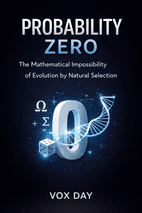
Vox Day's Probability Zero applies probability and information theory to argue against evolutionary biology, concluding complex life requires intelligent design. It serves readers seeking mathematical critiques of Darwinian mechanisms from an intelligent design perspective.
Feature
Insta.Page
Blinkist
Shortform
Summary Depth
Full Chapter-by-Chapter
15-min overview
Section-by-section guides
Audio Narration
✓
✓
✓
Visual Mindmaps
✓
✕
✕
AI Q&A
✓
✕
✕
Quizzes
✓
✕
✕
PDF Downloads
✓
✕
✓
Price
$89.99/yr
$146/yr (PRO)
$199/yr
*Competitor data last verified July 2026.
1 Page Summary
Probability Zero by Vox Day (the pseudonym of Theodore Beale) is a polemical work that argues against the scientific validity of the modern evolutionary synthesis. The book's central thesis is that the mathematical probability of complex biological structures arising through the unguided process of natural selection is effectively zero, rendering the theory a statistical impossibility. Day attempts to support this by applying concepts from probability theory and information theory, such as calculating the odds of specific proteins or genetic sequences assembling by chance, concluding that even over billions of years, the required combinations could not occur without intelligent guidance. The work is fundamentally a case for intelligent design, positioning itself as a mathematical refutation of Darwinian mechanisms.
The book exists within the historical context of the long-standing conflict between evolutionary biology and creationist or intelligent design movements. It draws directly from the arguments of figures like William Dembski and his concept of "specified complexity," attempting to formalize a mathematical critique that has been repeatedly rejected by the mainstream scientific community. Day frames his argument as a logical and quantitative takedown, bypassing traditional biological evidence to focus on statistical improbability, a tactic common in this genre of anti-evolution literature. The work is less an engagement with contemporary evolutionary theory—which does not posit chance assembly but the non-random process of natural selection acting on variation—and more a restatement of classic creationist probability arguments.
The lasting impact of Probability Zero is confined almost entirely to circles already skeptical of evolutionary science. It has not influenced mainstream scientific thought, as its core mathematical objections are based on fundamental misunderstandings of evolutionary processes, such as treating evolution as a series of independent random events rather than a cumulative, branching process with selection pressures. The book's primary significance lies as a resource for those advocating for intelligent design, serving as a purported "mathematical" justification for their position. However, within academia and the broader scientific community, its arguments are considered refuted, and the book stands as an example of the persistent attempt to use quantitative fields to challenge biological consensus without engaging with the actual theory's mechanisms.
Probability Zero
Overview
The chapter builds a case that evolution by natural selection is not just scientifically contentious but a mathematical impossibility. It argues that the probabilistic resources of time and population size throughout Earth's history are insufficient to account for the genetic complexity we observe. The narrative positions this not as a theological argument, but as a statistical one, grounded in the laws of mathematics and population genetics.
The Core Mathematical Challenge
The central problem posed is the sheer number of specific, beneficial mutations required to build complex biological systems. The chapter contends that even with billions of years and vast populations, the probability of these mutations arising and successfully fixing in a population is effectively zero. This introduces the concept of "waiting time"—the statistically expected time for a needed mutation to appear—which is argued to be far longer than the age of the universe for many evolutionary steps.
The Debates and Defining Models
A significant portion of the narrative recounts specific intellectual battles, like the Gariepy Debate, which served as a catalyst for refining these mathematical objections. From these engagements, key models were developed, most notably the MITTENS model and the Bio-Cycle Fixation Model. These attempt to formally quantify the limits of evolutionary change, incorporating factors like generational turnover and the compounding improbability of consecutive necessary mutations.
Addressing Evolutionary Counterarguments
The chapter anticipates and attempts to dismantle common evolutionary rebuttals, labeled as "escape hatches." These include the role of genetic drift (argued to be insufficient for complex adaptation) and the "Ancestral Alibi"—the idea that shared genetics in common ancestors reduces the need for new mutations. The author argues these do not resolve the fundamental probability crisis, leading to what is termed "The Question Darwin Could Not Answer": how to bridge the mathematical gap between simple beginnings and complex life.
An Alternative Explanation
Having argued natural causes are mathematically incapable, the chapter points toward Intelligent Genetic Manipulation as the only viable alternative that fits the evidence of rapid, specified genetic change. It concludes that the mathematical verdict is clear: unguided evolution cannot be the engine of biological complexity.
Key Takeaways
The argument against evolution is framed not in biological terms, but as a statistical impossibility, claiming the required mutations exceed the probabilistic resources of time and population.
Models like MITTENS and the Bio-Cycle Fixation Model are presented as formal demonstrations of this impossibility, focusing on the limitations of mutation fixation rates.
Standard evolutionary explanations like genetic drift and common descent are rejected as inadequate "escape hatches" that fail to address the core mathematical hurdle.
The conclusion is that an intelligent agent capable of direct genetic manipulation is presented as the only mathematically plausible explanation for observed biological complexity.
Key concepts: Probability Zero
1. Probability Zero
The Statistical Impossibility Argument
Evolution by natural selection is framed as mathematically impossible, not just biologically contentious
Probabilistic resources (time and population size) throughout Earth's history are insufficient for observed genetic complexity
The 'waiting time' for necessary mutations exceeds the age of the universe for many evolutionary steps
The argument is positioned as statistical rather than theological, grounded in mathematics and population genetics
Core Mathematical Models and Formulations
The MITTENS model quantifies limits of evolutionary change through mutation fixation rates
The Bio-Cycle Fixation Model incorporates generational turnover and compounding improbability of consecutive mutations
Models demonstrate that beneficial mutations required for complex systems cannot arise within available probabilistic resources
Intellectual debates (like the Gariepy Debate) catalyzed refinement of these mathematical objections
Counterarguments and Evolutionary 'Escape Hatches'
Genetic drift is argued to be insufficient for driving complex adaptation
The 'Ancestral Alibi' (shared genetics in common ancestors) fails to resolve the probability crisis
Standard evolutionary explanations cannot bridge the mathematical gap between simple beginnings and complex life
Leads to 'The Question Darwin Could Not Answer' regarding mathematical feasibility
Intelligent Genetic Manipulation as Alternative
Unguided evolution is mathematically incapable of producing observed biological complexity
Intelligent Genetic Manipulation is presented as the only viable alternative explanation
Direct genetic intervention fits evidence of rapid, specified genetic change
The mathematical verdict points toward intelligent agency rather than natural processes
💡 Try clicking the AI chat button to ask questions about this book!
Foreword
Overview
Frank J. Tipler's foreword serves as a provocative introduction to Vox Day's forthcoming argument, framing it as a definitive mathematical dismantling of Neo-Darwinism. He positions the work within a historical context of scientific skepticism and presents a directed alternative to evolution, which he names the "Gray Day Theory." The tone is one of confident challenge, asserting that the established view of evolution is not only flawed but mathematically impossible.
The Core Mathematical Challenge
Tipler zeroes in on the concept of randomness as the critical weakness in Darwinian theory. He explains that because natural selection relies on random genetic variations, and since most random mutations are harmful, an astronomically high number of generations would be required to stumble upon a beneficial one. He cites the pivotal 1966 Wistar Institute Conference, where mathematicians argued that the Earth's history simply does not contain enough generations for random mutation and selection to account for the observed complexity of life. Therefore, evolution as an undirected process is declared mathematically untenable.
Proposing an Alternative: The Gray Day Theory
If evolution cannot be random, Tipler argues, it must be directed. He introduces Vox Day's work as a sophisticated revival and extension of 19th-century botanist Asa Gray's idea that God directs variation. Dubbing this synthesis the "Gray Day Theory," Tipler claims it offers a superior and testable alternative. He provocatively links this to quantum mechanics, stating an appendix will prove the theory is implied by it, and invokes Albert Einstein's rejection of cosmic randomness ("God does not play dice") to lend philosophical and scientific weight to the idea of a deterministic, directed evolutionary process.
Historical Context and Claimed Significance
Tipler draws a parallel between the contributions of Asa Gray and Vox Day to those of Charles Darwin and Gregor Mendel. Just as Mendel's genetics were later synthesized with Darwin's ideas to form the "Modern Synthesis," he posits that Day is adding the essential genetic DNA component to Gray's original theory of directed variation. He concludes with a bold, unqualified assertion that Probability Zero represents "the most rigorous mathematical challenge to Neo-Darwinian theory ever published."
Key Takeaways
The foreword asserts a fundamental mathematical impossibility in Neo-Darwinism, centering on the insufficiency of time and generations for random mutations to produce observed complexity.
It rejects undirected, random evolution in favor of a directed process, synthesizing the ideas of Asa Gray and Vox Day into the "Gray Day Theory."
Tipler positions this theory as scientifically legitimate, claiming it is testable, supported by quantum mechanics, and aligned with a deterministic view of the universe exemplified by Einstein.
The argument is framed as a necessary correction to what is characterized as a philosophically driven adherence to a falsified theory.
Key concepts: Foreword
2. Foreword
The Mathematical Impossibility of Neo-Darwinism
Identifies randomness in genetic variation as the critical weakness of Darwinian theory
Cites the 1966 Wistar Institute Conference where mathematicians challenged evolutionary timescales
Declares Earth's history contains insufficient generations for random processes to achieve observed complexity
Concludes undirected evolution is mathematically untenable
The Gray Day Theory: A Directed Alternative
Proposes evolution must be directed if it cannot be random
Revives and extends 19th-century botanist Asa Gray's idea of God-directed variation
Claims the theory offers a superior, testable alternative to Neo-Darwinism
Links the theory to quantum mechanics, suggesting an appendix will prove this connection
Invokes Einstein's rejection of cosmic randomness ('God does not play dice') for philosophical support
Historical Significance and Synthesis
Draws parallel between Gray/Day and Darwin/Mendel contributions
Posits Day adds essential genetic DNA component to Gray's original directed variation theory
Frames this as analogous to Mendel's genetics synthesizing with Darwin's ideas
Claims Probability Zero represents 'the most rigorous mathematical challenge to Neo-Darwinian theory ever published'
Positions the work as a necessary correction to philosophically-driven adherence to a falsified theory
Introduction
Overview
This introduction presents a sweeping indictment of Enlightenment-era ideas, arguing they have progressively failed under modern scrutiny. It positions Darwin's theory of evolution by natural selection as the latest and most significant concept to face collapse, not through philosophical debate, but via a straightforward mathematical calculation that reveals it to be a statistical impossibility for explaining human origins.
The Collapse of Enlightenment Ideals
The chapter opens by charting the gradual abandonment of core 18th-century philosophies. Faith in reason and social contracts was shattered by the violence of the French Revolution. Utilitarianism failed to become a practical governing system. More recently, pillars like representative democracy, free speech, and free trade are seen as crumbling against modern realities. The author notes his own contribution to dismantling David Ricardo's theory of comparative advantage, which underpins free trade. A clear pattern emerges: the more abstract and aspirational the idea, the worse it has held up over time when subjected to empirical testing.
Darwin's "Dangerous Idea" as the Ultimate Target
While a 19th-century concept, Darwin's theory of evolution by natural selection is framed as the pinnacle and most important legacy of Enlightenment naturalist philosophy—a "universal acid" that transformed our worldview by explaining life through purely material causes. Quotes from prominent scientists across generations underscore its perceived profound importance. The author argues that just as cheaper travel and communication allowed the real-world testing of free trade's claims, advances in genetic science have now provided the tools to put Neo-Darwinian evolution to a definitive, quantitative test.
The Mathematical Verdict
The core of the argument is a direct probability calculation. Using the genetic divergence between humans and chimpanzees as a test case, the author lays out the variables:
It requires an estimated 20 million fixed mutations in the human lineage since diverging from a common ancestor with chimpanzees.
The estimated time for this divergence allows for 450,000 generations.
The fastest rate of fixed mutations ever observed (in lab bacteria) is one per 1,600 generations.
The math is stark: 450,000 generations ÷ 1,600 generations per mutation = a maximum of 281 possible fixed mutations. This accounts for a mere 0.0014% of the needed genetic change. The author states he has generously skewed every assumption in favor of Neo-Darwinism (using longer timeframes, faster rates, smaller genetic gaps) and the theory still fails catastrophically. Under more realistic assumptions, the percentage becomes even more negligible.
Institutional Resistance and New Evidence
The chapter concludes by addressing why this seemingly obvious arithmetic hasn't toppled the theory. It claims that elite mathematicians and physicists have raised serious objections since the 1960s, but that institutional biology—poorly trained in math and statistics—dismisses outside critique. The book positions itself as necessary because biologists "couldn't do the math" and "refused to listen to those who could." The final piece, the author asserts, is the recent mapping of the human and chimpanzee genomes, which provides the empirical data to validate the long-standing logical and mathematical objections, making denial impossible.
Key Takeaways
Enlightenment ideas are failing systematically when tested against modern empirical reality.
Darwinian evolution is positioned as the most significant and now the most vulnerable of these ideas.
A straightforward mathematical calculation, using the human-chimpanzee divergence, demonstrates that evolution by natural selection is statistically impossible as the primary engine for speciation.
The author claims the argument is conclusive, bolstered by recent genomic data and the historical dismissal of valid mathematical criticism from outside the field of biology.
Key concepts: Introduction
3. Introduction
The Collapse of Enlightenment Ideals
Enlightenment-era ideas have progressively failed under modern empirical scrutiny.
Core philosophies like reason, social contracts, and utilitarianism shattered by historical events like the French Revolution.
Modern pillars like representative democracy, free speech, and free trade are seen as crumbling against modern realities.
Abstract and aspirational ideas have held up poorly when subjected to empirical testing over time.
The author contributed to dismantling David Ricardo's theory of comparative advantage, which underpins free trade.
Darwin's Theory as the Ultimate Enlightenment Target
Darwin's theory of evolution by natural selection is framed as the pinnacle of Enlightenment naturalist philosophy.
Described as a 'universal acid' that transformed worldview by explaining life through purely material causes.
Quotes from prominent scientists underscore its perceived profound importance across generations.
Advances in genetic science now provide tools for definitive quantitative testing of Neo-Darwinian evolution.
Positioned as the most significant and now most vulnerable Enlightenment legacy.
The Mathematical Verdict Against Evolution
Probability calculation reveals evolution as statistically impossible for explaining human origins.
Requires 20 million fixed mutations but only 450,000 generations available since human-chimpanzee divergence.
Fastest observed mutation rate (lab bacteria) allows maximum of 281 possible fixed mutations.
This accounts for only 0.0014% of needed genetic change, even with generous assumptions favoring Neo-Darwinism.
Under more realistic assumptions, the percentage becomes even more negligible.
Institutional Resistance and New Evidence
Elite mathematicians and physicists have raised serious objections since the 1960s.
Institutional biology dismissed outside critique due to poor training in math and statistics.
Biologists 'couldn't do the math' and 'refused to listen to those who could.'
Recent mapping of human and chimpanzee genomes provides empirical data to validate mathematical objections.
The book positions itself as necessary to present conclusive evidence making denial impossible.
The Basics of Genetic Science
Overview
This chapter lays the essential groundwork in genetic science for readers new to biology, using clear analogies and straightforward explanations. It introduces the fundamental concepts—DNA, genes, mutations, and fixation—that are crucial for understanding the mathematical arguments about evolution that follow. The tone is reassuring and accessible, emphasizing that anyone can grasp these ideas, which serve as the building blocks for evaluating the Theory of Evolution by Natural Selection.
DNA: The Blueprint of Life
Imagine DNA as a detailed recipe book for constructing and operating a living organism. It's a molecule called Deoxyribonucleic Acid, written in a four-letter alphabet: A (Adenine), T (Thymine), G (Guanine), and C (Cytosine). These letters, known as nucleotides or bases, form the rungs of DNA's iconic twisted ladder, the double helix. The sides are made of sugar and phosphate, while the rungs consist of base pairs where A always pairs with T, and G always pairs with C. Genome size is typically measured in these base pairs, with the human genome containing a staggering 3 billion.
The Human Genome: Scale and Organization
Your entire genetic code, the human genome, is composed of approximately 3 billion base pairs. If printed as text, it would fill about 200 phone books. This DNA is packaged into 23 pairs of chromosomes, totaling 46 in most cells, with half inherited from each parent. Among these, one pair determines biological sex (XX for female, XY for male), and the other 22 are autosomes. Humans have around 20,000 genes, which is surprisingly close to the count in a tiny worm, highlighting that biological complexity arises more from how genes are regulated and interact than from sheer numbers.
Genes and Their Coding Sequences
Genes are specific sections of DNA that provide instructions for making proteins—the workhorses of your body, responsible for structures, signals, immunity, and chemical reactions. Within each gene, the coding sequence is the part that directly dictates protein construction. This sequence varies in length, from as small as 150 base pairs to as large as 90,000, with an average of about 1,250 base pairs. It's here, in the coding sequence, that mutations can have tangible effects, potentially altering proteins and influencing evolution.
Understanding Mutations
A mutation is any change to the DNA sequence, ranging from minor tweaks to major overhauls. These include point mutations (where a single base pair changes, also called SNPs), insertions (adding extra base pairs), deletions (removing base pairs), and chromosomal rearrangements (moving or copying large DNA segments). Most mutations are either neutral or harmful, with only a rare few offering benefits. For evolution to occur, beneficial mutations must not only arise but also spread through populations.
The Concept of Fixation
Fixation is the process by which a mutation becomes universal within a species. When a mutation first appears, it exists in only one individual. To become a permanent trait, it must spread until every member of the population carries it. This takes time—often many generations—depending on factors like population size and the advantage the mutation confers. Even highly beneficial mutations require significant periods to reach fixation, a bottleneck that shapes evolutionary timelines.
Comparing Humans and Chimpanzees
Evolutionary theory posits that humans and chimpanzees share a common ancestor, known as the Chimpanzee-Human Last Common Ancestor (CHLCA), which lived roughly 6 to 9 million years ago. While their DNA is often cited as 98% identical, this still translates to about 40 million genetic differences. Detailed studies, like the Chimpanzee Genome Project, identify around 35 million point mutations and 5 million insertion/deletion events. Since divergence, each lineage accumulated unique mutations, meaning approximately 20 million fixed mutations distinguish humans from the CHLCA.
Generations and Evolutionary Time
A generation is the average time between the birth of parents and their offspring—about 20 years for humans. Using a 9-million-year timeline since the CHLCA, this gives roughly 450,000 generations for mutations to accumulate and fix in the human lineage. However, there's a critical discrepancy: standard fixation models in population genetics assume that each generation represents complete population turnover, where all parents reproduce simultaneously and then vanish. In reality, human populations have multiple overlapping generations, with only about 24% turnover per 20-year period. This mismatch between model assumptions and actual demographics has profound implications for calculating whether there's been enough time for observed genetic changes.
Essential Terminology
To avoid confusion, the chapter clarifies key terms: base pairs (nucleotide pairs), genome (full DNA set), SNP (single nucleotide polymorphism), allele (gene variant), fixation (100% mutation frequency), CHLCA (common ancestor), TENS (Theory of Evolution by Natural Selection), and MITTENS (Mathematical Impossibility of TENS). These definitions help readers navigate the scientific jargon with ease.
The Crucial Numbers
Here are the pivotal figures that anchor the book's argument: the human genome has 3 billion base pairs and 20,000 genes; humans and chimps differ by 40 million fixed mutations; with 20 million unique to humans; a human generation is 20 years; and there have been about 450,000 generations since the CHLCA. These numbers set the stage for the central question: is 450,000 generations sufficient for 20 million mutations to reach fixation in the human lineage through natural selection?
Key Takeaways
DNA functions as a genetic blueprint, with a four-letter code (A, T, G, C) forming base pairs in a double helix structure.
The human genome contains 3 billion base pairs organized into chromosomes, with around 20,000 genes that code for proteins.
Mutations are changes in DNA, and fixation is the process by which they become universal in a population.
Humans and chimpanzees diverged from a common ancestor 6-9 million years ago, resulting in about 40 million genetic differences.
Human generations are approximately 20 years, but standard evolutionary models assume unrealistic population turnover, affecting fixation timelines.
The core inquiry is whether 450,000 generations provide enough time for 20 million mutations to fix in humans, challenging classical evolutionary mathematics.
Key concepts: The Basics of Genetic Science
4. The Basics of Genetic Science
DNA: The Blueprint of Life
DNA is a molecule (Deoxyribonucleic Acid) written in a four-letter alphabet: A, T, G, C.
These nucleotides form base pairs (A-T and G-C) in the double helix structure.
Genome size is measured in base pairs, with the human genome containing about 3 billion.
The Human Genome: Scale and Organization
The human genome is packaged into 23 pairs of chromosomes (46 total), half from each parent.
Humans have approximately 20,000 genes, similar in number to simpler organisms.
Biological complexity arises from gene regulation and interaction, not just gene count.
Genes and Their Coding Sequences
Genes are DNA sections that provide instructions for making proteins.
The coding sequence within a gene dictates protein construction and varies in length.
Mutations in coding sequences can alter proteins and influence evolution.
Understanding Mutations
Mutations are changes to DNA sequence, including point mutations, insertions, deletions, and rearrangements.
Most mutations are neutral or harmful; beneficial ones are rare.
For evolution, beneficial mutations must arise and spread through populations.
The Concept of Fixation
Fixation is when a mutation becomes universal within a species.
It requires spreading from one individual to the entire population over many generations.
The time to fixation depends on population size and the mutation's advantage.
Comparing Humans and Chimpanzees
Humans and chimps share a common ancestor (CHLCA) from 6-9 million years ago.
Their DNA is about 98% identical, equating to roughly 40 million genetic differences.
Humans have accumulated about 20 million fixed mutations since diverging from the CHLCA.
Generations and Evolutionary Time
A human generation is about 20 years, giving roughly 450,000 generations since the CHLCA.
Standard fixation models assume complete population turnover per generation, which doesn't match reality.
Actual human populations have overlapping generations with only about 24% turnover per 20-year period.
Essential Terminology
Key terms include base pairs, genome, SNP, allele, fixation, CHLCA, TENS, and MITTENS.
These definitions help navigate scientific jargon and clarify the book's arguments.
The Crucial Numbers
Human genome: 3 billion base pairs, 20,000 genes.
Human-chimp difference: 40 million fixed mutations (20 million unique to humans).
Evolutionary timeline: 450,000 generations since CHLCA.
Central question: Is 450,000 generations sufficient for 20 million mutations to fix via natural selection?
DNA Structure and Function
DNA serves as the genetic blueprint, using a four-letter chemical code (A, T, G, C).
The molecule forms a double helix structure where A pairs with T and G pairs with C.
This structure and code are fundamental for storing and transmitting genetic information.
Scale of the Human Genome
The human genome comprises approximately 3 billion base pairs.
This genetic material is organized into chromosomes.
It contains roughly 20,000 genes that directly code for proteins.
Genetic Variation and Mutation
Mutations are changes in the DNA sequence.
Fixation is the evolutionary process by which a mutation becomes universal within a population.
The chapter questions if there has been enough time for the necessary number of mutations to fix in humans.
Human-Chimpanzee Divergence
Humans and chimpanzees share a common ancestor from 6-9 million years ago.
This divergence has resulted in an estimated 40 million genetic differences between the two species.
The chapter focuses on the subset of approximately 20 million mutations that would need to fix in the human lineage.
Challenges to Evolutionary Timelines
Human generations are approximately 20 years long.
Standard population genetics models often assume unrealistic, rapid population turnover.
Given 450,000 generations since divergence, the core inquiry is whether this provides sufficient time for 20 million mutations to fix, challenging classical mathematical models.
You've reached the end of the free chapters
Next chapter: “The Descent of the Theory of Evolution by Natural Selection” is locked
Keep reading Probability Zero — and unlock all 600+ book summaries with audio, mindmaps and AI Q&A.
$0.00 due today · 7 days free, then $89.99/year ($7.49/mo) · Cancel anytime before day 7
Vox Day is the pen name of Theodore Beale, an American author and blogger known for his science fiction and fantasy works, including the "Sword of the Daywalker" series and the "Alt-Hero" comics. His writing and online commentary are often associated with the "Sad Puppies" movement within science fiction fandom and controversial political and cultural viewpoints.
📚 Explore Our Book Summary Library
Discover more insightful book summaries from our collection