As an Amazon Associate, we earn from qualifying purchases.
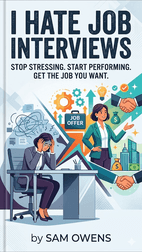
What is the book I Hate Job Interviews about?
Sam Owens's I Hate Job Interviews provides a systematic ten-hour preparation framework for mastering interviews, covering confidence-building, inside information gathering, story crafting, and negotiation. Written for anyone who dreads job interviews, from first-time seekers to seasoned professionals.
Feature
Insta.Page
Blinkist
Shortform
Summary Depth
Full Chapter-by-Chapter
15-min overview
Section-by-section guides
Audio Narration
✓
✓
✓
Full access to all 700+ summaries
✓
✓
✓
Visual Mindmaps
✓
✕
✕
AI Q&A
✓
✕
✕
Missing a book? Request it, usually live within 48h
✓
✕
✕
Quizzes
✓
✕
✕
PDF Downloads
✓
✕
✓
Send to Kindle
✓
✓
✓
Price
$89.99/yr
$146/yr (PRO)
$199/yr
*Competitor data last verified July 2026.
1 Page Summary
In I Hate Job Interviews, Sam Owens tackles the pervasive anxiety and self-doubt that plague job seekers, arguing that the biggest obstacle to success is internal—namely, a candidate's own lack of confidence. The book’s central thesis is that interviewing is a skill that can be systematically learned and mastered through specific, actionable preparation. Owens introduces core concepts like identifying and replacing "Bad Interview Thoughts (BITs)" and committing to a rigorous ten-hour preparation plan, which includes research, crafting "power examples," and extensive live practice. The author’s approach is distinctive for its confrontational yet pragmatic tone, encouraging readers to find the part of interviewing they hate most—the "suck"—and lean into it until it becomes a strength.
The book provides a step-by-step playbook for every stage of the interview process, moving from pre-interview intelligence gathering to mastering specific question types. Owens emphasizes the power of "inside information" gained through informational interviews and reframing the job description as an "open-book test." For behavioral questions, he introduces the SPAR model (Situation, Problem, Action, Result) and the concept of "bucketing" stories by core skills. The author also provides strategies for handling difficult scenarios, including trap questions, illegal or wacky queries, and open-ended scenario problems using a "Home Base" model. Later chapters cover the critical final phases: asking strategic questions, closing the interview convincingly, following up, and negotiating compensation using principles like the "milk analogy" and a focus on outward-facing value.
The intended audience is clearly anyone who dreads or feels underprepared for job interviews, from first-time job seekers to seasoned professionals. Readers will gain a systematic framework that transforms interviewing from a nerve-wracking ordeal into a manageable, skill-based challenge. What distinguishes this book is its promise that with deliberate effort—specifically, finding and overcoming the most uncomfortable part of the process—a candidate can gain a decisive edge over the competition. The book concludes by emphasizing that the ultimate goal is not just to land a job, but to thrive in the first critical months by focusing on relationship-building with a manager and executing on early performance.
Chapter One: Convince Your Harshest Critic: Believing in Yourself Changes Everything
Overview
The cost of low confidence is laid bare from the very first page: a thirteen-year-old kid who can’t sell a single newspaper subscription because his own disbelief has become a neon sign visible to every potential customer. If you wouldn’t trust a doubting roofer or a shaky-handed surgeon, why would an interviewer trust a candidate radiating self-doubt? The good news is that genuine confidence isn’t magic—it’s built. The mind first needs a cleanup: those destructive Bad Interview Thoughts (BITs) —like the idea that some people are born interviewers, that introverts are at a disadvantage, or that interviewers decide in five minutes—must be called out and replaced with truth. Only then can real preparation begin. And preparation means finding the part of interviewing you hate most—the "suck" —and leaning into it until it becomes a secret weapon. That’s what separates good interviewees from great ones. The chapter then introduces a concrete commitment: ten hours of preparation—three for research (including talking to real people), three for formulating power stories and answers, and four for practicing out loud until the words become fluid. A side-by-side comparison shows why an adequate B-plus interview loses every time to a candidate whose polish comes from deliberate work. A simple preparation checklist breaks the whole process into manageable tasks. Ultimately, self-belief isn’t won by positive thinking alone; it’s earned through the discipline of overpreparing, focusing on your weakest areas, and showing up with the evidence that you’ve done the work. That’s what convinces your harshest critic—yourself.
The Cost of Low Confidence
It’s 1995, and a thirteen-year-old kid is picked up from a street corner after failing to sell a single newspaper subscription. My boss points out what’s obvious: the kid is slouched, frowning, looking at his feet. He projects misery. After a few rejections, he stopped believing in himself, and that disbelief became a flashing sign that pushed customers away.
You wouldn’t hire a roofer who doubts their own abilities, or a pilot who seems wishy-washy, or a surgeon whose hands tremble with nerves. So why would an interviewer hire someone who radiates self-doubt? Confidence isn’t just nice to have—it’s the foundation of trust. If you don’t believe you’re the right hire, why should they? The good news: genuine confidence isn’t a mystical gift. It’s built through hard work and preparation. Three principles anchor that foundation.
Bad Interview Thoughts (BITs)
Your brain can’t run on negative narratives and expect to perform. I call these destructive thoughts BITs—bad interview thoughts. They’re the mental equivalent of eating fast food before a marathon. You have to clear them out. Here are the most common lies and the truths that crush them:
BIT: Some people are natural-born interviewers. Truth: Interviewing is a learned skill. If you can talk and smile, you have enough raw ability. Preparation beats natural talent every time.
BIT: Introverts are at a disadvantage. Truth: Success belongs to those who want it badly enough. Introverts often formulate concise answers; extroverts may ramble. Both need to prepare.
BIT: I didn’t get the job because I wasn’t qualified. Truth: You were selected to interview—you’re qualified. Usually, you lost because you didn’t interview well enough. That’s empowering: you can fix it.
BIT: Interviewers decide in the first five minutes. Truth: Only 30% do. Most take 5–15 minutes, and the rest take longer. Don’t bank on a strong start alone.
BIT: Interviewers are experts at interviewing. Truth: Many are untrained and inexperienced. Don’t surrender control to someone who might not know what they’re doing.
BIT: The best thing is to just be myself. Truth: You have many “selves.” Be your best prepared self.
BIT: I can’t prepare because I don’t know the questions. Truth: You can predict question types. The coming chapters will show you how.
BIT: I’m not sure I want this job, so why prepare? Truth: Make that decision after you have an offer. Until then, go all in.
Call out these BITs. Replace them with truth. Now your mind is clean and ready to build real confidence.
Embracing the Suck
Every candidate has a part of interview prep they hate. Mine was scenario questions. I avoided them, focused on what I was good at, and then bombed one in a real interview. That hurt. So I leaned into the pain. I asked myself: What if I were excellent at this? What would that take? I turned it into a game—reading, crafting answers, practicing on my commute. Eventually I became an expert. Now I love those questions.
That’s the difference between a good interviewee and a great one: they embrace the suck. They don’t avoid the hard part. They treat themselves like a toddler if needed—setting simple rules, forcing themselves to sit with the discomfort until mastery emerges. Whether it’s researching a company or practicing out loud, discipline turns weakness into a secret weapon.
The Ten-Hour Preparation Commitment
A one-hour interview determines years of your life. That’s absurdly high stakes for such a short event. So bring a bazooka. Commit to ten hours of preparation. Here’s how to spend them:
Research (3 hours):
One hour on company history, mission, values, financials, products/services, and current news. The other two hours? Talk to real people who know the company. Get off your screen and conduct informational interviews. That’s where the gold is.
Formulation (3 hours):
One hour to develop 7–10 power examples from your life that prove you’re perfect for the role. Two hours to translate those examples into sharp, versatile answers using models like SPAR (behavioral stories) and SEE (questions about you). You’ll learn these models later—they make a handful of stories carry you through the entire interview.
Practice (4 hours):
Say your responses out loud. First hour or two alone, refining as you catch awkward phrasing. Then practice with a friend or coach who gives feedback you missed. Practice doesn’t make you robotic—it makes you fluid, freeing you to improvise when needed. Four hours flies by when you cycle through practice, feedback, and revision.
Ten hours is one day’s work for a payoff that spans years. Most people prepare far less. That’s your edge.
The difference between a good interview and a great one becomes crystal clear when you see the contrast side by side. An unprepared interview might feel fine—you answer questions, avoid long pauses, and leave feeling like you gave a solid B-plus performance. But fine doesn’t win against fierce competition. When you haven’t done the work, your answers take longer to land, you repeat yourself, and unexpected questions catch you off guard. You fumble. Compare that to a candidate who has prepared intensely. She answers every question with precision and confidence. No rambling. No hesitation. The hiring manager sees polish, not potential. That polish isn’t magic—it’s the result of deliberate practice that turns similar skills and experience into an undeniable edge.
Your Preparation Checklist
Henry Ford said, “Nothing is particularly hard if you divide it into small jobs.” The same principle applies to interview preparation. Rather than feeling overwhelmed by everything you need to do, use a simple checklist to break it into manageable pieces. The checklist covers three core areas:
Research (3 hours): Investigate the company on paper and talk to people who work there.
Formulation (3 hours): Develop your power stories and craft answers for every likely question.
Practice (4 hours): Rehearse out loud alone and with a partner.
Each element builds on the last. The models and techniques mentioned in the checklist (like the STAR method and others) will become familiar as you move through the book. For now, the checklist is your roadmap—follow it, and you can walk into any interview fully confident you’ve done the work.
The Foundation of Self-Belief
Believing in yourself doesn’t come from positive affirmations alone. It comes from knowing you’ve prepared to the point of overpreparation. The chapter’s core message is simple but powerful: to convince your harshest critic (that’s you), you must do three things. First, take out your mental trash—identify negative thoughts and replace them with truth. Second, embrace the suck—find the interview component that causes you the most anxiety and attack it until it doesn’t scare you anymore. Third, commit to a full ten hours of preparation. Not “close enough.” Not “I’ll wing it.” Ten hours of focused work.
Key Takeaways
An interview that feels “adequate” (B-plus) will lose to a well-prepared candidate every time.
Use the preparation checklist to turn a vague process into a series of small, doable tasks.
Self-belief is earned through disciplined preparation, not wishful thinking.
Focus your practice on your weakest area—that’s where the biggest gains hide.
Key concepts: Chapter One: Convince Your Harshest Critic: Believing in Yourself Changes Everything
1. Chapter One: Convince Your Harshest Critic: Believing in Yourself Changes Everything
Cost of Low Confidence
Self-doubt becomes visible to others
Confidence is foundation of trust
Genuine confidence is built, not gifted
Bad Interview Thoughts (BITs)
Interviewing is a learned skill
Introverts can excel with preparation
You're qualified if selected to interview
Replace lies with empowering truths
Embracing the Suck
Identify the part of prep you hate most
Lean into discomfort until mastery emerges
Turn weakness into a secret weapon
Ten-Hour Preparation Commitment
3 hours for research and informational interviews
3 hours for power stories and answers
4 hours for practicing out loud
Research Strategy
Study company history, mission, and finances
Conduct informational interviews with insiders
Off-screen research yields gold
Preparation vs. Natural Talent
Preparation beats natural talent every time
B-plus interview loses to polished candidate
Deliberate work creates polish
Self-Belief Through Discipline
Overprepare to convince your harshest critic
Focus on weakest areas deliberately
Show evidence you've done the work
💡 Try clicking the AI chat button to ask questions about this book!
Chapter Two: Get Inside Information: Gaining an Easy Advantage
Overview
The author opens with the cautionary tale of Ivan Boesky, the infamous Wall Street insider trader who made $33 million from simple conversations with friends—and ended up in prison. But instead of warning us away from information, this story flips the script: what Boesky understood was the raw power of having knowledge that others don’t. The twist? In the world of job interviews, seeking out such “inside information” isn’t just legal—it’s smart, ethical, and surprisingly rare. This chapter makes the case that talking to people who know your target company is the single most effective way to prepare, far more valuable than hours of online research. You’re not committing a crime; you’re doing what any savvy operative would do before a big meeting: gathering intelligence.
Why Most People Won’t Do This (And Why You Should)
The author estimates that fewer than 20% of candidates conduct informational interviews before their formal interview. The reasons are predictable: fear of rejection, awkwardness, the belief that no one will talk to them. But that’s exactly why this becomes your edge. If you’re willing to pick up the phone or send a thoughtful message to a stranger (or better, a warm contact), you’re already ahead of the crowd. The chapter frames the investment as modest—fifteen minutes of someone’s time—but the payoff is exponential. You learn things no website or annual report can tell you: cultural nuances, power dynamics, the real traits interviewers look for, and even the unspoken quirks of the people you’ll meet.
Finding the Right People to Talk To
The golden rule: warm introductions beat cold outreach every time. Start with LinkedIn, but think beyond it: past coworkers, alumni networks, friends of friends. The hierarchy of helpfulness is clear: current employees in your target department are the jackpot, but anyone with company knowledge is valuable. The only people to avoid are those directly involved in hiring decisions—that creates an awkward conflict of interest. When reaching out, the author emphasizes personalization and a light touch. A generic request is a snooze; a message that references a shared connection, a common interest, or even a well-placed compliment can turn a “maybe” into a “yes.”
The REAL Framework for Informational Interviews
This is the heart of the chapter—a simple acronym to turn a potentially awkward chat into a productive, even enjoyable conversation:
Research – Spend fifteen minutes studying both the company and the person. Know their background, recent projects, or anything that can help you find common ground.
Express appreciation – Start by thanking them for mentoring you. Yes, use that word. It frames the conversation positively and makes the other person feel generous and wise.
Ask relevant questions – Avoid suck-up questions (trying to look smart), non-applicable questions (wrong person for the topic), and selfish questions (salary, vacation time). Instead, ask questions that are genuinely interesting to you, relevant to the job, and something only they can answer. Examples: “What’s the culture like?” “How do top performers excel?” “What advice do you have for succeeding in the interview process?”
Listen actively – Pay attention to cues—does the person seem rushed or engaged? Validate their responses by summarizing or restating. Ask follow-ups. Know when to wrap up.
Closing the Call and Opening New Doors
Before ending, thank them specifically: “I really appreciated learning about how cross-functional teams operate here—that will help me frame my experience better.” Then, ask the magic question: “Is there anyone else you think I should speak with?” This single question has turned dead-end conversations into gold mines. Depending on how the call went, you can also ask for a warm introduction, a referral to HR, or simply a “good word.” But the author warns: be mindful of the relationship’s temperature. If they seemed cold, don’t push. If they were warm and enthusiastic, you can be more forward.
Key Takeaways
Inside information (ethically gathered) is your biggest advantage—most candidates skip this step entirely.
Spend the bulk of your research time talking to people, not reading websites.
Warm introductions always beat cold outreach; leverage your network creatively.
Make every informational interview REAL: Research, Express appreciation, Ask relevant questions, Listen actively.
Always close by asking for referrals to other contacts. One good conversation can lead to many more.
Key concepts: Chapter Two: Get Inside Information: Gaining an Easy Advantage
2. Chapter Two: Get Inside Information: Gaining an Easy Advantage
Why Inside Information Gives You an Edge
Fewer than 20% of candidates do informational interviews
Learn cultural nuances and unspoken interview traits
Finding the Right People to Talk To
Warm introductions beat cold outreach every time
Use LinkedIn, alumni networks, and friends of friends
Current employees in target department are jackpot
Avoid people directly involved in hiring decisions
The REAL Framework for Informational Interviews
Research: Spend 15 minutes on person and company
Express appreciation: Thank them for mentoring you
Ask relevant questions only they can answer
Listen actively and validate their responses
Closing the Call and Opening New Doors
Thank them specifically for unique insights shared
Ask: 'Is there anyone else I should speak with?'
Request warm introductions or referrals if warm
Don't push if the conversation felt cold
Key Takeaways for Interview Preparation
Ethical inside information is your biggest advantage
Talk to people, not just read websites
Leverage your network creatively for warm intros
One good conversation can lead to many more
Chapter Three: Craft Power Examples: Positioning Yourself for the Job
Overview
The Arm & Hammer baking soda story proves that sometimes the same product, when repositioned, can transform from a $16 million flatliner into a $300 million powerhouse. That same psychological principle applies directly to job interviews: how you frame your experience can turn a potential weakness into an undeniable strength, much like Ronald Reagan turning a question about his age into a moment of wit and authority.
The real work starts with the job description, which most candidates treat as forgettable instructions. But it's actually an open-book test, handed to you before the interview. By breaking it down into a short list of required competencies—whether for a construction project manager or a social media role—you get a cheat sheet for exactly what skills will be tested and what questions are coming. With that list in hand, you build your power examples: at least three concrete, specific stories from your past for each target skill. These aren't polished stories yet—just rough sketches where you were the hero and achieved a tangible result. The goal is relevance, specificity, and making yourself look like a rock star.
Since no candidate is a perfect match, the chapter introduces bridging—a strategic technique for connecting seemingly unrelated experience to what the job demands. A PhD in history can land a marketing role by framing his understanding of human behavior; an insurance salesperson can pursue software sales by highlighting technical aptitude. The key is to explicitly articulate the transferable core of your experience. This idea of bridging appears twice in the chapter, reinforcing that it's not a last resort but a deliberate power move.
Why does this approach work? Because hiring managers are scanning for evidence, and you should spoon-feed them the reasons you're the best fit. Every example must be so clear that no interpretive leap is required—you control the story. The mechanical checklist turns all this theory into practice: after identifying the top three to five skills from the job description, you must create three distinct power examples per skill. Each example must be relevant, tangible, and specific, with metrics or concrete actions. Then run them through a relevance filter. This preparation ensures you never walk in empty-handed. The key takeaways reinforce that power examples are your primary currency, bridging is a strategic move, volume in examples gives flexibility, and you must always spoon-feed the connection. This chapter equips you to position yourself not as a candidate who fits the job, but as the obvious answer to their needs.
The Power of Positioning
The Arm & Hammer baking soda story is a masterclass in brand repositioning. When sales stalled at $16 million in the 1960s, the company didn't invent a new product—they simply changed how consumers thought about the existing one. By repackaging baking soda from a bag to a box and marketing it as a refrigerator deodorizer that needed monthly replacement, they turned a flatliner into a juggernaut. Sales grew 25 percent per year for two decades, eventually reaching over $300 million. That same psychological principle applies to job interviews: how you position yourself can transform a potential weakness into a compelling strength.
Consider Ronald Reagan's 1984 debate comeback. When asked about his age, he didn't defend or explain—he repositioned. "I will not exploit my opponent's youth and inexperience," he quipped, turning seventy-three into wisdom and maturity. The audience erupted. That's the power of controlling the story.
Leveraging the Job Description
Most candidates treat job descriptions like IKEA manuals—something to skim and discard. That's a mistake. A well-written job description is a cheat sheet. It tells you exactly what skills the interviewer needs to see and what questions they'll ask. Break it down into a short list of required competencies. For a retail construction project manager role, I'd spot five critical areas: managing complexity, stakeholder leadership, technical construction knowledge, financial analysis, and specific experience level. For a social media position, the priorities shift to platform expertise, collaboration, trend awareness, analytics, and organization.
The pattern holds across industries. Don't skip this step—it's open-book test material, and the book is handed to you.
Building Your Power Examples
Once you know the skills, pull three concrete examples from your past for each one. These aren't fully polished stories yet—just rough sketches where you were the hero and the result was tangible. For analytical ability, maybe you built an Excel tool that your department still uses. For collaboration, perhaps you turned a hostile coworker into an ally. For sales, you created a customer insight campaign that grew accounts by 50 percent.
Your examples must be relevant, specific, and make you look like a rock star. Aim for three per skill to have flexibility when interviewers ask about the same competency from different angles.
Bridging Experience Gaps
No one matches a job description perfectly. Employers know this. The trick is bridging—taking something from your background that seems unrelated and connecting it to what they need. A friend with a PhD in history used his understanding of human behavior to land a Disney marketing role. I once got a government IT communications job by sending writing samples rather than claiming I knew government contracts.
If you're selling insurance but applying for software sales, highlight your technical aptitude with insurance software or your self-taught coding skills. If you have no sales experience but know technology, talk about times you sold an idea or convinced a colleague. Whatever your gap, think creatively about what's transferable. Then give them reasons—through power examples—to bet on you.
Why “Spoon-Feeding” Works
When you walk into an interview, the hiring manager is mentally scanning for evidence. Don’t make them work for it. Your power examples should essentially spoon‑feed them the reasons you’re the best fit. Every example must be so clear that the connection between your past performance and their current need is obvious—no interpretative leaps required. The more explicit you are, the more you control the story.
Bridging: Turning “Not a Match” into “Exactly Right”
Not every skill you bring will perfectly mirror the job description. That’s where bridging becomes your secret weapon. Bridging takes an experience that on the surface seems unrelated—say, managing a volunteer fundraising drive when the job requires sales pipeline management—and reframes it to highlight the transferable core. You connect the dots for the interviewer by explicitly stating how that experience taught you the same muscle they’re looking for (negotiation, data tracking, stakeholder persuasion). Never assume they’ll see the parallel; carefully build the bridge.
The Mechanical Checklist
Preparation isn’t a one‑and‑done activity. After studying the job description and identifying the first three to five priority skills, you must create at least three distinct power examples for each of those skills. That’s not overkill—it ensures you have backup if an example doesn’t land or if follow‑up questions push deeper. Each example should be:
Relevant (fits the skill being tested)
Tangible and specific (includes metrics, outcomes, or concrete actions)
Once drafted, run them through the relevance filter: can you honestly say this example demonstrates the exact skill? If not, refine it or swap it. This checklist turns abstract “I’m a good fit” energy into a stack of undeniable proof.
Key Takeaways
Power examples are your primary interview currency. Without them, you’re making a vague promise; with them, you deliver evidence.
Bridging isn’t a last resort—it’s a strategic move. Any experience can become relevant when you frame the transferable skill explicitly.
Prepare at least three examples per target skill. Volume gives you flexibility, confidence, and depth.
Always spoon‑feed the connection. Don’t assume the interviewer will connect the dots; do it for them with clear, specific language.
Key concepts: Chapter Three: Craft Power Examples: Positioning Yourself for the Job
3. Chapter Three: Craft Power Examples: Positioning Yourself for the Job
Power of Positioning
Arm & Hammer repositioned baking soda from $16M to $300M
Same product, new framing transforms perception
Ronald Reagan turned age weakness into strength
Control the story to make weaknesses compelling
Leveraging the Job Description
Job description is an open-book test cheat sheet
Break it down into required competencies
Identifies skills tested and questions asked
Pattern holds across all industries
Building Power Examples
Create three concrete stories per target skill
Rough sketches where you were the hero
Must be relevant, specific, and rock star quality
Volume gives flexibility for different angles
Bridging Experience Gaps
Connect unrelated experience to job needs
PhD in history framed human behavior for marketing
Highlight transferable core of your background
Give reasons to bet on you despite gaps
Spoon-Feeding the Connection
Hiring managers scan for evidence
Make examples so clear no interpretation needed
You control the story completely
Spoon-feed reasons you are the best fit
Mechanical Checklist for Preparation
Identify top three to five skills from description
Create three distinct power examples per skill
Each example must have metrics or concrete actions
Run all examples through a relevance filter
Key Takeaways for Interview Success
Power examples are your primary currency
Bridging is a strategic power move
Volume in examples gives flexibility
Always spoon-feed the connection
Chapter Four: Practice with Humans: Accelerating Your Performance
Overview
If you’ve ever lost out on a job offer despite feeling like you gave a perfectly solid interview, this chapter explains why: somebody else simply interviewed better than you did. The hard truth is that being “good” isn’t enough when you’re competing against candidates who are willing to prepare harder. The author drives this point home by sharing his own story of learning Portuguese. Thrown into Brazil with a native-speaking companion who knew zero English, he was forced to speak the language every day—awkward, exhausting, and deeply uncomfortable. That discomfort, though, is exactly what accelerated his fluency. Interview practice works the same way. The most effective preparation isn’t reading notes or rehearsing in your head; it’s getting in front of another human and feeling the pressure.
The real reason practice gives you an edge
Most candidates stop short of serious practice. They’ll research the company, outline answers, maybe run through them mentally, and convince themselves they’ll be fine. But there’s a big gap between “fine” and “the best.” The author recalls losing a job to a schoolmate who simply wanted it more and prepared relentlessly. Later, he was on the winning side—beating out a coworker who was equally talented but hadn’t put in the same hours of deliberate practice. The lesson is consistent: in any competitive process, the person who outworks the rest often wins, regardless of natural ability.
Why do so many people skip practice? Three reasons stand out. First, it’s time‑consuming—four of your ten preparation hours should go here. Second, it’s uncomfortable because it exposes weaknesses fast. Third, there’s a myth that too much practice makes you sound robotic. Actually, mastery frees you to improvise naturally. Nobody ever regrets practicing; the regret is always on the side of not doing enough.
How to structure your practice time
The author breaks practice into three phases, borrowing from theater terminology.
Start with a read‑through. After writing your responses (or at least a rough structure), read them out loud as if an interviewer just asked you the question. You’ll instantly notice which sentences flow and which ones clunk. Go back, revise, and read again until it sounds right. This alone saves you from discovering problems during the real interview.
Go off book. Once the read‑through feels natural, ditch the script and speak from memory. This builds the neural pathways that let you deliver answers without fumbling. The author recommends doing this during walks or commutes—low‑pressure moments that turn repetition into habit. This phase typically takes one to two hours.
Dress rehearsal (mock interview). This is the most powerful step. A mock interview simulates the real experience and reveals exactly where you’re shaky. The key is to treat it seriously. Find an interviewer (a career coach is ideal, but a friend or family member can work) who will commit to the role. Don’t break character: if you ramble, feel the discomfort and find your way out—don’t stop to correct yourself. Save all feedback for the end. Ask for honest, candid comments on your answers, posture, tone, and everything else. Two forty‑five‑minute mock interviews with fifteen minutes of feedback each is the sweet spot. If you can only do one, still do it—it’s far better than none. And let your interviewer develop their own questions from the job description; you don’t know what you’ll face in the real thing, so don’t cheat yourself by practicing only the questions you expect.
Key Takeaways
Being a “good” candidate often isn’t enough; the person with the best interview gets the offer.
Most competitors won’t put in the uncomfortable work of live practice—that’s your advantage.
Practice has three stages: read out loud, memorize off book, then simulate with a mock interviewer.
For mock interviews: take them seriously, don’t break character, hold feedback to the end, seek honest critique, and aim for two sessions.
The discomfort you feel during practice is a signal that you’re improving—lean into it.
Key concepts: Chapter Four: Practice with Humans: Accelerating Your Performance
4. Chapter Four: Practice with Humans: Accelerating Your Performance
Why Live Practice Wins
Good isn't enough against prepared competitors
Discomfort during practice accelerates improvement
Most candidates skip serious practice entirely
Outworking others beats natural ability
Barriers to Practicing
Practice is time-consuming (4 of 10 hours)
It exposes weaknesses uncomfortably fast
Myth: practice makes you sound robotic
Mastery actually frees natural improvisation
Phase 1: Read-Through
Read written answers aloud after drafting
Instantly spot clunky sentences and fix them
Revise and repeat until it sounds natural
Prevents discovering problems in real interview
Phase 2: Go Off Book
Ditch script and speak from memory
Builds neural pathways for smooth delivery
Practice during walks or commutes
Takes one to two hours to build habit
Phase 3: Mock Interview
Simulate real experience with serious commitment
Don't break character or correct mid-answer
Save all feedback for the end
Aim for two 45-minute sessions with critique
You've reached the end of the free chapters
Next chapter: “Start with Momentum: Owning the First Question” is locked
Keep reading I Hate Job Interviews — and unlock all 700+ book summaries with audio, mindmaps and AI Q&A.
$0.00 due today · 7 days free, then $89.99/year ($7.49/mo) · Cancel anytime before day 7
Sam Owens is a historian and author specializing in 20th-century American social movements. His expertise focuses on the intersection of civil rights and labor history, as seen in his notable works, *The Long March for Justice* and *Working-Class Warriors*.
Frequently Asked Questions about I Hate Job Interviews
What is I Hate Job Interviews about?
This book provides a step-by-step system to transform job interview anxiety into confidence and success. It covers everything from building genuine self-belief and gathering inside information to crafting powerful stories and handling tricky questions. The author shares personal failures and wins to illustrate practical techniques like the SPAR model for behavioral questions and the Home Base model for scenario problems. It also includes guidance on negotiating salary and thriving in your new role after you land the offer.
Who is the author of I Hate Job Interviews?
Sam Owens is an interview coach and author who draws on his own career experiences—including painful interview failures at Target and Nestlé—to teach others how to prepare effectively. He has developed a research-backed approach that emphasizes ten hours of deliberate preparation, informational interviews, and structured story-telling. His methods are designed to help even the most introverted or nervous candidates turn interviewing into a repeatable skill.
Is I Hate Job Interviews worth reading?
Yes, because it offers concrete, actionable strategies instead of generic advice. The author breaks down exactly how to prepare, from replacing negative thoughts to practicing with live humans, and shows why most candidates leave easy advantages on the table. If you've ever felt stuck in interviews or lost offers to better-prepared competitors, this book gives you the roadmap to finally stand out.
What are the key lessons from I Hate Job Interviews?
First, build genuine confidence by identifying and replacing 'Bad Interview Thoughts' (BITs) with truth, then commit to ten hours of focused preparation. Second, gather inside information by conducting informational interviews—fewer than 20% of candidates do this, so it gives you a significant edge. Third, craft power examples using the SPAR model (Situation, Problem, Action, Result) and practice them out loud with another person to accelerate fluency. Finally, handle questions by using frameworks like the Home Base model for scenario problems and stay positive on trap questions, then close strong by asking thoughtful questions and addressing unspoken concerns.
📚 Explore Our Book Summary Library
Discover more insightful book summaries from our collection