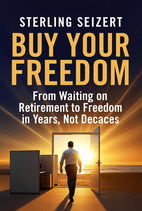
Sterling Seizert's Buy Your Freedom exposes the Accumulation Trap of traditional retirement saving and provides a military-minded framework for building income-producing Freedom Assets. Written for normal people who feel stuck working hard yet falling behind, it offers a five-to-ten-year path from Worker to Owner.
Feature
Insta.Page
Blinkist
Shortform
Summary Depth
Full Chapter-by-Chapter
15-min overview
Section-by-section guides
Audio Narration
✓
✓
✓
Visual Mindmaps
✓
✕
✕
AI Q&A
✓
✕
✕
Quizzes
✓
✕
✕
PDF Downloads
✓
✕
✓
Price
$89.99/yr
$146/yr (PRO)
$199/yr
*Competitor data last verified July 2026.
1 Page Summary
This book argues that the traditional path to retirement—saving diligently, maxing out a 401(k), and patiently waiting—is a broken system that keeps people dependent rather than free. The author, Sterling Seizert, identifies this as the "Accumulation Trap," a structure designed to postpone freedom rather than deliver it. Drawing on his Green Beret background, he applies an elite military mindset of terrain analysis and leverage points to personal finance. The core of his argument is that the goal should not be delayed financial security, but ownership of income-producing assets, which he calls "Freedom Assets." These are systems that generate income and appreciate in value while requiring minimal active labor, moving the reader from trading time for money (Stages 1-3) to having money work for them (Stages 4-5).
The book’s distinctive approach is its emphasis on control and operational performance over passive hope. While most financial advice focuses on market-driven appreciation or broad diversification, Seizert introduces the Freedom Matrix, a framework that distinguishes between speculative wealth and true ownership. He argues that true wealth is built by focusing on a single asset class deeply, not spreading bets thin through diversification, which he calls a preservation strategy, not a creation one. Key concepts include the Four Drivers of Appreciation (with Driver 4—operational performance—being the only one the investor can control directly), the strategic use of leverage and arbitrage, and the deliberate redeployment of equity to accelerate growth. The book also tackles the emotional side of wealth, urging readers to identify limiting beliefs (such as viewing wealth as morally wrong) and to filter financial advice by its source’s results rather than their confidence.
This book is written for the "normal person" who feels stuck in a cycle of working hard and saving, yet falling behind. It is for those who sense the system is rigged but lack a framework to escape it, especially those willing to trade short-term convenience for long-term freedom through strategies like house hacking or acquiring operational businesses. Readers will gain a clear, binary choice: remain a Worker who trades time for money and hopes for future freedom, or become an Owner who builds systems that pay in time, choice, and control. The author provides actionable roadmaps (in the appendices) and honest math—projecting a five-to-ten-year timeline to freedom—while emphasizing that the real transformation is not just financial, but a shift in identity and decision-making from passive saver to active builder.
Foreword
Overview
The foreword opens with a personal discovery—the author first encountered Sterling's work through the Freedom Matrix, a framework that immediately resonated. It’s compared favorably to the Cashflow Quadrant, but with a cleaner, more actionable design built for execution rather than theory. The author’s COO also independently reached out to Sterling about it, which says something about its magnetic clarity.
The focus then shifts to trust earned over time. Sterling was initially observed from a distance in self-storage investing communities, then in the War Room Mastermind, and eventually as a direct collaborator. The consistent thread? He delivers. His Green Beret background isn’t mentioned for flair—it’s the foundation of his approach. Elite military units train to read terrain, find leverage points, and anticipate second-order effects. That same intelligence mindset permeates every framework in the book.
What you’re holding isn’t motivational fluff or abstract theory. It’s the product of a life where clarity, preparation, and follow-through weren’t optional. Sterling’s investing and entrepreneurial moves all orbit around ownership, systems, and real outcomes—never shortcuts. The foreword makes it clear: this book is built for those ready to see the system clearly before acting.
Key Takeaways
The Freedom Matrix is a standout framework—more actionable and execution-focused than similar models like the Cashflow Quadrant.
Sterling’s credibility comes from consistent, observable delivery over years, not just reputation.
His Green Beret training informs a strategic, leverage-oriented mindset that avoids noise and superficial advice.
The book is grounded in real-world ownership and systems thinking, not theory or motivation.
Key concepts: Foreword
1. Foreword
The Freedom Matrix Framework
Personal discovery through the Freedom Matrix
More actionable than the Cashflow Quadrant
Built for execution, not theory
COO independently validated its clarity
Trust Earned Through Delivery
Observed consistently over years
Delivers results in self-storage investing
Credibility from War Room Mastermind
Direct collaboration confirmed reliability
Green Beret Strategic Mindset
Elite training in reading terrain
Focus on leverage points and outcomes
Avoids noise and superficial advice
Systems thinking over shortcuts
💡 Try clicking the AI chat button to ask questions about this book!
The System Isn’t What You Think
Overview
Sitting in traffic, not raging or spiraling, finally admitting a truth many of us bury—the fear of living the next thirty years exactly like the last seven. The author describes the realization that something felt off wasn’t about being lazy, reckless, or bad with money. It was about optimizing for the wrong target. The system we’re taught to trust—the one that promises safety through stability and patience—actually keeps us dependent. He calls this the Accumulation Trap: the belief that if you save long enough, invest responsibly enough, and wait, freedom will eventually arrive. But that path is a ghost. It feels safe and responsible because everyone around you follows it, yet it structurally prevents you from ever claiming your own time.
What That Realization Unlocked
Once you see the trap, the question shifts from “How do I earn more?” to “What is my time actually in service of?” The author didn’t want to escape work; he wanted ownership of what his work, money, and life were for. That morning, he chose a new mission: freedom over repetition. And it worked. Today his assets generate well over $8,500 a month. He runs a self-storage business, sometimes working five hours a week, sometimes thirty. He’s not retired in the traditional sense—no recliner, no TV marathons. Instead, he’s 42 and his time belongs to him and his family. That’s the fundamental difference. The goal isn’t to stop doing things; it’s to stop having your time dictated by someone else’s priorities.
The Unconventional Warfare Mindset
The author brings a unique lens to this shift. As a former U.S. Army Special Forces Intelligence Sergeant, he specialized in understanding systems—how they’re shaped by invisible rules, incentives, and pressure points. In unconventional warfare, you don’t just look at surface-level problems. You map the terrain, identify second and third order effects, and find where a small application of influence creates maximum change. The motto De Oppresso Liber—to free the oppressed—isn’t just for geopolitical missions. He applied the same methodology to financial systems at home. Before you can operate effectively inside any system, you have to understand how it actually works: the true players, the hidden defaults, the rewards that keep everyone compliant. This chapter sets the stage for that exploration, insisting that the most important step isn’t a new strategy—it’s a new understanding of the terrain.
Key Takeaways
The Accumulation Trap is the default script: save, invest, wait. It feels responsible but structurally keeps you dependent.
Nothing is wrong with wanting more than a repeat of the last three decades; that discomfort is a signal, not a flaw.
Freedom isn’t about escaping work—it’s about owning what your time is in service of.
Understanding the hidden rules and incentives of any system is a prerequisite to operating effectively within it.
Key concepts: The System Isn’t What You Think
2. The System Isn’t What You Think
The Accumulation Trap
Belief that saving and waiting brings freedom
Feels responsible but keeps you dependent
Default script everyone follows blindly
Structurally prevents claiming your own time
Redefining Freedom
Freedom is owning your time's purpose
Not about escaping work entirely
Goal: time belongs to you and family
Assets generate $8,500+ monthly from self-storage
Shifting the Core Question
From 'How do I earn more?' to new focus
Ask: 'What is my time in service of?'
Choose freedom over repetition as mission
Discomfort signals need for change, not flaw
Unconventional Warfare Mindset
Map hidden rules and incentives of systems
Identify second and third order effects
Small influence creates maximum change
De Oppresso Liber: free the oppressed
Understanding the Terrain First
Prerequisite: know how system actually works
Identify true players and hidden defaults
See rewards that keep everyone compliant
New understanding beats new strategy
Retirement - The Broken Plan That Fails Most People
Overview
The chapter opens with a jarring comparison from my own 1990s childhood: a candy bar and Mountain Dew for $1.50. Today, that same combo runs four or five dollars. It’s a quick gut check for anyone planning retirement with today’s numbers. You think you need $60,000 a year? That’s in today’s dollars. Factor in historical inflation, and a $16 burger in 1995 felt as absurd as a $50 burger does now—yet that’s where we’re headed in 30 years. In 20 years, you’ll need $120,000 just to match $60,000 today. In 30, it’s $168,000. And retirees don’t get hit with average inflation; they get hammered where it counts: healthcare costs exploding, property taxes and insurance climbing even after the mortgage is paid, roofs and HVAC systems failing on fixed incomes, plus food and services inflating faster than the CPI.
The math gets ugly quick. A 4% withdrawal from your savings balloons to about $104,000 per year. After federal and state taxes, that’s maybe $7,000 a month. Add Social Security and you’re at $8,900 a month in future dollars. In today’s purchasing power? Just $3,200 to $3,700 a month. Better than broke, but far from freedom.
The Perfect Case That Still Isn’t Enough
Even the best-case scenario under the Accumulation Model falls shockingly short. Imagine a married couple, both earning $100,000, both saving 15% of their income, both getting the full employer match, both executing perfectly for 30 years with zero mistakes, no layoffs. Their combined nest egg: roughly $5.2 million. Combined income plus Social Security: about $17,800 per month in future dollars. In today’s purchasing power, that’s $6,400 to $7,400 a month combined—or $75,000 to $88,000 a year for two people.
That’s the dream scenario. The one most people never even get close to. But even this perfect execution—two six-figure earners, full match, three decades of discipline—rewards you with splitting the equivalent of $7,000 a month and hoping the furnace doesn’t die. Sixty years of combined labor, perfect execution, and you end up not broke, but not free.
And for the households that don’t have two high earners? That don’t get a full 6% match? That can’t save 15% for three decades without interruption? The gap widens into a chasm.
What the Numbers Really Say
Here’s the brutal truth the traditional retirement plan doesn’t advertise: using the 4% Rule, generating $10,000 a month in retirement income requires roughly $3 million saved. Most people never hit that number. The plan isn’t just flawed—it’s broken. It fails the majority not because they lack discipline, but because the assumptions it’s built on—steady income, low inflation, stable returns, manageable taxes—don’t match real life. The Accumulation Model works perfectly on paper. In practice, it leaves even the most diligent couples living on a modest fraction of their former income, exposed to rising costs and unforseen expenses.
Key Takeaways
Inflation hits retirees harder than the average consumer because essential costs (healthcare, housing, food) rise faster than the CPI.
The “perfect” retirement scenario—two high earners saving 15% for 30 years with full matches—still yields only $75,000–$88,000 in today’s spending power for a couple.
Most households can’t replicate that perfect scenario, making the traditional Accumulation Model unrealistic for the majority.
To achieve just $10,000/month in retirement income under the 4% Rule, you need roughly $3 million saved—a target most people will never reach.
The broken plan isn’t about individual failure; it’s a structural flaw in assumptions about inflation, income stability, and real-world costs.
Key concepts: Retirement - The Broken Plan That Fails Most People
3. Retirement - The Broken Plan That Fails Most People
Inflation's Hidden Tax on Retirees
Retirees face higher inflation on healthcare, housing, and food
A $60,000 need today becomes $168,000 in 30 years
4% withdrawal yields only $3,200–$3,700 monthly in today's dollars
The Perfect Case Still Falls Short
Two $100k earners saving 15% for 30 years yields $5.2 million
That perfect scenario provides just $75k–$88k yearly for a couple
Even flawless execution leaves you not broke, but not free
The 4% Rule's Impossible Math
$10,000 monthly income requires roughly $3 million saved
Most people never reach that savings target
The rule assumes stable returns and low inflation that don't exist
Structural Flaws in the Accumulation Model
Assumptions of steady income and manageable taxes are unrealistic
Real-world costs like roof repairs and HVAC failures destroy budgets
The plan fails most people, not due to lack of discipline
The Gap Widens for Average Households
Most lack two high earners or full employer matches
Few can save 15% for 30 years without interruptions
The chasm between perfect and average is insurmountable
Follow the Money: How the System Was Built
Overview
If you’ve ever felt like you’re doing everything right—working hard, saving diligently, maxing out your 401(k)—yet somehow falling further behind every year, you’re not crazy. The system was designed that way. The chapter pulls back the curtain on the mechanics of money creation and shows how those closest to the printing presses benefit first, while everyone else gets stuck with eroded purchasing power. This isn’t a bug; it’s a feature.
The 18th-century economist Richard Cantillon first identified the pattern, now known as the Cantillon Effect: when new money enters the economy, it flows to those closest to the source—banks, financial institutions, the wealthy—before it ever reaches your paycheck. By the time you see a raise, prices have already risen to swallow it. Your salary never catches up because it was never supposed to.
The Gold Confiscation of 1933
This wasn’t an isolated incident. In 1933, President Roosevelt signed Executive Order 6102, making it illegal for ordinary Americans to own gold. Citizens were forced to sell their gold to the government at $20.67 per ounce. Then, almost immediately, the government revalued gold to $35 per ounce—a 41% overnight wealth transfer from the people to the Treasury. The message was clear: when the system is in trouble, the rules get rewritten to protect the system, not the savers.
Nixon’s Final Break
Fast forward to 1971. President Nixon ended the dollar’s convertibility to gold, removing the last external anchor on U.S. money creation. This was the coup de grâce. Under the gold standard, the government couldn’t just print money whenever it wanted—there had to be gold in the vaults to back it up. After Nixon, that constraint vanished.
The numbers tell the story. From 1920 to 1970, consumer prices roughly doubled over five decades. Since the early 1970s, prices have risen about eightfold over a similar span. You can see this in nearly everything that matters: houses, education, healthcare. The purchasing power of the dollar has been systematically hollowed out.
Key Takeaways
The Cantillon Effect explains why money creation benefits the wealthy first and leaves wage earners behind.
The 1933 gold confiscation was a direct wealth transfer from citizens to the government.
The 1971 end of gold convertibility removed the only brake on money printing, leading to decades of sustained inflation.
Saving cash and bonds in this environment is like trying to fill a leaky bucket—the system is built to devalue the currency over time.
Key concepts: Follow the Money: How the System Was Built
4. Follow the Money: How the System Was Built
Cantillon Effect
New money flows to those closest to source
Wealthy and banks benefit first
Wage earners get eroded purchasing power
Salary never catches up with rising prices
1933 Gold Confiscation
Executive Order 6102 banned gold ownership
Forced sale at $20.67 per ounce
Government revalued gold to $35 per ounce
41% overnight wealth transfer from citizens
1971 End of Gold Convertibility
Nixon removed dollar's gold anchor
Eliminated constraint on money printing
Prices rose 8x since 1970s vs 2x before
Houses, education, healthcare costs surged
System Design for Devaluation
Saving cash is like filling a leaky bucket
System built to devalue currency over time
Inflation benefits those closest to printing presses
Working hard and saving still leads to falling behind
You've reached the end of the free chapters
Next chapter: “Identify Your Money Beliefs” is locked
Keep reading Buy Your Freedom — and unlock all 600+ book summaries with audio, mindmaps and AI Q&A.
$0.00 due today · 7 days free, then $89.99/year ($7.49/mo) · Cancel anytime before day 7
Sterling Seizert is an author and historian specializing in American industrial and economic history, best known for his comprehensive works such as "The Rise of American Industry" and "Forging the Modern Economy." His expertise bridges the gap between technological innovation and its societal impact, drawing on decades of research and teaching at the university level. Seizert holds a Ph.D. in history from the University of Pennsylvania and has contributed numerous articles to academic journals on the evolution of manufacturing.
Frequently Asked Questions about Buy Your Freedom
What is Buy Your Freedom about?
This book reveals how the traditional financial system keeps most people dependent on trading time for money, trapped in what the author calls the 'Accumulation Trap.' It introduces frameworks like the Freedom Matrix and the Five Stages of Income to help readers transition from being a Worker to an Owner. The core message is that true freedom comes from building income-producing assets—such as real estate or businesses—that run independently of your labor. By focusing on ownership and control, you can escape the cycle of saving and waiting for decades.
Who is the author of Buy Your Freedom?
Sterling Seizert is the author, and his background as a Green Beret heavily shapes the book's disciplined, strategic approach. He is a successful investor in self-storage and other freedom assets, known for developing the Freedom Matrix framework. The foreword highlights that his military training taught him to read terrain, find leverage points, and anticipate second-order effects—skills he applies directly to investing and building wealth.
Is Buy Your Freedom worth reading?
Yes, because it offers a clear, actionable alternative to conventional retirement advice that often keeps people stuck. The book provides practical steps—like house hacking, using good debt, and focusing on operational performance—that can compress decades of wealth-building into a few years. It's grounded in real-world results, not theory, and challenges the beliefs that prevent most people from achieving financial independence.
What are the key lessons from Buy Your Freedom?
The most important lesson is that the traditional path of saving and waiting (the Accumulation Trap) doesn't lead to freedom; you must build income-producing assets. The Five Stages of Income show how to move from trading time for money to owning systems that pay you passively. Focus is more powerful than diversification for creating wealth—mastering one asset class accelerates results. Finally, ownership without control is incomplete; understanding how to classify and tax your income is essential to keeping what you build.
📚 Explore Our Book Summary Library
Discover more insightful book summaries from our collection