Buy Your Freedom Quotes
by Sterling Seizert
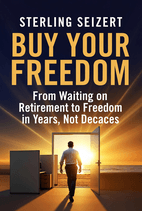
These quotes come straight from the pages of Buy Your Freedom, a book that doesn't waste a single word. You'll find sharp observations about why the traditional path to retirement isn't working and what to do instead. Each line is built for action, not motivation.
What makes this book so quotable is its refusal to sugarcoat. It challenges comfortable beliefs about money, work, and freedom. The author's background as a Green Beret shows in every sentence. There's no theory here, just hard won truths that stick with you long after you read them.
Top Quotes from Buy Your Freedom
“! can’t do this for another 30 years. I want different. I want more. I want freedom.”
The narrator admits this to himself while sitting in traffic, realizing he can't continue his current path.
This raw, honest confession captures the breaking point many feel but rarely articulate, and the simple desire for freedom resonates deeply with anyone stuck in a routine.
“I call it the Accumulation Trap: the belief that if you save long enough, invest responsibly enough, and wait patiently enough, freedom will eventually arrive.”
The narrator introduces his term for the flawed financial mindset most people follow.
This defines a universal yet unspoken illusion, giving readers a name for the trap they may be in and a clear target to escape.
“I was following the rules and falling behind.”
The author reflects on his own experience of diligently saving and investing yet losing purchasing power.
This short, relatable sentence encapsulates the frustration of playing by the system's rules only to find yourself worse off.
“Those closest to money creation benefit first and most. Those furthest away, people trading time for wages, pay the price through eroded purchasing power.”
The author explains the Cantillon Effect and its real-world impact on ordinary workers.
It vividly describes the structural unfairness built into the monetary system, helping readers understand why their wages never keep up.
“Your current results are the outcome of those old beliefs. If you want new results, you need new beliefs.”
Opening line of the chapter.
It directly links past beliefs to present outcomes and motivates change by stating the obvious truth that new results require new beliefs.
“If you wanted to get in shape, you wouldn't take advice from someone who's out of shape. Yet when it comes to money, most people take advice from friends, family, and coworkers stuck in the same paycheck-to-paycheck trap they're trying to escape.”
The author draws a sharp analogy between fitness and financial advice to highlight a common blind spot.
The simple, relatable analogy makes the irrationality of taking financial advice from non-wealthy people instantly clear, delivering a memorable wake-up call.
“Are you saving like a Worker, or building like an Owner?”
A closing question to self-assess one's financial strategy.
It forces a direct, actionable self-reflection, distinguishing between passive accumulation and active creation of asset-based income.
Themes Behind the Quotes
A central theme is what the author calls the Accumulation Trap. It describes how following conventional advice to save and invest patiently often leads to a life of delayed freedom. Inflation quietly erodes purchasing power, and the system is structured so that those furthest from money creation lose ground. The book argues that the real path to freedom is not through saving but through ownership and earning the right kind of income.
Another powerful theme is the challenge of mindset. Many people hold deep seated beliefs that money is dirty or that wealth is somehow wrong. These beliefs block true progress. The book pushes readers to examine who they take advice from and to separate signal from noise. It calls for a shift from acting like a worker to building like an owner, taking control of time and choices. The ultimate goal is not just money, but the ability to live life on your own terms.
Quotes by Chapter
Foreword
“It reminded me of Cashflow Quadrant, but felt cleaner, more actionable, and built for execution instead of theory.”
The author describes Sterling's Freedom Matrix and compares it to Robert Kiyosaki's Cashflow Quadrant.
This line highlights the book's practical edge over a well-known framework, appealing to readers seeking actionable strategies.
“His background as a Green Beret matters here, not as a flex, but because elite units are built on understanding terrain, identifying leverage points, and accounting for second-order effects before acting.”
The author explains why Sterling's Special Forces experience is relevant to his investing and writing.
It connects military discipline to business strategy, lending credibility and a sense of calculated precision to the book's advice.
“They're designed to help you see the system clearly before you move inside it.”
Referring to the frameworks Sterling presents in the book.
This concise statement encapsulates the book's core philosophy of strategic awareness, making it memorable and empowering.
“What you're reading isn't theory or motivation—it’s the product of a life spent operating in environments where clarity, preparation, and follow- through weren't optional.”
The foreword concludes by summarizing the book's source of authority.
It underscores that the content is grounded in real, high-stakes experience, differentiating it from typical self-help or motivational literature.
The System Isn’t What You Think
“The idea of living the next three decades exactly like the last seven years felt worse than any uncertainty I could imagine.”
The narrator reflects on the fear of perpetual repetition after his traffic epiphany.
It powerfully reframes risk, showing that staying the same can be scarier than embracing the unknown, a mindset shift that inspires change.
“I’m 42 and I get to do what I want, when I want, with whomever I want. My time belongs to me and my family.”
The narrator describes his current life after achieving financial freedom through his self-storage business.
It paints a vivid picture of the ultimate reward—autonomy over time and relationships—making the abstract goal of freedom tangible and aspirational.
Retirement - The Broken Plan That Fails Most People
“If you're thinking “I need $60,000 a year to retire comfortably,” you're probably thinking in today’s dollars. At historical inflation rates, a $16 burger today costs $50 in 30 years.”
The author illustrates how inflation erodes purchasing power over time, using a burger price comparison.
This makes the abstract concept of inflation concrete and shocking, forcing readers to realize their retirement savings may be far less valuable than they assume.
“And even the ones who can, who do everything right, end up here. Not broke. But not free either.”
After describing the ideal scenario of two six-figure earners saving perfectly for 30 years, the author sums up their mediocre outcome.
The stark contrast between 'not broke' and 'not free' captures the disillusionment with the traditional retirement model—working hard only to achieve mere survival, not true freedom.
“Sixty years of combined labor, perfect execution, and the reward is splitting the equivalent of $7,000 a month and hoping the furnace doesn’t die.”
The author calculates the real purchasing power of a perfectly executed retirement plan for a dual-income couple.
This line is devastatingly relatable, highlighting the fragility of retirement security when a single major expense can derail decades of disciplined saving.
Follow the Money: How the System Was Built
“All Currencies devalue or die, and when they do, cash and bonds (which are promises to receive currency) are devalued or wiped out.”
Ray Dalio's quote appears at the start of the chapter to frame the discussion on monetary systems.
It captures a fundamental truth about currency that challenges conventional assumptions, making readers question the safety of cash and bonds.
“Your raises never catch up to prices. They're not supposed to.”
A blunt follow-up to the Cantillon Effect explanation, revealing the system's intentional design.
This stark, almost cynical statement forces readers to recognize that wage stagnation is not an accident but a feature.
Identify Your Money Beliefs
“It took years to realize what was happening: part of me wanted success while another part felt guilty and saw it as maybe morally wrong.”
The author describes their own internal conflict upon approaching success.
Many readers recognize the same inner split between ambition and guilt, making this confession deeply relatable and validating.
“When you believe wealth is dirty, you will subconsciously avoid it. Then call it fate.”
The author explains the self-sabotaging result of moralizing wealth.
The punchy phrasing reveals how people rationalize their own avoidance, delivering a sharp wake-up call to take responsibility.
“Money is a tool that lets you serve the people you love at a higher level with more time, peace, presence, options, and stability.”
The author shares their reframed truth about money.
It transforms money from a source of guilt into a positive enabler of generosity and quality of life, offering a liberating perspective shift.
Protect Your Mind
“But look at the people giving that advice. Are they truly living the way you want to live? Are they wealthy? Are they financially free? Or are they just repeating what they were taught to sound smart, despite it not really working for them?”
The author challenges readers to scrutinize the financial advice they receive by examining the results of those who give it.
This passage forces readers to question authority and conventional wisdom, making them realize that most advice is hollow if the advisor hasn't achieved the desired outcome.
“The people closest to you will often resist your growth the most. Not because they don’t love you, but because they're scared for you.”
The author explains why friends and family often discourage ambitious financial moves.
This line reframes opposition as misplaced concern, helping readers understand that resistance isn't malice—yet still must be ignored to pursue freedom.
“In my old job, we called it signal versus noise. Most people are noise. Loud opinions with zero results. If you keep letting noise into your head, you will keep getting noise in your life.”
The author reflects on a workplace concept to distinguish valuable information from distractions.
The metaphor of signal versus noise is both memorable and actionable, giving readers a clear mental filter to protect their mindset from unhelpful influences.
Define Your Target
“Fast forward to the end of your life. What do you want to be remembered for?”
The author introduces the Legacy Method, asking readers to imagine their future legacy.
This question forces a deep, personal reflection on purpose and priorities, making it a powerful starting point for anyone seeking direction.
“He left behind financial freedom and the knowledge so we would never be ruled by money.”
The author shares what he hopes his daughters will say about him at the end of his life.
It captures the ultimate goal of financial freedom not as wealth for its own sake, but as a tool to prevent money from controlling one's life.
“When I wrote those statements, they felt impossibly far away. Now they guide every major decision I make.”
The author reflects on the gap between his initial aspirations and their eventual influence on his actions.
This line resonates because it shows that even distant, seemingly unattainable goals can become powerful daily compasses when written down.
The Five Stages of Income
“I'm already doing everything the owner does, if not more. Except I don't get paid like the owner does.”
Ryan, an HVAC technician, expresses his frustration after a night of emergency calls.
It articulates the universal worker resentment of doing equal or more work than the boss but not sharing in the rewards, striking a chord with anyone who feels undervalued.
“That quiet frustration isn't because you're doing anything wrong. It’s because you're earning the wrong kind of income.”
The author explains the root cause of the reader's struggle.
It reframes the problem from personal failure to systemic misalignment, offering clarity and hope that changing the type of income is the solution.
“The further you move toward ownership, the more control you have and the faster freedom becomes possible.”
The author describes the spectrum between Worker and Owner.
This encapsulates the core thesis of the chapter—progress is measured by moving away from trading time, and it motivates readers to shift their mindset.