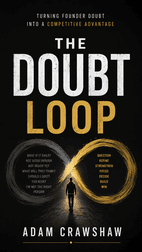
Adam Crawshaw's The Doubt Loop argues that self-doubt isn't a flaw but a signal to be harnessed, offering founders 18 practical disciplines—from choosing your primary motive to pressure-testing assumptions with a Belief Ladder—to turn internal friction into a competitive edge. Written for founders deep in the grind who need tactical tools, not platitudes, to transform doubt into forward thrust.
Feature
Insta.Page
Blinkist
Shortform
Summary Depth
Full Chapter-by-Chapter
15-min overview
Section-by-section guides
Audio Narration
✓
✓
✓
Visual Mindmaps
✓
✕
✕
AI Q&A
✓
✕
✕
Quizzes
✓
✕
✕
PDF Downloads
✓
✕
✓
Price
$89.99/yr
$146/yr (PRO)
$199/yr
*Competitor data last verified July 2026.
1 Page Summary
This book argues that self-doubt is not a flaw to be eliminated but a signal to be harnessed, offering founders a practical framework to turn that internal friction into a competitive edge. Drawing from the author’s own journey—from a childhood watching tightrope walkers to building and selling a company for $1.4 billion—the book rejects one-word cures and instead presents a field guide of 18 distinct disciplines. Each chapter addresses a specific pressure point, such as choosing your primary motive (Wealth, Control, Passion, or Ego), pressure-testing your core assumptions with a "Belief Ladder," and catching the right market wave, all while forcing you to confront the psychological traps that keep founders stuck.
The book is distinctive for its unflinching, tactical honesty. It replaces abstract startup advice with tools like the "Sticky Spaghetti Spectrum" for choosing a launch strategy, the "Three-Burn Dashboard" for measuring attention and credibility alongside cash, and the "GAIN Framework" for filtering valuable feedback from noise. Concepts such as “Spot Your Swans” (anticipating both black-swan and white-swan events) and “Mute the Rock Star” (hiring workhorses, not divas.) are grounded in raw, specific anecdotes—from a failed fire-extinguisher pitch to a three-year acquisition that never cracked 1% of revenue. The author’s overarching insight is that self-doubt is a furnace you either feed or get scorched by; the goal is not to silence it but to use it as a propellant by questioning everything with deliberate, repeatable discipline.
The intended audience is current and aspiring founders who are deep in the grind—whether in a dorm room, on a red-eye with slide decks, or staring down an AWS bill. Readers will gain permission to feel their doubt, along with the practical tools to transform it into forward thrust without sacrificing their sanity or relationships. The book teaches that by deliberately celebrating wins, building a culture that blends warmth and muscle, and knowing when to sell, a founder can treat their doubt as a private trainer—repeatedly turning the volume down from panic to performance without ever needing it to fully disappear.
Introduction
Overview
The chapter opens with a vivid childhood memory: a five-year-old watching teenage acrobats walk a tightrope in Peru, Indiana—once the “Circus Capital of the World.” In that moment the entire paradox of self-doubt is suspended: terror you’ll fall, followed by the thrilling suspicion that maybe you won’t. Six years later, basketball replaced trapeze dreams, but the same voice hissed after a disastrous season opener where the author racked five turnovers in two minutes. That voice—the one that says they’ve unmasked you—never really left. It followed him through a decade of grinding in finance and venture capital, through building and selling a company for $1.4 billion, and sat beside him at the celebration tacos. The core realization: self-doubt isn’t a phase you out-earn; it’s a furnace you either feed or get scorched by. The introduction lays out why this book exists—not as a one-word miracle cure, but as a field guide to turning doubt into forward thrust.
The Apprenticeship of Self-Doubt
The years between college and founding a company were a blur of fluorescent lights and spreadsheets. The author applied to exactly one school—Indiana University—because his internal veto had already dismissed the Ivy-League packets. He graduated with a 3.96, haunted by a single A- in History of the Mafia. Diploma still warm, he landed alongside Wall Street titans: Joe Perella, who taught him to interrogate every decimal; David Bonderman, who believed money was hidden everywhere and expected the same breadth of curiosity; and Michael Moritz, the Sequoia legend who drilled a journalist’s habit of going panoramic then zooming to bedrock. Each mentor added a layer of precision, breadth, or depth. Yet the self-doubt voice merely upgraded its demands: Nice apprenticeship, kid—now build something of your own.
The Unicorn That Didn’t Cure
The spark came with Sandeep Kella, a founder with real scar tissue and a habit of questioning conventional wisdom. They launched Assembly in 2018, betting on “picks and shovels” software for e-commerce sellers. In under three years, they sold half the company for $1.4 billion. Deal day looked nothing like the movies—the champagne tasted like battery acid. A seafood tower, then tacos at the strip-mall joint where Assembly had been sketched on a napkin. For one sunset, the author thought, Finally—hill climbed. At sunrise, the self-doubt returned: Lucky timing. COVID-19 bump. SaaS multiples did the heavy lifting. They kept lifting—tripling revenue, serving millions, achieving record profitability—and still the feeling perched on his shoulder. That’s when it clicked: the voice isn’t a phase. Smother it, and it fills the room with smoke. Pipe it into the engine, and it drives the machine.
The Doubt Loop and The Road Ahead
Think of adrenaline: the same molecule fuels a panic attack or a personal-best sprint. Chemistry doesn’t change; context and choreography do. The Doubt Loop is the choreography. A simple three-step cycle: notice the moment your stomach knots, name the hidden fear out loud, and convert it into a concrete action—a metric to track, an experiment to run, a conversation to schedule. Loop through those moves whenever doubt pipes up.
The chapter then previews how the loop evolves through the book. Early chapters push doubt toward curiosity (Catch the Wave, Choose Your Fuel, Question Yourself). Mid-book, it shifts into discipline (Throw Spaghetti, Feel the Burn, Pick Your Poison). Later, when wins stack up, the loop redirects doubt toward durability (Build a Bear, Don’t Trust Data, Smell the Roses). Each chapter is built to turn a specific fear into progress. The author sketches his own mistakes—basketball shoes hung up, anxiety knotted stomachs, impatience chasing milestones—and promises that what follows isn’t a victory lap, but the playbook he wishes someone had handed him before fear made him hang up those shoes.
Key Takeaways
Self-doubt is not a phase to outgrow; it’s a furnace that must be channeled, not smothered.
The Doubt Loop—Notice, Name, Convert—turns gut-punch moments into actionable forward motion.
Early career experiences with demanding mentors build skills but don’t quiet the inner voice; the voice just sets higher bars.
External success (a $1.4 billion exit) doesn’t automatically silence self-doubt; recognition of the pattern is the real turning point.
The book is structured as a field guide: each chapter addresses a specific type of doubt and offers a framework to redirect it into fuel.
Key concepts: Introduction
1. Introduction
The Persistence of Self-Doubt
Self-doubt is not a phase to outgrow
It follows you through success and failure
External achievements don't silence the inner voice
The voice upgrades its demands over time
The Apprenticeship Years
College and early career shaped discipline
Mentors taught precision, breadth, and depth
Skills grew but self-doubt only raised the bar
The voice demanded: build something of your own
Success Doesn't Cure Doubt
Built and sold a company for $1.4 billion
Celebration felt hollow; doubt returned at sunrise
Attributed success to luck and market timing
Realized doubt must be channeled, not smothered
The Doubt Loop Framework
Notice the moment your stomach knots
Name the hidden fear out loud
Convert fear into concrete action
Loop through these steps whenever doubt appears
Book Structure as Field Guide
Early chapters turn doubt into curiosity
Mid-book shifts doubt into discipline
Later chapters redirect doubt toward durability
Each chapter addresses a specific fear with a framework
💡 Try clicking the AI chat button to ask questions about this book!
1. Choose Your Fuel
Overview
The first and most personal question every founder must face: Why am I really doing this? The moment you step away from a stable career—or even just start dreaming of it—a voice whispers doubt. The answer determines everything downstream. If you pick the wrong fuel, you’ll build a life you secretly resent. The author strips away the romanticized startup myth and forces you to choose one dominant driver from four: Wealth, Control, Passion, or Ego. None is right or wrong, but trying to chase all four at once is a recipe for gridlock. The chapter provides a microquiz to help you identify your primary motive, then walks through how each one reshapes your journey along the J-curve—the inevitable dip between starting and payoff.
Wealth: Show Me the Money
When Wealth is your engine, every decision converts into the same question: Does this bring me closer to my freedom number? The only metric that matters is Point D on the J-curve—the after-tax payout that makes work optional. Everything else is either an investment or noise. The author advises naming that number, setting a hard deadline, and being willing to pivot if progress stalls. Founders who succeed on Wealth fuel often use specific playbooks: manifesting (Sara Blakely, SPANX), lightning exits (Dubin, Dollar Shave Club), hungry hoarding (Chestnut, Mailchimp), clone-and-flip (Samwer brothers), or permanent-capital collecting (Wilkinson, Tiny). The key is to accept that Wealth is back-loaded—you’ll live on less than $150k for years while the payoff compounds in the distance.
Control: My Sandbox, My Rules
Control-fueled founders measure success by how much decision-making power they keep. On the J-curve, the critical shape is the depth of the trough (Point B) and how fast you climb to self-funded territory (Point C). Every outside dollar widens that trough and hands levers to someone else; nights, weekends, and grit don’t cost equity. The author distinguishes between explicit control (voting shares, board seats) and implicit control (budget approval, calendar freedom). The trade-off is clear: maximizing control often means slower growth, smaller rounds, or narrower scope. Examples include Bezos’s six-page memos, Zuckerberg’s super-voting shares, Kamprad’s foundation structure, MrBeast’s self-funded content, and Musk’s impossible deadlines. The lesson: if you can’t survive on founder-friendly capital, either widen your circle of trust or choose a different motive.
Passion: Caffeinated by Purpose
Passion-driven founders don’t obsess over valuation or board politics—they gush about the feature that made a user cry. The only KPI that matters is whether tomorrow’s work still lights you up and serves your customer. The J-curve becomes a line you’re willing to surf indefinitely; Point B can stretch into sleepless years, Point C may never arrive, but none of it rattles you as long as progress toward the mission continues. The author warns: passion can sour. The chef who opens a dream restaurant and fails risks losing the love of cooking entirely. Sanity-check yourself: Would I still do this with zero applause, no funding, and an invisible job title? If the answer wavers, call it curiosity. Examples of those who stayed lit: Chouinard (Patagonia), Torvalds (Linux), Dyson, Tristan Walker (Bevel), and Bren Smith (GreenWave).
Ego: Vendetta Ventures
Ego-fueled founders score wins by humiliation dealt and incumbents embarrassed, not by revenue or retention. Only two J-curve snapshots matter: the supersized dip (proof you went big) and the skyscraper exit (the story that trumps every scorched bridge). The author suggests codifying your target—name the antagonist in one clear sentence—and spelling out what winning looks like for you, not for the haters who won’t send thank-you cards. Beware collateral damage: rivalry-chasing startups burn 30% more capital pre-profit and are 1.5 times likelier to overexpand. Examples include Hastings (Netflix, vengeance against Blockbuster), Luckey (Anduril, second-at-bat after Oculus), Wolfe Herd (Bumble, flipping the industry), Ma (Alibaba, proving doubters wrong), and Armstrong (Coinbase, daring regulators). Ego is binary fuel—it can propel or flame out.
What You Can Do With a Motive
Once you know your dominant motive, every decision sharpens. Co-founder search? Swipe left on brilliant people whose hunger clashes with yours—a Wealth-driven founder and a Passion-driven copilot will knife-fight over every pivot. Team culture follows: Wealth founders use aggressive options and OKRs, Control founders keep head count lean, Passion founders hire missionaries, and Ego founders hire snipers. Strategy choices shrink: Wealth points to market-maximizing plays, Control to minimal funding and profitable niches, Passion to patient capital, and Ego to head-to-head positioning and PR theatrics. You can even use this lens outward to understand rivals or customers—tailor your product and negotiations to play directly to (or against) their hunger.
So What Was My Vice?
The author confesses: back at Atlas Café, laptop blank, they expected Passion to stage-dive from the rafters. Instead, option paralysis set in. The spiral only stopped when they forced the confession—Ego, not Passion, was the phantom driver. After years critiquing founders from a diligence perch, the self-doubt voice taunted, Can you actually build? Assembly became a rebuttal. Every term sheet declined, every 3 a.m. spreadsheet was a silent memo to the old self: I can build; watch me. The punchline: when you question your path, choose one dominant motive and fence it. Whether you’re chasing commas, control levers, midnight joy, or righteous payback, set your limits.
Key Takeaways
The four dominant founder motives are Wealth, Control, Passion, and Ego. Pick one to drive; the rest can ride shotgun.
Trying to optimize for all four creates paralysis and conflict—the J-curve becomes a food fight in a moving car.
Your motive determines your relationship with funding, team culture, strategy, and what you define as success.
Use the microquiz to identify your primary fuel. If multiple ties, read the deeper descriptions to see which resonates.
Each motive comes with clear trade-offs: Wealth requires patience and risk of dilution; Control may slow growth; Passion risks burnout or financial failure; Ego can scorch bridges and overextend resources.
Once you know your motive, every decision—co-founder, hiring, fundraising, positioning—becomes crystal clear.
Key concepts: 1. Choose Your Fuel
2. 1. Choose Your Fuel
The Core Question
Why am I really doing this?
Answer determines everything downstream
Pick wrong fuel, build a life you resent
Chasing all four motives causes gridlock
Wealth: Show Me the Money
Every decision: does this reach my freedom number?
Maximizing control means slower growth, smaller rounds
Passion: Caffeinated by Purpose
KPI: does tomorrow's work light you up?
J-curve becomes a line you surf indefinitely
Passion can sour if tied to outcomes
Sanity check: would you do it with zero applause?
Ego: Vendetta Ventures
Wins scored by humiliation dealt, not revenue
Only two snapshots: supersized dip and skyscraper exit
Codify your target antagonist in one sentence
Rivalry-chasing burns 30% more capital pre-profit
Applying Your Motive
Co-founder search: avoid clashing hungers
Team culture: options, lean, missionaries, or snipers
Strategy: market-max, minimal funding, patient capital, or PR
Use lens to understand rivals and tailor negotiations
Author's Confession
Expected Passion, found Ego as phantom driver
Self-doubt taunted: can you actually build?
Assembly became a rebuttal to old self
Choose one dominant motive and fence it
2. Question the Insight
Overview
The quiet dread that your idea might be a land mine—that everyone else already spotted the flaw and you're about to look like a fool—isn't a bug. It's the signal that your worldview needs pressure-testing. This chapter is about naming that fear, then building a device to turn suspicion into conviction. The device is a Belief Ladder: a plain-English stack of assumptions that must be true for your business to work. Not a pitch deck, not a vision statement—just the handful of rungs that explain why you should exist and what needs to hold for you to win.
The authors learned this the hard way. For twelve months, they cycled through startup ideas, each one abandoned by Friday. The only idea that survived was the one they stress-tested with dozens of founders, sellers, and investors, asking the same question in a thousand dialects: What are we missing? When no one could kill it, pattern recognition beat paranoia. That's when they wrote the bet in plain English—five rungs, no buzzwords—so they could see exactly what had to be true and begin testing.
The Belief Ladder: More Than a Hypothesis
A proper ladder separates macro forces (outside your control) from micro insights (inside your control). For Assembly, the macro was simple: e-commerce would keep compounding, and the number of online sellers would mushroom. They didn't steer those tectonic plates; they just decided to join for the ride. The micro rungs—brands migrating from single-point tools to all-in-one solutions, sellers trusting third-party software over platform dashboards, scrappy up-and-comers winning shelf wars—were the contrarian hunches they could steer.
To build your own ladder, start with an assumption dump: ten minutes, messy page, anything that starts with "this has to be true." Then sort into market forces, human pain points, and competitive dynamics. Tag each rung for control—outside bets must be trusted; inside bets must be proven. Finally, layer on the worldview: Is each rung mainstream, debatable, or borderline crazy? A balanced ladder rides a couple of obvious waves and sharpens a few lonely edges.
The classic example is Uber. The macro was incontestable: smartphone penetration, GPS, digital payments, a labor slump. Uber didn't create those trends. What it shaped were the contrarian moves: one-tap pickup, two-way ratings, surgeon pricing, and a "launch first, lobby later" posture. Each gamble compounded the network effect. The lesson: surf the force you can't change, then pour every ounce of ingenuity into the variable you can.
Lean on the Macro, Control the Micro
Stripe, Airbnb, Coinbase—each story follows the same choreography. Stripe rode the incontestable wave of e-commerce surging online, then reduced the pain of payment integration to seven characters: stripe.checkout(). Airbnb recognized that hotel capacity was chronically tight during events, and that spare bedrooms were dormant inventory. They didn't build hotels; they built psychological safety. Coinbase bet that Bitcoin would survive volatility, then replaced the nightmare of wire transfers and USB wallets with a friendly Venmo-like interface.
The pattern is not a coincidence. Obsess over the part outside your grasp and you'll burn cash and sanity. Master the slice you can bend, and the macro does the heavy lifting for free.
Put Your Goggles On
Before you swing at assumptions, choose the goggles you're wearing. The belief ladder isn't abstract truth-seeking—it's a machine. And the output of that machine should directly feed your motive.
Ego: Correct assumptions produce volume. If the outcome is quiet, you aimed at the wrong target.
Wealth: Right assumptions bring money at scale. If the ladder resolves into a "nice business," that's misalignment.
Control: Accuracy buys freedom. If your ladder requires constant capital or platform mercy, control will leak.
Passion: The payoff is energy. If you're drained by the work and only excited by outcomes, your assumptions are pointing elsewhere.
The worst-case scenario isn't failure. It's being crystal clear on your motive—and designing a business that doesn't feed it.
Your Market Isn't $200 Billion
Jab every data point you can find. Most early-stage evidence is outdated, cherry-picked, or wishful math. When a deck boasts a "$200 billion TAM," run the citation to ground. In practice, most TAM numbers are wildly inflated. Treat shaky numbers like spoiled milk.
Build the model yourself, bottoms-up. Count only the customers you can realistically reach in five years, multiply by the price they've already paid for comparable solutions, and adjust for likely adoption—not perfect penetration. If you need a stretch scenario to break $30 million in ARR, admit you're running a lifestyle business and fund it accordingly. If you're aiming for venture speed, only widen the funnel after the core math clears $100 million revenue or $1 billion exit on paper.
The Baby Is Ugly
Close the deck, leave the office, and wade into the watering holes your users already haunt. Show up empty-handed. No demo, no hypothesis to defend. Just honest curiosity: What's the worst part of your day? Then dig where it hurts. Ask the questions that make you squirm: Why hasn't anyone paid for this? What would make you dump my tool tomorrow?
If the room goes quiet, good. It's cheaper to apologize to a stranger at a trade show than to your board after you've built a solution in search of a problem. The authors learned this firsthand when they discovered their real buyers weren't seasoned e-commerce veterans, but teachers, nurses, and college kids running midnight side hustles. Different dream, different pain.
Sometimes you'll blurt something awkward—like "I don't mean to sh*t on your baby." But that accidental honesty forces the other person to either defend their idea's beauty or confess the scar tissue. Either way, you get intel you'd never find in polite nods and survey checkboxes.
Stalk the Competitive Landscape
"Obsess over the customer; ignore the competition" leaves free intel on the table. Every dollar rivals pour into ads, content, or failed features is a live experiment you can analyze for pennies. Study them hard enough, and they'll hand you a roadmap for what not to build, where the white space sits, and which tricks already work.
Use the Pirate Playbook: track the first-use case they attack, the channels they use, their monetization model, and their glaring weakness. Then pivot one square in the grid where they're asleep. Find a narrower wedge, a forgotten channel, a flipped pricing model, or a patched crack in their user experience.
This isn't breaking the rules. It's the script of every incumbent dismantling in the last twenty years. Dropbox watched Box chase enterprises; Drew Houston focused on viral consumer adoption, then marched into the enterprise later. Instagram copied Snapchat's Stories and leveraged existing distribution to dominate. Microsoft Teams bundled into Office 365 and leveraged enterprise distribution to overtake Slack. The market favors learners, not originators.
Assumptions Aren't Forever
Your ladder is a living document. Markets stall, laws change, channels saturate. Stripe launched assuming card-not-present fees would stay high; then interchange caps tightened in Europe, and they rewrote pricing. Airbnb once banked on cities ignoring short-term rentals; today it employs policy specialists and collects hotel-style taxes.
Treat your ladder like quarterly maintenance. Every three months—or after any shock—reread each rung and ask two questions: Has the fact pattern changed? Does this still have to be true for us to win? Expect to rewrite at least one rung a year. Companies that survive a decade cycle through half a dozen ladders. Each one is a snapshot of what mattered most then, and each is a reason they're still alive to climb the next.
Key Takeaways
Turn the dread that your idea is wrong into a testable Belief Ladder—plain-English rungs separating macro forces (outside your control) from micro insights (inside your control).
Surf the macro wave you can't change; pour your ingenuity into the micro lever only you can move.
Align your ladder with your motive—Ego, Wealth, Control, or Passion—or the business will feel almost right but never feed you.
Build your own TAM model bottoms-up; most early-stage numbers are fantasy.
Get into the field empty-handed and ask the painful questions; raw pain is worth more than polished origin stories.
Stalk competitors for free intel: find their wedge, channel, monetization, and weakness, then pivot where they're asleep.
Update your ladder every quarter. Assumptions are not forever—proof of steering with live instruments is better than clinging to last year's forecast.
Key concepts: 2. Question the Insight
3. 2. Question the Insight
The Belief Ladder
Plain-English stack of assumptions for business viability
Separates macro forces from micro insights
Start with assumption dump, then sort and tag
Balance obvious waves with lonely edges
Lean on Macro, Control Micro
Macro forces are outside your control
Micro insights are contrarian hunches you can steer
Most early-stage TAM data is inflated or cherry-picked
Build bottoms-up model with realistic reach
Count customers you can reach in five years
Admit lifestyle business if core math is small
The Baby Is Ugly
Go to user watering holes empty-handed
Ask what's worst part of their day
Dig into why no one has paid for this
Silence is cheaper than building wrong solution
Stress-Test Assumptions
Ask 'What are we missing?' in many dialects
Test with founders, sellers, and investors
Pattern recognition beats paranoia when no one kills it
Write bet in plain English to see what must be true
Macro Forces Are Free Rides
E-commerce compounding is incontestable macro
Don't steer tectonic plates, join the ride
Obsessing outside grasp burns cash and sanity
Master slice you can bend for free leverage
3. Catch the Wave
Overview
Every founder knows the sinking feeling: you’ve got the insight, the team, the conviction—and yet nobody seems to care. The phones don’t ring. Investors smile and say “circle back.” Customers call it interesting but not urgent. That’s the hidden doubt this chapter unpacks: the fear that you might paddle like hell and find the ocean flat. The difference between a brilliant idea and a billion-dollar outcome often isn’t the idea itself—it’s whether you launch when the tide is with you.
The chapter opens with the author’s own experience building Assembly in the Shopify app ecosystem. In 2017, the market was a sleepy flea market of “lifestyle projects.” The thesis—that value would leak from core platforms to third-party bundles—was sound. But capital was indifferent. Then COVID hit, e-commerce jumped a decade forward, and the same thesis that once earned polite brush-offs became a bidding war. Timing, not insight, was the missing ingredient.
The lesson crystallizes through the Webvan-versus-Instacart story. Both aimed to deliver groceries. Webvan drowned in the dot-com crash because too many rungs on its ladder—broadband, smartphones, gig labor, consumer trust—were unproven. Fifteen years later, Instacart skated across the same beach on rungs that had hardened. Same insight, different surf conditions.
The Tide Framework
To make timing tangible, the chapter introduces four shoreline moods that determine how much cash to raise, how fast to hire, and how long you can stay sane.
Low Tide – Analysts yawn, capital is cheap, press indifferent. Your playbook is learn, not earn. Build relationships, prototype in silence, keep the team tiny (five to seven people), and measure traction in qualitative heat: referrals, unsolicited testimonials, a single customer doubling seats. The enemy is morale, so manufacture momentum—celebrate beta signups, share customer quotes. Treat Low Tide as paid graduate school.
Rising Tide – Early users rave on social, but incumbents still look away. Money starts flowing (seed rounds triple in size on average). Your playbook flips to capacity first, polish later. Pre-buy server credits, overstaff support, lock in long-term ad deals. Stress-test your model assuming acquisition costs double and churn ticks up. Ship faster than the news cycle; people remember the first mover, not version 3.0. Substack’s 2017 creator-economy bet is the case in point.
High Tide – Shoulder-to-shoulder competition, category Gartner Quadrant, a New York Times trend piece. Money is easy but vicious—hiring, ads, customer expectations all expensive. Differentiate or niche down: rely on unique data, regulatory advantages, embedded workflows that create switching friction. Snowflake survived High Tide by separating compute from storage, making migration painful for customers. Fortify the parts of your business others overlook—turn users into evangelists, build network effects. Preach patience to the team; budget for twelve months of flat revenue.
Receding Tide – Funding rounds evaporate, trade-show booths shrink, pundits call the category “over.” SaaS multiples can fall 60% in two quarters. For founders with dry powder, this is clearance season. Triage: cut fat, lean into upsells, renegotiate everything. Then go deal-hunting—pick up distressed codebases, customers, entire teams. Adobe’s 2009 acquisition of Omniture for roughly 4x revenue became the backbone of Adobe Experience Cloud. Communicate clearly with your team; a founder who explains the plan keeps A-players engaged even through pay-freeze winters.
Matching Motive to Tide
The chapter argues that your personal motive—wealth, autonomy, mission, or spotlight—must sync with the tide. Money-first founders thrive from late-Rising into High Tide, when multiples expand. Autonomy lovers are happiest at Low Tide, where bootstrapping buys quiet runway. Mission die-hards can paddle out anytime, but Low-to-Rising gives room to iterate without hype. Spotlight seekers crave High Tide’s cameras but must build cash buffers before the applause peaks. The key is to recheck your motive at every funding round or macro shock—tides change, and so do people.
How to Nudge the Moon
Waiting for the perfect swell is passive. The boldest founders learn to shift the tide itself. Three examples:
Tesla campaigned for zero-emission credits and state rebates, effectively subsidizing its own sticker price and pulling demand forward.
HubSpot coined “inbound marketing,” released the playbook for free, certified legions of practitioners—who then needed HubSpot’s tools to practice what they’d learned.
Peloton wove hardware, live video, and social competition into one experience, manufacturing demand long before gyms locked down.
You can spot a shiftable tide when (1) a policy lever, jargon, or workflow bottleneck keeps adoption pent up, (2) a small but vocal group already aches for a fix, and (3) there’s an underpriced resource waiting to be revalued.
The Ocean Color Trap
Strategy books split oceans into blue (wide-open) and red (shark-infested). But the chapter warns: whichever color you pick, the tide decides whether you float. A calm blue ocean at Low Tide can leave you marooned. A swelling red ocean at Rising Tide can lift even a scrappy entrant. Don’t waste energy debating color—read the swell.
The chapter closes with a brutal inventory of companies that ignored the tide: Quibi (launched a commuting app into a lockdown), Jawbone (bet on hardware just as component prices bottomed and Apple set a new bar), BlackBerry (stayed keyboard-corporate while the iPhone rewrote consumer expectations). All had sound instincts; all were snapped by the wave.
Key Takeaways
Timing is the silent partner of insight. A correct thesis launched at the wrong moment drowns; the same thesis at the right moment rides a billion-dollar wave.
Use the four-tide framework to calibrate your spending, hiring, and pace: Low Tide (learn), Rising Tide (speed), High Tide (differentiate), Receding Tide (consolidate).
Match your personal motive to the tide you’re in—don’t fight the current.
You can nudge the tide by lobbying regulators, educating customers, or bundling products to pull demand forward.
Before you launch, run a three-part check: (1) know the tide you’re in, (2) be honest about how long you can swim, and (3) decide if you can create your own current if the forecast looks flat.
Key concepts: 3. Catch the Wave
4. 3. Catch the Wave
The Tide Framework
Four shoreline moods determine strategy and survival
Low Tide: learn, not earn; keep team tiny
Rising Tide: capacity first, polish later
High Tide: differentiate or niche down
Timing Over Insight
Brilliant ideas fail without right surf conditions
Webvan drowned; Instacart thrived on hardened rungs
COVID made Assembly's thesis a bidding war
Same insight, different tide—outcome flips
Matching Motive to Tide
Wealth seekers thrive from late-Rising to High Tide
Autonomy lovers happiest at Low Tide bootstrapping
Adam Crawshaw is a British author and historian specializing in the social and maritime history of the 18th and 19th centuries. He is best known for his acclaimed book *The Dreadful Trade: Life on the 18th-Century Slave Ship*, which draws on extensive archival research to detail the brutal realities of the Middle Passage. Crawshaw has also contributed to documentary projects and taught at the University of Oxford.
Frequently Asked Questions about The Doubt Loop
What is The Doubt Loop about?
This book explores how self-doubt can be transformed from a paralyzing force into a strategic advantage for entrepreneurs. Through the author's personal journey of building and selling a company for $1.4 billion, it offers a field guide with practical frameworks like the Belief Ladder, the Three-Burn Dashboard, and the Mirror Test. It covers topics ranging from choosing your core motivation and timing market waves to hiring wisely and celebrating wins, all while turning doubt into forward thrust.
Who is the author of The Doubt Loop?
Adam Crawshaw is an entrepreneur who built and sold a company for $1.4 billion, following a decade in finance and venture capital. His experiences with self-doubt throughout his career—from childhood acrobat dreams to the pressures of founding a startup—led him to write this book as a practical guide for other founders. He draws on personal stories and tested frameworks to help readers navigate the emotional and strategic challenges of entrepreneurship.
Is The Doubt Loop worth reading?
Yes, this book offers a rare blend of raw personal honesty and actionable frameworks that you can apply immediately. Instead of generic advice, it provides specific tools like the Mirror Test for self-assessment and the GAIN framework for evaluating feedback. It helps you turn the voice of doubt from a paralyzing force into a performance-enhancing coach, making it valuable for any founder or entrepreneur facing uncertainty.
What are the key lessons from The Doubt Loop?
First, identify your primary fuel—wealth, control, passion, or ego—to avoid building a life you secretly resent. Second, pressure-test your assumptions using a Belief Ladder before committing to an idea, and time your market entry carefully since the same insight can win or fail based on external waves. Third, manage three types of burn—cash, attention, and credibility—to keep your startup and yourself healthy. Finally, learn to bank your wins and celebrate milestones instead of always moving the finish line.
📚 Explore Our Book Summary Library
Discover more insightful book summaries from our collection









![The Explosive Child [Sixth Edition] by Ross W. Greene PhD - Book Summary](/_next/image?url=https%3A%2F%2Fapi.insta.page%2Fstorage%2Fv1%2Fobject%2Fpublic%2Fsmall_bookcovers2%2FB08NP52GTW.png&w=3840&q=75)