The Doubt Loop Quotes
by Adam Crawshaw
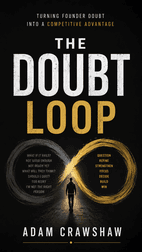
These quotes are the kind that stick with you long after you put the book down. They pull from the raw, real moments of building something from scratch, when doubt feels louder than anything else. Expect lines that cut through the noise with sharp metaphors and a voice that sounds like a honest friend, not a guru.
The book earns its quotability by refusing to sugarcoat hard truths. Every line lands because it comes from lived experience, not theory. You will find phrases that reframe anxiety as fuel and warnings that read like wisdom from a seasoned trail guide. No fluff, just the stuff you need to hear.
Top Quotes from The Doubt Loop
“Inside that one heartbeat lived the entire paradox of self-doubt: terror you'll fall, followed by the thrilling suspicion...but maybe I won't.”
Author recalls watching acrobats as a child.
Captures the dual nature of self-doubt as both fear and possibility, making it instantly relatable.
“The self-doubt voice isn't a phase you out-earn; it’s a furnace you either feed or get scorched by.”
After selling his company, author realizes self-doubt persists.
Reframes self-doubt as a permanent force to be managed, not eliminated, which is a counterintuitive and liberating insight.
“Smother it, and it fills the room with smoke. Pipe it into the engine, and it drives the machine.”
Continuation of the furnace metaphor.
Vivid imagery shows that suppressing doubt is destructive, while channeling it creates momentum—a memorable call to action.
“Ideas are napkin sketches; insights are the laws that make them inevitable.”
The author concludes the chapter by distinguishing between raw ideas and the validated assumptions that turn a hunch into a durable business.
This elegant aphorism elevates the entire chapter's thesis—that disciplined testing of assumptions, not mere brainstorming, is what separates ventures that fail from those that feel destined to succeed.
“If Webvan drowned in a rip current, and Instacart surfed the very same beach, the lesson is clear: before you grab a board, look at the water.”
The author contrasts Webvan's failure with Instacart's success to illustrate the importance of market timing.
The surfing metaphor is vivid and memorable, driving home that the same idea can succeed or fail based solely on when you execute. It forces readers to check their own market conditions before plunging in.
“Exhausted founders sink companies more often than bad ideas do.”
The author warns against ignoring personal limits in the 'Sink or Swim' section.
This blunt truth reframes founder burnout as a greater threat to a startup than a flawed business model. It empowers readers to prioritize self-preservation over stubborn perseverance.
“The self-doubt voice didn’t whisper; it roared.”
The author reflects on the emotional aftermath of a failed product launch.
This line captures the visceral intensity of inner doubt with stark simplicity. It resonates with anyone who has experienced the overwhelming volume of their own self-criticism.
Themes Behind the Quotes
A central thread in these quotes is the idea that self doubt is not an enemy to eliminate but a force to manage. The book frames it as a furnace or engine, something that can either destroy you or drive you forward depending on how you handle it. Another key theme is the power of motive. Getting your deepest reason for building something wrong can lead to a life you secretly resent, so clarity on that single driving motive becomes essential.
There is also a strong focus on self awareness and honesty. Founders are pushed to examine their own limits, exhaustion levels, and hidden fears before they pour energy into an idea. The quotes highlight that survival often depends on recognizing when you are the weak link and taking precautions. Finally, the book stresses the importance of timing and context. It distinguishes between ideas that fail and ideas that fail because the market or founder was not ready, urging readers to study the water before they paddle out.
Quotes by Chapter
1. Choose Your Fuel
“That moment—whether it's at a coffee shop, on your couch, or reading an email from your boss: “pls fix. thx”—will come sooner or later.”
The author describes the first hidden fear gate every founder walks through when they ask themselves 'Why am I doing this?'
The line perfectly captures the universal, mundane trigger of founder doubt with a darkly humorous example, making the experience feel both relatable and inevitable.
“Get the motive wrong, and you'll create a life you secretly hate.”
After posing the question 'Why am I doing this?', the author warns of the downstream consequences of misaligned motivation.
It’s a blunt, high-stakes warning that cuts through self-deception, forcing readers to confront the personal cost of ignoring their true motives.
“One motive must drive you forward; the rest can ride shotgun, occasionally yelling directions but never grabbing the wheel.”
The author explains that the four dominant motives (Wealth, Control, Passion, Ego) tax each other, so only one should lead.
The vivid driving metaphor makes the abstract concept of prioritization instantly memorable and actionable, empowering readers to focus without guilt.
“When you question your path, choose one dominant motive and fence it.”
The author concludes the chapter, reflecting on his own experience of motive ambivalence at a coffee shop.
This concise, imperative sentence serves as a powerful takeaway—actionable, decisive, and easy to recall when facing doubt.
2. Question the Insight
“If a dozen smart people couldn't kill the idea, maybe the idea deserved to live.”
The author describes how after months of interviewing founders, sellers, and investors, pattern recognition replaced paranoia about their startup idea.
It reframes doubt as a test of conviction—if an idea survives honest scrutiny from many knowledgeable people, it gains legitimate credibility. The line is concise and offers a practical heuristic for founders wrestling with uncertainty.
“Surf the force you can’t change, then pour every ounce of ingenuity into the variable you can.”
The author summarizes the pattern behind breakout companies like Stripe, Airbnb, and Coinbase, urging founders to distinguish macro trends from micro levers.
This mantra crystallizes a core strategic insight: accept uncontrollable tailwinds and obsess over the one lever you can pull. Its rhythmic, imperative structure makes it both memorable and actionable.
“The worst-case scenario isn't that your idea fails. It's that you're crystal clear on your motive—and you design a business that doesn't feed it.”
The author explains how aligning your belief ladder with your personal motive (Ego, Wealth, Control, or Passion) prevents building a business that succeeds on paper but leaves you unsatisfied.
It flips the typical fear of failure into a deeper warning about misalignment, which resonates with anyone who has chased external success at the cost of inner fulfillment. The twist is sharp and thought-provoking.
3. Catch the Wave
“What if I paddle like hell only to find the ocean flat?”
The chapter opens with the 'Doubt Voice' posing this question.
It encapsulates the core anxiety entrepreneurs face: the fear of investing immense effort into a market that never materializes. The metaphor is visceral and instantly relatable.
“The hidden fear wasn’t if we were right but when: Would we spend the next decade mumbling “just you wait” while our bank accounts and morale ran dry?”
The author reflects on the early days of Assembly, when investors ignored their thesis about the Shopify app ecosystem.
This line articulates the brutal psychological toll of being right too early, a fear that haunts any founder betting on a timing-dependent insight. It turns a strategic doubt into an emotional gut punch.
4. Spot Your Swans
“That whiplash—from “far-fetched” to “inevitable” in a single headline—is why the drill matters: the only moment you can price in tail risk or upside is before the sh*t hits the fan.”
The author explains how hindsight makes black-swan events seem obvious, emphasizing the need to prepare before they happen.
The vivid contrast between 'far-fetched' and 'inevitable' crystallizes the human bias that makes proactive risk assessment so crucial.
“Voicing your darkest what-ifs isn't masochism; it's insurance.”
The author introduces the concept of the Imposter's Playground as a tool for preparing for worst-case scenarios.
This succinct aphorism reframes fear as a practical, protective strategy, empowering readers to confront their anxieties head-on.
5. Question Yourself
“What if I am the hidden flaw— the founder-shaped hole that sinks a perfectly good opportunity?”
The author reflects after a firefighter quickly exposes his lack of industry credibility.
This line captures the universal fear of being the weakest link in one's own venture, making it deeply relatable for any founder questioning their own fitness.
“The Mirror Test is often the hardest part: Before you hire, raise, or even wire-frame, stare down four practical questions about yourself—superpower, style, 2:00 p.m. energy, and credibility—and score them with the same honesty you apply to your market research.”
The author introduces the central framework of the chapter, the Mirror Test.
It distills a complex self-assessment into a memorable, actionable checklist, demanding the same rigorous honesty founders typically reserve for external analysis.
“A superpower is the task where your personal effort-to-impact ratio is absurdly lopsided—minutes of your time move the scoreboard like hours of anyone else's.”
The author defines what a superpower means in the context of founder-market fit.
This pithy definition reframes personal strengths as leverage, helping readers identify their unique edge with clarity and precision.
“If you can't riff on the economics, the jargon, and the hidden landmines, you haven't lived in the problem long enough.”
The author describes the 'three-hour riff' test for credibility.
Its blunt, no-excuses tone forces founders to confront whether they truly understand their domain, making it a powerful call to immersion.
6. Brace for Impact
“Balance isn’t laziness; it's preventative maintenance, the refuel that lets you hit the throttle again tomorrow at the same pace.”
The author argues that founders must treat balance as a strategic necessity, not a sign of weakness.
It reframes self-care as a performance enabler, using a powerful automotive metaphor that resonates with high-achievers who fear slowing down.
“A company only scales as far as its founder can stay on their feet.”
The author explains why founders must monitor their own well-being as a core business priority.
This concise, memorable line ties founder health directly to company growth, making it a sobering truth that entrepreneurs can't ignore.
“Nobody earns a medal for acting like a sealed vault that finally explodes in year ten.”
The author advocates for release valves to vent stress before it builds up destructively.
The vivid image of a sealed vault exploding underscores the futility of bottling emotions, urging founders to find healthy outlets early.
“Guarding those moments is not a perk; it’s the insurance that keeps victory from feeling like defeat.”
The author warns against skipping personal milestones in pursuit of startup success.
This line captures the paradoxical risk of sacrificing life for victory only to find the victory hollow, making it a poignant call to protect what matters.
7. Throw Spaghetti
“The real phantom behind all that turmoil is simpler: It’s the dread that your very first step will be the wrong one.”
The author identifies the core fear that drives indecision and overplanning.
It names a universal anxiety in high-stakes situations—the terror of making an irreversible mistake. This insight helps readers recognize and address that fear directly.
“We built a campfire before we built code.”
The author explains how Assembly’s first product found product-market fit by starting with community conversation.
The metaphor is vivid and memorable, encapsulating a powerful strategy: engage people first, then build the solution. It encourages founders to prioritize relationship over technology.
“When the headache is brutal enough, even a tool that looks like dial-up internet can become the launchpad for an empire.”
The author discusses the tool launch approach, citing Assembly’s early dashboard.
This line celebrates raw utility over polish, reassuring readers that solving a real pain outweighs aesthetics. It’s a rallying cry for shipping imperfect solutions that meet urgent needs.
8. Mute the Rock Star
“Who wants a real rock star on Day One? Rock stars trash hotel rooms, show up late, and demand a bowl of green M&Ms, which is opposite of the teammate you need when the shipment goes missing at dawn and a furious customer is already on the phone.”
The author contrasts the 'rock star' hiring myth with the gritty reality of early-stage startups.
This line brilliantly subverts a common startup cliché by painting a vivid, humorous picture of why flashy hires fail in high-pressure, operational environments. It resonates because it reframes 'rock star' from aspirational to destructive.