The Doubt Loop Key Takeaways
by Adam Crawshaw
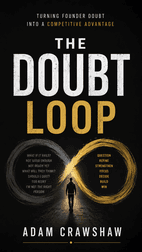
5 Main Takeaways from The Doubt Loop
Self-doubt is a furnace, not a phase—channel it with the Doubt Loop.
Adam Crawshaw argues that self-doubt never disappears; it changes shape. The Doubt Loop—Notice, Name, Convert—turns gut-punch moments into actionable forward motion, transforming paralysis into preparation and fear into fuel.
Pick one primary motive to avoid paralysis: Wealth, Control, Passion, or Ego.
Trying to optimize for all four founder motives creates conflict and indecision. Choosing your dominant fuel clarifies every decision from co-founder selection to fundraising, and prevents the J-curve from becoming a food fight in a moving car.
Time your moves using the four-tide framework: Low, Rising, High, Receding.
Timing is the silent partner of insight. The same idea launched in the wrong tide drowns; in the right tide it rides a billion-dollar wave. Match your spending, hiring, and pace to the tide you're in, and nudge it by lobbying or educating customers.
Hire Translators, Builders, and Zealots—not rock stars—for early stage.
Early-stage startups don't need glamorous talent; they need people who match the riskiest assumptions on your Belief Ladder. Translators bridge domain gaps, Builders execute on complexity, and Zealots provide grit and mission fluency—all with zero ego.
Guard three invisible burns: cash, attention, and credibility—in that order.
Cash is visible, but attention and credibility are smokeless killers. Bucket expenses into 70% Validation, 25% Scaling, ≤5% Vanity. Never hype what you haven't earned; credibility lost makes you unbackable, while maintaining it keeps you fundable even after failure.
Executive Analysis
These five takeaways form a unified loop: self-doubt is the constant background noise of entrepreneurship, but instead of fighting it, you redirect it through a systematic process. Start by naming your primary motive to stop internal conflict, then question your insight with a Belief Ladder and time it with the tide framework. Build the right team and protect your three burns to sustain the loop. The central thesis is that success doesn't silence doubt—it turns the volume knob from panic to performance, and the Doubt Loop is the dial.
This book matters because it moves beyond generic motivation into a practical field guide for founders and leaders wrestling with uncertainty. Crawshaw blends hard-won experience (a $1.4B exit) with frameworks that are immediately applicable—like the microquiz for motives, the ROSE test for celebration, and the SIGNAL framework for data. It sits at the intersection of startup strategy and leadership psychology, offering a counterpoint to the 'fake it till you make it' culture by showing that honest self-assessment and structured doubt are the real superpowers.
Chapter-by-Chapter Key Takeaways
Introduction (Introduction)
Self-doubt is not a phase to outgrow; it’s a furnace that must be channeled, not smothered.
The Doubt Loop—Notice, Name, Convert—turns gut-punch moments into actionable forward motion.
Early career experiences with demanding mentors build skills but don’t quiet the inner voice; the voice just sets higher bars.
External success (a $1.4 billion exit) doesn’t automatically silence self-doubt; recognition of the pattern is the real turning point.
The book is structured as a field guide: each chapter addresses a specific type of doubt and offers a framework to redirect it into fuel.
Try this: Treat every surge of self-doubt as a signal to run the Notice-Name-Convert loop instead of trying to suppress it.
1. Choose Your Fuel (Chapter 1)
The four dominant founder motives are Wealth, Control, Passion, and Ego. Pick one to drive; the rest can ride shotgun.
Trying to optimize for all four creates paralysis and conflict—the J-curve becomes a food fight in a moving car.
Your motive determines your relationship with funding, team culture, strategy, and what you define as success.
Use the microquiz to identify your primary fuel. If multiple ties, read the deeper descriptions to see which resonates.
Each motive comes with clear trade-offs: Wealth requires patience and risk of dilution; Control may slow growth; Passion risks burnout or financial failure; Ego can scorch bridges and overextend resources.
Once you know your motive, every decision—co-founder, hiring, fundraising, positioning—becomes crystal clear.
Try this: Complete the microquiz to identify your dominant motive (Wealth, Control, Passion, or Ego) and let that single driver guide your next strategic decision.
2. Question the Insight (Chapter 2)
Turn the dread that your idea is wrong into a testable Belief Ladder—plain-English rungs separating macro forces (outside your control) from micro insights (inside your control).
Surf the macro wave you can't change; pour your ingenuity into the micro lever only you can move.
Align your ladder with your motive—Ego, Wealth, Control, or Passion—or the business will feel almost right but never feed you.
Build your own TAM model bottoms-up; most early-stage numbers are fantasy.
Get into the field empty-handed and ask the painful questions; raw pain is worth more than polished origin stories.
Stalk competitors for free intel: find their wedge, channel, monetization, and weakness, then pivot where they're asleep.
Update your ladder every quarter. Assumptions are not forever—proof of steering with live instruments is better than clinging to last year's forecast.
Try this: Build a Belief Ladder with plain-English rungs separating macro forces from micro insights, then update it quarterly with field-tested data.
3. Catch the Wave (Chapter 3)
Timing is the silent partner of insight. A correct thesis launched at the wrong moment drowns; the same thesis at the right moment rides a billion-dollar wave.
Use the four-tide framework to calibrate your spending, hiring, and pace: Low Tide (learn), Rising Tide (speed), High Tide (differentiate), Receding Tide (consolidate).
Match your personal motive to the tide you’re in—don’t fight the current.
You can nudge the tide by lobbying regulators, educating customers, or bundling products to pull demand forward.
Before you launch, run a three-part check: (1) know the tide you’re in, (2) be honest about how long you can swim, and (3) decide if you can create your own current if the forecast looks flat.
Try this: Assess the current market tide using the four-tide framework before making any major hiring or spending commitment.
4. Spot Your Swans (Chapter 4)
Confront your 3 a.m. fears head-on with a preparade/postmortem memo that sketches both the ticker-tape victory and the eulogy.
Spot swans by doubling your ambition—stretch targets force your radar to search for extraordinary upside and downside. Screen candidates through plausibility, magnitude, and readiness.
Hedge black swans early by identifying single-point dependencies, keeping a volatility cash fund, and engineering customer loyalty loops that make switching expensive.
Plant seeds for white swans with low-effort two-way doors (trademarks, partnerships, API endpoints) and sketch a ten-times growth plan on paper long before you need it.
Court serendipity—accept weird opportunities, quirky sponsorships, and obscure conference slots.
Protect the house and build the empire as one circuit. Design a model that profits from both market melt-ups and fire sales, turning volatility into a feature rather than a flaw.
Try this: Write a preparade/postmortem memo today that sketches both your best-case and worst-case scenarios, then identify two black swan hedges and one white swan seed.
5. Question Yourself (Chapter 5)
The Mirror Test consists of four questions: superpower, style, 2:00 p.m. energy, and credibility. Score them with the same honesty as market research.
A superpower is the task where minutes of your time move the scoreboard like hours of anyone else’s. Identify it via flow, feedback, and the boomerang effect.
Choose a style (chameleon or peacock) that matches your market—selling to insiders? Blend in. Disrupting an incumbent? Stand out.
Your 2:00 p.m. slump instinct reveals true founder–company fit. If your fatigue-time task fuels the core engine, you’re aligned.
Credibility isn’t borrowed authority—it’s earned through immersion, partnership, or narrowing your scope.
Co-founders should derisk at least one rung on your Belief Ladder. Chemistry without strategic leverage is just friendship.
During low or rising tides, ignorance plus obsession can be a rational bet—you can earn stripes while the market is forgiving.
The mirror doesn’t demand flawlessness. It demands one key assumption tipped in your favor. That’s enough to light the fuse.
Try this: Score yourself honestly on the Mirror Test (superpower, style, 2 p.m. energy, credibility) and adjust your founder–company fit before your next funding round.
6. Brace for Impact (Chapter 6)
Every doubt has a specific countermove; learn to match them fast.
The “Brace for Impact” response buys you clarity: preblock time, vent on schedule, reset daily.
These six strategies form a single loop—catch the sentence, answer with practice, keep moving.
Try this: When doubt strikes, schedule a 15-minute 'preblock' to vent, then reset with a single forward action—don't let the emotion linger past the timer.
8. Mute the Rock Star (Chapter 8)
Early-stage startups don't need rock stars; they need Translators, Builders, and Zealots who match the riskiest assumptions on your Belief Ladder.
Assess your own domain depth to decide whether you need to hire a Translator, an advisory circle, or a co-founder.
Match the Builder's skillset to the lift complexity (simple, hard, abstract) to avoid brilliant insights that never scale.
Zealots are the glue: hire for zero ego, edge skills, mission fluency, learning ability, range, and toughness. Accept rough edges if the core superpowers are present.
Onboard Zealots with honesty, an early win, a stress test, and room to adapt.
Don't fear hiring people who outshine you. It raises the floor, compounds talent, and proves you're building for scale.
Try this: Map the riskiest assumption on your Belief Ladder and hire a Translator, Builder, or Zealot who directly derisks that rung instead of chasing a rock star resume.
9. Pick Your Poison (Chapter 9)
Investor fit matters more than investor pedigree. Ask “Were they a fit for us?” before you over-laugh at dinner jokes.
Every source of capital comes with an antidote (speed, distribution, patience) and a poison (dilution, pressure, shifting priorities). Map your motive and your Belief Ladder to find the match.
Pitch like a movie trailer: world shift, world divided, promised land, bridge, map. Hook the feeling first, then lace with facts. Name a blind spot to earn trust.
Softball questions are X-rays. Listen for the subtext: can you size the market realistically, respect competitors, explain your business model evolution, prove one acquisition channel, and state your motive clearly?
Rejection is data, not identity. Autopsy the “no” to avoid repeating the same mistake. The right “yes” will eventually quiet the critic.
Try this: Map your motive and Belief Ladder to each capital source—ask 'Were they a fit for us?' before accepting any term sheet, and pitch in movie-trailer structure.
10. Feel the Burn (Chapter 10)
Track three burns: cash, attention, and credibility. The last two are the smokeless killers.
Bucket every expense: 70% Validation, 25% Scaling, ≤5% Vanity. Move money toward proof.
Never hype what you haven’t earned. Filter future statements through earned reality, credible stretch, and fantasy land.
Guard your attention with a handful of productivity frameworks—and treat every hack as an experiment.
Credibility is your rarest asset. Lose it and you’re unbackable; keep it and you stay fundable even after failure.
Try this: Bucket every expense into 70% Validation, 25% Scaling, and ≤5% Vanity, then audit your last month's spending against those ratios.
11. Be Monogamous (Chapter 11)
Ruthless monogamy beats frantic poly-marketing. Pick one channel and master its physics before adding a second.
Know your customer's real life, not just their profile. Shadow them like an anthropologist. Maria the donut-shop owner lives a very different day than your spreadsheet predicts.
Use the One True Love Test to choose your channel. Evaluate day-in-the-life fit, trust transfer, signal speed, resource fit, defensibility, profitability, and scalability.
Add a second channel only when your first is predictably performing. Plant next season's crop while eating tonight's harvest.
Use paid advertising with intention, not desperation. Treat it as a product R&D tool or a land-grab accelerant, not a default solution.
Know when to kill a channel. Set leading and trailing metrics in advance, give the data enough time to speak, but cut fast when both signs stay flat.
Try this: Pick one customer acquisition channel using the One True Love Test and master its physics before adding a second channel.
12. Open Your Eyes (Chapter 12)
Guard three fuses: cash (visible), credibility (audible), and attention (felt). Losing one ignites the others.
When customer acquisition stalls, commit to one channel that targets your audience, test it, and iterate before adding more.
Before quitting, run a diagnostic on market, product, and channel. Pivot until your motive changes or the team isn’t a fit.
Self-sabotage often masquerades as fear or exhaustion—use these protocols to tell the difference.
Try this: When customer acquisition stalls, commit to just one channel targeting your audience, iterate for 30 days, then run a three-part diagnostic on market, product, and channel.
13. Build a Bear (Chapter 13)
Culture is built, not declared. Avoid extremes (kind vs. harsh); aim for bear‑like warmth with claws.
Hire for persona balance. Ten archetypes cover adaptability, speed, structure, candor, foresight, magnetism, spirit, and wisdom. Overuse any one; neglect any one.
Promote deliberately. Move from Doer → Driver → Manager → Leader → Guru only when the team needs scale, not earlier.
Resist bloat and tourist managers. Keep roles lean, promote internally, cap outside hires, enforce single‑threaded ownership.
Replace clichés with concrete behaviors. “Family” and “A‑players” mask trade‑offs. Name the actual expectations and actions.
Find your own lane. Ask people who’ve seen you under pressure what persona you really embody. Then build your team to cover the rest.
Try this: Define your company's ten archetypes for culture, hire for persona balance, and promote only when the team needs scale—resist the temptation to add tourist managers.
14. Beta Blocker (Chapter 14)
Board meetings test your ability to project calm certainty even when you're sweating self-doubt. The beta blocker ritual is the mental switch you flip.
Treat board seats as strategic patches: financial investors for data rigor, industry insiders for narrative and partnerships, company operators for execution efficiency.
Eliminate surprises by running a “meeting before the meeting” and assuming every slide is forwardable. Control the takeaway in writing.
Managing teams is about diagnosing macro desires and micro needs—pay people in the currency that truly motivates them, not just money or titles.
Most people problems come from one of four root causes: execution, decision, idea, or management. Spot the root and the fix is obvious.
During a crisis, stop the panic, size the impact, assign a single owner, broadcast an update, and write a postmortem. The calm, neutral framework builds trust faster than any heroics.
Sincerity in admitting gaps earns more trust than fake confidence.
Publicly showing your learning process invites others to root for you.
Bravado pushes people away; transparency invites them in.
Confidence that compounds comes from caring, learning, and being honest—not from pretending.
Try this: Run a 'meeting before the meeting' before every board session, assume every slide is forwardable, and control the takeaway in writing to eliminate surprises.
15. Don’t Trust Data (Chapter 15)
Data is never objective. Every metric inherits bias from how it's gathered. Trace the lineage before trusting the number.
More data is not better data. Fewer, sharper metrics that connect directly to outcomes beat sprawling stat sheets every time.
Use the SIGNAL framework (Strategic, Intuitive, Granular, Near-time, Actionable, Longevity-adjusted) to qualify every metric you keep.
Gut and data are partners, not enemies. Treat instinct as a hypothesis generator, then wrap measurement around it.
Don't confuse guiding metrics with proving metrics. The numbers that help you steer day-to-day (like nights booked per listing) are different from the numbers you show your board (like LTV/CAC).
Find your North Star by iterating in public. Don't wait for perfection; ship a live dashboard, test three candidates, kill what doesn't change behavior.
When you hit the right metric, it becomes the company's heartbeat. Conversations shorten, side quests die, and the goal becomes muscle memory.
Try this: Trace the lineage of every metric you track, apply the SIGNAL framework to cut your dashboard to fewer than ten metrics, and treat gut as a hypothesis engine, not an enemy.
16. Listen to the Noise (Chapter 16)
Default to qualifying outside opinions, not disqualifying them. The GAIN framework (Goal fit, Amplitude, Incentive, Next step) turns gut reaction into a systematic test.
Competitors, employees, board members, and random outsiders all carry potential signal. Treat ideas on merit, not on the messenger’s title or how the comment landed.
When internal rumblings echo, investigate. They often reveal frontline truth that dashboards miss—and ignoring them can cost billions (Wells Fargo) or a company’s existence (Borders).
Know when to shut it down. The STFU protocol protects team morale and truth when the noise turns malicious, misinformed, or destructive.
You can’t welcome external noise until you’ve tamed the internal one. This chapter lands near the end of the book because once you’ve steadied your mental compass, you’re ready to let new signals in.
Try this: Use the GAIN framework (Goal fit, Amplitude, Incentive, Next step) to qualify outside opinions systematically, and apply the STFU protocol when noise turns malicious.
17. Bank the Win (Chapter 17)
A win is a springboard, not a stopping point. Use it to fuel the next big vision.
Ownership of the ending rests with you—write it to serve the mission, the team, and your own journey.
The person who started it all (your earlier self) deserves to be honored in how you close each chapter.
Try this: When you achieve a win, use it as a springboard to fuel the next big vision—write the ending to serve the mission and honor the earlier self who started the journey.
18. Smell the Roses (Chapter 18)
Most founders skip celebration; that robs them of psychological fuel. You need permission to hit pause.
Use the ROSE test (Real significance, Owned outcome, Stakeholder impact, Enduring memory) to decide which milestones deserve confetti.
Celebrate first customers, on-time products, employee anniversaries, and unsolicited praise. Downplay head count growth, noncore whales, conference keynotes, and sandbagged KPIs.
Distinguish money raised (accountability) from money sold for (realized value). Toast the latter, celebrate the former in proportion.
Choose your company’s volume intentionally; loud wins attention but paints a target. Use ROSE to guide PR.
Keep self-doubt alive enough to stay curious. Unchecked ego is the fastest path from swagger to scandal.
The ultimate test of a milestone: does it still teach or inspire after the quarter ends? If not, let it pass without fanfare.
Try this: Apply the ROSE test (Real significance, Owned outcome, Stakeholder impact, Enduring memory) before celebrating any milestone, and keep self-doubt alive enough to stay curious.
Conclusion (Conclusion)
Self-doubt never vanishes; it changes shape. Learn to use its voice as a gauge for preparation, not permission to quit.
Most failures aren’t disastrous events—they’re quiet surrenders. The only way to lose the fight is to stop pushing.
“Unqualified” translates to “unprepared”; preparation is a choice, not a birthright.
Build a visible safety net (mentors, metrics, boundaries) before you attempt the high wire. Fearlessness is a myth; survival is engineered.
Success doesn’t silence the inner critic—it turns the volume knob from panic to performance. That tension is the signal you’re still alive and still climbing.
Try this: Replace the phrase 'unqualified' with 'unprepared'—preparation is a choice—then build a visible safety net of mentors, metrics, and boundaries before attempting your next high-wire act.
Continue Exploring
- Read the full chapter-by-chapter summary →
- Best quotes from The Doubt Loop → (coming soon)
- Explore more book summaries →