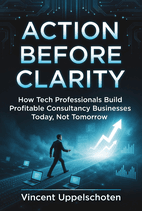
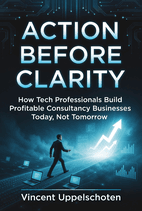
Vincent Uppelschoten's Action Before Clarity challenges tech professionals to stop overplanning and start a profitable consultancy using the 1-5-2 framework—defining one client, analyzing five competitors, and creating two offers. Written for experienced experts stuck in the Sunday evening loop of endless preparation.
Feature
Insta.Page
Blinkist
Shortform
Action Before Clarity
✓
✕
✕
Summary Depth
Full Chapter-by-Chapter
15-min overview
Section-by-section guides
Audio Narration
✓
✓
✓
Visual Mindmaps
✓
✕
✕
AI Q&A
✓
✕
✕
Quizzes
✓
✕
✕
PDF Downloads
✓
✕
✓
Price
$89.99/yr
$146/yr (PRO)
$199/yr
*Competitor data last verified July 2026.
1 Page Summary
This book is a direct challenge to the instinct that has made many tech professionals successful in their careers: the need for exhaustive preparation before action. Vincent Uppelschoten argues that this "planning trap" is the primary obstacle to starting a profitable consultancy. Drawing on his own experience of a derailed dream to become a pilot and three decades in corporate tech, he posits that clarity does not precede action—it follows it. The book’s central thesis is that your consulting offer already exists within your accumulated expertise, and the goal is not to create something new, but to recognize and articulate what you already know. The antidote to paralysis is acting before you feel ready, a principle that gives the book its title.
The author’s distinctive approach is pragmatic and structured, centered on the 1-5-2 framework. First, you define your "one" specific client and the problem you solve for them. Then, you analyze just "five" competitors (two large providers, one or two regional specialists, and one boutique firm) using a rapid, focused method to find gaps in the market. Finally, you create "two" clear service offers, because a single offer forces a binary yes/no decision, while two options shift the conversation to "which one is best." This is complemented by "reverse benchmarking," which flips traditional analysis to identify what competitors fail to do, and a value-pricing strategy that moves beyond day rates to quantify the return on investment your client will receive.
The intended audience is the experienced tech professional who has been "thinking about it" for too long—the person caught in the "Sunday evening loop" of planning without starting. These readers will gain a concrete, low-risk path forward that requires only five to ten focused hours per week. What sets this book apart is its insistence that the reader already possesses the most critical asset: deep, commercial and technical expertise. It provides the permission and the practical tools to stop theorizing and start testing, with the ultimate goal of landing that first paying client to validate the approach and build momentum.
Cover
Overview
The cover of Action Before Clarity does more than introduce a book—it lays down a challenge. The subtitle, “How Tech Professionals Build Profitable Consultancy Businesses Today, Not Tomorrow,” sets an urgent, practical tone. The front matter, including praise from clients who achieved tangible results (a £250K milestone, a £100K roadmap, a “game changer” transformation), signals that this isn’t abstract theory: it’s a playbook tested with real people.
The introduction wastes no time. It names the core problem: the “planning trap” that keeps experienced tech professionals stuck in analysis, convincing themselves they need more certainty before they start. The antidote is right there in the title—act first, and clarity will follow. The author, Vincent Uppelschoten, draws on three decades in corporate tech (Avaya, product management, channel sales) and his own leap into coaching to argue that your consulting offer already exists; you just need permission to see it.
The contents page reveals a structured journey: from defining your one client and your five target companies, to pricing strategy, pipeline building, and your first 90-day plan. The acknowledgements ground the book in personal history—a father’s dry-cleaning business, a brother’s competitive streak, a wife’s patience—making the advice feel earned, not manufactured. And the “About the Author” section reinforces that Vincent is his own target reader: a tech professional who spent years waiting for the path to become obvious and eventually decided to stop waiting.
This opening doesn't just set the table. It hands you a plate and says, “Start eating. The recipe will become clear as you go.”
Key Takeaways
Action before clarity is the core philosophy: Overthinking is the biggest barrier; taking even a small step generates real learning.
Your consulting offer already exists: You don’t need a brand-new idea—just package what you already know and do.
The book is written for experienced tech professionals who feel stuck in corporate roles but have the expertise to build something of their own.
Real client results are used as proof of method, not hype: £250K revenue, clear pricing, scalable client acquisition.
The author’s own story mirrors the reader’s: decades in corporate, then a leap into entrepreneurship—so the advice comes from lived experience, not a textbook.
Key concepts: Cover
1. Cover
Core Philosophy
Action before clarity is the central challenge
Overthinking is the biggest barrier to starting
Small steps generate real learning
Your Consulting Offer
Your offer already exists within your expertise
Package what you already know and do
You just need permission to see it
Target Audience
Experienced tech professionals stuck in corporate roles
Those feeling trapped in the planning trap
People with expertise to build their own business
Proof of Method
Real client results: £250K revenue milestone
Clear pricing and scalable client acquisition
Game changer transformations as evidence
Author's Credibility
Three decades in corporate tech (Avaya, product management)
Own leap into coaching mirrors reader's journey
Advice comes from lived experience, not theory
💡 Try clicking the AI chat button to ask questions about this book!
Introduction
Overview
The chapter opens with a deceptively simple piece of advice: “Having doubts is normal, the outcome is better if you act than if you don’t.” It’s a line that immediately frames the entire arc of what’s to come—action over paralysis, even when uncertainty lingers. The author then grounds this sentiment in a vivid personal memory. At eighteen, the dream was to become a pilot. A short flight in a small Cessna with his father, out of Eelde Airport (a two-hour drive from their hometown of Utrecht), was all it took. By the time they landed, the decision felt final. The path was clear.
But life had other plans. Mandatory military service—standard for young men in the Netherlands at the time—meant a routine medical exam. And that exam uncovered something neither the author nor his family had ever known: partial deafness in his left ear, a birth defect that had gone undetected for nearly two decades. The hearing loss was specific, affecting only a certain range of frequencies, but it was enough to complicate the pilot dream. The examiner was...
Key Takeaways
Certainty can dissolve in a moment. A lifelong dream can be interrupted by something as quiet as a missed frequency on a hearing test.
Doubts are normal, but waiting for perfect clarity before acting often costs more than acting with imperfect information.
Unexpected discoveries—even unwelcome ones—can reshape a story before you've fully written it.
Key concepts: Introduction
2. Introduction
The Power of Action Over Doubt
Doubts are normal, but action yields better outcomes
Waiting for perfect clarity often costs more
Acting with imperfect information is preferable to paralysis
A Dream Interrupted
At eighteen, the author dreamed of becoming a pilot
A short flight in a Cessna solidified the decision
Mandatory military service uncovered partial deafness
A birth defect derailed the pilot dream
Unexpected Discoveries Reshape Stories
Certainty can dissolve in a single moment
A missed frequency on a hearing test changed everything
Unwelcome discoveries can alter life's trajectory
You’ve been thinking about it
Overview
The author’s own moment of collapse: a failed medical exam at eighteen that vaporized his plan to become a pilot. Without a backup, he simply enrolled in a local polytechnic and walked into his first job four years later—unprepared, planless, but moving. The central insight lands softly but firmly: clarity doesn’t precede action; it follows it. Not because uncertainty is romantic, but because that’s the only order that works. Life, as John Lennon wrote, happens while you’re busy making other plans. The plan is gone, and life is already moving.
The Sunday Evening Loop
The chapter then turns to you—the person who has been thinking about starting a consulting business for longer than you’d like to admit. You have the experience. You have the knowledge. You know there are people out there who need exactly what you know. But you haven’t started. Not really. The reasons feel airtight: you need a clearer niche, the timing isn’t right, you need pricing figured out first, you need a more solid plan. The author calls this the “Sunday evening loop.” You sit down to start, decide you need a clearer plan, stare at a blank document, then realize you need to find a niche—timing isn’t right—need to figure out pricing. Around and around.
Behind that loop, for most people, sits a number. A salary that barely covers the mortgage. School fees on the horizon. A retirement calculation that only works if nothing changes. Or maybe it’s the gap between where you expected to be by now and where you actually are. All of it is real. All of it is also a reason to move. The situation you’re in right now is not the only option. You can move.
The Author’s Own Loop
The author knows this loop intimately—not just from watching others, but from living it himself. Vincent Uppelschoten spent thirty years in tech at Avaya: product management, product marketing, commercial strategy, pricing, offer development, channel sales, channel leadership. He understood what clients needed and how to build offers that felt fair on both sides. He loved doing it. But alongside that job, for years, he spent evenings and weekends trying to build something on the side. All of it driven by the same thing: money. Trading. Crypto. Amazon. Whatever seemed like a side door to more.
None of those side projects stuck. Because the loop was still running. The plan needed to be clearer. The timing needed to be right. Sound familiar?
The chapter closes by pointing toward what he eventually discovered—that the only way out of the loop is to stop trying to think your way through it and just take the next step. Clarity arrives after the action. The plan you wanted will reveal itself as you move.
Key Takeaways
Clarity emerges from action, not from waiting for the perfect plan.
The “Sunday evening loop” is a self-reinforcing cycle of analysis paralysis—break it by moving, not by thinking harder.
The reasons you haven’t started feel legitimate, but they are also the same reasons everyone stays stuck.
Your current situation is not your only option. You can move, even without a perfect picture of where you’re going.
The author’s own failed side projects prove that even experienced professionals fall into the same trap—knowing and doing are different things.
Key concepts: You’ve been thinking about it
3. You’ve been thinking about it
The Sunday Evening Loop
Analysis paralysis from overthinking
Reasons feel airtight: niche, timing, pricing
Self-reinforcing cycle of inaction
Break it by moving, not thinking harder
Clarity Follows Action
Clarity doesn't precede action
Plan reveals itself as you move
Author's failed medical exam proved this
Life happens while making other plans
The Real Barrier: Fear and Finances
Salary, mortgage, school fees behind the loop
Gap between expectations and reality
All reasons are real but also reasons to move
Current situation is not your only option
Author's Own Loop
30 years in tech at Avaya
Evenings and weekends chasing side projects
Trading, crypto, Amazon—none stuck
Same trap: knowing vs. doing
The Only Way Out
Stop trying to think your way through
Take the next step without perfect plan
Clarity arrives after action
Move even without full picture
Take the first step anyway
Overview
Most of us spend years chasing what looks like the safe bet—the venture with the clearest path, the least risk, or the most digestible playbook. Forex trading, sports betting, crypto, Amazon FBA, affiliate marketing, a weight loss business—none of it stuck. Not because the ideas were bad, but because none of them were built on the one thing that was already there: thirty years of commercial and technical knowledge in an industry full of people who had the tech but lacked the business side. That crossover, the blend of depth and clarity, had always been the part he loved most. He just couldn’t see it as the thing.
The thing you're sitting on probably isn't hidden either. It's so familiar you've stopped noticing it.
The Short Book, Big Idea
This isn’t a comprehensive manual. It doesn't try to cover everything. What it offers is the thinking and frameworks used with every tech professional who walks through the door: identifying what you actually know and who needs it, then moving through pricing, positioning, and landing that first client. The whole thing rests on one insight: you don’t need clarity to start. You need to start to get clarity.
Running as a Metaphor for Starting
Every day for over three years—seven days a week, no exceptions—he runs. Even on a ski holiday in the French Alps, through snow, while everyone else slept. Not out of obsession with fitness. Because running taught him that you get better at something by doing it before you feel ready. Consistency does something planning never can. Starting a consulting business works exactly the same way. You won’t feel ready. The plan won’t be complete. The timing will never be perfect.
This book isn’t a guarantee. The author is still on the journey and hasn’t figured out all of it. What he knows is that moving is better than waiting. The detail you think you need before you begin will reveal itself once you move. The only question is whether you take the first step anyway.
Key Takeaways
Your most valuable business idea is probably the one you've stopped seeing because it's too obvious—your existing, hard-won expertise in a field where most others lack one side of the equation.
Clarity is an outcome of action, not a prerequisite for it. Start before you feel ready, and the path will become visible.
Consistency outperforms planning. Small, repeated steps build momentum that no amount of preparation can match.
The first step doesn't need to be perfect; it just needs to be taken.
Key concepts: Take the first step anyway
4. Take the first step anyway
Your Hidden Expertise
Your best idea is already obvious to you
Crossover of tech and business knowledge is valuable
Most people overlook their own hard-won expertise
Clarity Through Action
Clarity is an outcome, not a prerequisite
Start before you feel ready
The path becomes visible only after moving
Consistency Over Planning
Small repeated steps build momentum
Consistency outperforms any perfect plan
Running daily taught the power of doing
Embrace Imperfect First Steps
The first step doesn't need to be perfect
Timing will never be ideal
Just take the step anyway
The Book's Core Framework
Identify what you know and who needs it
Move through pricing, positioning, and first client
Not a manual, but thinking and frameworks
You've reached the end of the free chapters
Next chapter: “Action Before Clarity” is locked
Keep reading Action Before Clarity — and unlock all 600+ book summaries with audio, mindmaps and AI Q&A.
$0.00 due today · 7 days free, then $89.99/year ($7.49/mo) · Cancel anytime before day 7
Vincent Uppelschoten is a Dutch historian and author specializing in early modern European maritime and economic history. His notable works include *The Dutch in the Mediterranean, 1590-1650* and *Seaborne Commerce and the Rise of Antwerp*, which examine trade networks and imperial competition. Uppelschoten holds a PhD from Leiden University and has published extensively on the intersection of global commerce and state formation.
Frequently Asked Questions about Action Before Clarity
What is Action Before Clarity about?
This book presents a practical framework for tech professionals to build a profitable consultancy business by taking action before achieving full clarity. It challenges the common 'planning trap' that keeps experienced experts stuck in analysis, arguing that certainty only emerges after you begin. Through the 1-5-2 method, readers learn to define their ideal client, research competitors, craft offers, and price based on value rather than time.
Who is the author of Action Before Clarity?
Vincent Uppelschoten is the author, drawing on over three decades in corporate tech including roles at Avaya in product management and channel sales. He transitioned into coaching tech professionals to launch their own consultancies, and his advice is grounded in real client successes like a £250K milestone and a 'game changer' transformation. The book is personal, referencing his father's dry-cleaning business and his own failed dream of becoming a pilot due to partial deafness.
Is Action Before Clarity worth reading?
Yes, this book is worth reading for any tech professional who has been thinking about starting a consultancy but feels stuck. It cuts through the hesitation with a tested, actionable playbook that emphasizes movement over perfection. The real-world examples and straightforward frameworks (like the 1-5-2 method) make the advice immediately applicable, turning theoretical planning into concrete progress.
What are the key lessons from Action Before Clarity?
The central lesson is that clarity follows action, not the other way around—you cannot think your way out of the planning trap. Your consulting offer already exists within your accumulated experience; the challenge is learning to see its value from a distance. Use reverse benchmarking to find the gaps competitors ignore, and price based on the value you deliver (using the four-number ROI conversation) rather than day rates. Finally, consistency in outreach and starting with just 5–10 focused hours per week bridges the gap between knowing and having a paying client.
📚 Explore Our Book Summary Library
Discover more insightful book summaries from our collection