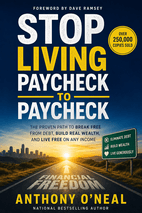
Stop Living Paycheck to Paycheck Summary by Anthony O'Neal (Free)

Chapter 1: Why Are We Living Paycheck to Paycheck?

Chapter 1 of 4
0:000:00
EN
1x
Voice
PDF

Stop Living Paycheck to Paycheck

by Anthony O'Neal

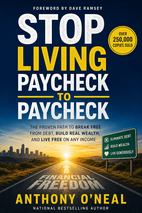
Stop Living Paycheck to Paycheck book cover

What is the book Stop Living Paycheck to Paycheck about?

Anthony O'Neal's Stop Living Paycheck to Paycheck presents a phased "Escape Plan" for breaking free from financial instability, centered on a written vision, zero-based budgeting, and the Debt Snowball Method. Written for anyone trapped in the cycle regardless of income, it covers building a one-month buffer, earning extra income, investing, and creating family wealth structures to achieve lasting freedom.

FeatureInsta.PageBlinkist
Summary DepthFull Chapter-by-Chapter15-min overview
Audio Narration
Visual Mindmaps
AI Q&A
Quizzes
PDF Downloads
Price$89.99/yr$146/yr (PRO)
*Competitor data last verified July 2026.

1 Page Summary

In Stop Living Paycheck to Paycheck, Anthony O’Neal argues that the root of financial instability isn’t a lack of income but a combination of destructive decisions, a culture that equates spending with success, and misguided internal mindsets—such as “fake it ’til you make it,” fear of money, or passive waiting for things to work out. The book’s central thesis is that wealth is built not by earning more, but by committing to a written vision, giving every dollar a purpose through zero-based budgeting, and systematically eliminating consumer debt. O’Neal emphasizes that even households earning $150,000 or more can live paycheck to paycheck, while many earning under $50,000 do not, making clear that behavior and planning matter more than salary.

The author’s distinctive approach is a phased “Escape Plan” that prioritizes emotional and practical momentum over mathematical optimization. He advocates for the Debt Snowball Method—paying off smallest balances first to build psychological wins—rather than the interest-focused Debt Avalanche, and insists on building a one-month buffer before tackling debt. The book also covers earning extra income, negotiating bills, buying a home only when truly ready, and investing 12–15% of net income after becoming debt-free. Later chapters introduce unconventional but practical tools like monthly money meetings for couples, family wealth meetings to prevent generational loss, and a Legacy Binder for estate planning, all framed around the idea that wealth buys back time and freedom rather than retirement for its own sake.

Written for anyone trapped in the paycheck-to-paycheck cycle—regardless of income level—the book appeals to both secular and faith-based readers, weaving in personal stories, biblical references, and real-life examples like the Hendersons, a young couple who escape debt and build millions through consistent investing. Readers will gain not just budgeting mechanics but a holistic framework for aligning money with life goals, protecting against emergencies, and building lasting multigenerational wealth. O’Neal’s emphasis on vision, discipline, and communication makes the path accessible, while his warnings about cultural traps and the high cost of consumer debt serve as a compelling call to action.

Chapter 1: Why Are We Living Paycheck to Paycheck?

Overview

People with good jobs and steady paychecks still end up with nothing to fall back on, and a single unexpected bill can wipe them out. The trap tightens across incomes, not just at the bottom. What keeps so many households stuck there?

The Road to Zero Wealth

Institute for Policy Studies' report, "The Road to Zero Wealth," projects median wealth to zero for Black Americans by 2053 and Latino Americans by 2073. Wealth is what remains after debts: the buffer against shocks, the capital for opportunity.

Three Causes
  • destructive decisions
  • a corroded culture
  • misguided mindsets
Destructive Decisions

Poor choices dominate. Two-thirds of households earning under $50,000 do not live paycheck to paycheck; about 20 percent of households earning $75,000 to $100,000 or over $150,000 do. Credit card debt grew from $478 billion (1999) to $770 billion (2019) to $1.23 trillion in late 2025. Illness, systemic racism, disasters, and layoffs are genuine; the fix starts with asking whether spending matches income.

A Corroded Culture

Culture equates success with display. At a hot-chicken spot, the author's BMW drew nothing; his Bentley drew questions. They came to the car, not the man.

Key Takeaways
  • Paycheck to paycheck is a condition of net worth, not a salary bracket, since high earners can be left with nothing after debts while many modest earners are not.
  • The Institute for Policy Studies projects that median wealth will effectively vanish for Black and Latino households within the next few decades if the current trajectory holds.
  • Spending discipline is the primary lever: the starting question is whether outflows match inflows, even when illness, discrimination, disasters, and layoffs are genuine causes of hardship.
  • A status-driven culture turns wealth into display, so people buy symbols of success rather than security, and the Bentley draws attention the driver never receives.
  • Mindsets matter as much as budgets and culture, because the same income can yield accumulation or emptiness depending on what money is believed to be for.

Key concepts: Chapter 1: Why Are We Living Paycheck to Paycheck?

Chapter 1: Why Are We Living Paycheck to Paycheck?

The Paycheck-to-Paycheck Trap

  • Good incomes still leave no safety net
  • One unexpected bill can wipe out savings
  • Affects households across all income levels

The Road to Zero Wealth

  • Wealth is what remains after debts
  • Black median wealth projected zero by 2053
  • Latino median wealth projected zero by 2073
  • Wealth is buffer against shocks and opportunity

Destructive Decisions

  • Spending often doesn't match income
  • Credit card debt tripled since 1999
  • High earners can live paycheck to paycheck
  • Fix starts with asking if outflows match inflows

A Corroded Culture

  • Success equated with display, not security
  • Bentley drew attention; BMW drew nothing
  • People buy symbols of status over wealth

Misguided Mindsets

  • Same income yields accumulation or emptiness
  • Money's purpose determines financial outcome
  • Mindsets matter as much as budgets and culture

💡 Try clicking the AI chat button to ask questions about this book!

Introduction

Overview

Millions follow the prescribed path of hard work, saving, and retirement, yet still end up broke or dependent in their later years. Something about that path itself must be wrong, but the alternative is not obvious. What would have to change to escape the trap?

Two cultural traps

Two cultural pressures keep people living paycheck to paycheck. One pushes spending money we don't have to display success that isn't real. The other is the American Dream: work for decades, retire on a 401(k), pension, and social security. Older couples finish that road without enough, working into their seventies or leaning on their children.

Misguided mindsets

Three reasons explain the trap: poor decisions, culture, and misguided mindsets. Culture is external; mindset is internal:

  • "Fake it 'til you make it": living at one level while pretending to be at a higher one, measuring worth by job title, salary.
  • "I'm scared of money": fear of losing money or not knowing how to invest. A savings account at 0.02 percent loses at least 3 percent a year to inflation. In Christian circles it confuses humility with lack.
  • "Everything is going to work out": waiting passively for miracles. Faith comes with working hands; the book quotes Jesus promising abundant life.
Wealth as freedom

Wealth is freedom. The author's father, with less money, called himself wealthy while golfing on a Tuesday afternoon: free to be present with his son, no boss to answer to. That is the wealth pursued here: freedom, joy, peace, time with family, and generosity across generations.

Phase 1

John and Jasmine owe $7,000 on a credit card, nothing saved, and learn they are expecting. Jasmine wanted a house before kids; John vows to find a way.

Key Takeaways
  • Reject the cultural script that money exists to signal status; measure wealth by how much freedom you can actually live into.

  • Treat every dollar spent in "fake it till you make it" as a down payment on a future you don't want, not an investment in the one you do.

  • Face your fear of managing money squarely: leaving cash in a barely yielding savings account quietly guarantees you lose buying power every single year.

  • Put your faith to work in your finances; waiting passively for a breakthrough is a mindset, while abundant life comes from acting on what you believe.

  • Build wealth for what it buys beyond retirement: unclaimed afternoons, family presence, and the joy of giving across generations.

Key concepts: Introduction

Introduction

The Trap of the Prescribed Path

  • Hard work, saving, retirement still leads to broke
  • Cultural script is fundamentally flawed
  • Alternative path is not obvious

Two Cultural Traps

  • Spending money we don't have for fake success
  • American Dream: decades of work, inadequate retirement
  • Older couples work into seventies or depend on children

Misguided Mindsets

  • Fake it 'til you make it: living above your level
  • Fear of money: savings accounts lose buying power
  • Passive waiting for miracles instead of acting on faith

Wealth as Freedom

  • Wealth measured by freedom, not net worth
  • Father's example: golfing Tuesday, no boss
  • Wealth buys joy, peace, family time, generosity

Phase 1: John and Jasmine

  • $7,000 credit card debt, no savings
  • Expecting a baby, house dream before kids
  • John vows to find a way out

Chapter 2: Write Your Financial Vision

Overview

Dreams alone feel like progress, yet they leave financial goals permanently out of reach. The comfort of imagining a future can replace the uncomfortable work of committing to one. Something more than a wish is required before any plan can take shape.

Dreams Versus Visions

Dreams about the future are comforting fantasies, and that comfort makes them enemies of financial success: satisfaction with dreaming kills the urgency to act. A vision is a written dream with a plan and a commitment. Dreams comfort; visions compel.

Defining a Financial Vision

A Financial Vision is three to five sentences describing the financial house complete, at retirement or a chosen horizon. Work backward from the end. Guiding questions:

  • What will life look like when goals are met in ____ years?
  • What must it look like at five years?
  • What must be accomplished at three years?
  • What must be accomplished at two years?
  • What major steps at one year?
The Hendersons' Vision

John and Jasmine Henderson, young professionals struggling to cover bills, envisioned their life at forty-five: a paid-off home, a retirement plan of at least $1 million returning 8-10 percent, 529 accounts funding college, term life insurance worth ten times income, and monthly budget meetings with annual wealth check-ins. Working backward: at five years, a home with 20 percent down on a fifteen-year mortgage and a six-month emergency fund; at three years, $20,000 for the down payment and maxed Roth IRAs; at one year, all non-student debt paid off.

A God-Sized Vision

A young woman at a meeting introduced the God-sized goal: a vision so large it cannot happen without God.

Small visions do not inspire. Dharius Daniels said why: a "why" without tears will never survive the price of commitment.

Three Steps
  1. Write down every dream that matters, thinking big.
  2. Circle the five to ten dreams with emotional pull or that solve real problems; keep them financial.
  3. Combine overlapping dreams into three to five statements, set a timeline, and work backward to one-, two-, three-, and five-year landmarks.
Key Takeaways
  • Write your dreams into a definite plan and commitment, or the comfort of dreaming will keep you satisfied without acting.
  • Define your financial house as complete in three to five sentences, then work backward from that end point to set one-, two-, three-, and five-year milestones.
  • Make your vision large enough to require help beyond your own resources, because a small vision will not survive the price of commitment.
  • List every dream that matters, circle the ones with emotional pull or practical weight, combine overlapping ones, and set a timeline.

Key concepts: Chapter 2: Write Your Financial Vision

Chapter 2: Write Your Financial Vision

Dreams vs. Visions

  • Dreams are comforting fantasies that kill urgency
  • Visions are written dreams with plan and commitment
  • Dreams comfort; visions compel action

Defining a Financial Vision

  • Three to five sentences describing financial house complete
  • Work backward from retirement or chosen horizon
  • Ask guiding questions for 5, 3, 2, 1-year milestones

The Hendersons' Example

  • Envisioned paid-off home and $1M retirement at 45
  • Set five-year goal: 20% down, emergency fund
  • Three-year: $20K down payment, maxed Roth IRAs
  • One-year: eliminate all non-student debt

God-Sized Vision

  • Vision so large it requires divine help
  • Small visions fail to inspire commitment
  • A 'why' without tears won't survive the price

Three Steps to Write Vision

  • Write down every dream that matters, think big
  • Circle 5-10 emotionally or practically significant dreams
  • Combine overlaps into 3-5 statements with timeline
  • Work backward to set 1, 2, 3, 5-year landmarks

Chapter 3: Give Your Money a Mission

Overview

For many people, spending money feels like a gamble: every purchase carries the quiet terror of not knowing whether the account will cover it. The usual fixes, earning more, spending less, don't remove that dread. Something more fundamental has to change.

The Problem with No Plan

Handing over your card at a restaurant while silently praying the balance covers the check is a familiar fear. The root problem is not an unknown or insufficient balance: it is having no vision and no plan for your money.

What a Monthly Money Vision Is

A Monthly Money Vision is the short-term plan behind your long-term Financial Vision. Before the month starts, write down how every penny of expected income will be spent, a zero-based approach, then follow it. If only $25 remains in a $500 grocery budget after $475 is spent, stretch it with leftovers and pantry items. If a $150 pair of shoes exceeds the $100 left for clothing, wait. Planned money counts as already spent. This ends paycheck-to-paycheck living.

Why Budgeting Is Necessary

The word "budget" sounds like bondage, but three reasons make it necessary.

  • "You can't manage what you don't measure," made famous by Peter Drucker. Budgeting monitors income, plans spending, and tracks what goes out.
  • A budget tells you what you can afford. A bank balance does not cover rent, car payments, tuition, and medical bills still to come. Luke 14:28-30 records Jesus asking who builds a tower without first estimating the cost.
  • Budgeting protects marriage. A survey found 42 percent of divorced people cited credit cards and overspending, and 56 percent cited disagreements over big purchases. Another report found married couples in their fifties averaged $643,000 in wealth, remarried couples $459,000. A shared plan creates accountability.
Building a Monthly Money Vision in Six Steps

Start with the upcoming month, and if married, only with your spouse.

  1. Track income history. Review bank statements and payment apps from the past three months and record every deposit, including tips, side-hustle revenue, alimony, and gifts.
  2. Identify Total Expected Income. Average irregular income over three months, add regular extras, and exclude employer-paid benefits.
  3. Track expenses. Review statements and pull credit reports from Experian, Equifax, and TransUnion. Group spending into categories, starting with the six Cornerstones:
    • Housing
    • Utilities
    • Groceries
    • Transportation
    • Childcare and education
    • Tithes and offerings Add other categories:
    • Debt repayment
    • Healthcare
    • Insurance
    • Clothes
    • Entertainment
    • Miscellaneous buffer
  4. Identify Average Monthly Outflow. Average each category over the past ninety days and sum them.
  5. Determine Expected Monthly Outflow. Subtract the average outflow from expected income. If income is $5,000 and outflow is $5,500, trim $500. That only breaks even, and the goal is to spend less than you earn. The book's sample budget includes rollover (R) categories whose unused amounts carry into the next month.
  6. Record every purchase. Log amount, place, and date for each expense, subtract it from its category, and update immediately or at day's end. Handwritten ledgers, spreadsheets, and budgeting apps all work, including the book's app, In the Black.
Key Takeaways
  • Before the month begins, assign every dollar of expected income to a specific category, and treat each assigned dollar as already spent rather than as available cash.
  • If your planned outflow is higher than expected income, trim until the plan is below your income, not merely equal to it; breaking even leaves you with nothing to build on.
  • Reconstruct your spending from the last ninety days of bank statements and payment apps, sort it into the six Cornerstones plus debt, health, insurance, clothes, entertainment, and a buffer, then log each purchase the same day it happens.
  • Let unused category funds roll into the next month instead of vanishing, so a grocery leftover carries forward and every new month starts with the full picture of what remains.
  • Create the monthly plan with your spouse as a joint commitment, and hold each other to it; a shared budget replaces money arguments with shared accountability.

Key concepts: Chapter 3: Give Your Money a Mission

Chapter 3: Give Your Money a Mission

The Problem with No Plan

  • Spending without a plan causes financial dread
  • Earning more or spending less doesn't fix fear
  • Root issue: no vision or plan for money

Monthly Money Vision Defined

  • Short-term plan behind long-term Financial Vision
  • Assign every dollar of expected income before month starts
  • Planned money counts as already spent
  • Ends paycheck-to-paycheck living

Why Budgeting Is Necessary

  • You can't manage what you don't measure
  • Budget reveals what you can truly afford
  • Protects marriage from money arguments
  • Shared plan creates accountability

Building a Monthly Money Vision in Six Steps

  • Track income history from past three months
  • Identify total expected income, averaging irregular amounts
  • Track expenses into six Cornerstones plus extras
  • Determine average monthly outflow over ninety days

Key Takeaways

  • Assign every dollar before month begins
  • Plan must be below income, not equal
  • Reconstruct spending from last ninety days
  • Let unused funds roll into next month
You've reached the end of the free chapters

Next chapter: “Get Safe and Secure” is locked

Keep reading Stop Living Paycheck to Paycheck — and unlock all 500+ book summaries with audio, mindmaps and AI Q&A.

$0.00 due today · 7 days free, then $89.99/year ($7.49/mo) · Cancel anytime before day 7

About the Author

Anthony O'Neal

Anthony O'Neal is a bestselling author and financial educator known for his work empowering young adults to achieve financial independence, most notably through his book *The Graduate's Guide to Life and Money*. He is a frequent speaker and former radio host who gained national recognition through his partnership with Dave Ramsey’s Ramsey Solutions, where he developed courses on student debt and money management. O'Neal’s expertise focuses on helping individuals avoid debt, build wealth, and make intentional financial decisions early in life.

Frequently Asked Questions about Stop Living Paycheck to Paycheck

What is Stop Living Paycheck to Paycheck about?
The book exposes why people with steady incomes still end up with no savings and shows a step-by-step escape plan. It covers writing a financial vision, creating a monthly money mission, building a one-month buffer, eliminating consumer debt with the debt snowball method, and then saving, investing, and building lasting family wealth. It also addresses the cultural and mindset traps—like faking success and fearing money—that keep households stuck, and offers practical guidance on home buying, giving, and estate planning to secure your financial future.
Who is the author of Stop Living Paycheck to Paycheck?
Anthony O'Neal is a financial educator and author who shares personal stories from his own journey, including racking up credit card debt, living out of his car, and later becoming a youth pastor before transforming his finances. He draws on his experiences and the tested strategies of his community to teach others how to break free from paycheck-to-paycheck living and build wealth through disciplined planning and investing.
Is Stop Living Paycheck to Paycheck worth reading?
Yes, this book is worth reading because it offers a clear, actionable plan that goes beyond generic budgeting advice. It tackles the root causes of financial struggle—destructive decisions, cultural pressures, and misguided mindsets—and provides a proven framework that includes practical tools like the Monthly Money Vision and Debt Snowball Method. The personal examples and step-by-step phases make it easy to apply the lessons to your own life, whether you're just starting out or trying to get back on track.
What are the key lessons from Stop Living Paycheck to Paycheck?
The most important lessons include writing a clear financial vision that turns dreams into a compelling plan, and giving every dollar a mission through a zero-based monthly budget. You need to build a one-month buffer before paying off debt, then use the Debt Snowball Method to gain momentum by clearing the smallest balances first. Real wealth comes from investing consistently over time—ideally 12-15% of your income—and from giving, which is framed as your first investment. Finally, family wealth meetings, a legacy binder, and a trust ensure that what you build survives into the next generation.
0