Stop Living Paycheck to Paycheck Key Takeaways
by Anthony O'Neal
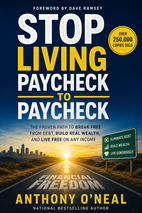
5 Main Takeaways from Stop Living Paycheck to Paycheck
Measure wealth by freedom, not by income or status
A high salary can leave you broke if your outflows eat it, while a modest earner who spends less than they make builds margin. Stop judging finances by what a purchase signals and judge them instead by how much life you can choose.
Give every dollar a mission before the month begins
A zero-based budget assigns each expected dollar to a specific category and treats it as already spent. Reconstruct the last ninety days of spending, log every purchase, and keep planned outflow below income so something is left to build on.
Build a one-month buffer before paying off debt
A month of net pay in a high-yield savings account is your protection against job loss, disaster, or medical trouble. It keeps you from borrowing or raiding retirement while you're paying down what you owe.
Use the debt snowball and celebrate every small win
List every balance from smallest to largest and throw extra cash at the smallest one first. Once it's cleared, roll its payment into the next balance and mark each victory to keep going.
After debt freedom, save, invest, and plan your legacy
Build three to six months of emergency savings, then route former debt payments into opportunities and seasonal buckets. Invest 12 to 15 percent of take-home income, give first, and pass both the wealth and the habits to the next generation.
Executive Analysis
These takeaways form one integrated argument: paycheck-to-paycheck is a net-worth problem, not an income problem, driven by status, untracked spending, and debt. The system starts with a zero-based budget that assigns every dollar a mission, protects that base with a one-month buffer and emergency savings, then uses the debt snowball to free cash flow. Once the leaks are sealed, former debt payments become investing and giving, so wealth is freedom to choose meaningful work and generosity, not display. The book is a sequencing plan: vision, margin, debt freedom, savings, investment, legacy.
This book matters because it targets the psychology beneath budgeting. O'Neal makes debt payoff, high-yield savings, insurance, estate planning, and investing concrete for anyone whose paycheck is already spoken for. It sits in the Dave Ramsey total-money-makeover tradition, but adds faith-based giving and family wealth meetings aimed at communication and trust. For a stuck reader, the payoff is a step-by-step plan that replaces anxiety with agency and treats money as a tool for freedom rather than status.
Chapter-by-Chapter Key Takeaways
Why Are We Living Paycheck to Paycheck? (Chapter 1)
Paycheck to paycheck is a condition of net worth, not a salary bracket, since high earners can be left with nothing after debts while many modest earners are not.
The Institute for Policy Studies projects that median wealth will effectively vanish for Black and Latino households within the next few decades if the current trajectory holds.
Spending discipline is the primary lever: the starting question is whether outflows match inflows, even when illness, discrimination, disasters, and layoffs are genuine causes of hardship.
A status-driven culture turns wealth into display, so people buy symbols of success rather than security, and the Bentley draws attention the driver never receives.
Mindsets matter as much as budgets and culture, because the same income can yield accumulation or emptiness depending on what money is believed to be for.
Try this: Reframe your money problem as a net-worth issue by listing every monthly outflow and checking whether your spending buys security or status; the same income can create wealth or emptiness depending on that choice.
Introduction (Introduction)
Reject the cultural script that money exists to signal status; measure wealth by how much freedom you can actually live into.
Treat every dollar spent in "fake it till you make it" as a down payment on a future you don't want, not an investment in the one you do.
Face your fear of managing money squarely: leaving cash in a barely yielding savings account quietly guarantees you lose buying power every single year.
Put your faith to work in your finances; waiting passively for a breakthrough is a mindset, while abundant life comes from acting on what you believe.
Build wealth for what it buys beyond retirement: unclaimed afternoons, family presence, and the joy of giving across generations.
Try this: Reject the status-driven script by defining wealth as freedom, and face your money fear by moving cash out of a low-yield account and acting on your faith rather than waiting passively for a breakthrough.
Write Your Financial Vision (Chapter 2)
Write your dreams into a definite plan and commitment, or the comfort of dreaming will keep you satisfied without acting.
Define your financial house as complete in three to five sentences, then work backward from that end point to set one-, two-, three-, and five-year milestones.
Make your vision large enough to require help beyond your own resources, because a small vision will not survive the price of commitment.
List every dream that matters, circle the ones with emotional pull or practical weight, combine overlapping ones, and set a timeline.
Try this: Write a three-to-five-sentence vision of a complete financial house, work backward from it into one-, two-, three-, and five-year milestones, and make the vision large enough to require help beyond yourself.
Give Your Money a Mission (Chapter 3)
Before the month begins, assign every dollar of expected income to a specific category, and treat each assigned dollar as already spent rather than as available cash.
If your planned outflow is higher than expected income, trim until the plan is below your income, not merely equal to it; breaking even leaves you with nothing to build on.
Reconstruct your spending from the last ninety days of bank statements and payment apps, sort it into the six Cornerstones plus debt, health, insurance, clothes, entertainment, and a buffer, then log each purchase the same day it happens.
Let unused category funds roll into the next month instead of vanishing, so a grocery leftover carries forward and every new month starts with the full picture of what remains.
Create the monthly plan with your spouse as a joint commitment, and hold each other to it; a shared budget replaces money arguments with shared accountability.
Try this: Assign every dollar of expected income to a category before the month begins, log each purchase the same day, and trim planned outflow until it is below income rather than merely equal.
Get Safe and Secure (Chapter 4)
Fund a one-month buffer of net pay in a high-yield savings account before you pay down any debt, because that cash is what lets you survive a job loss without borrowing or raiding retirement.
Keep that buffer reserved for true emergencies only: job loss, disaster, or medical trouble, never for meals out, gifts, or vacations.
Set up power of attorney and a will even if you are married, since a spouse does not automatically gain those legal powers, and add a letter of intent covering your funeral wishes.
Buy term life insurance sized at ten times your annual take-home income plus all debts plus $100,000 per child, and store the policies with a passcode sheet in a fireproof safe.
Try this: Fund a one-month net-pay buffer in a high-yield savings account before debt payoff, and pair that safety net with term life insurance at ten times income plus debts, a will, power of attorney, and a letter of intent.
Why Your Debt Is Deadly (Chapter 5)
Classify every purchase as an asset or a liability before you finance it, and reserve borrowing for things that can gain value, like a home.
When you consider any loan, add the full price: the interest, the years of payments, the options you close, and the stress you carry, not just the sticker amount.
Base your financial tracking on net worth instead of a credit score, since a high score only proves you have borrowed and repaid well, not that you are building wealth.
Make opting out of consumer debt an active decision, even though credit offers and lender pressure make debt feel like the default of modern life.
Try this: Stop financing anything that won't gain value; before taking any loan, add up the interest, years, stress, and closed options, and track net worth instead of your credit score.
How to Get Rid of Debt (Chapter 6)
Write down every outstanding balance, from the smallest to the largest, and direct all extra cash to the lowest one first.
Treat the debt as a spending problem, not an income problem, and free up the extra payments by cutting expenses rather than waiting for a raise.
When each small debt is cleared, fold its monthly payment into the attack on the next one, so the amount you can throw at debt grows automatically.
Build a small payoff ritual for each victory; the emotional boost of a quick win keeps you moving long after the novelty wears off.
Follow Dave Ramsey's debt snowball instead of targeting the highest interest rate first, because the avalanche's mathematical edge rarely survives the loss of motivation.
Try this: List every debt from smallest to largest and attack the smallest with extra cash freed by cutting expenses; when it's paid, add its payment to the next debt and build a small ritual for each victory.
Where to Find More Money (Chapter 7)
Start with the counter-system as a whole: a God-sized financial vision, a Monthly Money Vision budget, a one-month net-pay buffer in a high-yield account, estate-planning basics, a changed consumer-debt mindset, and a debt-snowball payoff order, because this economy is engineered to keep you paying interest and the pieces only work together.
Cut costs before you chase income, since an expense you eliminate is a raise under your control: negotiate anything you have treated as fixed, cancel forgotten subscriptions and expired trial renewals, and drop vices and luxury purchases outright.
In parallel, add income through gig work, a side hustle built on your day-job skills, or a fast retraining in high-demand tech roles, and let AI tools shrink the hours each revenue stream eats.
When a real emergency lands, pay it from your buffer rather than your credit, then rebuild the buffer before anything else; seeing the system absorb the blow is what turns discipline into genuine confidence that you can stay the course.
Try this: Cut fixed costs and cancel forgotten subscriptions before chasing income, then add a side hustle built on your day-job skills and use AI to keep the hours down; pay real emergencies from your buffer first.
How to Build Your Savings (Chapter 8)
Treat savings, not debt payoff, as the real source of wealth: debt freedom only creates the room, and margin is what turns that room into stability.
Size your emergency fund at three months of primary net income for stable households and six months if you have dependents, inconsistent income, high medical costs, or a volatile industry.
Keep that emergency money in a high-yield savings account where it stays liquid, and define an emergency narrowly so a broken TV or a down payment never drains it.
Once the Security Bucket is full, route the former debt payments into a separate opportunities account, so future purchases and investments happen without rebuilding debt.
Fund irregular annual costs like Christmas, school expenses, and maintenance through a dedicated seasonal bucket, planning ahead instead of borrowing when those dates arrive.
Try this: Build a three-to-six-month emergency fund in a high-yield savings account once debt is gone, then route former debt payments into a separate opportunities account and a dedicated seasonal bucket for irregular costs.
How to Build a Financial Rhythm (Chapter 9)
Close out each month with a money meeting, bringing the budget, the bank statement, and any unpaid bills, so the next month's plan starts from a shared conversation.
Replace "you pay this, I pay that" splitting with one pooled pot, and give each spouse a matching personal allowance so neither guards a private wallet.
Treat credit cards as a convenience you settle in full every month, not a borrowing tool, and be ready to cut them up the moment interest appears.
Run each meeting in three beats: compare what was budgeted with what was actually spent, talk over what served you and what didn't while keeping blame out of it, then revise the template and name one focus goal for the month ahead.
Let the children sit in for the end of the meeting and see the real numbers, because they sense hidden financial strain anyway and absorb the household's habits by watching.
Try this: Run a monthly money meeting with your spouse: compare planned versus actual spending, discuss without blame, revise the template, set one focus goal, and let the children see the real numbers.
Buying a Home (Chapter 10)
Confirm the four readiness criteria before house hunting: a year of zero-based budgeting, no consumer debt, three months of household income saved beyond the down payment, and a housing amount you set yourself.
When financing, aim for a 20% down payment and a fifteen-year fixed-rate mortgage; if that is years away, accept a smaller down payment through VA, FHA, USDA, or first-time buyer programs with a thirty-year fixed rate, and never an adjustable-rate or balloon loan.
Borrowing the down payment is never acceptable; the only safe source is your own savings.
After the purchase, shift focus to retirement: fully funding Roth IRAs each year produces retirement income that dwarfs the home's equity gain.
Try this: Verify a year of zero-based budgeting, no consumer debt, three months of savings beyond the down payment, and your own housing number before house hunting; then pick a 20% down, 15-year fixed mortgage or a safe low-down-payment program with a 30-year fixed rate, and never borrow the down payment.
Why You Need to Invest (Chapter 11)
Shift your emergency cash into a high-yield account so it earns enough interest to cover small wants, but accept that inflation means savings only tread water.
Put 22 to 25 percent of net income to work: 10 percent to your church and 12 to 15 percent into stocks, mutual funds, and real estate.
Start investing now, even with $20,000 or a modest annual contribution, because compounding turns those amounts into seven figures by retirement.
Treat investing as a long-term commitment with real risk, not a savings habit, and it becomes the way your money buys back your time and freedom.
Try this: Move emergency cash into a high-yield account and invest 22 to 25 percent of net income — 10 percent to church and 12 to 15 percent into stocks, mutual funds, and real estate — starting now so compounding does its work.
Giving Is Your First Investment (Chapter 12)
Give your first 10% of net income to your local church before budgeting anything else, because tithing is the first investment your money makes.
Treat any giving beyond the tithe as an offering, and let your cheerfulness rather than your leftover cash set its size.
Accept Malachi's storehouse test as a real offer: bring the full tithe and expect blessing that overflows your capacity to store it.
The author's lights-out night and the rental house he was offered show that tithing opens a virtuous cycle, but it only works when joined to the budget discipline his six-figure years lacked.
Try this: Give your first 10 percent of net income to your local church before budgeting anything else, then let cheerfulness set the size of any offering and trust the promise only alongside budget discipline.
How to Invest the Right Way (Chapter 13)
Once you are debt-free, begin investing a modest slice of take-home income and increase it each year until you are putting away 12 to 15 percent, because consistent early contributions, not lucky picks, are what produce serious wealth.
Allocate your savings in a specific order: capture the employer match, ideally in a Roth, then fill a Roth IRA, then add more to the 401(k), and only turn to a taxable brokerage after those tax-advantaged spaces are maxed.
For children, open a 529 for future education, a custodial Roth IRA if they have earned income, or a custodial brokerage account, and make sure they sit in on the family's annual money review so they inherit your habits rather than just your dollars.
Steer clear of the classic investor sins: postponing, owning things you don't understand, timing the market, and letting fear or greed dictate trades.
Keep in mind that the end goal is not a retirement age but freedom over your own time, and for many families a greater capacity to give, as the tithing conversation makes clear.
Try this: Invest 12 to 15 percent of take-home income after debt freedom in this order: employer match in a Roth, a Roth IRA, more 401(k), then taxable brokerage, and open a 529, custodial Roth, or custodial brokerage for your children.
Family Wealth Meetings (Chapter 14)
Sequence the gathering so the first session is about the family's challenges and victories and the second is about the numbers; heirs who hear both in the same weekend learn that money belongs to a larger story.
Make the invitation broad, the roster whatever it is, and the method purely your own example; a meeting that anyone is pressed into attending will not produce the candid talk it exists for.
Build the binder before you need it and place it where your executor can actually reach it; the estate plan you cannot put your hands on does not protect anyone.
Add the legacy letter beside the legal documents, recording the beliefs you hold and the lessons that cost you dearly, because the next generation inherits your reasoning long before it inherits your assets.
Expect the family fortune to survive or fail on the quality of its communication and trust rather than on its investment returns; the wealth that usually vanishes by the third generation is lost to silence, not to markets.
Try this: Plan a family wealth meeting with the first session on challenges and victories and the second on numbers, build a binder with estate documents and a legacy letter, and make sure your executor can find it.
Final Steps (Chapter 15)
Treat wealth as the ability to choose meaningful work over a paycheck, the way a retiree who volunteers full-time does.
Replace your will with a revocable trust so your estate stays private and skips probate; Ramsey puts typical probate costs at up to 7 percent of an estate, with inheritances held up for months.
Insure for ten times your income, every current debt including the mortgage, and $100,000 per child for college, and add coverage only for real exposures like rental properties, business disability, medical costs, or tuition.
Pay off your mortgage with biweekly half-payments, which builds one extra principal-only payment a year, or make it your next Debt Snowball target.
Write legacy gifts into your trust or will, and let a scholarship endowment pay out annually so a single gift keeps funding students for decades.
Try this: Shift from a will to a revocable trust to keep your estate private and skip probate, insure for ten times income plus every debt and $100,000 per child, and pay off the mortgage with biweekly half-payments.
Epilogue (Epilogue)
Open the serious money conversation in the most ordinary corner of your home; that spot will hold more meaning than any spreadsheet you ever build.
Save toward the range of lives you can choose, so that picking between the beach and a week in Paris costs you no anxiety.
Hold to a single plan across decades, because its payoff appears as unforced mornings rather than dramatic windfalls.
Count the emotional dividend as part of the gain; success is a plan that leaves you quietly grateful for unexceptional days.
Try this: Start the serious money conversation in the most ordinary corner of your home, save toward a range of possible lives, and count quiet gratitude for unexceptional days as part of the plan's success.