Stop Living Paycheck to Paycheck Quotes
by Anthony O'Neal
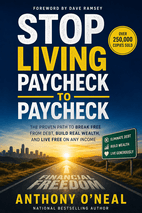
Here you’ll find the lines from Anthony O’Neal’s book that have stuck with readers long after they close the cover. Some are tough love wake up calls. Others are gentle nudges to rethink the story we tell ourselves about money. They cut through the noise and get straight to the heart of why so many of us feel broke even when we’re earning.
These quotes work because they’re grounded in real life. O’Neal talks about marriage, stress, impulse buys, and the pressure to look successful. He doesn’t pretend the journey is easy. Instead he gives you language for the struggle and a reason to believe a different path is possible. That mix of honesty and hope is what makes the book so quotable.
Top Quotes from Stop Living Paycheck to Paycheck
“It pressures us to spend money we don't have so we can project an image of success that isn't real—an image that ultimately costs us everything.”
The author explains how cultural pressure drives paycheck-to-paycheck living.
It names the trap of performing success with money we don't have, and it shows why that image can destroy us.
“Keep your head down and work hard, and the system will take care of you in the end. That's the American Dream. In reality, it's a nightmare.”
The author is describing the American Dream as it's often sold to people.
It captures the painful gap between the promise of hard work and the financial reality many people eventually face.
“Dreams pacify us, but visions drive us. Dreams keep us comfortable, but visions spur us into action. Dreams are static—they don't go anywhere—but visions are always in motion.”
The author is explaining the difference between a dream and a written, planned vision.
The parallel structure makes the core idea instantly memorable, and it frames inaction as the real enemy of progress.
“Money problems lead to marriage problems. And, unfortunately, marriage problems lead to more money problems.”
The author says this while arguing that a budget is necessary for family harmony.
It captures a painful cycle many couples will recognize. It makes a strong case for creating a shared plan with money.
“Eating out is not an emergency. Christmas gifts are not an emergency. A date is not an emergency. A new iPhone hitting the shelves is not an emergency—even if the phone is on sale. And I know someone needs to hear this: A vacation is not an emergency.”
Anthony warns against using the emergency fund for ordinary expenses.
The blunt, humorous list makes the rule impossible to forget. It challenges readers to be honest about what truly counts as an emergency.
“I had to live on the streets off Highway 76 there in Oceanside before I got it through my head that debt isn't freedom. It's bondage.”
After racking up credit card debt as a young man, the author ended up living in his car.
It turns an abstract warning into a lived consequence, and the contrast between freedom and bondage is stark.
“It's not normal to pay more than double the price for something tomorrow because you can't afford it today.”
He says this while breaking down the true cost of paying minimum balances on credit cards.
It exposes the insanity of normalizing interest payments and challenges readers to rethink what they call affordable.
Themes Behind the Quotes
One of the biggest themes is the difference between appearing successful and actually building wealth. Many people spend money they don't have to project an image, and that pressure keeps them trapped. The book challenges that mindset by showing that real financial success is more about security, peace, and choices than about what others see.
Another theme is that debt is not a tool or a normal part of life. It is a form of bondage that causes stress, hurts marriages, and robs people of freedom. The solution involves making a written plan, measuring every dollar, and building a buffer so that unexpected problems don't become disasters. Those habits turn a family into a team, and they create something lasting: wealth, wisdom, and peace that can be passed down.
Quotes by Chapter
Chapter 1: Why Are We Living Paycheck to Paycheck?
“Wealth is the buffer families need when faced with unexpected economic shocks like a lost job or a broken-down car. Wealth is also the capital available to families to take advantage of economic opportunities, like buying a home, saving for college or investing in the stock market.”
The author explains the report's definition of wealth and why it matters.
It makes the abstract idea of wealth concrete: wealth is not income or stuff, but security and opportunity.
“Ultimately, wealth can be the difference between a family maintaining and strengthening their economic status or flailing in economic insecurity.”
The author summarizes the stakes of the wealth gap described in the report.
This line captures the profound real-world consequences of having or lacking wealth in one sentence.
“Our culture taught this young man that a wealthy person is a successful person, and that he could always tell who is wealthy by the way they put on a show.”
After a restaurant worker is impressed by his Bentley, the author reflects on what really happened.
It exposes how appearances shape our definition of success and distract from real financial discipline.
Introduction
“It says I have to show people that I'm successful even when I’m not, otherwise I'll never be taken seriously. Worse, I'll never actually become successful. I have to fake it before I can really achieve anything.”
The author describes the 'fake it ‘til you make it' mindset.
It voices the fear behind pretending to be successful, and it resonates with anyone who has hidden their real finances.
“Listen, if it requires a miracle for you to buy a house or pay your bills or save enough for retirement, I don’t think you're on the right track. More importantly, I don’t think you're on the path or plan God has laid out for you.”
The author challenges passive 'everything will work out' thinking in the church.
It reframes faith with responsibility and warns against waiting for divine intervention instead of doing the work.
Chapter 2: Write Your Financial Vision
“Your dreams are some of the greatest enemies of your financial success.”
The author opens the chapter by challenging the reader's assumption that dreams always help.
It is a deliberate, provocative reversal that makes readers question whether passive wishing is actually sabotage.
“A vision is a dream that is written down. A vision is a dream with a plan. And a vision is a dream I have committed to achieve.”
The author defines what elevates a dream into a vision.
It gives readers a clear, actionable definition and moves them from fantasy to commitment.
“It takes something we can’t see and gives it flesh and bones to make it real.”
The author explains how a vision pulls dreams into reality.
The physical imagery of 'flesh and bones' makes the abstract idea of vision-building feel concrete and attainable.
Chapter 3: Give Your Money a Mission
“You can't manage what you don’t measure.”
The author cites Peter Drucker while explaining why a monthly budget is necessary.
It turns a well-known business principle into a personal finance rule. It reminds readers that clarity begins with tracking.
“If you spend your money on impulse buys today, chances are pretty good you won't be able to afford necessary expenses tomorrow.”
This appears in the section explaining why a budget helps you know what you can afford.
It makes the cost of impulse spending vivid and easy to remember. It reframes budgeting as protecting tomorrow's needs.
“The key is to treat your Monthly Money Vision as if you are actually spending your money at the beginning of each month—as if making the plan is the same as removing the money from your account.”
This is the author's advice for sticking to a budget when tempted to overspend.
It gives readers a concrete mental trick to avoid impulse buys. It makes a budget feel real and binding before the month begins.
Chapter 4: Get Safe and Secure
“Your job isn't guaranteed. Your side hustle isn’t guaranteed. Your secondary sources of income are not guaranteed— including social security.”
Anthony summarizes what Marcus’s sudden layoff teaches about income.
It strips away the illusion of job security and makes the case for an emergency buffer. Readers feel the urgency to save before a crisis hits.
“I make bad decisions when I feel cornered, or when I feel like my back is up against the wall. I rush my choices. I don’t calculate all the variables the way I should. I let stress pressure me into doing things I wouldn't normally do.”
Anthony admits how financial pressure affects his own judgment.
This vulnerable confession helps readers recognize their own stress-driven choices. It frames an emergency fund as a way to protect not just finances, but clear thinking.
“When you have a one-month buffer saved up, you have groceries for thirty days. You have your rent or mortgage covered for thirty days. You have your bills paid for thirty days. You have thirty days of peace to gather your resources, work with your spouse and your other advisors, and make the right decision.”
Anthony paints the practical difference a one-month buffer makes.
It turns an abstract savings goal into a tangible feeling of peace. The repetition drives home how one month of breathing room can transform a crisis into a solvable problem.
Chapter 5: Why Your Debt Is Deadly
“The Bible says, “The rich rule over the poor, and the borrower is slave to the lender” (Proverbs 22:7).”
In a section about the true cost of consumer debt, the author quotes Proverbs.
It gives debt a moral and spiritual weight, reminding readers that borrowing is not just a financial decision.
“At eighty-three, her life should be filled with great-grandchildren and reliable healthcare and morning conversations with God over a warm cup of tea. Instead, she’s stuck with no money, no time, no choices, and no peace—primarily because of the decisions she made decades ago.”
The author is recounting a late-night encounter with an 83-year-old McDonald's worker.
It makes the cost of bad financial decisions painfully human, not just numeric.
Chapter 6: How to Get Rid of Debt
“I could not even be intimate with my husband because of how stressed I feel about our debt.”
A wife on a Zoom call tells Anthony how debt stress ruined their date night.
It exposes the hidden emotional toll of debt and makes financial stress painfully relatable.
“Breaking free from the bondage of debt is hard work. You are swimming against the stream of culture when you start down that path, which means you'll encounter a lot of resistance.”
Anthony explains why it is important to celebrate debt-payoff victories.
It names the loneliness of debt freedom and validates how difficult the journey is.
“I can say confidently that most families don't get into debt simply because they lack money. They get into debt because they spend more than they can afford.”
Anthony challenges the idea that debt is caused by not having enough income.
It reframes debt as a spending behavior people can change, sparking self-accountability.
“If all you're doing is paying off high interest payments each month, you don’t actually make progress in removing the debt.”
Anthony explains why the Debt Snowball Method can beat the math of the Debt Avalanche Method.
It's a sharp warning that minimum payments can feel like action while leaving you trapped.
Chapter 14: Family Wealth Meetings
“You're building the kind of structure that will leave behind not just money, but wealth—freedom and security and financial literacy and peace.”
The author explains what true legacy-focused financial planning creates for a family.
It reframes wealth as more than dollars, highlighting freedom, knowledge, and peace as the real inheritance.
“You can be the catalyst that transforms your family from a group of isolated silos into a united, supportive, multiplying community.”
The author encourages readers to start family wealth meetings even if only with their immediate family.
It empowers the reader to see themselves as the one who can change their family’s financial and relational trajectory.
“That means family wealth gatherings don’t just preserve your family's wealth—they preserve peace.”
The author is describing how regular, honest financial conversations reduce conflict over inheritances.
It captures in a single line the dual purpose of these meetings: protecting both money and relationships.