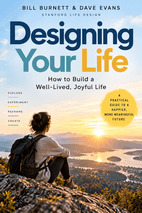
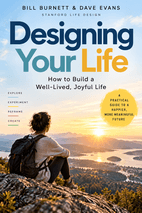
Bill Burnett's Designing Your Life applies design thinking to career and life decisions, teaching readers to reframe dysfunctional beliefs, build a Workview and Lifeview compass, and use tools like the Good Time Journal, mind maps, and Odyssey Plans. For anyone feeling stuck, bored, or lost at any career stage.
Feature
Insta.Page
Blinkist
Shortform
Summary Depth
Full Chapter-by-Chapter
15-min overview
Section-by-section guides
Audio Narration
✓
✓
✓
Visual Mindmaps
✓
✕
✕
AI Q&A
✓
✕
✕
Quizzes
✓
✕
✕
PDF Downloads
✓
✕
✓
Price
$89.99/yr
$146/yr (PRO)
$199/yr
*Competitor data last verified July 2026.
1 Page Summary
At its core, Designing Your Life argues that people too often lock in a first idea about their careers and then spend decades defending it, even when it stops working. Drawing on design thinking, the book treats problem finding as just as important as problem solving, because there is no point working the wrong problem. It introduces tools like the Workview and Lifeview—a personal philosophy of work and a sense of how the world works—to help readers build a "compass" for navigating when the destination is unknown. Rather than hunting for a single right answer, the authors encourage generating many possibilities, using methods such as the Good Time Journal, mind maps, and three Odyssey Plans to explore multiple lives one might live within a single lifetime.
What makes this approach distinctive is its insistence that life is not a paint-by-numbers kit but more like an abstract painting that can be read in many ways. The book reframes common dysfunctional beliefs: that work isn't meant to be enjoyable, that one must find the one right idea, that happiness requires making the right choice. Instead, it offers practical design practices—wayfinding by following engagement and energy, prototyping possibilities at small scale and low exposure, and building "failure immunity" rather than merely reducing failure. It also challenges the standard job hunt, noting that only about 20 percent of U.S. jobs are posted and that the hidden job market opens through relationships, as illustrated by Kurt's fifty-six Life Design Interviews leading to seven offers.
The intended audience is anyone feeling stuck, bored, or lost in their career—whether they are launching a first path, changing direction mid-career, or rethinking what comes next. The book promises readers a way to move forward from wherever they are, without needing to have it all figured out alone: life design is done alongside others, with a team of supporters, players, and intimates. Ultimately, it teaches that balance is a myth to be achieved over time, that choosing well matters more than choosing "right," and that you never finish designing your life—it is a never-ending project of building your way forward.
1. Start Where You Are
Overview
Figuring out where you are sounds easy, but it's hard to actually pin down. You can work hard for years on a problem that feels like yours and still end up somewhere you never meant to be.
Over the design studio at Stanford hangs a sign reading You Are Here, and students find it clarifying. Your background and your past jobs don't decide what happens next. You are not too late, and you are not too early. Design thinking helps you move forward from wherever you are right now. But first you have to know where you are and what problem you are solving.
Wicked Problems and the Wrong Problem
Designers get energized by wicked problems. They are called wicked not because they are evil, but because they never get fully solved. Somewhere you are stuck, and that is a fine place to begin. Design thinking treats problem finding as just as important as problem solving, since there is no point working the wrong problem. People usually describe their trouble as something to add or something to remove: get a better job, more money, more balance; get rid of ten pounds, unhappiness, pain. Usually the problem is defined by what is missing. Choosing which problem to work on may be the most important decision a person makes, because people lose years, or a lifetime, to the wrong one.
Dave's Two-and-a-Half-Year Detour
Dave spent two and a half years on a problem that was clear to everyone else in about two weeks. He entered Stanford as a biology major, certain his destiny was field-research marine biology. Two people gave him that idea:
Jacques Cousteau was his childhood hero, and Dave watched every Undersea World episode. The best life he could picture was getting paid to play with seals. Mrs. Strauss was his high school biology teacher. He liked biology best because he liked her best, mistaking her good teaching for his own interest in the subject.
Stanford had no marine biology major, so he majored in biology, mostly biochemistry and molecular biology. He forced his way into a bio lab doing RNA research, which mostly meant cleaning test tubes. Teaching assistants kept asking why he was a biology major, cut off his Cousteau-and-Strauss answer, and told him he was no good at it, didn't like it, was grumpy, and should drop it, since arguing was the only thing he did well. He kept going anyway, stuck on the problem he had in mind instead of the real one.
Failure, Success, and a Beginner's Mind
In office hours, people waste a great deal of time on the wrong problem. The lucky ones fail fast and are forced by circumstance onto better problems. The unlucky ones are smart, so they succeed. Then they wake up ten years later wondering how they got there and why they are unhappy. A beginner's mind would have changed Dave's path. Instead of assuming answers before asking questions, he would have been curious, learned what a marine biologist actually does, and asked some, beginning with the Hopkins Marine Station an hour and a half from campus.
Key Takeaways
Name the problem you are actually working on before you start solving it, and notice whether you have framed it as something missing rather than something you want to build. Treat your history and current job as a starting point, not a verdict. Where you stand now does not fix how far you can go. Test a field by finding out what the daily work actually looks like, instead of trusting the hero or the favorite teacher who first made it appealing. Read failure as cheap correction, and watch out for being good at something early, since being good at something you dislike is how people spend a decade in the wrong place. Put deliberate effort into choosing which problem to take on, because that choice shapes your years more than how hard you work once you have made it.
Key concepts: 1. Start Where You Are
Start Where You Are
Start Where You Are
You Are Here sign clarifies: past jobs don't decide what's next
You are not too late or too early; move forward from now
First know where you are and what problem you're solving
Wicked Problems and the Wrong Problem
Wicked problems never get fully solved; being stuck is a fine start
Problem finding matters as much as problem solving
Problems usually framed as something missing: add or remove
Choosing the wrong problem can cost years or a lifetime
Dave's Two-and-a-Half-Year Detour
Dave chased marine biology for 2.5 years over a two-week realization
Cousteau and Mrs. Strauss inspired him for the wrong reasons
He mistook liking a teacher for liking the subject
TAs warned him; he stayed stuck on the wrong problem
Failure, Success, and a Beginner's Mind
Lucky ones fail fast and get forced onto better problems
Unlucky smart ones succeed, then wake up unhappy years later
A beginner's mind asks questions before assuming answers
Dave should have explored what marine biologists actually do
Key Takeaways
Name the real problem before solving; avoid 'missing' framing
Treat history and current job as a starting point, not a verdict
Test a field by its daily work, not its heroes or teachers
Read failure as cheap correction; beware early success you dislike
💡 Try clicking the AI chat button to ask questions about this book!
Introduction: Life by Design
Overview
People lock in a first idea young, then spend decades defending it and grinding on problems they never actually investigated. When the effort stops paying off, nothing in the situation tells them whether to push harder or walk away.
We fall in love with a first idea and refuse to let it go. Letting a misguided seventeen-year-old decide where you work for the rest of your life is a poor bargain. Like Dave, we lose years to a good problem that is not actually our problem. Wanting a better job is not the answer to being unhappy at work and wishing you were home with your kids. A marriage problem does not get solved at the office.
A gravity problem is not a real problem. The working rule is that if it's not actionable, it's not a problem. It's only a situation, a circumstance, a fact of life. Some are totally unactionable, like gravity itself. Others are unactionable in practice, like the median income of a full-time poet. People fight reality with everything they have, and reality comes out ahead every time.
Take the five-year unemployed job seeker. Employers shown identical résumés that differed only in how long the applicant had been out of work avoided the long-term unemployed. That perception cannot be changed. How you appear to them can, through volunteer roles, recorded professional results, and industries with less ageism. Or the family firm outsider. Nobody without the family name has reached an executive role in 132 years, so the three-to-five-year path to a VP title rests on no evidence. Change firms, or trade authority for value and become the highest-paid manager. Or ten years to the M.D. You begin treating patients in your second year, and residents do most hospital doctoring. Or become a physician's assistant, or run prevention programs for an insurer.
Fighting City Hall is still right for injustice, women's rights, food justice, homelessness and climate change, but do it smart. Acceptance is the You Are Here phase, and it is where designers begin.
The life design assessment breaks a life into four areas. Health: being well in mind, body and spirit. Work: anything you do that is part of the shared human project, paid or not, so raising children and keeping a home both count. Play: any activity that brings joy in the pure doing of it. Done to win, advance or achieve, it is not play. Love: arriving as affection, community or desire, and it has to flow both ways.
The dashboard works like a car's gauges. The dysfunctional belief is that you should already know where you are going. The reframe is that you cannot know that until you know where you are. Fred, an entrepreneur, had entered nothing under health or play. He hired a trainer, worked out three times a week, and listened to a challenging audiobook on his commute, then reported better efficiency and higher satisfaction.
The future cannot be predicted. That much is given. What matters more is this: once you design something, the futures available to you change. Designing your life is not about fitting a plan to a life already in motion. It opens some paths and closes others. So there is no way to work out a great life design before you begin, and no point in trying. What you can know in advance is your starting point. From there, the work is not to chart the whole journey but to get pointed in the right direction. For that, you need a compass, not a map.
The Health / Work / Play / Love Dashboard takes the four areas and turns them into gauges, like the dials on a car's panel. Each one runs from 0 to Full, and each is read on its own: work, play, love, health. The exercise is filed under the heading "Try Stuff," which says what kind of exercise it is, less a matter for reflection than for doing.
Write a few sentences about how things are going in each of the four areas. Mark where you currently sit on each gauge, on a scale from 0 to Full. Ask whether there is a design problem you would like to tackle in any of these areas. Ask whether the problem you have named is actually a gravity problem.
That fourth step is the one that keeps the exercise honest. Not everything that registers as an unsatisfying reading on a gauge is something design can move. Some are conditions to accept rather than problems to solve, and separating the two is what stops effort from being spent on the unchangeable. Read the dials first, name problems second. The gauges establish where you are, and only then does it make sense to ask what, if anything, should be redesigned. That reading is the beginning of the journey, not the end of it.
Sort what dissatisfies you into circumstances to accept and real problems to design your way out of, and stop spending effort on the first kind. Keep fighting where the target is injustice rather than a fact of life, but aim your effort at a strategy instead of at reality itself. Count raising children and running a home as actual work, use joy in the doing as the only test of play, and make sure affection, community and desire run in both directions. Read your four gauges before deciding anything needs redesigning, and treat the assessment as an exercise you perform rather than a question you sit with. The readings tell you where you stand, and only then does naming a problem make sense. Point yourself in a direction with a compass instead of plotting the route on a map, because a finished life design worked out in advance does not exist to be found.
Key concepts: Introduction: Life by Design
Introduction: Life by Design
Gravity Problems vs. Real Problems
If it's not actionable, it's not a problem—it's a situation.
People fight reality and lose; accept what cannot be changed.
Distinguish circumstances to accept from problems to design.
Fight injustice, but aim effort at strategy, not reality.
The Life Design Dashboard
Four gauges: Health, Work, Play, Love—each read 0 to Full.
Health: well in mind, body, and spirit.
Work: any part of the shared human project, paid or not.
Play: joy in the pure doing; Love: affection, community, desire—both ways.
Acceptance: The Starting Point
You Are Here is where designers begin.
You can't know where you're going until you know where you are.
Read your gauges before deciding what to redesign.
The assessment is an exercise to perform, not a question to sit with.
Compass Over Map
The future cannot be predicted; no perfect life design exists in advance.
Designing opens some paths and closes others.
You can only know your starting point, not the whole journey.
Use a compass to get pointed in the right direction, not a map.
Reframing Dysfunctional Beliefs
Don't let a seventeen-year-old decide your life's work.
A marriage problem won't be solved at the office.
You don't need to know your destination to start designing.
Stop defending a first idea; investigate what actually works.
2. Building a Compass
Overview
Most people can say their name. Far fewer can say what their quest is. That question can go unanswered for years, and while it goes unanswered, it still shapes how you live.
What is your quest
Two of the three questions are easy: your name, and the speed of an unladen swallow. Your quest is the hard one. Worrying, analyzing, and guessing won't get you there. They just leave you going in circles for months or years. The real questions keep coming back: what is the good life, how do you define it and live it, why am I here, what am I doing, why does it matter?
Workview and Lifeview
A compass needs two parts. The Workview is your philosophy of work: what work is for, why you do it, what makes good work good. It is not a job description but a statement of what you believe, and having one makes it harder for others to design your life for you. Work here means more than just what pays. It takes up more of your waking life than anything else.
The Lifeview is your sense of how the world works: what gives life meaning, what makes it worthwhile, and what money, fame and accomplishment have to do with satisfaction. Both views change over a lifetime, so the compass you need is the one for right now.
Borrowed compasses
Parker Palmer, the educational reformer who wrote Let Your Life Speak, found he was doing a noble job of living someone else's life. He valued Martin Luther King, Jr. and Gandhi, and he steered by their compass: a Ph.D. at UC Berkeley and a track toward a respected university presidency, which he hated. He rebuilt his life as a writer and thought leader, keeping their goals but replacing imitation with authenticity. Powerful voices keep telling you who to be, so say clearly what your own views are.
Coherency
The aim is coherency: connecting who you are and what you believe with what you are doing. A Lifeview about leaving the planet better for the next generation, joined to a job at a polluting corporation that pays well, produces disappointment and discontent. Trade-offs are normal. When a Lifeview prizing art meets a Workview insisting children be provided for, the compromise is fine because it is conscious. A good compass helps you make those deals and shows when you are on course, when there is tension, and when a correction is due.
The two reflections
Write the Workview down, not in your head, in thirty minutes and about 250 words. It should answer why work matters, what work is for, what work means and how it relates to you, to others and to society, what makes work good or worthwhile, and what money, experience, growth and fulfillment have to do with it.
The Lifeview takes the same half hour and length. It should answer why we are here, whether there is a higher power or something beyond us and what impact that has, and what roles joy, sorrow, justice, injustice, love, peace and strife play.
No Lifeview is wrong, and design does not favor one set of values over another. Seligman's research found that people who connect their work to something socially meaningful are more likely to find satisfaction and to adapt to work's stresses and compromises.
True North
Read both views and write about where they complement each other, where they clash, and whether one drives the other. Students report their biggest aha moments here. Together they are your True North. Sailors cannot hold a straight line. They adjust with wind and conditions, hug shorelines to avoid rough seas, and sometimes get lost or capsize. Check your direction at least once a year, and before any change.
Dysfunctional belief: you should know where you are going. Reframe: "I won't always know where I'm going," but you can always tell whether you are heading in the right direction.
Key Takeaways
Write down your Workview and Lifeview, about 250 words each. Together they become the instrument that tells you whether your direction is holding, straining, or in need of a reset.
When the two rub against each other, you'll feel it as restlessness or disappointment in ordinary days. Treat that feeling as useful information, not as a verdict on your character.
Make your trade-offs on purpose. That way, a compromise between what you believe and what you need is one you chose, not one handed to you by someone else's expectations.
Check your direction at least once a year, and again before any major change. If your life has moved on, an old compass will point the wrong way.
Tie what you do to something you consider socially meaningful. Seligman's research found that people who make that connection report greater satisfaction and handle work's stresses and compromises better.
Key concepts: 2. Building a Compass
Building a Compass
The Quest Question
Most know their name; few can name their quest
Worrying and analyzing leave you going in circles
Core questions: what is the good life, why am I here
Workview and Lifeview
Workview: your philosophy of what work is for
Lifeview: how the world works and what gives meaning
Both views evolve, so build the compass for now
Borrowed Compasses
Parker Palmer lived someone else's life successfully but unhappily
Keep others' goals but replace imitation with authenticity
Powerful voices tell you who to be; state your own views
Coherency and True North
Coherency connects who you are with what you do
Conscious trade-offs are fine; unconscious ones breed discontent
Workview plus Lifeview together form your True North
Writing and Checking the Compass
Write each view in 30 minutes, about 250 words
Note where they complement, clash, or drive each other
Recheck direction yearly and before any major change
3. Wayfinding
Overview
Many people arrive at a respectable career only to find themselves bored, restless, and lost, with no idea what they actually want. They have no destination to aim for, yet they still need a direction. The usual advice is to pick a new plan or a new map. But that doesn't fix the real problem.
Michael's mother planned out his whole life. Cal Poly. Civil engineering. Then following Skylar to Amsterdam. At 34, he was bored and miserable. He had never figured out his own Lifeview or Workview.
Dysfunctional Belief: Work isn't meant to be enjoyable, which is why it's called work.
Reframe: Enjoyment can guide you toward the right work.
Wayfinding
Wayfinding is an ancient practice for navigating when the destination is unknown. A compass and a direction matter more than a map. Lewis and Clark had no map when Jefferson sent them to the Pacific. They mapped 140 maps along the way. Life has no single destination, so watch for clues. Start with engagement and energy.
Engagement
Michael didn't know what he liked. He kept a Good Time Journal. When he was bored, restless, or unhappy, he logged what he was doing. When he was excited, focused, and having a good time, he logged that too. This catches you in the act of having a good time.
Flow
Flow is an intensified form of engagement. Time stops. You're fully absorbed. The challenge matches your skill. Flow was discovered by Professor Mihaly Csikszentmihalyi, who has researched it since the 1970s. People in flow report:
Complete involvement.
Ecstasy or euphoria.
Inner clarity.
Calm and peace.
Time standing still.
Flow can happen in almost any physical or mental activity.
Energy
The second clue is energy. A colleague found arguing engaging but exhausting. Energy can go negative. Boredom drains you, but it's easier to recover from than being truly de-energized.
It's About Joy
Michael learned he loved complex engineering problems. He hated difficult personalities, communication struggles, and administrative tasks. Instead of business school, he entered a Ph.D. program and became a high-level civil and structural engineer. Mostly alone. Working on complex problems. Going home with more energy. Work is fun when you lean into your strengths and feel deeply engaged and energized. Not because of office parties, money, or vacations. A career adds up to 90,000 to 125,000 hours.
Purpose and the Good Time Journal
Purpose comes from your Workview and Lifeview. Engagement and energy are only clues. The Good Time Journal has two elements:
Activity Log: where you record engagement and energy.
Reflections: where you discover what you are learning.
Log daily or at least twice a week for three weeks, then reflect weekly. Bill used his journal to improve his current life. He adjusted his schedule and redesigned his coaching environment. Michael used his to choose a new career path.
Zooming In and AEIOU
After a week or two, make your entries more specific. AEIOU gives you five sets of questions for reflections:
Activities: What were you doing?
Environments: Where were you, and how did it feel?
Interactions: Were you interacting with people or machines, formally or informally?
Objects: What objects or devices were present?
Users: Who else was there, and what role did they play?
Record whatever comes up. Don't judge it. There are no right or wrong feelings about an experience. The point is not to grade the feeling. It's to collect information that will help you design.
Looking Back at Big Moments
You can mine the past for the same insights. Think about the moments that stay with you. The ones that felt like standing on a mountaintop. Past work-related highs, even from long ago, deserve a Good Time Journal entry. Those memories stuck for a reason. You can list them, or write them out as stories. A story about the team that planned the sales meeting people still talk about, or the procedure manual that new writers still receive as the standard, gives you far more to work with than a quick bullet point. Written out, it becomes easier to pull out the activities that most engaged and energized you and apply those insights today.
The Historical Journal
Looking backward helps when the present won't cooperate. Someone between jobs, or someone just starting out with too little experience to sample, can run a historical Good Time Journal over anything that seriously engaged them. School projects, summer programs, volunteer work, activities from other parts of life, even decades back, all count. The aim is to notice when life was working and what you were doing then.
An Honest Record
One hazard applies: rewriting your own history. Being too kind to the good days or too critical of the bad ones distorts what the record is meant to show. Honesty is the requirement.
Enjoy the Journey
The habit of noticing guides what comes next. Lewis and Clark are the example: mapping territory already covered while seeing new possibility ahead. You start paying attention to how things actually feel, not what your mother, father, boss, or spouse thinks. That is wayfinding. Moving from where you are to the next possible place, with a compass and the journal's insights. Michael found his way. So did Lewis and Clark.
Next comes generating as many options as you can, so you have plenty to experiment with and prototype. That calls for mind mapping. The practices described here are gathered into an exercise set with a worksheet.
Key Takeaways
Keep a Good Time Journal for at least three weeks, logging twice a week and reviewing weekly, so patterns of engagement and energy show up before you make any career decisions.
Treat absorption and a challenge that matches your skill as signs of flow. Treat depletion after an activity as a warning, since negative energy is harder to bounce back from than simple boredom.
Be honest on every page. Flattering the good days and condemning the bad ones corrupts the record and hides what you are trying to learn.
After a week or two, sharpen your entries with the AEIOU prompts and note what you felt without grading it. You want raw data, not a verdict.
Write out your past peak experiences as full stories rather than bullets. If your present life offers too little to sample, run the same journal over school projects, volunteer work, or summer programs from any earlier decade.
Key concepts: 3. Wayfinding
Wayfinding
Wayfinding vs. Map-Following
Life has no single destination; a compass beats a map
Lewis and Clark mapped 140 maps while heading into the unknown
Watch for clues instead of forcing a predetermined plan
Michael's mother's plan left him bored and miserable at 34
Engagement and the Good Time Journal
Log what you're doing when bored, restless, or unhappy
Log when excited, focused, and having a good time
Catches you in the act of enjoying yourself
Log daily or twice weekly for three weeks, then reflect
Flow: Intensified Engagement
Time stops; challenge matches skill; full absorption
Discovered by Mihaly Csikszentmihalyi, researched since the 1970s
Reports include euphoria, inner clarity, calm, time standing still
Can occur in almost any physical or mental activity
Energy as the Second Clue
Energy can go negative; some engaging activities drain you
Boredom drains but is easier to recover from than de-energizing work
Michael thrived on complex problems alone, drained by admin and difficult people
Work is fun when you lean into strengths and feel energized
Purpose, Workview, and Lifeview
Purpose comes from your Workview and Lifeview
Engagement and energy are only clues, not the whole answer
A career adds up to 90,000–125,000 hours
Enjoyment guides you toward the right work
Zooming In with AEIOU
Activities: What were you doing?
Environments: Where were you, and how did it feel?
Interactions: People or machines, formal or informal?
Objects and Users: What was present, and who else was there?
Mining the Past and Enjoying the Journey
Historical journal works for those with too little present experience
Write big moments as stories, not bullet points
Honesty required; don't rewrite your own history
Notice how things actually feel, not what others think
You've reached the end of the free chapters
Next chapter: “Getting Unstuck” is locked
Keep reading Designing Your Life — and unlock all 600+ book summaries with audio, mindmaps and AI Q&A.
$0.00 due today · 7 days free, then $89.99/year ($7.49/mo) · Cancel anytime before day 7
Bill Burnett is an American author, designer, and executive director of the Design Program at Stanford University, where he co-created the popular course "Designing Your Life." He is best known as the co-author, with Dave Evans, of the bestselling books Designing Your Life and Designing Your New Work Life, which apply design thinking principles to career and personal fulfillment. A former executive at Apple and Silicon Graphics, Burnett holds numerous patents and has spent decades blending design expertise with practical life coaching.
Frequently Asked Questions about Designing Your Life
What is Designing Your Life about?
It teaches readers to apply design thinking principles to their careers and lives, treating life as a series of wicked problems that can be reframed and prototyped. The book guides you through building a personal compass with a Workview and Lifeview, using wayfinding to navigate when the destination is unknown, and generating multiple possible lives rather than chasing one perfect plan. It also covers practical strategies like conducting life design interviews to access the hidden job market, making choices that lead to happiness, and developing failure immunity. Ultimately, it shows that a well-designed life is a never-ending project of building your way forward, not a finished destination.
Who is the author of Designing Your Life?
The book is written by Bill Burnett, a designer and educator connected to the design studio at Stanford where these ideas were developed. He helps readers apply design thinking to their own lives and careers.
Is Designing Your Life worth reading?
It is absolutely worth reading because it offers a practical, actionable framework for anyone feeling stuck or unsure about their next step. Instead of chasing a single perfect plan, it teaches you to prototype possibilities, build a supportive team, and develop resilience against failure. The tools like the Good Time Journal and Odyssey Plans are immediately useful for making real progress.
What are the key lessons from Designing Your Life?
Key lessons include that there is no single right choice—only good choosing—and that you can design multiple lives rather than one. You learn to reframe dysfunctional beliefs, such as 'I'm stuck' or 'work isn't meant to be enjoyable,' into actionable perspectives. Building a compass with a Workview and Lifeview helps you navigate without a map, while prototyping and life design interviews open the hidden job market. Finally, failure immunity and a design team sustain you through a never-ending process of building a well-designed life.
📚 Explore Our Book Summary Library
Discover more insightful book summaries from our collection