As an Amazon Associate, we earn from qualifying purchases.
What is the book Hidden Multipliers about?
Jason Cohen's Hidden Multipliers argues that stalled growth comes from misdirected effort, not scarce budget, and introduces levers with outsized payback—Profit Whale analysis, ideal-customer targeting, pricing, churn math, and disciplined experiments—for founders and operators of recurring-revenue and SaaS companies.
Feature
Insta.Page
Blinkist
Shortform
Summary Depth
Full Chapter-by-Chapter
15-min overview
Section-by-section guides
Audio Narration
✓
✓
✓
Full access to all 700+ summaries
✓
✓
✓
Visual Mindmaps
✓
✕
✕
AI Q&A
✓
✕
✕
Missing a book? Request it, usually live within 48h
✓
✕
✕
Quizzes
✓
✕
✕
PDF Downloads
✓
✕
✓
Send to Kindle
✓
✓
✓
Price
$89.99/yr
$146/yr (PRO)
$199/yr
*Competitor data last verified July 2026.
1 Page Summary
Jason Cohen's Hidden Multipliers: Jumpstart Growth With Your Existing Budget and Team opens with a blunt diagnosis: when relentless effort on everything produces no growth, the problem is not scarcity of effort but the inability to tell which actions actually matter. Cohen introduces "multipliers"—a small set of levers with outsized payback, qualified by four tests (they are extreme, mechanistic, and so on)—as the answer to that aimlessness. From there the book devotes its chapters to specific multipliers drawn largely from recurring-revenue software experience: the Profit Whale (ranking customers by individual profitability, where small slices of customers can drive or destroy profit), targeting the ideal customer ("Carol") despite apparent exclusion, identifying keystones that attract the best buyers and repel the worst, framing products around growth rather than savings, and raising prices deliberately—while distinguishing earned willingness from coercion, as in the Daraprim case. Later chapters address churn and the "growth ceiling" (new customers divided by cancellation rate), net revenue retention and the consumer-surplus split, designing defensible experiments rather than running a "false-positive factory," unearthing a company's own unique multipliers (illustrated by WP Engine's pricing, packaging, and positioning changes), and building strategy on genuine strengths and weaknesses rather than image. Appendices offer practical tooling, including how to calculate a Profit Whale and a "write-storming" workshop that separates solo idea generation from group processing.
What makes the book distinctive is its insistence that the constraint is diagnosis, not effort or budget: Cohen repeatedly starts from counterintuitive, uncomfortable premises—that a small percentage of customers may be ruining the business, that narrow targeting can broaden reach, that a higher price can coexist with more signups—and grounds them in concrete, arithmetic demonstrations rather than inspirational anecdotes. The prose is direct and willing to name failures (the SpareFoot A/B testing chapter, the cable and pharma pricing examples), and the book pairs its conceptual multipliers with operational tools and appendices, so the levers are meant to be computed and applied rather than merely admired. Its self-aware framing—growth achieved with the existing team and budget, and strategies that fit what a company is actually built for—runs through the whole arc.
The intended audience is founders, operators, and leaders of growing companies—particularly recurring-revenue and SaaS businesses—who are working hard, spending on acquisition, and still watching growth stall while the market remains large. Such readers will gain a diagnostic lens for where their current effort is misdirected, a vocabulary and set of levers (Profit Whale analysis, ideal-customer and keystone targeting, pricing and framing decisions, NRR and growth-ceiling math, disciplined experimentation) they can test against their own numbers, and a method for combining customer insight with known patterns to find multipliers unique to their company. The appendices extend that value to teams, offering concrete procedures for profitability analysis and for capturing a group's best thinking.
Introduction: Hidden Multipliers
Overview
You are working hard on everything and growth still is not materializing. Customers leave, meetings demand answers, and a list of possible actions offers no clue which one would actually change the outcome. Effort is not the scarce thing; knowing where it would matter is.
A Different Target
Working hard on many things can still produce no growth and no profit, and four in the morning is when the arithmetic gets honest: every cancellation reads as a vote of no confidence, and the certainty you project at company meetings is guesswork. The diagnosis is blunt. If tremendous effort is not working, the effort is aimed at the wrong thing. The obstacle is not a shortage of candidate actions but the inability to tell which one will matter, and the internet does not close that gap, since the smug thread and the podcast founder crediting explosive growth to a single insight both leave you without one. What closes it is a small set of levers with outsized payback, the multipliers.
Four Tests of a Multiplier
Four properties qualify a lever:
Extreme: the time and money applied come back far beyond expectation.
Mechanistic: predictable mechanisms make it exploitable by reliable methods.
Incremental: partial application still pays, so perfection is unnecessary.
Feasible: it runs on the current budget and the current team.
Seven Affiliates, Half the Revenue
At WP Engine, seven affiliates, the top 1%, generated 50% of all revenue from the affiliate channel in the final quarter of 2015. Adding or losing one of them moved the whole channel, and the pattern repeats across industries, which meant the existing team could act at once. They knew each of the seven personally, understood what motivated them, and built dedicated campaigns with them. Signing a single large-audience affiliate justified months of effort.
The Bet That Looked Wasteful
Affiliates earned $100 per sale, so WP Engine offered $200 in exchange for exclusivity. By standard financial measures the offer looked reckless, and competitors said so; a rival's marketing director told a conference circle that affiliates deliver nothing and that only flabby companies chase them. The channel became reliable and closed to rivals at the same time.
Partial wins compound rather than demanding total commitment. Three of the top four affiliates instead of the first still bends the curve, and some exclusivity deals still pay. Stacked multipliers carried WP Engine from $1M to more than $5M in annual revenue within a single year, driven by four pricing changes made in January 2012, and fifty customers later added $1M of profit.
Why They Stay Hidden
Textbook asymmetries are widely known. The top Google result takes 40% of clicks, and by the book's accounting, 90% of venture returns come from 5% of investments. Multipliers of this kind hide for three reasons:
The data to identify them does not exist, because no one can build a complete mathematical model of a business, its competitors and its customers.
They look like ordinary ideas, so they go unrecognized, or their importance is sensed without a method for exploiting it.
They are recognized and avoided out of fear, as when high cancellation traces to a product that breaks its promises.
Eleven of Them
The list comes from twenty-five years of building four companies, one of which failed, one sold, and two now valued in the billions, along with sixty startups invested in or advised. Each chapter takes one:
The Profit Whale's Tail
Carol Loves You for You
Speaking Carol Into Existence
A Rose by Any Other Name
Price Is Just a Number
Price Is Not Just a Number
And After All That, They Left
Splitting the Surplus
Your False-Positive Factory
A Multiplier of One's Own
To Thine Own Self Be True
Finding Your Entry Point
A troubleshooting index maps specific symptoms, such as stalled growth or customers leaving, to the relevant chapter, and supplementary AI skill guides accompany the material. Reading straight through first is the recommended route, with the index as the fallback for whatever is keeping you awake.
Key Takeaways
Screen every proposed action against four requirements: outsized return, an exploitable mechanism, payoff from partial adoption, and fit with your current budget and team.
Concentrate on the handful of customers, partners, or affiliates that move an entire channel, and build dedicated campaigns for them instead of optimizing the average.
Treat above-market payments as a competitive tool when they buy exclusivity or reliability; a deal that looks expensive by standard ratios can be cheap if it closes the channel to rivals.
Assume the highest-payback levers are hidden by absent data, ordinariness, or fear, and search uncomfortable signals such as cancellations rather than waiting for a complete model.
Start with partial deployment, since capturing three of the top four accounts or only some exclusivity still bends the curve; full commitment is not a prerequisite.
Key concepts: Introduction: Hidden Multipliers
Introduction: Hidden Multipliers
The Real Problem: Aim, Not Effort
Effort isn't scarce; knowing where it matters is
Hard work on the wrong target yields no growth
Too many candidate actions, no way to choose
Multipliers are small levers with outsized payback
Four Tests of a Multiplier
Extreme: returns far exceed time and money applied
Mechanistic: predictable, exploitable by reliable methods
Incremental: partial application still pays off
Feasible: runs on current budget and current team
Concentration Beats the Average
Seven affiliates (top 1%) drove 50% of channel revenue
Build dedicated campaigns for the few that move everything
Paying $200 vs $100 bought exclusivity and reliability
Expensive-looking deals can be cheap if they close rivals out
Why Multipliers Stay Hidden
No complete model of business, competitors, customers exists
They look ordinary, so they go unrecognized
Recognized but avoided out of fear (e.g., cancellations)
Chase uncomfortable signals instead of waiting for data
Finding Your Entry Point
Eleven multipliers drawn from 25 years, four companies
Troubleshooting index maps symptoms to chapters
Read straight through first; use index as fallback
Start with partial deployment—full commitment not required
💡 Try clicking the AI chat button to ask questions about this book!
Ch 1: The Profit Whale’s Tail: 10% of your customers are ruining your business.
Overview
Most companies treat every customer as worth keeping and measure health by adding more. But what if a small slice of customers is wiping out profit faster than the rest bring it in, and no normal dashboard shows it?
The Profit Whale, also called Customer Profitability Analysis, ranks every customer by how much profit each one brings in on its own, then adds them up from top to bottom. Profit here means the money a customer brings in minus the costs tied directly to serving them — before shared costs like marketing, sales, product development, office space, accounting, and admin. At WP Engine in early 2013, the curve covered 7,000 customers. The top was extreme: 5% of customers produced 40% of profit, and the 50 biggest customers alone produced 20%. Adding 50 more like them was worth as much as adding 1,000 typical customers — a 20-to-1 multiplier that justified spending up to twenty times more to win them. The best customers brought in about ten times the profit. The bottom was just as striking: cutting the bottom 10% would have raised profit by 30%, and the bottom 100 customers alone lost $1 million.
A Recurring Shape
The curve shows up across industries. Kaplan's insurance analysis found the top 40% of customers generated 130% of annual profit, the middle 55% broke even, and the bottom 5% lost 30%. Accenture's study of a $5 billion consumer-goods company found 20% of customers generated 80% of profits, while 15% caused losses of 10%. Reinaldo Guerreiro's Brazilian food business drew 80% of margin from 6% of customers, with half the customers at a net loss.
This pattern is normal, not exceptional.
The GPM Whale
If you plot cumulative profit as a percentage of revenue, you get the GPM Whale. At WP Engine, the bottom 10% pulled profit margin from 80% to 55%. That gap matters: 80% is among the best in the world and supports a strong company value, while 55% can make it hard to raise money and turn a profit. Benchmark data put public-company margins at 37%, software at 72%, and only 23% of software firms above 80%. The other 90% were already steady at 80%, so cutting costs and raising prices there wasn't the priority. The Profit Whale showed the top, while the GPM Whale showed how the bottom drags down margin. Both pointed to the same task: deal with the unprofitable customers, but not by treating them badly.
Trimming the bottom, however necessary, doesn't create growth. Cost cuts can't bring in new revenue, and every business keeps some unprofitable customers no matter how hard it prunes. A company that makes cutting its main strategy is protecting margin while leaving the bigger opportunity untouched.
Growth at the Top
The better strategy sits at the top of the Profit Whale, among the best customers. These are the ideal customers, and the upside from serving more of them is limited only by the size of the market. The work shifts from deciding whom to remove to understanding why the best customers fit and how to reach more like them.
Cutting the bottom and growing the top answer different questions. Cutting is defensive: it stops loss and lifts margin, but it's finite because you can only cut once. Growing is offensive: it creates revenue and can scale with demand. Both matter, but they shouldn't be confused. Stopping losses is not the same as building growth.
Key Takeaways
Rank customers by the profit each one brings in on its own and read the cumulative curve. A small top, a break-even middle, and a loss-making bottom show up in insurance, consumer goods, and software alike — so treat the shape as normal, not as a flaw unique to your company.
Price acquisition against the top's leverage. When a few dozen accounts match the output of a thousand ordinary ones, you can justify paying many times more per customer to win the next batch of lookalikes.
Watch how the bottom affects margin, not just profit. A narrow band of loss-making accounts can drag a leading margin down to one that makes raising money and reaching profitability hard.
Cut the bottom if you must, but don't mistake that for a growth strategy. Losses can be removed only once, while the open-ended opportunity lies in learning what makes your best customers a fit and finding more of them.
Key concepts: Ch 1: The Profit Whale’s Tail: 10% of your customers are ruining your business.
Ch 1: The Profit Whale’s Tail: 10% of your customers are ruining your business.
The Profit Whale: Ranking Customers by Profit
Rank each customer by standalone profit, then sum cumulatively top to bottom
Profit = revenue minus direct serving costs, before shared overhead
WP Engine: 5% of customers produced 40% of profit
Bottom 10% cut would have raised profit by 30%
A Recurring Shape Across Industries
Kaplan insurance: top 40% generated 130% of profit; bottom 5% lost 30%
Accenture: 20% of customers drove 80% of profits; 15% caused losses
Brazilian food business: 6% of customers gave 80% of margin
Treat this pattern as normal, not a flaw unique to your company
The GPM Whale: How the Bottom Drags Margin
Plot cumulative profit as % of revenue to see margin impact
WP Engine: bottom 10% pulled margin from 80% to 55%
80% margin ranks among world's best; 55% hinders fundraising
Other 90% of customers were already steady at 80%
Cutting the Bottom Is Defensive, Not Growth
Trimming unprofitable customers lifts margin but creates no revenue
Cutting is finite—you can only cut once
Some unprofitable customers remain no matter how hard you prune
Stopping losses is not the same as building growth
Growth at the Top: The Real Opportunity
Best customers bring ~10x profit; 50 top accounts equal 1,000 typical
20-to-1 multiplier justifies spending up to 20x more to acquire lookalikes
Shift from whom to remove to why the best customers fit
Growing is offensive and scales with market demand
Ch 2: Carol Loves You for You: Win ideal customers despite your weaknesses.
Overview
Focusing every marketing and sales decision on a single perfect customer looks like self-sabotage: it appears to shut out nearly everyone else in the market. The obvious question is whether that narrowness can ever produce broader reach, or whether it only trades volume for clarity.
The Ideal-Customer Multiplier
At WP Engine, 5% of customers produced 40% of profit. Those are ideal customers. Growing the company 30% with one third of new customers ideal would double profit. That is the multiplier: a small change with outsized effect. The counterintuitive move is to aim marketing, branding, sales, and product development at that top 5% even though 95% are not ideal. Targeting them feels reckless, yet it improves market pull, loyalty, and feature prioritization.
Carol is the constructed ideal customer: every problem the product solves is hers, urgently; she has budget; she wants the product's exact solution; her vocabulary is on the homepage; and she advocates for life. With only Carols, advertising, conversion, sales, support, and prioritization become easy. The apparent objection is exclusion: an esoteric Java versus JavaScript joke delights Carol and baffles everyone else.
The Subaru Proof
Subaru shows why targeting Carol reaches the whole market. Its attributes:
Weaknesses: weak performance, little sportiness, uncoolness, ugliness.
Carol values the strengths and rejects the weaknesses.
Diana, ten times more numerous, values the strengths and tolerates the weaknesses.
Eddie, a hundred times more numerous than Diana, weighs trade-offs; some choose Subaru.
The full target is far larger than Carol alone.
In 1994, sales declining, Subaru researched consumer segments and found lesbians were strongest, four times more likely to buy than any other group. The choice was risky: Ellen DeGeneres came out in 1997 and Chrysler pulled advertising, and IKEA faced bomb threats over a gay-couple commercial. Subaru invested anyway. Subaru grew faster than any other car company over the next decade, and most buyers were not gay. They chose its affordable, safe, rugged attributes.
Finding Your Carol
A crisp Carol definition begins with your own strengths and weaknesses. The method:
Generate raw facts about the product and company.
Distill them into the attributes that matter most.
Classify each attribute as a strength or weakness, or both.
Raw facts come from an outside-consultant stance: observe decisions and outcomes, do not interrogate employees, and use four to ten people who know customers firsthand. Write-storming has participants write alone, then deduplicate and enhance. Distillation gathers observations, converts each into a deeper truth, resists acting too soon, and merges or drops weak items. Attributes can cut both ways: being inexpensive attracts price-conscious buyers but signals low quality to others.
Step 3: Classify Strengths and Weaknesses
Whether a feature is a strength or a weakness depends on the buyer. A product with one hundred features can be “everything I want and more” to one customer and too complex to another who resents paying for unused capability. Two questions settle the classification.
Strength: more than one-third of the market treats the attribute as a strength, or some customers love or need it enough to buy for that reason alone.
Weakness: more than one-third of the market treats it as a weakness, or for some customers it makes the product impossible to use, so they refuse to buy for that reason alone.
Typically only one side is true. A lightning-fast, snappy interface is a strength under the first test and almost never a weakness. Missing security and governance certification can be a deal-breaker in enterprise sales under the second test even though most of the market does not care. Sometimes both are true, as with the hundred-features example. List the attribute as both. These why not both characteristics are especially useful because they reveal that market segments disagree, forcing a clear choice. Clear choices are the essence of strategy. If both answers are no, nobody cares, so drop the attribute and focus on fewer things that matter.
For attributes that pass both tests, list them in both columns. That duplication is not indecision. It captures a real split in the market and makes the strategic choice explicit. The categories are then processed separately.
The Carol Who Loves You for You
The workshop behind this classification yields material for more than targeting: ideas for operations, organization and product. The best strategy leans on strengths and avoids weaknesses, and you cannot build that strategy or its positioning until you know what your strengths and weaknesses are. Positioning that highlights genuine strengths and admits weaknesses attracts customers who accept the trade-offs and are more likely to stay. That requires an honest look at who you actually are. Then define the Carols who accept you and love you as you are.
Key Takeaways
Concentrate marketing, sales, and product decisions on the small share of buyers who would choose you for one strength alone; the profit gained by shifting that fraction outweighs chasing the larger, indifferent majority.
Build the ideal-customer profile from observed buying decisions and outcomes, using a handful of people who know customers firsthand, not from what employees say about themselves.
Test every attribute by asking who treats it as a reason to buy and who treats it as a reason to refuse; when both answers are yes, list it as both a strength and a weakness because the disagreement marks a real market split you must choose between.
Discard attributes that nobody treats as decisive in either direction; they consume attention that should go to the few things that actually drive purchase.
State your genuine weaknesses openly so buyers who cannot accept them exit early and those who can become the durable base for positioning and retention.
Key concepts: Ch 2: Carol Loves You for You: Win ideal customers despite your weaknesses.
Ch 2: Carol Loves You for You: Win ideal customers despite your weaknesses.
The Ideal-Customer Multiplier
5% of customers produce 40% of profit; targeting them doubles profit.
Aim marketing, sales, and product at the top 5% despite 95% not ideal.
Carol is the constructed ideal customer: urgent problem, budget, exact solution.
With only Carols, advertising, conversion, and prioritization become easy.
Weaknesses: weak performance, little sportiness, uncoolness, ugliness.
Carol values strengths and rejects weaknesses; Diana tolerates weaknesses; Eddie weighs trade-offs.
Targeting Carol reaches a larger market: Diana and Eddie also buy.
Finding Your Carol
Start with your own strengths and weaknesses to define Carol.
Generate raw facts via outside-consultant stance and write-storming.
Distill facts into attributes that matter most.
Classify each attribute as strength, weakness, or both.
Classifying Strengths and Weaknesses
Strength: >1/3 of market sees it as strength, or some buy for it alone.
Weakness: >1/3 sees it as weakness, or some refuse to buy for it alone.
List attributes passing both tests in both columns; these reveal market splits.
If both answers are no, drop the attribute and focus on fewer things.
The Carol Who Loves You for You
Classification yields ideas for operations, organization, and product.
Best strategy leans on strengths and avoids weaknesses.
Positioning that highlights strengths and admits weaknesses attracts loyal customers.
Define Carols who accept you and love you as you are.
Focus on the Decisive Minority
Concentrate marketing, sales, and product decisions on buyers who choose you for one strength alone.
Shifting that small fraction yields more profit than chasing the indifferent majority.
Discard attributes nobody treats as decisive; they drain attention from real purchase drivers.
Build Profiles from Observed Decisions
Derive ideal-customer profile from actual buying decisions and outcomes, not self-reported traits.
Use a handful of people who know customers firsthand, not employee assumptions.
Test each attribute: who treats it as a reason to buy versus a reason to refuse.
When both answers are yes, list it as both strength and weakness—a real market split.
Ch 3: Speaking Carol Into Existence: Pinpoint the customers who love to buy and stay forever.
Overview
Finding customers who will buy and stay looks like a targeting exercise until the obvious shared traits turn out to describe almost everyone. A product can solve a real problem and still leave the buyer unmoved. We don't yet know what separates devoted buyers from the merely interested.
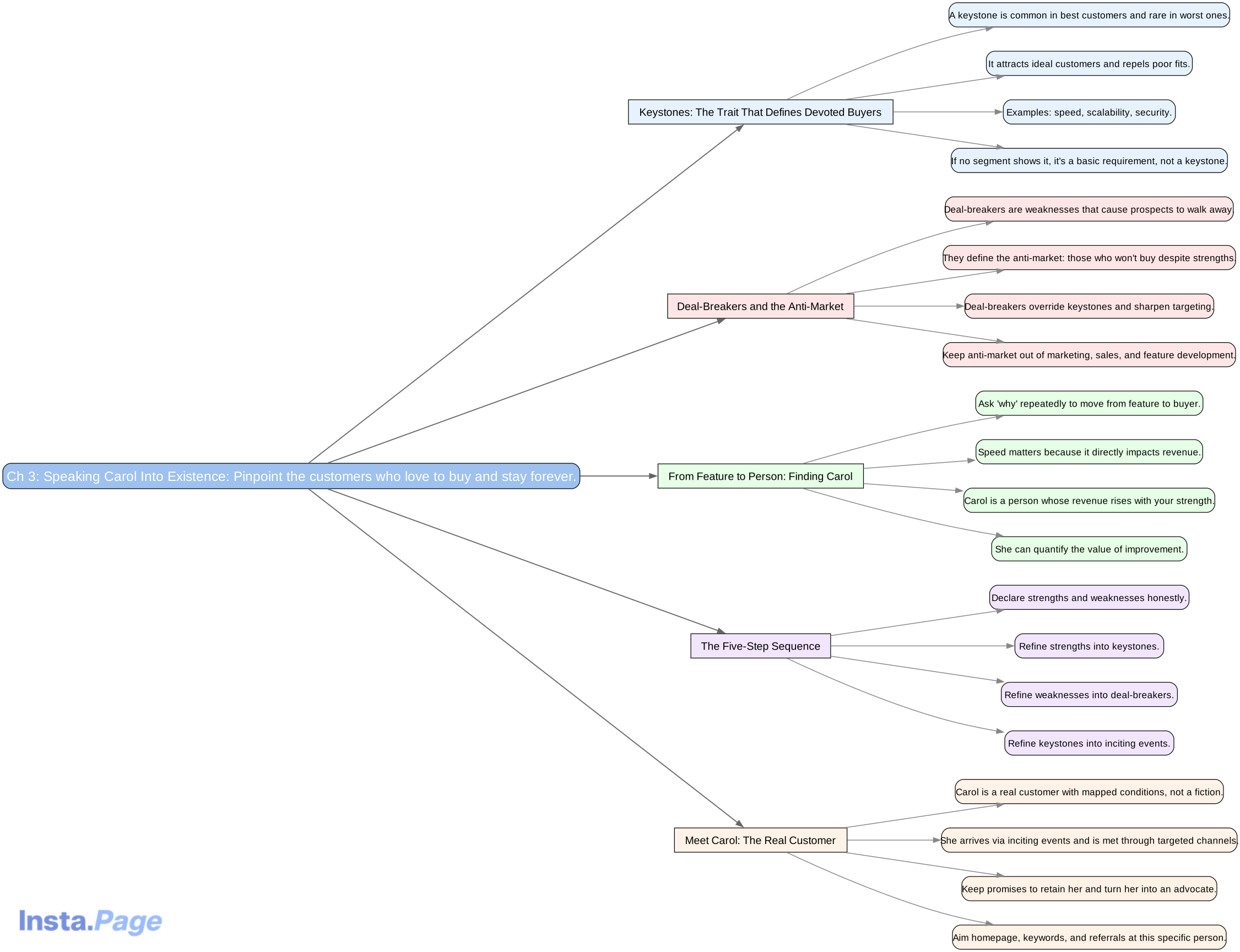
Keystones
Convincing someone to buy is heavy work: learning new software, persuading peers, rebuilding workflows, staking a reputation. Mild enthusiasm for a few features will not carry that weight. Strong decisions come from one strength that pulls hard enough that a customer has to make the product work for them. That characteristic is a keystone.
A keystone does two things: it attracts the best customers and turns away the worst ones. So asking what the best customers have in common doesn't work. Those traits usually show up among the worst customers too, and anything shared by everyone predicts nothing. A real keystone is common in the best customers and rare or absent in the bad ones. Find them by asking what circumstances, behaviors, or characteristics demand an extreme version of a strength.
Fast: Amazon and Walmart each found 1% of revenue lost per 0.1 second of load time, and fast e-commerce sites convert three times better than slow ones.
Scalable: a news site that can be featured in Google's or Apple's News areas and absorb a hundredfold traffic spike.
Secure: a business that was just hacked, or one under legal mandate for security and governance certifications.
If no significant segment shows a candidate trait, it's a basic requirement everyone expects. A single keystone means the product is not compelling yet: spend more marketing where keystones already exist, and research what to build next.
Deal-Breakers and the Anti-Market
Weaknesses become deal-breakers, and deal-breakers mark out the anti-market. A company requiring SOC 2 compliance will not buy from a vendor without it, however many keystones align. Deal-breakers beat keystones, and they sharpen the keystone definition. Because WP Engine is expensive, the e-commerce keystone tightens to stores processing at least $5,000 a month; because it supports only WordPress, "already built with WordPress" gets appended. Tighter descriptions mean easier targeting, more relevant testimonials, clearer feature priorities. Keep the anti-market out of marketing, sales, and feature development: a tagline positioning the product for the most demanding WordPress sites turns away both non-WordPress users and the price-sensitive, while appealing to a Carol with a large, slow WordPress site.
From Speed to Carol
The first answer is rarely the useful one. Ask what part of their website the best customers worry about and speed comes back every time, but speed is a feature, not a market segment. Push on why, and Carol appears. Three chains run from speed to money:
E-commerce: a slow checkout costs sales, and each hundred milliseconds of load time visibly moves conversion.
Media and publishing: faster pages mean more articles read per session, so more ads served per visitor.
B2B lead generation: speed reduces bounce and produces more leads, which matters when a marketing budget centers on a few thousand visits.
Broad categories such as WordPress users or companies above $1M in revenue will not do. Carol is a person whose revenue rises directly with a faster site and who can put a dollar figure on a hundred milliseconds. Marketing can target her, Sales can qualify her, Product can build for her, and that precision makes every step that follows work better.
The Five-Step Sequence
Declare your strengths and weaknesses, the good, the bad and the ugly, which outline how Carol thinks and what Eddie weighs.
Refine strengths into keystones: characteristics of Carol or her circumstances that make her value what you do beyond price and despite weaknesses.
Refine weaknesses into deal-breakers: the reasons someone will not buy even if they love you, marking out the anti-market.
Refine keystones into inciting events: what moves a prospect from a theoretical buyer to someone who wants to buy today.
Define Carol by behavior and attitude rather than demographic category.
Meet Carol
No gardener can force a plant to grow in mismatched temperature, water and soil, and no founder can force a product to thrive in a mismatched market. Carol is a real customer whose conditions have been mapped, not a fiction to invent. She is an ideal who may never exist in her purest form, but she arrives because an inciting event sent her looking, and she is met through keywords, ads and word of mouth from other Carols. Keep the homepage promises and she stays for good and recruits others.
Key Takeaways
Find the single trait that is common among the buyers you want more of and rare among the ones you regret, and reject any candidate that also describes the regret list.
List the conditions that make a prospect walk away even when the product fits, then keep those prospects out of campaigns, sales qualification and feature requests.
Keep asking why a feature matters until you can name a buyer whose revenue rises with it and who can attach a dollar amount to the improvement.
Run the sequence in order: state strengths and weaknesses plainly, convert strengths into selection criteria, convert weaknesses into exclusions, then identify the event that turns interest into a purchase now.
Describe your target by what they do and believe, not by broad category, and aim the homepage, keywords and referrals at that specific person.
You've reached the end of the free chapters
Next chapter: “Ch 4: A Rose by Any Other Name: Products don’t sell themselves; your words do.” is locked
Keep reading Hidden Multipliers — and unlock all 700+ book summaries with audio, mindmaps and AI Q&A.
$0.00 due today · 7 days free, then $89.99/year ($7.49/mo) · Cancel anytime before day 7
Jason Cohen is an Austin-based entrepreneur and writer best known as the founder of WP Engine, a leading WordPress hosting company, and as the author of books including Startup Mixology and The Gift of Maybe. His writing draws on his experience as a four-time entrepreneur and startup mentor, offering practical guidance on business strategy, company culture, and personal decision-making.
Frequently Asked Questions about Hidden Multipliers
What is Hidden Multipliers about?
The book argues that when relentless effort fails to produce growth, the problem isn't a shortage of possible actions but the inability to identify which action will actually matter. It introduces the idea of multipliers — a small set of levers that return far more than the time and money put into them — and lays out tests a lever must pass, such as delivering extreme returns and working through a predictable mechanism. Each chapter then examines a specific multiplier in depth, from customer profitability and ideal-customer targeting to pricing, churn, retention, and experimentation. The result is a practical framework for finding the few decisions that compound instead of spreading effort evenly across everything.
Who is the author of Hidden Multipliers?
Jason Cohen is an entrepreneur and founder who writes from direct operating experience, drawing many of the examples from WP Engine's early years and its climb from one million to five million dollars in recurring revenue. His approach is grounded in observable business data rather than theory, using real customer curves, pricing experiments, and testing failures to illustrate each idea. The book reflects a founder's perspective on strategy, pricing, and the discipline of choosing where effort actually pays off.
Is Hidden Multipliers worth reading?
It is worth reading because it replaces vague growth advice with a concrete method for spotting the few levers that produce outsized returns, illustrated with data rather than platitudes. Founders and operators will find immediately usable ideas, including customer profitability analysis, keystone-based targeting, and reframing pricing around growth instead of savings. The chapters on churn ceilings and flawed A/B testing are especially valuable for anyone whose growth has quietly stalled despite constant effort.
What are the key lessons from Hidden Multipliers?
Not all customers are equal: ranking customers by profitability often reveals that a small segment drives most profit while a bottom slice actively destroys it, so cutting the worst customers can raise profit substantially. Growth comes from targeting a narrow ideal customer — and from identifying a keystone trait that attracts the best buyers while repelling the worst — rather than appealing to everyone. How a product is framed and priced changes what customers will pay, so positioning around growth rather than savings and charging what the value justifies both raise revenue and improve fit. Retention and experimentation are multipliers too: churn rates set a hard ceiling on growth that acquisition alone cannot overcome, and rigorous experiment design is needed to avoid a factory of false positives.
📚 Explore Our Book Summary Library
Discover more insightful book summaries from our collection