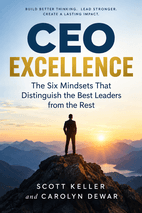
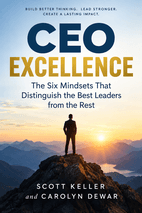
Carolyn Dewar's CEO Excellence distills interviews with top chief executives into six mindsets—vision, strategy, resource allocation, culture, talent, and personal leadership—for senior executives and board members seeking to close the gap between good and exceptional leadership.
Feature
Insta.Page
Blinkist
Shortform
Summary Depth
Full Chapter-by-Chapter
15-min overview
Section-by-section guides
Audio Narration
✓
✓
✓
Visual Mindmaps
✓
✕
✕
AI Q&A
✓
✕
✕
Quizzes
✓
✕
✕
PDF Downloads
✓
✕
✓
Price
$89.99/yr
$146/yr (PRO)
$199/yr
*Competitor data last verified July 2026.
1 Page Summary
Carolyn Dewar's CEO Excellence: The Six Mindsets That Distinguish the Best Leaders from the Rest argues that the difference between average and exceptional chief executives lies not in working harder within an established playbook but in fundamentally rethinking how they approach their role. Drawing on the practices of leaders such as Satya Nadella, Ajay Banga, Reed Hastings, and Mary Barra, the book organizes its insights around six mindsets—covering areas like vision, strategy, resource allocation, culture, organization design, talent, team composition, operating rhythm, board relationships, social purpose, and personal leadership. Rather than presenting a single formula, the book repeatedly shows how top CEOs reframe the game, make big moves early, act like outsiders when allocating capital, and find the "one thing" that drives cultural change, illustrating these principles through vivid examples ranging from the 1995 Springbok rugby team to the 1992 US Olympic basketball "Dream Team."
What distinguishes the book is its emphasis on counterintuitive, mindset-level shifts rather than incremental tactics. It uses memorable analogies and historical vignettes—Abraham Wald's insight about bomber armor, the flexible engineering of modern skyscrapers, forest ecosystems that thrive on cooperation—to make abstract leadership concepts concrete. The chapters pair these stories with research findings and comparisons between top performers and the rest, reinforcing the central claim that exceptional CEOs change what success means instead of merely raising targets within an existing framework. The result is a book that reads as both practical guide and analytical study, grounding its advice in observable patterns from real leaders and companies.
The intended audience is current and aspiring senior executives, board members, and business leaders seeking to understand what separates the best CEOs from their peers. Readers will gain a structured framework for examining their own practices across key domains, along with specific habits and examples they can adapt—such as building a "to-be" list, designing an operating rhythm tailored to strategy, or cultivating humility and candor with a board. While the book does not promise a one-size-fits-all solution, it offers a thoughtful, example-rich resource for those who want to lead at a higher level and close the gap between good and exceptional performance.
Chapter 1: Vision Practice: Reframe the Game
Overview
Most leaders try to get better results by raising the target inside a game everyone already understands. Effort goes up, but only so far. The harder question is whether they are playing the right game at all. Almost no one knows how to answer that.
Nelson Mandela asks Francois Pienaar, in the movie Invictus, how a leader makes a team better than it thinks it can be. The Springboks won the 1995 World Cup. They were driven less by a rugby title than by the chance to unite a nation fractured by apartheid. The CEOs in this book change the game the same way. They change what success means instead of just aiming higher.
Ajay Banga at Mastercard saw a slogan about commerce and did the math. More than 85 percent of consumer transactions still happened in cash. His vision became "kill cash." He competed for that 85 percent instead of the 15 percent already electronic. Reed Hastings said in 2002 that Netflix's dream was to be a global entertainment distribution company. That is why it was named Netflix and not DVD BY MAIL. Aiming to be the number one DVD company in America would probably have ended in Blockbuster's fate.
Four practices drive a game-changing vision. Find and amplify intersections. Make it about more than money. Do not be afraid to look back to look forward. And involve a broad group of leaders in the process.
Hubert Joly found the right course where four circles overlap: what the world needs, what you are good at, what you are passionate about, and how you can make money. Best Buy was losing 1.7 billion dollars a year when he arrived in 2012. His answer was enriching lives through technology. By June 2019, shares were up 330 percent, while the S&P 500 rose 111 percent.
Piyush Gupta took over as CEO of DBS Group in late 2009. At the time, it ranked worst in Singapore for customer service. No one thought it possible to dream of being Asia's best. The confidence and capacity simply were not there. He compared it to telling a minor league team it could not only play in the major league but win the championship. He settled on "the Asian bank of choice" as a vision his leaders could embrace. By 2013, regional rankings recognized DBS as Asia's best bank. At that year's off-site, 250 of his leaders said they wanted to be the best bank in the world. In 2018, Global Finance named DBS the world's best bank. It was the first Asian bank to take that honor from the New York publication. Euromoney and The Banker gave the same title. Gupta kept going, adopting a tech company mentality toward "Making Banking Joyful" to redefine financial services.
The best CEOs use vision, mission and company purpose almost interchangeably. Advisers, academics and HR can argue about the distinctions. What matters is a clear, simply stated direction that redefines success, shapes decisions and inspires people to act.
A Japanese proverb says vision without action is merely a dream. The challenge that follows is turning a bold vision into reality.
Key Takeaways
Change what counts as winning before you try to win harder.
Aim at the large unmet need in your market instead of the slice everyone already fights over.
Build your direction at the overlap of what the world needs, what you are good at, what you care about, and how you earn money.
Make it about more than profit, and bring a broad group of leaders into shaping that direction. Expect them to raise the ambition once they own it.
Settle on one plainly stated direction and stop arguing over whether it is called vision, mission or purpose. Treat the vision as the beginning of the work, not the end. Converting it into reality is the harder half.
Key concepts: Chapter 1: Vision Practice: Reframe the Game
Chapter 1: Vision Practice: Reframe the Game
Reframing the Game
Change what success means instead of just aiming higher.
Aim at large unmet needs, not the slice everyone fights over.
Mandela inspired Springboks to unite a nation, not just win.
Real-World Examples
Mastercard's 'kill cash' targeted 85% of transactions still in cash.
Netflix aimed to be global entertainment distribution, not DVD-by-mail.
Best Buy's 'enriching lives through technology' led to 330% stock rise.
DBS became world's best bank by aiming to be 'Asian bank of choice'.
Four Vision Practices
Find and amplify intersections.
Make it about more than money.
Look back to look forward.
Involve a broad group of leaders.
Finding Your Sweet Spot
Overlap of world's needs, your strengths, passions, and profit.
Hubert Joly used this to turn Best Buy around.
Piyush Gupta set ambitious vision despite low confidence.
From Vision to Reality
Use vision, mission, purpose interchangeably; clarity matters.
One plainly stated direction redefines success and inspires action.
Vision without action is merely a dream; execution is harder.
💡 Try clicking the AI chat button to ask questions about this book!
Chapter 2: Strategy Practice: Make Big Moves Early and Often
Overview
Most leaders inherit a system that rewards caution, and the gap between average and exceptional performance does not close through small, steady steps. The tension is that the moves capable of changing a company's trajectory are also the ones most often postponed or avoided.
On May 25, 1961, John F. Kennedy told a joint session of Congress that his vision was to win the worldwide battle between freedom and tyranny, and his strategy was a run of big moves. The moonshot is the famous one, but he also asked for funding for unmanned space exploration, a nuclear rocket, and satellite technology, alongside the Peace Corps, new civil rights legislation, and fresh economic cooperation with Latin America.
Satya Nadella, who became Microsoft's CEO in April 2014, reframed its mission as "empowering every person and every organization on the planet to achieve more," then spent more than $50 billion on acquisitions including LinkedIn and GitHub, doubled investment in cloud and artificial intelligence, and moved the company from shrink-wrapped software to online subscriptions. He also sold the mobile phone business despite billions spent chasing Apple and Google. Through 2020 revenue grew more than 60 percent and the stock nearly sixfold while the S&P 500 doubled.
The Five Moves That Matter Most
McKinsey analyzed 3,925 of the world's largest companies across fifteen years to identify which bold moves most reliably lift a company from average to top profit generator:
Buy and Sell. At least one deal a year, cumulatively above 30 percent of market cap over a decade. Aon's Greg Case reports more than 220 acquisitions and 150-plus divestitures in fifteen years.
Invest. Capital expenditures to sales exceeding 1.7 times the industry median for ten years. Mary Barra put $27 billion, over half of GM's product development capital through 2025, behind electric vehicles.
Improve Productivity. 25 percent more improvement than the industry median over a decade. Allianz's Oliver Bate drove the expense ratio from a decades-flat 30 percent to below 28 percent.
Differentiate. Gross margins 30 percent or more above the industry across a decade. LEGO's Jørgen Vig Knudstorp called his approach niche differentiation and excellence.
Allocate. Shifting more than 60 percent of capital expenditure among business units over ten years creates 50 percent more value than reallocating slowly.
How Many Moves, and When
Roughly 40 percent of companies in the middle quintiles of economic profit creation made no big moves in ten years, and another 40 percent made only one. Two moves more than double the chance of rising to the top, and three or more make it six times likelier. Moves made early beat late ones.
Managing the Downside of Big Bets
Doug Baker's sixteen years at Ecolab show what early boldness buys. With Nalco's rival tied up in its own acquisition, Ecolab announced in July that it would buy Nalco for $8.1 billion, worth 75 percent of Ecolab's market cap at the time, and Baker planned to spin off pieces of it to cap the risk. More than a hundred smaller deals widened Ecolab's products and reach. Market capitalization rose eightfold while revenue grew from $4 billion to $15 billion.
Larry Culp's three acquisition hurdles at Danaher had to be cleared in sequence:
Like the space and the company.
Be able to add value.
Make the math work.
Bankers reverse that order, and Culp says that gets you into trouble. Danaher's early deal mindset led with the math and bought indiscriminately, while Culp as CEO favored higher-margin, less capital-intensive instrumentation. Over his 2001-2014 tenure, shareholder return was 465 percent against the S&P 500's 105 percent, market value rose from $20 billion to $50 billion, and revenue quintupled.
Acting Like an Owner
Investor Ted Forstmann told first-time CEO Ed Breen to look in the mirror and decide for himself, and Breen began judging as though he owned all of General Instruments, which settled the competing claims of vendors, customers, employees, and investors. At Itaú Unibanco, Roberto Setubal was panicking as inflation ended overnight and the bank began losing money. He announced account fees in public, competitors predicted clients would flee, and customers accepted the fees because the bank was transparent about them.
Heart Paddles and S-Curves
Dominic Barton describes a rhythm of change he calls heart paddles applied to the organization, since average corporate lifespan fell from ninety years in 1935 to eighteen in 2015, making it existential for a company to ask why it should exist in a decade. Best Buy's Hubert Joly closed his Renew Blue turnaround, declared it over, and opened Building the New Blue, the next in a series of S-curves, adding smart home, senior care through sensors and artificial intelligence, and Total Tech Support. Every big move should have a start and a finish, with each completion building confidence and capacity for the next.
CEOs act boldly by pairing a clear view of the future and understood risk/reward trade-offs with owner thinking and heart paddles. Without big moves made early and often, few companies reach the top.
Key Takeaways
Build your strategy as a run of bold moves rather than one flagship bet, and launch the first ones early: McKinsey's fifteen-year study of 3,925 large companies found that a second move more than doubles the odds of reaching the top tier of profit creation, while three or more makes it six times likelier.
Draw those moves from the five that separate top profit generators from the rest: a steady cadence of acquisitions and divestitures, capital spending well above the industry norm, faster productivity gains, gross margins far above peers, and aggressive reallocation of capital between business units.
Screen acquisitions on fit first, your ability to add value second, and the numbers last, and arrange a way to shed pieces before you sign, since leading with the math is how buyers end up overpaying for the wrong assets.
Judge major decisions as though you owned the whole enterprise, and when you must impose or raise prices, explain them openly so that customers accept them instead of walking.
Give every big move a clear start and a declared finish, and have the next one ready before the current one ends, so the organization keeps moving instead of standing still.
Key concepts: Chapter 2: Strategy Practice: Make Big Moves Early and Often
Chapter 2: Strategy Practice: Make Big Moves Early and Often
The Case for Bold Moves
Most leaders inherit systems that reward caution, delaying transformative moves.
Kennedy's moonshot strategy included multiple big moves beyond space.
Nadella reframed Microsoft's mission and made $50B+ acquisitions.
Microsoft revenue grew 60% and stock nearly sixfold under Nadella.
The Five Moves That Matter Most
Buy and Sell: annual deals exceeding 30% of market cap over a decade.
Invest: capex to sales 1.7x industry median for ten years.
Improve Productivity: 25% more improvement than industry median.
Differentiate: gross margins 30%+ above industry for a decade.
How Many Moves, and When
40% of mid-tier companies made no big moves in ten years.
Two moves double the chance of rising to the top.
Three or more moves make top-tier success six times likelier.
Moves made early beat late ones.
Managing the Downside of Big Bets
Ecolab's $8.1B Nalco acquisition was 75% of market cap.
Baker planned spinoffs to cap risk and made 100+ smaller deals.
Culp's three hurdles: like the space, add value, make math work.
Danaher's early math-first mindset led to indiscriminate buying.
Acting Like an Owner
Ted Forstmann advised CEO Ed Breen to judge as if owning the whole company.
Breen's owner mindset settled competing stakeholder claims at General Instruments.
Itaú Unibanco's Setubal announced account fees transparently.
Customers accepted fees because the bank was transparent.
Heart Paddles and S-Curves
Average corporate lifespan fell from 90 years in 1935 to 18 in 2015.
Dominic Barton calls for 'heart paddles' to jolt organizations.
Best Buy's Joly closed Renew Blue and opened Building the New Blue.
Each completed S-curve builds confidence and capacity for the next.
Conclusion: Boldness as Strategy
CEOs act boldly by pairing future vision with risk/reward trade-offs.
Owner thinking and heart paddles enable big moves.
Without big moves made early and often, few companies reach the top.
Chapter 3: Resource Allocation Practice: Act Like an Outsider
Overview
Capital is supposed to follow strategy, but in most companies it stays right where it was last year. The people who have the power to move it understand why they should, and they still don't do it. What holds them back isn't a lack of analysis.
The planes that came back
Abraham Wald was a mathematician who fled Austria after the 1938 annexation. He was asked to help cut bomber losses. Commanders wanted to reinforce the panels that returning planes showed riddled with holes. Wald reasoned that aircraft hit in critical areas never came back at all. So the spots with the most holes were the wrong ones to armor.
Eighty-three percent of chief executives say capital allocation is a key growth lever, ahead of operational excellence and buying other companies. Yet a third of companies move only about 1 percent of their capital a year, compared with more than 6 percent at the top performers. When money doesn't follow strategy, the strategy is just slides. And a CEO who moves money worse than the markets do will soon face a push from activist investors. Two things stall the movement of money. Moving it between units is politically painful. And when profits dip for a year or two afterward, the markets punish that.
Borrowing outsider eyes
Andy Grove asked Gordon Moore what a newly installed CEO would do. Moore said exit memory chips, and Intel did, staking its future on the microprocessor. Danaher made that same outsider view into a business model, giving the movement of money more than half of management's time. Under Larry Culp, Danaher bought $22 billion worth of companies while selling off over a third of its business.
The habits:
Start from zero.
Solve for the whole.
Manage by milestones, not annual budgets.
Kill as much as you create.
Starting from zero
An anchor is the information a decision leans on. With a "limit 12 per customer" sign, shoppers in one of Daniel Kahneman's experiments bought seven cans of soup. With no limit, they bought just over three. Last year's budget is the corporate anchor, and starting from zero means refusing to treat any investment as a given. GM's Mary Barra turned down hundreds of millions for a market whose plan was to lose money, and eventually exited it.
Solving for the whole
Lockheed Martin's Marillyn Hewson reviewed every business area's plan together. She cut the weakest and doubled down on shared priorities, judging investments by what the corporation gained rather than what each unit wanted.
Making pruning a ritual
Pruning becomes a way of life when it is built into ritual. Sundar Pichai reflects on advice from his mentor Bill Campbell, a three-time chief executive at Claris, Intuit and GO Corporation, who asked him each Monday what ties he had broken that week. Similar products like Play Music and YouTube Music stick around until somebody makes the call, and Pichai treats breaking those ties as a way of empowering people, expecting his leaders to do the same on their teams.
A funeral that became a rebirth
Feike Sijbesma gave the discipline ritual form at DSM with a "Hall of Failures": funerals for failed projects that honored the attempt as long as lessons were learned and shared, signaling that no resources would go to it. Technicians from other divisions attended and shared what they had learned.
One such funeral became a rebirth. A multiyear project had produced a coating that pushed all incoming photons through picture frame glass, but the technology was far too expensive, and museums, the only market for it, were too small for DSM. As the eulogy was delivered, a technician from another unit asked whether applying the chemistry to solar panels would give them more photons to absorb. Sijbesma and his chief innovation officer exchanged looks of disbelief: the sales department had fixated on picture frames. The project was resurrected, testing showed a 5 to 10 percent power boost, and the antireflective coatings business grew on funds freed by other pruned products.
Pruning and nurturing across the portfolio
Valeo's Jacques Aschenbroich moved resources out of former core products into emissions-reduction and driver assistance systems.
Adidas's Kasper Rorsted cut inventory held by retail partners to build the online channel.
Israel Discount Bank's Lilach Asher-Topilsky drew money from international operations toward domestic opportunities.
No excellent chief executive felt they had moved money too aggressively. Majid Al Futtaim's Alain Bejjani says the difficulty comes from organizations anchored in commitments and realities outside their control. That is why boldness wins. An outsider has no political debts and no history to protect, and that freedom is what breaks through.
Key Takeaways
Decide where resources go by reading what is absent: the canceled programs, the units that shrank, and the bets nobody proposed tell you more than the funding requests in front of you.
Treat the earnings dip and the internal fight as fixed costs of moving money, and argue from the position of someone with no stake in past commitments when the pressure to reverse arrives.
Make every business earn its next dollar from zero, with no claim on the budget it held the year before.
Sit over all units at once, cut the bottom of the ranking, and concentrate the savings on bets the corporation as a whole needs rather than ones each division would choose for itself.
Give pruning a recurring calendar and a social form: announce the kills, harvest the lessons and the people, and stay alert to a discarded technology whose real market is somewhere else entirely.
Key concepts: Chapter 3: Resource Allocation Practice: Act Like an Outsider
Chapter 3: Resource Allocation Practice: Act Like an Outsider
The Capital Allocation Gap
Capital should follow strategy, but often stays put.
A third of companies move only 1% of capital yearly.
Top performers move over 6% annually.
Political pain and market punishment stall reallocation.
Outsider Thinking
Wald: armor where returning planes have no holes.
Grove and Moore: exit memory chips, bet on microprocessors.
Danaher: outsider view as a business model.
Start from zero, solve for the whole.
Zero-Based Resource Allocation
Last year's budget is an anchor; refuse to treat it as given.
GM's Barra turned down hundreds of millions for a losing market.
Lockheed's Hewson reviewed all plans together, cut weakest.
Judge investments by corporate gain, not unit wants.
Rituals of Pruning
Pichai asks weekly: what ties have you broken?
DSM's Hall of Failures: funerals for failed projects.
A failed coating became a solar panel breakthrough.
Pruning frees funds for new bets.
Portfolio Pruning and Nurturing
Valeo shifted from core products to emissions and driver assistance.
Adidas cut retail inventory to build online channel.
Israel Discount Bank moved money from international to domestic.
Boldness wins; outsiders have no political debts.
Chapter 4: Culture Practice: Find the One Thing
Overview
Culture change stalls when leaders treat it as one more item on a crowded list. The temptation is to spread attention across every value and behavior at once. That is where most efforts fall apart.
The One Thing
Paul O'Neill's first shareholder address as Alcoa's CEO was about worker safety, not margins or revenue. Investors sold the stock. Yet within a year Alcoa delivered record profits. By his retirement thirteen years later, net income had risen fivefold. People cannot be ordered to change, he reasoned. But disrupting habits around one thing spreads through a company.
Other CEOs settled on their own single focus:
Marillyn Hewson at Lockheed Martin: "Innovation with Purpose"
Reed Hastings at Netflix: "Freedom and Responsibility"
Ajay Banga at Mastercard: the Decency Quotient
How the One Thing Gets Found
At Microsoft, a team from across the company ran a deep review with experts, senior leaders and focus groups. Then a group of seventeen leaders, chaired by Satya Nadella, sorted through the findings. He chose growth mindset, drawn from Stanford psychologist Carol Dweck's research on learning from mistakes. He shed the company's individualistic, failure-averse habits.
Confidence in one's own ability to behave in desired ways
Greg Case worked all four for Aon United. He carried the message through earnings calls and a Manchester United sponsorship. He tied senior leader pay to a single firm-level P&L. Aon grew from $6 billion to over $50 billion in market capitalization by early 2020.
Make It Personal
According to the book, 86 percent of CEOs say they model desired change. Only 53 percent of their direct reports agree. Nadella once badly answered a question about women seeking raises. He told employees he was wrong and examined his own biases.
Make It Meaningful
Masahiko Uotani made English Shiseido's official headquarters language. He offered lessons that three thousand employees accepted. Shiseido reached its 1 trillion yen sales goal three years ahead of schedule. Toby Cosgrove gave all forty thousand Cleveland Clinic employees badges reading "I am a caregiver." Patient experience there went from last to first among large American hospitals.
Phrases and Questions That Carry the Culture
Getting a cultural message out to a diverse workforce calls for a handful of memorable phrases beneath the main principle. Sam Walton built Walmart's service aspiration into a ten-foot rule: any employee within ten feet of a customer should meet their eye, smile and offer help. Nadella made Carol Dweck's Mindset required reading for his lieutenants. Then he simplified it for everyone else into a shift from "know-it-alls" to "learn-it-alls." After those six words, risk aversion and office politics began to decline. Kan Trakulhoon of Siam Cement turned innovation into a shop-floor question about improving process and productivity. The first foreman he asked froze. Trakulhoon, a believer in the Buddhist philosophy of metta, or loving-kindness, reassured him that any answer was safe. On his next visit, everyone had an answer ready.
Measure What Matters
Microsoft asks employees a single pop-up question daily. First whether they know about growth mindset, later whether leaders show it. Jim Owens set Caterpillar's target at 90 percent of employees understanding the vision and their own part in it. The industry benchmark was 65 percent positive feedback. Caterpillar reached 82 percent by the end of 2009. Johan Thijs at KBC turns the Accountability element of PEARL into a scorecard covering capital, liquidity, profitability and people. Promotion into management there requires outside screening on Performance, Empowerment, Accountability, Responsiveness and Local embeddedness.
The First Leg of the Stool
Measuring culture also informs merger judgment. Maurice Lévy walked away from a merger with Omnicom that would have created the world's largest advertising group, largely over cultural differences. Reed Hastings says Netflix's distinctive culture has ruled out many deals. Culture, in Marvin Bower's phrase, is "the way we do things around here." That is broad enough that the best CEOs pick one thing. It is the first leg of a three-legged stool supporting delivery of vision and strategy. Arthur W. Jones observed that organizations are perfectly designed to get the results they get. That leads next to organization design.
Key Takeaways
Commit to one cultural priority instead of a wall of values. Employees can hold only a few behaviors in mind, and a single focus spreads on its own.
Arrive at that priority through genuine diagnosis: gather evidence across levels and functions, let a small senior group sift it, and pick a principle grounded in research rather than in fashion.
Reshape the environment rather than lecturing people. Pull at once on the stories and questions in circulation, formal structures and incentives, the behavior leaders visibly model, and employees' confidence that they can act differently.
Admit it out loud when your own conduct contradicts the standard. Then give the principle a concrete, repeatable form: a rule for the shop floor, a badge, a shared phrase, a question anyone can answer without fear.
Ask employees on a regular cadence whether they know the priority and see leaders living it. Let those readings shape promotions, pay, and which mergers you pursue or walk away from.
Key concepts: Chapter 4: Culture Practice: Find the One Thing
Chapter 4: Culture Practice: Find the One Thing
The Power of One Cultural Priority
Focus on one behavior, not a wall of values
Paul O'Neill's safety focus led to record profits
Other CEOs chose single focuses like growth mindset
A single focus spreads through the company
Finding the One Thing
Gather evidence across levels and functions
Small senior group sifts findings to choose
Choose a principle grounded in research, not fashion
Microsoft's growth mindset came from Carol Dweck
Reshaping the Work Environment
Four forces: stories, formal mechanisms, role modeling, confidence
Greg Case used all four for Aon United
Tie senior leader pay to firm-level P&L
Aon grew from $6B to over $50B market cap
Making It Personal and Meaningful
86% of CEOs say they model change, only 53% of reports agree
Admit when your conduct contradicts the standard
Give the principle a concrete, repeatable form
Shiseido's English mandate and Cleveland Clinic badges
Measuring and Embedding Culture
Ask employees regularly if they know the priority
Use readings to shape promotions, pay, and mergers
Microsoft's daily pop-up question
Caterpillar's 90% target for vision understanding
You've reached the end of the free chapters
Next chapter: “Organization Design Practice: Solve for “Stagility”” is locked
Keep reading CEO Excellence — and unlock all 600+ book summaries with audio, mindmaps and AI Q&A.
$0.00 due today · 7 days free, then $89.99/year ($7.49/mo) · Cancel anytime before day 7
Carolyn Dewar is a senior partner at McKinsey & Company and a co-leader of its CEO Excellence practice, advising top executives on leadership and performance. She is the co-author of the bestselling book CEO Excellence: The Six Mindsets That Distinguish the Best Leaders from the Rest, along with related research on what separates exceptional chief executives. Her expertise centers on CEO leadership, organizational transformation, and corporate strategy.
Frequently Asked Questions about CEO Excellence
What is CEO Excellence about?
It explores how the world's best chief executives approach their role, drawing on research and interviews with top leaders. The chapters cover practices like reframing the game, making big moves early, acting like an outsider on capital allocation, and focusing culture on one thing. It also addresses organization design, talent, team composition, board relationships, social purpose, crisis leadership, and personal energy. The result is a practical guide to the mindsets and behaviors that separate exceptional CEOs from average ones.
Who is the author of CEO Excellence?
Carolyn Dewar is the author, and the work is grounded in extensive research and interviews with leading chief executives. The content reflects a deep study of how top CEOs operate across a range of industries and challenges.
Is CEO Excellence worth reading?
Yes, because it offers actionable insights drawn from real CEOs who have navigated major strategic shifts, cultural transformations, and crises. Readers will find practical frameworks for vision, talent, board management, and personal leadership that can be applied at any level. It is a compelling read for anyone interested in what makes exceptional leadership.
What are the key lessons from CEO Excellence?
The most important lessons include reframing the game rather than just raising targets, making big strategic moves early and often, and focusing culture change on one critical behavior. Leaders should allocate capital like an outsider, solve for 'stagility' by being both stable and agile, and define key roles before filling them with people. Building an integrated team, establishing a steady operating rhythm, and earning board trust through radical transparency are also essential. Finally, the best CEOs manage their time and energy in sprints, live by a 'to-be' list, and stay humble despite their power.
📚 Explore Our Book Summary Library
Discover more insightful book summaries from our collection