CEO Excellence Interactive Mindmaps for CEO Excellence (Free)

CEO Excellence — Interactive Mindmaps

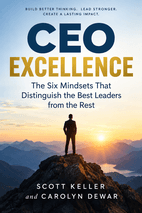
CEO Excellence by Carolyn Dewar Book Cover

by Carolyn Dewar

Carolyn Dewar's CEO Excellence distills interviews with top chief executives into six mindsets—vision, strategy, resource allocation, culture, talent, and personal leadership—for senior executives and board members seeking to close the gap between good and exceptional leadership.

On Insta.page you also get an Apply This Book tool that lets you combine insights from up to 3 books to solve your specific situation.

Chapter mindmaps

Free preview: chapters 1–4 are fully interactive. Click any node to expand or collapse. Subscribe to unlock the rest.

Chapter 1: Vision Practice: Reframe the Game

Key concepts: Chapter 1: Vision Practice: Reframe the Game

Chapter 1: Vision Practice: Reframe the Game

Reframing the Game

  • Change what success means instead of just aiming higher.
  • Aim at large unmet needs, not the slice everyone fights over.
  • Mandela inspired Springboks to unite a nation, not just win.

Real-World Examples

  • Mastercard's 'kill cash' targeted 85% of transactions still in cash.
  • Netflix aimed to be global entertainment distribution, not DVD-by-mail.
  • Best Buy's 'enriching lives through technology' led to 330% stock rise.
  • DBS became world's best bank by aiming to be 'Asian bank of choice'.

Four Vision Practices

  • Find and amplify intersections.
  • Make it about more than money.
  • Look back to look forward.
  • Involve a broad group of leaders.

Finding Your Sweet Spot

  • Overlap of world's needs, your strengths, passions, and profit.
  • Hubert Joly used this to turn Best Buy around.
  • Piyush Gupta set ambitious vision despite low confidence.

From Vision to Reality

  • Use vision, mission, purpose interchangeably; clarity matters.
  • One plainly stated direction redefines success and inspires action.
  • Vision without action is merely a dream; execution is harder.

Chapter 2: Strategy Practice: Make Big Moves Early and Often

Key concepts: Chapter 2: Strategy Practice: Make Big Moves Early and Often

Chapter 2: Strategy Practice: Make Big Moves Early and Often

The Case for Bold Moves

  • Most leaders inherit systems that reward caution, delaying transformative moves.
  • Kennedy's moonshot strategy included multiple big moves beyond space.
  • Nadella reframed Microsoft's mission and made $50B+ acquisitions.
  • Microsoft revenue grew 60% and stock nearly sixfold under Nadella.

The Five Moves That Matter Most

  • Buy and Sell: annual deals exceeding 30% of market cap over a decade.
  • Invest: capex to sales 1.7x industry median for ten years.
  • Improve Productivity: 25% more improvement than industry median.
  • Differentiate: gross margins 30%+ above industry for a decade.

How Many Moves, and When

  • 40% of mid-tier companies made no big moves in ten years.
  • Two moves double the chance of rising to the top.
  • Three or more moves make top-tier success six times likelier.
  • Moves made early beat late ones.

Managing the Downside of Big Bets

  • Ecolab's $8.1B Nalco acquisition was 75% of market cap.
  • Baker planned spinoffs to cap risk and made 100+ smaller deals.
  • Culp's three hurdles: like the space, add value, make math work.
  • Danaher's early math-first mindset led to indiscriminate buying.

Acting Like an Owner

  • Ted Forstmann advised CEO Ed Breen to judge as if owning the whole company.
  • Breen's owner mindset settled competing stakeholder claims at General Instruments.
  • Itaú Unibanco's Setubal announced account fees transparently.
  • Customers accepted fees because the bank was transparent.

Heart Paddles and S-Curves

  • Average corporate lifespan fell from 90 years in 1935 to 18 in 2015.
  • Dominic Barton calls for 'heart paddles' to jolt organizations.
  • Best Buy's Joly closed Renew Blue and opened Building the New Blue.
  • Each completed S-curve builds confidence and capacity for the next.

Conclusion: Boldness as Strategy

  • CEOs act boldly by pairing future vision with risk/reward trade-offs.
  • Owner thinking and heart paddles enable big moves.
  • Without big moves made early and often, few companies reach the top.

Chapter 3: Resource Allocation Practice: Act Like an Outsider

Key concepts: Chapter 3: Resource Allocation Practice: Act Like an Outsider

Chapter 3: Resource Allocation Practice: Act Like an Outsider

The Capital Allocation Gap

  • Capital should follow strategy, but often stays put.
  • A third of companies move only 1% of capital yearly.
  • Top performers move over 6% annually.
  • Political pain and market punishment stall reallocation.

Outsider Thinking

  • Wald: armor where returning planes have no holes.
  • Grove and Moore: exit memory chips, bet on microprocessors.
  • Danaher: outsider view as a business model.
  • Start from zero, solve for the whole.

Zero-Based Resource Allocation

  • Last year's budget is an anchor; refuse to treat it as given.
  • GM's Barra turned down hundreds of millions for a losing market.
  • Lockheed's Hewson reviewed all plans together, cut weakest.
  • Judge investments by corporate gain, not unit wants.

Rituals of Pruning

  • Pichai asks weekly: what ties have you broken?
  • DSM's Hall of Failures: funerals for failed projects.
  • A failed coating became a solar panel breakthrough.
  • Pruning frees funds for new bets.

Portfolio Pruning and Nurturing

  • Valeo shifted from core products to emissions and driver assistance.
  • Adidas cut retail inventory to build online channel.
  • Israel Discount Bank moved money from international to domestic.
  • Boldness wins; outsiders have no political debts.

Chapter 4: Culture Practice: Find the One Thing

Key concepts: Chapter 4: Culture Practice: Find the One Thing

Chapter 4: Culture Practice: Find the One Thing

The Power of One Cultural Priority

  • Focus on one behavior, not a wall of values
  • Paul O'Neill's safety focus led to record profits
  • Other CEOs chose single focuses like growth mindset
  • A single focus spreads through the company

Finding the One Thing

  • Gather evidence across levels and functions
  • Small senior group sifts findings to choose
  • Choose a principle grounded in research, not fashion
  • Microsoft's growth mindset came from Carol Dweck

Reshaping the Work Environment

  • Four forces: stories, formal mechanisms, role modeling, confidence
  • Greg Case used all four for Aon United
  • Tie senior leader pay to firm-level P&L
  • Aon grew from $6B to over $50B market cap

Making It Personal and Meaningful

  • 86% of CEOs say they model change, only 53% of reports agree
  • Admit when your conduct contradicts the standard
  • Give the principle a concrete, repeatable form
  • Shiseido's English mandate and Cleveland Clinic badges

Measuring and Embedding Culture

  • Ask employees regularly if they know the priority
  • Use readings to shape promotions, pay, and mergers
  • Microsoft's daily pop-up question
  • Caterpillar's 90% target for vision understanding
You've reached the end of the free mindmaps

Next chapter: “Chapter 5: Organization Design Practice: Solve for “Stagility”” is locked

See every chapter of CEO Excellence as an interactive mindmap — and unlock all 600+ book summaries with audio and AI Q&A.

$0.00 due today · 7 days free, then $89.99/year ($7.49/mo) · Cancel anytime before day 7

plus sales tax where applicable

Continue exploring CEO Excellence