CEO Excellence Key Takeaways
by Carolyn Dewar
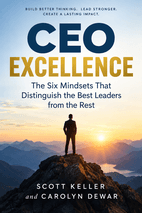
5 Main Takeaways from CEO Excellence
Reframe Winning Around Unmet Needs, Not Harder Competition
Change what counts as winning before trying to win harder. Aim at the large unmet need in your market, and build direction at the overlap of what the world needs, what you are good at, what you care about, and how you earn money. Bring leaders into shaping one plainly stated direction, then treat converting it into reality as the real work.
Make Bold Strategic Moves Early, Often, and in Sequence
McKinsey's study of 3,925 large companies found a second bold move more than doubles the odds of top-tier profit creation, while three or more makes it six times likelier. Draw moves from acquisitions and divestitures, above-peer capital spending, productivity gains, gross-margin leadership, and aggressive capital reallocation. Screen acquisitions on fit first, declare each move's finish, and have the next ready before the current one ends.
Anchor Culture in One Priority and Design for Stagility
Commit to one cultural priority instead of a wall of values, diagnose it with evidence across levels, and reshape stories, structures, incentives, leader modeling, and employee confidence. Design the organization for stability and movement at the same time, reorganizing only after naming what the current system produces and giving new ventures legitimate bypasses. Run development in short customer-facing cycles rather than waiting for a perfect restructure.
Earn Board Trust and Stakeholder Permission Through Transparency
Treat board trust as the asset that decides how much room you have to act: disclose bad news early, invest in the chair, give directors prepared access to managers, and use unscripted small-group sessions. Stakeholders grant permission to operate, so cap external hours, know what each side wants, tell one consistent story, close promise-delivery gaps, and prepare for crises before they hit. Invite directors' criticism and answer it directly.
Lead Yourself in Sprints and Measure Others' Growth
Manage time and energy in intervals with real recovery, keep a tight-but-loose schedule, compartmentalize attention, and build support before depletion. Begin each day with a to-be list, hold core beliefs even when costly, adapt leadership to context, and tell the truth alongside concrete fixes. Treat the seat as borrowed and judge your tenure by whether people accomplish what they once thought was out of reach.
Executive Analysis
The five takeaways form a single argument: CEO excellence is not a heroic solo performance but a disciplined operating system that starts with reframing what winning means, then cascades through bold strategic moves, a focused culture and agile organization, transparent external trust, and sustainable personal leadership. Dewar shows that each layer reinforces the next: a clear direction gives strategy its target, culture and org design let big moves actually land, board and stakeholder trust buys latitude, and a CEO who manages energy and ego can keep the whole system steady. Excellence is therefore cumulative and repeatable, not charismatic.
This book matters because it converts abstract leadership advice into specific practices drawn from McKinsey's study of CEOs and large companies, such as the finding that a second bold move doubles the odds of top-tier profit creation while three or more makes it six times likelier. For readers, it offers a practical playbook for vision, strategy, culture, governance, stakeholders, crises, and self-management, with questions and cadences they can apply immediately. In the leadership genre, it sits alongside evidence-based classics like Good to Great and High Output Management, but with a distinctly modern, CEO-level scope.
Chapter-by-Chapter Key Takeaways
Vision Practice: Reframe the Game (Chapter 1)
Change what counts as winning before you try to win harder.
Aim at the large unmet need in your market instead of the slice everyone already fights over.
Build your direction at the overlap of what the world needs, what you are good at, what you care about, and how you earn money.
Make it about more than profit, and bring a broad group of leaders into shaping that direction. Expect them to raise the ambition once they own it.
Settle on one plainly stated direction and stop arguing over whether it is called vision, mission or purpose. Treat the vision as the beginning of the work, not the end. Converting it into reality is the harder half.
Try this: Define winning by the unmet need you can serve, co-create one plain direction with leaders, and treat the harder half as converting that direction into reality.
Strategy Practice: Make Big Moves Early and Often (Chapter 2)
Build your strategy as a run of bold moves rather than one flagship bet, and launch the first ones early: McKinsey's fifteen-year study of 3,925 large companies found that a second move more than doubles the odds of reaching the top tier of profit creation, while three or more makes it six times likelier.
Draw those moves from the five that separate top profit generators from the rest: a steady cadence of acquisitions and divestitures, capital spending well above the industry norm, faster productivity gains, gross margins far above peers, and aggressive reallocation of capital between business units.
Screen acquisitions on fit first, your ability to add value second, and the numbers last, and arrange a way to shed pieces before you sign, since leading with the math is how buyers end up overpaying for the wrong assets.
Judge major decisions as though you owned the whole enterprise, and when you must impose or raise prices, explain them openly so that customers accept them instead of walking.
Give every big move a clear start and a declared finish, and have the next one ready before the current one ends, so the organization keeps moving instead of standing still.
Try this: Sequence strategy as bold moves rather than one bet: launch early, screen acquisitions on fit and value, reallocate capital often, and declare each move's finish before starting the next.
Culture Practice: Find the One Thing (Chapter 4)
Commit to one cultural priority instead of a wall of values. Employees can hold only a few behaviors in mind, and a single focus spreads on its own.
Arrive at that priority through genuine diagnosis: gather evidence across levels and functions, let a small senior group sift it, and pick a principle grounded in research rather than in fashion.
Reshape the environment rather than lecturing people. Pull at once on the stories and questions in circulation, formal structures and incentives, the behavior leaders visibly model, and employees' confidence that they can act differently.
Admit it out loud when your own conduct contradicts the standard. Then give the principle a concrete, repeatable form: a rule for the shop floor, a badge, a shared phrase, a question anyone can answer without fear.
Ask employees on a regular cadence whether they know the priority and see leaders living it. Let those readings shape promotions, pay, and which mergers you pursue or walk away from.
Try this: Choose one cultural priority from real diagnosis, reinforce it through stories, incentives, leader modeling and honest self-correction, and track whether people see leaders living it before tying it to pay and promotions.
Organization Design Practice: Solve for “Stagility” (Chapter 5)
Design for stability and movement at the same time. Keep strategy, structure and culture steady while experimentation runs underneath, instead of treating the two needs as a trade-off.
Only reorganize once you can name what the current system is actually producing. The reflex to restructure creates churn far more reliably than it creates improvement.
For each centralization question, find the midpoint between efficiency and responsiveness. Then give the decision to a short list of accountable executives, not a crowd of signatories.
Build a legitimate way to bypass your own rules. Give new ventures their own leader, team and tools, and let people and resources move to wherever they add the most value instead of staying fixed to the reporting chart.
Run development in short cycles that end in something a customer can react to. Pace each round the way a continuous-improvement event paces a factory floor.
Try this: Design for stagility by keeping strategy, structure and culture stable while experiments run, clarifying centralization trade-offs to a few owners, and giving new ventures bypasses plus short customer-facing development cycles.
Operating Rhythm Practice: Get into a Groove (Chapter 9)
Set the annual cadence yourself, treating the calendar as strategy made visible: sequence the work, sharpen it as priorities become clear, and taper when it counts.
Organize standing meetings by decision type, such as performance, future growth and capital allocation, and keep a short executive session whose only job is to convert their output into action.
Require granular, unit-by-unit numbers instead of aggregates, and standardize the processes and metrics behind them so results can be compared across the business.
Divide your attention deliberately: leave well-run areas to strong leaders and go deep where the company is being transformed.
Model the discipline you ask of others by pre-reading, starting and ending on time, and closing every meeting with action items and follow-ups.
Try this: Set an annual cadence that sequences decision types, uses granular unit metrics, reserves executive attention for transformation, and models discipline by pre-reading and closing every meeting with follow-ups.
Board Relationships Practice: Build a Foundation of Trust (Chapter 10)
Treat trust with the board as the asset that decides how much room you have to act.
Disclose bad news as readily as good, including your own missteps and the lessons you drew from them, since directors grant latitude to leaders who tell them the truth early.
Invest deliberately in your board chair, adapting how often and in what form you engage so the relationship fits that person's working style.
Give directors wide access to your management team, but prepare executives for those conversations: tell them how a director can be useful, and require that anything material reaches you.
Put directors and managers together in unscripted, small-group settings with no pre-cleared questions, so directors learn the business, its rising leaders, and one another.
Try this: Build board trust by disclosing bad news early, investing in the chair, giving directors prepared access to managers, and creating unscripted small-group contact.
Board Capabilities Practice: Tap the Wisdom of Elders (Chapter 11)
Shrink and reshape your board around criteria the directors themselves agree to, then stand behind the group when it makes painful calls on reserves or dividends.
Draw a clear line between what the board owns and what management owns, so directors can judge a strategy they did not write and can halt the train fast if something goes badly wrong.
Recruit for skill and appetite to win, then build the group's cohesion deliberately, since directors spend only a sliver of their hours together as a team.
Treat the chair or lead director as your partner in getting the right people on the board and in making its meetings count. Trust and good composition are the starting line, not the finish.
Invite directors' criticism and answer it directly, because leaders who endure that scrutiny describe it as energizing rather than diminishing.
Try this: Shrink and reshape the board around agreed criteria, separate board ownership from management, recruit for skill and appetite, and invite direct criticism while partnering with the chair.
Board Meetings Practice: Focus on the Future (Chapter 12)
Start each meeting with an unstructured private session. The chair says what's on their mind, with no materials prepared. This gets context to the table and surfaces half-formed concerns before they're ready for a vote.
Point the agenda at where the business is going. Name the two or three things where you actually want the board's advice, so its energy goes there. Put succession on the schedule early and revisit it every year instead of waiting for a transition to force it.
Join another company's board at least once. Watching a room react when a CEO leaves is the fastest way to learn how governance really works.
Don't touch the board's own procedures, including how it evaluates you and screens successor candidates. A well-meant move will later look like favoritism and ruin the outcome.
Try this: Focus board meetings on the future by starting with an unstructured private session, naming two or three advice topics, scheduling succession yearly, and leaving board procedures untouched.
Social Purpose Practice: Impact the Big Picture (Chapter 13)
Map what each group you lead or serve actually draws meaning from, and shape your purpose message to those sources. A rallying cry built on your own motivation reaches only the fraction of people who happen to share it.
Make social purpose part of how the company earns its money, not a side charity. Lean on strengths you already have, and expect the payoff in customer loyalty, cheaper capital and earlier sight of risk.
Write down the principles the company itself will defend. Keep them separate from your personal convictions, and decide ahead of time how you will respond when those principles are breached.
Meet a divided workforce with listening before statements. Bring people together so they are heard, ask what the company can do, and admit what you do not know instead of issuing a polished letter.
Weigh your stakeholders' sense of purpose as heavily as your own. A company whose people find meaning in the work earns an engagement that pay alone cannot buy.
Try this: Ground social purpose in what stakeholders find meaningful and in how the company earns money, define principles you will defend, listen before speaking to a divided workforce, and weigh engagement beyond pay.
Stakeholder Interaction Practice: Get to the Essence (Chapter 14)
Treat your company's permission to operate as something granted by the people it affects rather than by your org chart, and assume a small, everyday complaint can grow into a threat to the company's survival.
Cap the hours you spend outside the company, and make every external request justify itself against the internal work competing for that same time.
Walk into each stakeholder meeting having worked out what the other side actually wants, and walk out with at least one idea you can put to use inside your own business.
Give every audience the same story; a separate account for each group destroys the consistency the whole effort is supposed to buy.
Close the gap between what you promise and what you deliver, and guard your own team's time while still making each external encounter count, because the relationships you build before a crisis are the ones that carry you through it.
Try this: Treat operating permission as granted by stakeholders: cap external hours, know what the other side wants, tell one consistent story, deliver promises, and protect your team's time.
Moments of Truth Practice: Stay Elevated (Chapter 15)
Crises can make or break a leader, and the first hours often matter most.
Prepare before trouble hits by stress-testing worst cases and rehearsing rare severe events.
When crisis strikes, assemble a dedicated team, keep a long-term view, and stay steady so others can follow.
Protect your own equilibrium by leaning on people outside work and refusing to take company criticism personally.
Switch between hands-on action and stepping back to see the bigger picture.
Try this: Prepare for crises by stress-testing worst cases and rehearsing rare events; when they hit, assemble a dedicated team, keep a long-term view, protect your equilibrium, and alternate hands-on action with big-picture perspective.
Time and Energy Practice: Manage a Series of Sprints (Chapter 16)
Judge a load by how long you carry it, not how heavy it looks. The same duties held without pause will wear you down. You control when you take a break, not how much you take on.
Plan your time in intervals rather than as one long sprint or an even marathon pace. Alternate short bursts of high intensity with real recovery. More gets done inside a rhythm you can sustain.
Keep a schedule that is tight but loose. Committed enough to protect your priorities, flexible enough to absorb the urgent matters that will arrive anyway.
Compartmentalize deliberately. Give whoever is in front of you your full attention so that work and home stop draining each other.
Build recovery into your routine before you feel depleted. Energy you never restore shows up as poorer judgment, not just tiredness.
Shape your support structure around your actual life. Use a chief of staff or assistant to filter demands and carry outside commitments that would otherwise consume your best hours.
Try this: Manage energy as sprints: judge load by duration, plan intervals with real recovery, keep a tight-but-loose schedule, compartmentalize attention, and build a support structure before depletion.
Leadership Model Practice: Live Your “To-Be” List (Chapter 17)
Begin each morning by naming a small number of qualities you intend to embody that day, alongside the tasks you intend to finish.
Hold to your core beliefs in every setting, even where doing so costs you standing, and treat that cost as the proof rather than a reason to retreat.
Adjust how you lead to fit what the organization needs at a given moment, while refusing any adjustment that would contradict what you believe.
Give people the plain truth about a bad situation in the same breath as concrete fixes and a credible picture of better days ahead.
Treat how your people feel and who they become under your leadership as the final measure of your tenure, not headcount, share price or money.
Try this: Begin each day by naming qualities to embody, hold core beliefs even at cost, adapt leadership to context, tell the truth with fixes, and measure tenure by who your people become.
Perspective Practice: Stay Humble (Chapter 18)
Treat the seat as borrowed rather than owned, and let each day's work be the argument for keeping it.
Check your calendar, your attention, and your recovery against the priorities you claim out loud; the gap between them shows where ego has quietly taken over.
Train for the decathlon instead of the single event, since the edge belongs to whoever can set direction, align people, mobilize action, engage a board and connect stakeholders in the same season.
Expect the job ahead to demand ethical transparency, a wider range of backgrounds at the top, endurance under constant scrutiny, and a willingness to speak for stakeholders beyond shareholders.
Judge your leadership by whether the people around you end up accomplishing what they once assumed was out of reach, whatever rung you currently occupy.
Try this: Treat the seat as borrowed: align calendar, attention and recovery with stated priorities, train across the full CEO decathlon, expect higher ethical and stakeholder demands, and judge success by others' reach.