CEO Excellence Quotes
by Carolyn Dewar
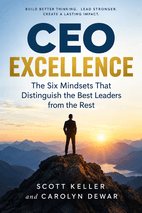
This page collects some of the most useful lines from CEO Excellence, the book by Carolyn Dewar. You will find sharp reminders about vision, capital allocation, culture, talent, and team building, all drawn from how real chief executives think and act.
The quotes work because they are direct, practical, and occasionally contrarian. They turn big leadership ideas into lines you can remember, debate, and apply on Monday morning. Some are poetic, some are blunt, and many sound like advice from a mentor who has been in the room.
Top Quotes from CEO Excellence
“Be bold and be right. If you're not bold, you're not going to do much of anything. If you're not right, you're not going to be here.”
Steve Ballmer’s advice to Satya Nadella as he handed over the Microsoft CEO role.
It distills the twin demands of boldness and judgment in strategic leadership.
“The best CEOs aren't only willing to venture into uncharted waters—they’re also willing to boldly stay the course on stormy seas.”
The authors describe the resolve required after making bold strategic moves.
It distinguishes bold entry from the equally hard work of persevering when conditions turn rough.
“When you're CEO, you've got to realize that every time you say or do something, it’s got a massive consequential effect. The whole company pivots.”
DBS's Piyush Gupta describes the surprising weight of a CEO's everyday actions.
It captures why CEO behavior is never neutral: it silently sets the organization's direction. Readers feel the pressure and opportunity of leadership presence.
“Today's skyscrapers are strong enough to withstand strong winds and earthquakes not because of their rigidity, but because of their flexibility.”
The authors use skyscraper engineering as a metaphor for organization design.
It makes flexibility a source of strength rather than a weakness. The image is simple, vivid, and memorable.
“In the same way the Navy leadership first defines the role of a Navy SEAL and then finds recruits who fit the job, the best CEOs know that building a great organization doesn't start with people but, instead, with roles.”
The chapter opens with Navy SEAL selection to argue that great organizations define roles before finding people.
It captures the chapter’s counterintuitive thesis: roles, not people, should come first.
“The best way to introduce new thinking is to introduce new thinking.”
U.S. Bancorp’s former CEO Richard Davis says this about the benefits of hiring from the outside.
Its tautology is memorable: external hires are the clearest way to bring genuinely new perspectives.
“Talent wins games, but teamwork and intelligence win championships.”
Michael Jordan is quoted at the start of the chapter.
It captures why assembling talent is not enough; coordinated teamwork is what wins at the highest level.
Themes Behind the Quotes
A major theme is courageous ambition. Several ideas push leaders to set a bigger definition of success, take calculated risks, and keep going when conditions get rough. Reallocation and capital discipline also matter, because a vision loses force if resources do not follow it. The CEO sets the tone, so small signals can reshape how everyone behaves.
Another theme is organizational design and talent. The quotes stress defining value-creating roles before filling them, building balanced teams, and mixing stability with agility. They also highlight trust, identity, and shared purpose as the glue that turns individual stars into a high-performing group. Across all the lines, the message is that excellent CEOs combine bold strategy with disciplined execution and careful attention to people.
Quotes by Chapter
Chapter 1: Vision Practice: Reframe the Game
“How do we inspire ourselves to greatness?”
Nelson Mandela asks this while reflecting on how to inspire a team to be better than they think they can be.
It frames the leader’s deepest challenge as creating greatness from within, not just demanding performance.
“They didn't just raise aspiration levels; they changed the definition of success.”
The authors summarize what they learned from interviewing the most successful CEOs.
It captures the chapter’s central idea: real vision reframes what winning means rather than merely escalating goals.
“From then on I talked about our vision as being to ‘kill cash.’ Instead of fighting for a piece of the fifteen percent of transactions that were electronic, we fought for a piece of the eighty-five that weren't (yet).”
Mastercard’s former CEO Ajay Banga explains how he reframed the company’s market and vision.
It shows how a bold reframe can shift a company from a crowded niche to a vastly larger opportunity.
“The goal wasn’t to be the biggest and the richest, it was to start creating products that help athletes perform better, so the runner can run faster, the tennis player and the soccer player can play better. If we did that and provided good service to our consumers, the financials would follow.”
Herbert Hainer describes the vision he set for Adidas as CEO.
It reveals how purpose and customer impact can drive financial success more powerfully than chasing size or profit directly.
Chapter 2: Strategy Practice: Make Big Moves Early and Often
“When we did daring things my board asked, ‘Are you sure?’ My answer was, ‘Of course not, there’s no way to be sure.’ We created a culture to be open about having insecurities, but also to have the guts and determination to go after the opportunities.”
Former Royal DSM CEO Feike Sijbesma on taking daring strategic bets amid uncertainty.
It reframes uncertainty as something to acknowledge openly while still acting with guts.
“CEOs who make too few moonshot-size moves—or make them too late in their tenure—fall behind the pack.”
The chapter summarizes research on CEOs who fail to make enough bold strategic moves.
It warns that timidity and delay, not just wrong moves, are costly.
Chapter 3: Resource Allocation Practice: Act Like an Outsider
“Insanity is doing the same thing over and over again, but expecting different results.”
Epigraph attributed to Rita Mae Brown (often attributed to Albert Einstein) at the start of the chapter.
It frames the chapter's call to break from routine thinking in resource allocation. The familiar line makes the outsider mindset memorable.
“Thinking like an outsider when it comes to reallocation means a CEO isn't wed to tradition, encumbered by internal loyalties, or willing to bow to short-term pressures. Instead, they regularly ask themselves what a new CEO with no emotional ties or history would do if brought in to take over the company.”
The chapter summarizes what it means for CEOs to adopt an outsider mindset when reallocating resources.
It distills the book's core resource-allocation principle into a crisp test. The contrast between tradition and a fresh CEO makes it actionable.
“When allocation decisions don’t line up with the company’s vision and strategy, the latter become just hollow words in corporate presentations that quickly lose credibility and potency.”
The chapter explains why resource allocation must match vision and strategy.
It shows that strategy without aligned capital becomes empty rhetoric. The phrase 'hollow words' makes the risk vivid.
“Further, if a CEO cannot allocate capital more effectively than capital markets, the business will lose its legitimacy in the eyes of its shareholders and might even trigger an activist investor campaign to break up the company.”
The chapter warns about the external consequences of poor capital allocation.
It raises the stakes by linking allocation to shareholder legitimacy and activist risk. The concrete threat makes the principle urgent.
Chapter 4: Culture Practice: Find the One Thing
“I knew I had to transform Alcoa, but you can't order people to change. That's not how the brain works. So I decided I was going to start by focusing on one thing. If I could start disrupting habits around one thing, it would spread to the entire company.”
Paul O'Neill explains how he approached culture change after taking over Alcoa.
It shows that deep culture change starts with one focused habit rather than top-down commands. The line is memorable because it turns a grand transformation into a simple, repeatable starting point.
“I was determined to use the incident to demonstrate what a growth mindset looks like under pressure.”
Satya Nadella reflects on responding to his viral misstep at a women in tech event.
It turns a public failure into a leadership lesson about accountability and learning. The sentence is powerful because it defines growth mindset through action under scrutiny.
“We changed everybody's identity, and now everybody is referred to as not an employee, but a Cleveland Clinic Caregiver.”
Toby Cosgrove describes giving every Cleveland Clinic worker a badge that named them a caregiver.
It illustrates how a simple symbolic act can redefine belonging and purpose across an entire workforce. The line sticks because identity, not policy, is shown as the heart of culture change.
Chapter 5: Organization Design Practice: Solve for “Stagility”
“Stability and agility aren't a trade-off to be made; both should be present just as in a modern high-rise building—hence, our coining the combination “stagility.””
The authors introduce their term for combining stable and agile organizational elements.
It reframes stability and agility as complements instead of competing priorities. The coined word makes the chapter’s core idea sticky.
“Organizations that have both stable and agile elements are three times more likely to be high-performing than those that are agile but lack stable operating disciplines, and more than four times more likely to be high performing than those that are stable, but lack agile elements.”
The authors cite research on what distinguishes high-performing organizations.
It quantifies the value of combining stability and agility. The comparison gives leaders a compelling reason to pursue both.
“In a helix organization, it's not a “dual hard line” or a “dotted line” reporting structure. Rather, it's a “split hard line” where an employee reports to two different leaders for two different purposes (thus the two intertwined strands).”
The authors explain the helix model for creating accountability in complex organizations.
It offers a crisp alternative to the confusing matrix. The “split hard line” idea is practical and easy to visualize.
Chapter 6: Talent Management Practice: (Don’t) Put People First
“Your people decisions are really where all your leverage is. As a CEO, you absolutely have to get those right. And you can’t do that at a distance.”
GE CEO Larry Culp says this about the centrality of people decisions.
It reminds leaders that talent decisions are a core lever and cannot be delegated from a distance.
“It's only after the best CEOs rigorously define the value-creating roles that they add actual people into the talent management equation—as soon as people are involved, so are politics.”
This line concludes the section on defining value-creating roles before inserting people into the equation.
It warns that once people enter the process, politics can distort talent decisions unless roles are defined first.
Chapter 7: Team Composition Practice: Create an Ecosystem
“The strength of the team is each individual team member. The strength of each member is the team.”
Phil Jackson epigraph opens the chapter on team composition.
It captures the reciprocal relationship between individual excellence and collective strength. It reframes team building as both personal and interdependent.
“Similarly, in organizational life, a group of high performers only becomes truly high performing if its members are complementary and connected to one another like in old-growth forests, not simply working side by side like replanted Douglas firs.”
The authors contrast old-growth forests with replanted single-species forests to explain team composition.
It offers a vivid metaphor for why diversity and connection matter more than simply assembling talented individuals. It suggests that real high performance comes from interdependence, not proximity.
“You can’t play with only 11 strikers or 11 goalkeepers. You need an excellent goalkeeper, an excellent striker, and excellent supporting players. One of the most important tasks for a CEO is to build a team around them that they can rely on, where there's trust and synergy.”
Adidas’s Herbert Hainer uses a football metaphor to explain team composition.
It makes the case for complementary roles over a collection of similar stars. It also ties team design directly to trust and synergy.
“Any coach who needs to replace all the players isn't as good a coach as they think they are.”
Intuit’s Brad Smith uses a sports analogy to argue against wholesale team replacement.
It warns leaders that replacing everyone may signal poor coaching rather than a broken team. It encourages CEOs to develop and transform talent before cutting it.
Chapter 8: Teamwork Practice: Make the Team the Star
“What really makes the team successful is the way the individuals, whatever their nature, deal with each other. It's not only the bricks but also the cement! That has an even bigger impact on results.”
DSM's Feike Sijbesma explains what makes a team successful.
It reframes team success as a function of relationships and trust rather than individual brilliance alone.