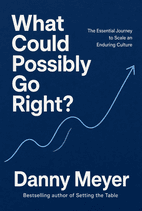
What is the book What Could Possibly Go Right? about?
Danny Meyer's What Could Possibly Go Right? traces four stages of cultural development—from seeding culture through scaling, succession, and crisis—using Union Square Hospitality Group's restaurants, Shake Shack's IPO, and pandemic upheavals. Written for founders and leaders in hospitality and service businesses navigating growth without losing what made them distinctive.
Feature
Insta.Page
Blinkist
Shortform
Summary Depth
Full Chapter-by-Chapter
15-min overview
Section-by-section guides
Audio Narration
✓
✓
✓
Visual Mindmaps
✓
✕
✕
AI Q&A
✓
✕
✕
Quizzes
✓
✕
✕
PDF Downloads
✓
✕
✓
Price
$89.99/yr
$146/yr (PRO)
$199/yr
*Competitor data last verified July 2026.
1 Page Summary
Danny Meyer's What Could Possibly Go Right?: The Essential Journey to Scale an Enduring Culture argues that growth is a double-edged sword: the very forces that allow a company to expand can erode the culture that made it worth expanding in the first place. Drawing on the trajectory of Union Square Hospitality Group from its early restaurants through Shake Shack's IPO and the upheavals of the COVID-19 pandemic, Meyer traces four stages of cultural development—"The Seeds of Culture," "One Foot on the Accelerator, the Other on the Brake," "The Shack Trap," and "Crossing the Bridge"—and insists they must be understood in order. Central to the book is the concept of Enlightened Hospitality and four family values: Excellence, Hospitality, Entrepreneurial Spirit, and a fourth that anchors the whole. Meyer introduces related frameworks including "microcaring versus micromanaging," "mindshare, heartshare, essentiality," and the winemaker's approach to tending culture as soil. The book's recurring question—"what could possibly go right?"—reframes growth not as a threat to be managed but as an invitation to keep acting small, local, and genuinely creative even at scale.
What distinguishes the book is Meyer's willingness to narrate failure and doubt alongside triumph. He describes closing Tabla despite its critical acclaim, losing Union Square Cafe's lease, the breakup with a business partner, the painful rollout and partial rollback of Hospitality Included, and the fracture of his senior leadership team. His approach is confessional and reflective rather than prescriptive: he admits to ignoring his gut, delaying hard decisions, and mistaking luck for skill. The book is structured around concrete episodes—a hot dog cart, a Citi Field concession, a Roman trattoria, a Miami parking garage—each used to illustrate a broader principle about culture, succession, or resilience. Meyer coins or adopts memorable language ("stubborn, persistent resilience") and grounds abstract ideas in specific people, places, and numbers. The result is less a how-to manual than a memoir of organizational learning, with the timeline of photographs from 2001 to 2017 serving as a visual spine.
The intended audience is leaders, founders, and managers—particularly in hospitality and service businesses—who are navigating growth and worry about losing what made them distinctive. Readers will gain a candid account of the trade-offs involved in scaling: how to honor loyalty when a partner becomes a competitor, how to decide whether to close or reinvent a beloved but unprofitable restaurant, how to share financial upside with employees, and how to recognize when the skills that built a company no longer suffice. The book offers frameworks for gut-checking opportunities, definitions of culture that go beyond slogans, and a vision of "essentiality" as the ultimate goal—becoming so woven into people's lives that losing you would leave them smaller. Above all, it offers permission to keep asking what could go right, even when the evidence points the other way.
Introduction
Overview
Danny Meyer started a hot dog cart in 2001. By 2017, he was running a restaurant group with locations across New York and beyond. The company kept growing, and every new location brought a new set of problems. The hardest ones didn't show up until they got expensive.
Before the introduction, there is a contents list, a dedication, and an illustrated timeline. None of these make an argument on their own.
Structure
Twenty-one chapters are grouped into four parts, each named for its opening chapter:
Part I, "The Seeds of Culture"
Part II, "One Foot on the Accelerator, the Other on the Brake"
Part III, "The Shack Trap"
Part IV, "Crossing the Bridge"
Timeline
A visual chronology built from photographs and captions runs from 2001 to 2017. It ties dates to places including the Whitney, a backyard grill, Martina, and Tacocina. Acknowledgments and an about-the-author page close the book.
Key Takeaways
Read the four parts in order. Each part covers a stage a culture goes through, and later stages only make sense after the earlier ones.
Look at the photo timeline before chapter one. It shows the years and places where these ideas were tested.
The section headings describe real tensions: growth pulling against restraint, and the moment when a winning formula starts to trap the people who built it.
Each part opens with a scene from the business. Those first scenes carry the argument, so they matter more than their length suggests.
Key concepts: Introduction
Introduction
The Growth Story
Danny Meyer started with a hot dog cart in 2001
By 2017, he ran a restaurant group across New York and beyond
Growth brought new problems, hardest ones appeared when expensive
Book Structure
Twenty-one chapters grouped into four parts
Parts named for opening chapters: Seeds of Culture, Accelerator/Brake, Shack Trap, Crossing the Bridge
Read parts in order; later stages depend on earlier ones
Key Takeaways
Photo timeline from 2001 to 2017 shows years and places ideas were tested
Section headings describe real tensions: growth vs. restraint, winning formula trapping builders
Each part opens with a business scene that carries the argument
💡 Try clicking the AI chat button to ask questions about this book!
Chapter 1: The Seeds of Culture
Overview
What does it take to become yourself when everyone around you has already defined success? A young person with unfinished confidence tries on every available identity, absorbs rejection, and faces a choice between performing for approval and discovering a direction that is actually his.
He grew up in St. Louis hearing, mostly from his mother, that he had a lot going for him and was not living up to his potential. The expectation at home, never stated outright, was to apply yourself at a very high level to everything. Everyone but him seemed like an overachiever. His father was a serial entrepreneur who founded a global travel business, survived two bankruptcies, and died of lung cancer at fifty-nine.
His mother pushed him toward John Burroughs, where his older sister Nancy was a star. His first attempt to transfer failed when he told the admissions director, truthfully, that his mother was the reason. He reapplied for tenth grade and got in. A teacher that year asked why he was not as good a student as his sister. At the mirror at home, he decided that if he could not measure up, he would not try. In March 1976, three thin envelopes arrived. Princeton and Brown rejected him. Trinity waitlisted him. He wrote to Trinity's dean of admissions pledging to enroll if accepted. Two weeks later, he had a place. Determined to prove them wrong, he earned straight A's his first semester.
At twenty-seven, he opened Union Square Cafe in 1985. He knew only that he wanted guests to leave feeling better than they arrived. Working the door, the dining room, and the kitchen, he learned that how guests felt mattered as much as the food. Within a decade, the restaurant held three New York Times stars and a James Beard Award for service. When he opened Gramercy Tavern with Tom Colicchio in 1994, leading by example stopped working. He could not be everywhere, and regulars said the new place did not feel like his. At an all-staff meeting, he defined hospitality as being on someone else's side. He separated it from service, the technical delivery of the product, and gave his team the Golden Rule of Hospitality: treat others as you believe they want to be treated.
When the cookies come out of the oven, a child's message is either "Look what I made" or "Look what I made for you." That second version points to a kid with high HQ.
Every role, from dishwasher to sommelier, is screened for HQ. These are people who find thoughtful acts toward others selfish, because their energy is renewed by making others feel better. Drive to win matters just as much. The belief that hospitable people cannot also be competitive is a false choice. "Nice guys finish last" deserves loathing, and "soft skills" sneers at abilities that are genuinely hard. Hiring targets 100 percent candidates: 49 percent what they know how to do, 51 percent who they are while doing it. Competitive drive keeps complacency away, and nobody coasts on the team's record.
Athleticism here means a set of mental and emotional traits, not sports prowess: competitiveness, work ethic, resilience, dot-connecting, and sharp strategic thinking. Asking what motivates a competitor reveals how to lead them. Three styles recur. Beating others: joy comes from defeating someone, as in the photograph of Muhammad Ali standing over Sonny Liston. Hating to lose: an allergy to anything but first place. John McEnroe at Wimbledon disputed a call, lost the point, drew a fine, and still won the match and tournament. Beating your own best: "It's me against me." Allyson Felix, chasing her own previous standard toward seven Olympic golds. No style outranks another, though a mix suits a team. He began in the second and became the third.
A bank of interview questions probes HQ, and good answers carry earnestness, clarity, vulnerability, humility and some humor. Overuse of "I" is a red flag, as are lateness and no sign of preparation.
The annual Zagat Survey prompted a scorecard of fifty competitors. In 2004, Gramercy Tavern finished second to Union Square Cafe, ahead of Bouley, Le Bernardin, Aureole and Gotham, with Tabla and Eleven Madison Park at twenty-four and twenty-six. The foundation felt solid, until it wasn't.
Key Takeaways:
Treat hospitality and service as separate obligations. Impeccable execution is the product you deliver, but the choice to stand on a guest's side is what stays with them afterwards.
Hire close to an even split between what a candidate can do and who they are while doing it. Favor people who draw energy from giving, and do not read that generosity as an absence of competitive fire.
Work out which competitive style drives each person you lead, whether beating a rival, refusing anything but first place, or surpassing their own last mark. Build a team that mixes all three rather than ranking them.
Meet rejection with a commitment instead of a retreat. A letter promising to enroll is what turns a waitlist into a place.
Keep the rankings in perspective. First and second place held by your own two restaurants describe a moment, not ground that cannot move.
Key concepts: Chapter 1: The Seeds of Culture
Chapter 1: The Seeds of Culture
Formative Years and Early Identity
Grew up in St. Louis with high expectations from mother
Father was serial entrepreneur who survived bankruptcies
Rejected by Princeton and Brown, waitlisted at Trinity
Pledged to enroll at Trinity, earned straight A's
Hospitality vs. Service
Opened Union Square Cafe in 1985, focused on guest feeling
Defined hospitality as being on someone's side
Service is technical delivery; hospitality is emotional connection
Golden Rule: treat others as they want to be treated
Hiring for HQ (Hospitality Quotient)
Screened every role for HQ: thoughtful acts renew their energy
Hiring targets 49% skills, 51% who they are while doing it
Competitive drive and hospitality are not mutually exclusive
Three styles: beating others, hating to lose, beating your own best
No style outranks another; a mix suits a team
Ask what motivates a competitor to learn how to lead them
Author began with hating to lose, evolved to beating his own best
Perspective on Success and Rankings
2004 Zagat: Gramercy Tavern second to Union Square Cafe
Rankings describe a moment, not fixed ground
Meet rejection with commitment, not retreat
Keep success in perspective; foundation can shift
Chapter 2: Speed Bumps in Paradise
Overview
When a restaurant group grows past one kitchen, it faces a question no org chart can answer: is it one business or a collection of independent ones? Every way of honoring both turns out to cost something. Someone is always paying for a loyalty that has no single address.
A Partner Becomes a Competitor
In 2001 Tom Colicchio, Gramercy Tavern's founding chef and Danny Meyer's partner, planned to open his own restaurant in Gramercy Tavern's backyard. Meyer wanted each restaurant led by its own fully committed executive chef. He had opened Eleven Madison Park and Tabla with Kerry Heffernan and Floyd Cardoz rather than enlarge Colicchio's role. Colicchio offered him a minority stake, provided it stayed outside Union Square Hospitality Group. Meyer declined, saying Colicchio could not run both. Colicchio said he would rather cut off his right arm than leave Gramercy Tavern. Two days later, Bob Scott had the law firm Davis Polk hand-deliver a letter. Scott was Morgan Stanley's chief financial officer and one of Gramercy Tavern's largest investors. The letter warned that firing Colicchio would violate Meyer's duty to shareholders. Meyer stood down. Craft opened in 2002.
Six Years of Awkward Dancing
For six years the two stayed tied together even as they pulled apart. Colicchio kept a loyal kitchen staff. He joined Gramercy Tavern's family meal to be seen, then left for Craft. The staff did not know whether they answered to Tom or to Danny. A states-versus-feds split set the home office against the restaurants. Accounting, public relations, and human resources colleagues were made to feel unwelcome at Gramercy Tavern. A 3 percent management fee infuriated leaders who saw themselves as the source of the company's success.
The Split Becomes Official
After Colicchio's chef de cuisine John Schaefer departed, with Colicchio cast as Top Chef's head judge and planning a second Craft in Los Angeles, the two finally negotiated. Valuing the business stalled them. Meyer offered to flip a coin for who bought whom, which Colicchio refused. Walking past the restaurant with Audrey, Meyer was told he could not sell the place he had poured himself into. He bought Colicchio out at a price that felt equally unfair to both.
At Eleven Madison Park, the order was to end the rival camps. No one was permitted to look down on a colleague. Meyer doubted he was the right person to deliver that message, given the conflicts he had mediated at Gramercy Tavern.
Earning a Fourth Star, Losing a Third
Three stars from the New York Times pushed Eleven Madison Park forward, but Daniel and general manager Will Guidara wanted a fourth. In 2009 Frank Bruni returned for a third review, and the staff, recognizing him, planned every detail of his visits.
From Germany's Black Forest, where Meyer was on a family vacation, PR director Michelle Lehmann relayed that the Times wanted to photograph dishes. They belonged not to Eleven Madison Park but to Union Square Cafe, a three-star restaurant since 1988 whose dining room managers had not noticed the critic in the house.
Two Stars
The night before publication Meyer was at Citi Field as the Cardinals led the Mets by a run in the fifth. Lehmann's first text said Union Square Cafe had kept its three stars. Her second said the paper had posted the wrong review. Two stars. In twenty-four years of business he had never lost one.
He left the game and, shaken, drove not to the restaurant but onto the departures ramp at LaGuardia's American Airlines terminal. At Union Square Cafe, no one spoke. There was no wine, no music, no champagne like past celebrations.
The L of Leadership
Paul Bolles-Beaven answered a question about leadership by hinging his palms and outstretched fingers into an L. The lower hand supports the team, the upper pushes it forward. A good leader does both. A great one knows what proportion of pressure each requires.
A week later Eleven Madison Park earned its fourth star. The pride and the shame together were nearly unmanageable. The joy between the restaurants had turned into rivalry. Enlightened Hospitality worked, but the systems and structure supporting it were fraying. Meyer's identity as a restaurateur had to give way to leading a hospitality company.
Key Takeaways
Decide whether a star colleague's own venture belongs inside your company or beside it, and draw that line before the venture exists rather than after it opens.
Accept that your authority over who stays has a ceiling set by the people who own the business, and plan for the moment the two pull in opposite directions.
End a murky separation fast; dragging it out breeds years of internal infighting that guests never see and always pay for.
Balance support and pressure deliberately, adjusting how much of each a person needs, and expect your proudest and worst professional news to arrive in the same week.
Once a working philosophy proves itself, the real constraint becomes how the company is structured, and your identity has to widen from running a restaurant to leading a company.
Key concepts: Chapter 2: Speed Bumps in Paradise
Chapter 2: Speed Bumps in Paradise
Partner Becomes Competitor
Tom Colicchio planned Craft near Gramercy Tavern.
Danny Meyer insisted each restaurant have its own chef.
Investor letter forced Meyer to let Colicchio stay.
Craft opened in 2002, creating direct competition.
Six Years of Awkward Dancing
Staff confused about loyalty to Tom or Danny.
Home office and restaurants developed states-versus-feds split.
3% management fee infuriated restaurant leaders.
Colicchio balanced Gramercy Tavern and Craft.
The Split Becomes Official
Negotiations stalled over business valuation.
Meyer bought Colicchio out at an unfair price.
At Eleven Madison Park, Meyer ended rival camps.
Meyer doubted he could deliver the unity message.
Earning a Fourth Star, Losing a Third
Eleven Madison Park aimed for a fourth star.
Staff recognized critic Frank Bruni and planned visits.
Times mistakenly photographed Union Square Cafe dishes.
Union Square Cafe lost a star after 24 years.
The L of Leadership
Leadership balances support and pressure.
Eleven Madison Park earned fourth star a week later.
Pride and shame arrived together, unmanageable.
Meyer's identity shifted to leading a hospitality company.
Chapter 3: Failing Up
Overview
A beloved restaurant can be packed for years and still lose money. So what does its leader owe the people inside it when every attempt to fix the numbers fails and closing looks like surrender? What do you do when holding on protects your story but not your team?
Tabla opened in 1998. Chef Floyd Cardoz applied French technique to Indian flavors, and Ruth Reichl gave it three stars in The New York Times. For two years it was one of the city's hardest reservations, with annual revenue near $8 million. But the space was huge, the rent was high, and the margins were thin. Break-even was about $7 million, and later years fell short. The final two years lost nearly $500,000 each. Bad weather ruined two crucial patio summers. Every pivot failed — menu, pricing, uniforms, lighting, art, even swapping a Ganesh statue. The team's underdog loyalty kept it alive anyway.
Danny Meyer delayed the decision two years. He used bank loans to pay staff and suppliers. Then RC told him something that changed his mind: keeping an unprofitable business open hurt the team, who had gone two years without raises or promotions. Closing, it turned out, was more generous than staying open. Instead of padlocking the door, Tabla gave four months' notice, with final service on December 30, 2010. Staff got coaching on résumés and interviews. Job fairs were hosted with USHG restaurants and Tabla alumni. Special dinners were held, including a Madison Square Park Conservancy benefit and guest-chef dinners celebrating new Indian cooking.
To sell the remaining seven and a half years of the lease, Meyer met La Mar Cevicheria, the Lima restaurant of Gaston Acurio. On a family trip to Peru, the La Mar team served endless ceviche, tiradito, and two bowls of uni. Meyer ate about twenty sea urchins to show respect, then spent three days recovering from iodine and altitude before Machu Picchu. La Mar bought the lease. The proceeds covered staff, rent, sales tax, and vendors, and returned investors about $1.08 on the dollar.
In 2011, Eleven Madison Park won a third Michelin star and Wine Spectator's Grand Award. Will Guidara and Daniel Humm asked to develop the Nomad Hotel while staying at EMP, but outside USHG. Meyer refused to repeat the Tom Colicchio/Craft split. He told them to buy EMP. They did, backed by hedge fund managers and investment bankers. Six years later they made it the world's number-one restaurant. John Ragan stayed with USHG and became a master sommelier, wine director, and president.
Tabla's thirteen years launched careers, including Dan Kluger's James Beard awards. The closure freed money and time and redeployed talented staff. A park kiosk, born as a hot dog cart in EMP's private dining kitchen, remained.
Key Takeaways
When a business can no longer support its team, close it as generously as you opened it.
Give long notice, coach people for their next roles, and accept that staying open can hurt them more than closing.
Sell or hand off a thriving property when keeping it inside your company would limit its leaders.
Honor obligations before returning capital. Danny Meyer's sale of Tabla's lease to La Mar settled payroll, rent, taxes, and suppliers, then returned investors roughly $1.08 per dollar.
Judge a venture by the people it advanced and the resources it freed, not just by whether it survived.
Key concepts: Chapter 3: Failing Up
Chapter 3: Failing Up
The Tabla Dilemma
Beloved restaurant packed for years but losing money
High rent, thin margins, break-even at $7M
Final two years lost nearly $500K each
Every pivot failed; team loyalty kept it alive
The Decision to Close
Meyer delayed two years, using loans to pay staff
RC convinced him: staying open hurt team without raises
Closing more generous than staying open
Four months' notice, final service Dec 30, 2010
Closing with Generosity
Coaching on résumés and interviews
Job fairs with USHG restaurants and Tabla alumni
Special dinners and benefits held
Sold lease to La Mar, returned investors $1.08 per dollar
Empowering Leaders to Leave
Guidara and Humm asked to develop Nomad outside USHG
Meyer refused to repeat Tom Colicchio/Craft split
Told them to buy EMP; they did, later world's #1
John Ragan stayed, became master sommelier and president
Legacy and Lessons
Tabla's 13 years launched careers like Dan Kluger's
Closure freed money, time, and redeployed staff
Judge ventures by people advanced and resources freed
Honor obligations before returning capital
You've reached the end of the free chapters
Next chapter: “One Foot on the Accelerator, the Other on the Brake” is locked
Keep reading What Could Possibly Go Right? — and unlock all 600+ book summaries with audio, mindmaps and AI Q&A.
$0.00 due today · 7 days free, then $89.99/year ($7.49/mo) · Cancel anytime before day 7
plus sales tax where applicable
More ways to explore What Could Possibly Go Right?
Danny Meyer is an American restaurateur and author known for founding the Union Square Hospitality Group, which includes landmark New York restaurants such as Gramercy Tavern and Shake Shack. His notable book, Setting the Table: The Transforming Power of Hospitality in Business, outlines his philosophy of enlightened hospitality and has become a widely read guide for service-industry leaders. A prominent advocate for humane business practices, Meyer is also recognized for pioneering the elimination of tipping at his restaurants.
Frequently Asked Questions about What Could Possibly Go Right?
What is What Could Possibly Go Right? about?
It explores how a restaurant group builds and sustains a culture through four distinct stages, from discovering personal direction and defining shared values to expanding, facing crises, and striving for essentiality. The narrative follows real challenges such as partner conflicts, financial collapses, the COVID-19 shutdown, tipping debates, and the tension between growth and intimacy. It is structured around four parts that each represent a stage a culture goes through, and later stages only make sense after the earlier ones.
Who is the author of What Could Possibly Go Right??
Danny Meyer is a restaurateur who began with a hot dog cart in 2001 and grew a restaurant group with locations across New York and beyond. He founded Union Square Hospitality Group and Shake Shack, and his career includes leading through recessions, the pandemic, and major industry shifts. His writing draws on decades of personal experience building a culture around hospitality, excellence, and entrepreneurial spirit.
Is What Could Possibly Go Right? worth reading?
Yes, it is worth reading for its candid, story-driven look at how a company can grow without losing its soul. The chapters are full of real dilemmas—partner disputes, financial crises, the pandemic—and the thinking behind each decision. Leaders and entrepreneurs will find practical wisdom on culture, values, and staying essential to the people you serve.
What are the key lessons from What Could Possibly Go Right??
Key lessons include that culture must keep moving and evolving, like a shark, and that the bigger a company gets, the smaller it needs to act to stay connected to local communities. Leaders should trust their gut through a structured check, be willing to change their grip even when it feels unnatural, and practice stubborn, persistent resilience through setbacks. The book also emphasizes essentiality—becoming so meaningful that people cannot imagine losing you—and core values like excellence, hospitality, and entrepreneurial spirit. Growth brings hard trade-offs, and closing or changing something can sometimes be the most caring choice for a team.
📚 Explore Our Book Summary Library
Discover more insightful book summaries from our collection