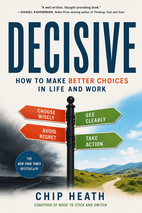
Chip Heath's Decisive diagnoses the four cognitive villains that sabotage decision-making and introduces the WRAP framework—multitracking options, testing assumptions, creating distance from emotion, and preparing for multiple futures—to counteract them. Written for executives, entrepreneurs, and anyone facing high-stakes career or personal choices, it offers a disciplined process for making wiser decisions that honor core priorities.
Feature
Insta.Page
Blinkist
Shortform
Summary Depth
Full Chapter-by-Chapter
15-min overview
Section-by-section guides
Audio Narration
✓
✓
✓
Visual Mindmaps
✓
✕
✕
AI Q&A
✓
✕
✕
Quizzes
✓
✕
✕
PDF Downloads
✓
✕
✓
Price
$89.99/yr
$146/yr (PRO)
$199/yr
*Competitor data last verified July 2026.
1 Page Summary
Decisive: How to Make Better Choices in Life and Work by Chip Heath and Dan Heath tackles the systemic flaws in human decision-making, arguing that even intelligent, careful people routinely make choices that later appear obviously wrong. The book's central thesis is that our natural decision-making process is distorted by four "villains": narrow framing (treating decisions as binary yes/no questions), confirmation bias (seeking evidence that supports what we already believe), short-term emotion (letting fleeting feelings hijack judgment), and overconfidence (trusting our own impressions precisely when the stakes are highest). The authors demonstrate that analysis alone doesn't fix these problems—citing a study of 1,048 decisions where process mattered more than analysis by a factor of six—because rigorous thinking gets suppressed unless the decision-making procedure gives it a fair hearing.
The book's distinctive approach is the WRAP process, a four-step framework designed to counteract each villain. To fight narrow framing, readers are urged to multitrack—exploring several options in parallel, as the naming firm Lexicon did for Colgate's disposable toothbrush—and to find someone who's already solved the problem, whether externally (like Walmart copying Ben Franklin stores' centralized checkout) or internally (like Kaiser Permanente discovering a doctor who'd cut sepsis deaths). Against confirmation bias, the authors advocate considering the opposite, citing research showing people are more than twice as likely to seek confirming as disconfirming information, and recommending institutionalized dissent (like the Catholic Church's "promoter of the faith"). For short-term emotion, they offer techniques like 10/10/10 (asking how a decision will feel in 10 minutes, 10 months, and 10 years) and physical or temporal distance. Finally, to combat overconfidence, they suggest ooching—running small experiments before committing, as National Instruments did with a crude wireless sensor prototype—and bookending the future by estimating a dire lower bound and a rosy upper bound for any investment.
The intended audience is broad: executives facing mergers, entrepreneurs weighing ventures, and anyone making career or personal choices. What readers gain is not a formula for perfect decisions—the authors stress that emotion sits at the core of every choice and that two people can decide oppositely and both be wise—but a disciplined process for expanding options, testing assumptions, and making choices that honor core priorities. The book is distinctive in its blend of rigorous research (from Kahneman to Nutt's studies of hundreds of decisions), vivid organizational examples (Quaker's Snapple disaster, Intel's Andy Grove, Zappos's $1,000 quit offer), and practical, memorable tools like tripwires and graded ooches. It concludes by emphasizing that procedural justice—feeling heard, receiving accurate information and candid explanation—matters as much as the outcome itself, turning decision-making into a fair process that builds commitment even among those on the losing side.
Introduction
Overview
Most decisions are made from a small slice of what is visible, and that slice rarely contains what a good decision requires. Even when we try to be more thoughtful, we don't know how to expand the view, and the failure shows up in careers, businesses, and personal lives.
The spotlight effect
People are rarely stumped. Given a brief description of Clive, an underperforming IT director, most readers immediately form an opinion, though obvious alternatives like reshaping his role go unconsidered. Psychologist Daniel Kahneman calls this reliance on visible information "what you see is all there is"; the authors call it the spotlight effect.
Process beats analysis
The track record is poor: 83% of mergers create no shareholder value, and 60% of 2,207 executives rated bad decisions about as common as good ones. Analysis alone does not fix this. In a study of 1,048 decisions, researchers Lovallo and Sibony found that process mattered more than analysis by a factor of six, because rigorous analysis gets suppressed unless the decision process gives it a fair hearing.
The limits of pros and cons
Franklin's "moral algebra" lists pros and cons, strikes out pairs of equal weight, and reveals where the balance lies. Two centuries later, this remains the standard deliberate approach, yet 40 years of psychology research shows biases that doom it. The book introduces four such villains and a process to counteract them.
Key Takeaways
The information that is immediately visible in a decision crowds out alternatives that would be obvious if named, so a brief description of a person or situation rarely raises the question of whether the role itself is the problem.
Because rigorous analysis is routinely overridden by how a decision is conducted, the quality of the process, not the volume of analysis, determines whether good reasoning gets heard.
Lovallo and Sibony found process outweighed analysis by a factor of six in 1,048 decisions, implying that a procedure designed to surface and weigh unpopular options is worth more than additional analytical firepower.
The pros-and-cons method that has dominated deliberation since Franklin appears neutral but systematically inherits known psychological biases, so countermeasures must be built into the procedure rather than left to individual judgment.
Key concepts: Introduction
Introduction
The Spotlight Effect
Visible information dominates decisions
People form opinions from brief descriptions
Alternatives like reshaping roles go unconsidered
Kahneman: 'what you see is all there is'
Process Beats Analysis
83% of mergers create no shareholder value
60% of executives rate bad decisions common
Process outweighs analysis by factor of six
Rigorous analysis suppressed without fair process
Limits of Pros and Cons
Franklin's moral algebra remains standard approach
40 years of research shows inherent biases
Method appears neutral but inherits psychological flaws
Countermeasures must be built into procedure
Key Takeaways
Visible information crowds out unstated alternatives
Process quality determines if good reasoning is heard
Procedure to surface unpopular options beats analysis
Biases require built-in countermeasures, not judgment
💡 Try clicking the AI chat button to ask questions about this book!
1. The Four Villains of Decision Making
Overview
Even careful, intelligent people routinely choose options that later seem obviously wrong. The reasoning process feels thorough and honest, but the outcome is systematically distorted. Something between the first impression and the final commitment leads the decision astray.
Narrow framing
HopeLab needed a design partner for a device to measure kids' exercise, and research chief Steve Cole refused to pick one firm. He ran a horse race: shrinking the project to its first step and hiring five Bay Area firms to work independently, then combining the best ideas or picking a winner. That fights narrow framing, the tendency to treat decisions as binary: break up or stay, buy a car or not. A pros-and-cons list would still assume one vendor is uniquely right; the horse race kept alternatives alive.
Confirmation bias
Confirmation bias means gathering evidence that supports what you already believe while thinking you are being analytical. In a 1960s study, smokers preferred a headline saying smoking does not cause lung cancer to one saying it does. Dan Lovallo, a decision researcher, calls it "probably the single biggest problem in business."
Short-term emotion
Intel's Andy Grove faced the third villain when his company lost money on memory chips to Japanese competitors in the early 1980s. Factions argued for new factories, new technology, or specialty markets, and Grove was paralyzed. He broke free by asking what a new CEO would do: get out of memory. Grove and chairman Gordon Moore did exactly that. The obstacle was short-term emotion, the internal turmoil and political infighting that obscured the obvious exit. The bet paid off: $1,000 invested in Intel in 1985 was worth $47,000 in 2012 versus $7,600 for the S&P 500.
Overconfidence
Decca rejected the Beatles in 1962 because "groups are out." Doctors who are completely certain of a diagnosis are wrong 40% of the time, and students who give themselves a 1% chance of error are wrong 27%. We shine a spotlight on familiar information and cannot see surprises like the Internet. This is overconfidence.
The decision process
These villains attack at each stage of a normal decision:
Encountering a choice: narrow framing hides options.
Making a choice: short-term emotion tempts you wrong.
Living with it: overconfidence blinds you to the future.
The standard pros-and-cons approach fights none of them.
The WRAP process
Each villain has an antidote, because each attacks a different phase. The four-part method, captured by the mnemonic WRAP, is:
Widen Your Options: narrow framing hides alternatives at the moment of choice, so deliberately expand the set.
Reality-Test Your Assumptions: confirmation bias feeds self-serving analysis, so collect trustworthy outside information.
Attain Distance Before Deciding: short-term emotion distorts the choice, so step back.
Prepare to Be Wrong: overconfidence flatters predictions, so plan for an uncertain future.
The steps are sequential but not rigid: you may double back or skip a step, as when a promotion needs no distancing. The model shifts from "auto spotlight" to manual spotlight, deliberately aiming at strategic corners instead of letting visceral emotions, self-serving information, and overconfident predictions drive what you notice.
The goal is not perfection, only a bit fewer bad decisions and a bit more decisiveness, plus sharper advice for others, since their biases are easier to see than your own. The process applies to decisions that take longer than five minutes: buying a car, taking a new job, ending a relationship, handling a difficult colleague, allocating a budget, starting a business. It does not apply to split-second calls like an NFL quarterback choosing a receiver. Intuition works only in predictable settings with quick, repeated feedback, as in chess; hiring managers get delayed, confounded feedback and should not trust their gut.
The process works like a grocery list: a correction for forgetfulness, not a demand to focus harder. The payoff is small but consistent. A .250 hitter is mediocre, a .333 hitter is an All-Star and eventually a Hall-of-Famer, yet the gap is one extra hit in twelve at-bats; that edge requires technique, practice, and process.
Tripwires
The process also alerts you that a decision exists. Van Halen's contract included Article 126: no brown M&Ms backstage, under penalty of forfeiting the show. David Lee Roth checked the bowl at each venue; a brown M&M meant the stagehands had not read the specifications, so he would demand a line check and find a dangerous error. The diva demand was an operational tripwire for a complex stage production. In ordinary life, tripwires can be a trigger weight for exercise or a calendar date to check your relationships. Psychologist Roy Baumeister compares life to driving: you spend 95% of the time going straight, but turns determine where you end up.
Key Takeaways
When a choice appears to have only two sides, force yourself to generate more options, even if that means shrinking the project to its first step and running several alternatives in parallel.
Treat any evidence that supports your preference as suspect until you have actively hunted for evidence that would prove you wrong.
In a tense or emotional decision, ask what a newly appointed leader would do, because that question removes you from the internal politics that keep the obvious answer hidden.
Make your forecasts probabilistic: assume the future will surprise you, and build in prearranged signals, like a trigger number or a scheduled check, that tell you when to change course.
Reserve the WRAP routine for decisions that take longer than five minutes, use it as a grocery list rather than a demand for perfection, and accept that its payoff is a small but compounding edge.
Key concepts: 1. The Four Villains of Decision Making
Overconfidence: flatters predictions, blinds to surprises
The WRAP Process
Widen Your Options: expand alternatives deliberately
Reality-Test Your Assumptions: seek outside trustworthy data
Attain Distance Before Deciding: step back from emotion
Prepare to Be Wrong: plan for uncertain future
How Villains Attack Decision Stages
Encountering choice: narrow framing hides options
Analyzing options: confirmation bias feeds self-serving data
Making choice: short-term emotion tempts wrongly
Living with it: overconfidence blinds to future
Applying the Process
Use for decisions longer than five minutes
Not for split-second calls or intuitive settings
Works like grocery list, not perfection demand
Payoff is small but compounding edge
Tripwires and Key Takeaways
Tripwires alert you that a decision exists
Van Halen's brown M&Ms as operational signal
Generate options even if shrinking first step
Treat supporting evidence as suspect until tested
2. Avoid a Narrow Frame
Overview
Most decisions feel like a choice between yes and no, but that framing hides every alternative not put on the table. When the only question is whether or not to do something, the real decision has already been made. How do we escape a frame that narrows before we even begin?
The teenage pattern
Claireabelle asked Ask.com whether to break up with a boyfriend whose family insulted her. That is a whether or not decision: an up-or-down vote on a single option. Carnegie Mellon's Baruch Fischhoff, interviewing 105 teenage girls, found that such votes, along with statements of resolve like "I'm going to stop blaming others," made up about 65 percent of teen decisions. That is narrow framing.
Organizations are no better
In 1983, Quaker's William Smithburg bought Gatorade for $220 million after tasting it; it grew toward $3 billion. In 1994 he paid $1.8 billion for Snapple, a price analysts called a billion too high, and nobody argued the no side. Sales stalled, the debt nearly sank Quaker, and Snapple sold for $300 million. Paul Nutt's study of 168 decisions found only 29 percent weighed more than one alternative, and "whether or not" decisions failed 52 percent versus 32 percent for decisions with alternatives.
Widen Your Options
Heidi Price founded College Match when helping her daughter choose a college proved frustrating. Her nephew Caufield Schnug, an indifferent Texas student, blossomed at Hendrix College and entered a Harvard PhD program. Price tells families to ask what they want from life rather than which school will admit them. Father J. Brian Bransfield reframes similarly: God has no single intended path; many choices would please Him.
Shane Frederick's research on opportunity cost, the value of what a choice gives up, began when a Vancouver salesman asked whether he preferred the $1,000 Pioneer or the $700 Sony plus $300 of albums. In one study, 75 percent of people bought a $14.99 video; a reminder to keep the money for other purchases cut that to 45 percent. A weak hint of another alternative improves decisions, though life rarely interrupts focus; a Dwight D. Eisenhower speech was a rare acknowledgment of opportunity costs.
Dwight D. Eisenhower's 1953 speech priced military hardware in what it gave up:
one heavy bomber meant a modern brick school in more than 30 cities, two power plants serving 60,000 people, two hospitals, or 50 miles of concrete highway;
a fighter meant half a million bushels of wheat;
a destroyer meant homes for more than 8,000 people.
Starting every decision by asking what else the same time and money could do would produce better choices.
The Vanishing Options Test
A further technique: imagine that Aladdin's genie has an older brother who removes options rather than granting wishes. The Vanishing Options Test asks what you could do if your current alternatives disappeared.
Margaret Sanders, career-services director at a government graduate school, was deciding whether to fire Anna, an administrative assistant who handled expenses and the database well but was painfully introverted as the office's front door, making the center less effective. Termination meant months of awkward process. When asked what she would do if Anna were stuck but could not be the front door, Sanders immediately proposed moving Anna to full-time administrative work, rotating professional staff through hourly front-door shifts, and hiring work-study students for about $2.50 an hour, roughly $20 a day. Losing the option exposed an alternative she had not been seeing.
Forced removal shifts the mental spotlight; a generic request to "generate another option" usually yields minor variants. The cruel-seeming genie is kindhearted.
Acting as a decision adviser
The decision adviser role, which Heidi Price and Father Bransfield played, means watching colleagues and loved ones for "whether or not" language and endless rehashing of the same options. Ask what else they could do with the time and money, or run the Vanishing Options Test. A narrow frame is invisible from inside and obvious from outside.
Key Takeaways
Whenever you hear yourself posing a “should I or shouldn’t I” question, force a second alternative into the frame; Paul Nutt’s research shows such single-option decisions succeed far less often than those weighing other paths.
Before committing money or time, ask what else this exact sum could do, and let the answer compete with the option in front of you.
When no alternative appears, remove the current options mentally: imagine your existing choice is impossible, then describe what you would do; the vanishing options test uncovers solutions that a simple request for alternatives rarely reaches.
Become the decision adviser for those around you: when you hear “whether or not” language or someone obsessively replaying one decision, ask the widening question, because a narrow frame is easy to see from outside and impossible to see from inside.
Key concepts: 2. Avoid a Narrow Frame
Avoid a Narrow Frame
The Problem of Narrow Framing
Whether-or-not decisions dominate teen choices (65%)
Organizations also default to single-option decisions
Nutt's study: single-option decisions fail 52% vs 32%
Narrow frame hides all alternatives not on table
Widening Options
Ask what you want from life, not which option to pick
Consider opportunity cost: what else could time/money do
Eisenhower priced military hardware in schools, hospitals, wheat
Reminding people of alternatives improves decisions dramatically
The Vanishing Options Test
Imagine current options are impossible—what would you do?
Forced removal shifts mental spotlight to new alternatives
Generic 'generate another option' yields only minor variants
Sanders found cheaper, better solution when Anna couldn't be front door
Becoming a Decision Adviser
Watch for 'whether or not' language in others
Ask what else they could do with time and money
Run the Vanishing Options Test for them
Narrow frame is invisible inside, obvious from outside
Key Takeaways
Force a second alternative into any should-I-or-shouldn't-I question
Let opportunity cost compete with the option in front of you
Use vanishing options test when no alternative appears
Help others widen their frames as a decision adviser
3. Multitrack
Overview
A creative team that locks onto one idea early can spend the whole session polishing a frame that never should have been adopted. The pressure to choose quickly and revise in sequence feels efficient, but it may be exactly what keeps better options out of reach.
Multitracking at Lexicon
Lexicon, a small Sausalito firm, has coined names for fifteen billion-dollar brands. Its process, multitracking, explores several options in parallel rather than locking early into one frame. For Colgate's 2006 disposable mini-toothbrush, smallness was the obvious frame. Using the brush themselves, the team found its real trait was lightness: almost no lather, a sensation closer to a breath strip. So the name should evoke lightness, and after 70 linguists in 50 countries generated candidates, "wisp" surfaced. A blind "excursion team," given a fictional Olay brief, reached a dead end; parallel work tolerates waste.
Simultaneous beats sequential
Graphic designers who developed three banner ads at once beat designers who revised a single ad through the same number of feedback rounds, by the judgment of editors, ad executives, and click-through rates. They also felt better: over 80% found the critiques helpful, against 35% of the sequential group, because a single design fuses ego with the work.
One extra option is enough
Choice overload is real: shoppers offered 24 jams were 10 times less likely to buy than those offered 6. But most decisions are made with a single "jam." Among 83 major decisions at a German technology firm, considering more than one alternative produced six times as many "very good" outcomes, 40% versus 6% for whether-or-not choices.
Real options and two mindsets
Options must differ meaningfully, not be shams. Kissinger described the bureaucratic trick of presenting a leader with three options where two are obvious losers; his joke was nuclear war, present policy, or surrender. Two mindsets shape whether distinct options appear: a prevention focus scans for dangers, a promotion focus chases gains. Across three recessions, the book reports, the most successful of 4,700 companies combined both; in the 2000 downturn, Staples cut costs and closed weak stores while hiring 10% more staff.
The recession test
Office Depot cut 6% of its workforce and skipped comparable investments. Over the three years after the downturn, Staples ran about 30% more profitable. Researchers counted a rebound as beating rivals by 10% or more on both sales and profit growth. Multitrackers were 42% more likely to rebound strongly than purely promotion-focused firms, and 76% more likely than purely prevention-focused ones.
Nudging the missing mindset
When budgets tighten, prevention dominates. Better to ask whether an 8% cut could free money for the most exciting opportunities than how to make the least harmful 5% cut. The opposite case needs the opposite nudge: a screenwriter newly arrived in Los Angeles, dazzled by possibilities, needs a friend to ask how to stay financially afloat while waiting for them to pay off.
Doreen's list
Psychologist Susan Nolen-Hoeksema's book profiles Doreen, a Los Angeles County welfare caseworker who loved her work but burned out on it. Apathetic clients infuriated her, and needy clients dropped from the rolls broke her heart. Stress leaked into family life, with evenings spent exploding at a child or hiding in the den. A church mentor urged proactivity, and she wrote six options:
Quit.
Go half-time.
Make the children less irritating.
Lean more on Frank.
Find a less stressful job.
Release stress before coming home.
The first four were impractical, and abandoning welfare work would betray her religious commitment to serving the poor. Frank shifted the frame: instead of merely limiting stress, she could increase happiness, with calming music on the commute or a workout at the YMCA. He added a promotion focus to her prevention focus.
This and that
When life offers a "this or that" choice, the right question may be whether "both" works. Simultaneous options reveal the shape of the problem, and sequential exploration, even stretched over years, is weaker.
Key Takeaways
Explore several real options in parallel rather than honing a single frame; the discarded candidates are what let the winning trait surface.
Whenever a choice looks like "go or no go," force at least one alternative into the set; one genuine extra option changes the odds of a very good decision.
Keep every option meaningful: a menu with decoys offers no more real choice than a single option.
Diagnose which mindset you are in and add its opposite: if budget pressure makes you defensive, ask what you would fund with a small saving; if opportunity makes you giddy, ask how you will stay afloat while waiting.
In any this-or-that dilemma, try to design a both; parallel options expose what the problem is, while working through options one after another hides it.
Key concepts: 3. Multitrack
Multitrack
Core Concept
Multitracking explores options in parallel, not sequentially
Locking early onto one frame blocks better options
Lexicon's process coined names for billion-dollar brands
Colgate's wisp emerged from lightness, not smallness
Evidence for Parallel Work
Simultaneous banner ads beat sequential revisions
Parallel designers felt critiques more helpful (80% vs 35%)
One extra option improves decision outcomes sixfold
Choice overload: 24 jams reduced buying tenfold
Meaningful Options
Options must differ genuinely, not be decoys
Kissinger's trick: two losers plus one real choice
Chip Heath is a professor of organizational behavior at Stanford Graduate School of Business, renowned for his research on why ideas succeed and how to communicate effectively. He is the co-author of the bestsellers "Made to Stick," "Switch," and "The Power of Moments," which apply psychology and behavioral economics to real-world challenges. His work bridges academia and practical application, offering leaders and communicators clear frameworks for influencing change and crafting memorable messages.
Frequently Asked Questions about Decisive
What is Decisive about?
The book examines why even careful, intelligent people make poor decisions and presents a practical framework to counteract the hidden forces that distort judgment. It identifies four key villains—narrow framing, confirmation bias, short-term emotion, and overconfidence—and offers step-by-step antidotes such as multitracking options, testing assumptions through small experiments, gaining distance from emotion, and preparing for the future. The guidance is grounded in research from psychology and business, illustrated with real-world examples ranging from mergers to personal career choices.
Who is the author of Decisive?
Chip Heath is the author of the book, a professor and researcher known for his work on communication, decision-making, and how ideas spread. He draws on extensive academic research and real-world case studies to make the concepts accessible and actionable for readers.
Is Decisive worth reading?
Yes, it is absolutely worth reading because it offers a clear, memorable framework that directly addresses the most common mental traps that lead to bad decisions. The book is filled with compelling stories and practical tools that readers can immediately apply to both major life choices and everyday business problems.
What are the key lessons from Decisive?
The core lessons include widening your options to avoid narrow frames, considering the opposite to fight confirmation bias, and using small experiments or 'ooching' to test big assumptions before fully committing. It also teaches the importance of emotional distance, such as using the 10/10/10 method, honoring your core priorities, and setting tripwires to interrupt autopilot behavior. Ultimately, the book shows that a fair, transparent decision process consistently beats raw analysis alone.
📚 Explore Our Book Summary Library
Discover more insightful book summaries from our collection