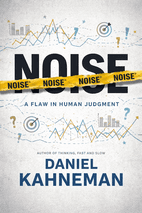
Daniel Kahneman's Noise investigates the costly variability in human judgment across fields like medicine and law, offering leaders and professionals a framework for decision hygiene to reduce inconsistency and improve fairness.
Feature
Insta.Page
Blinkist
Shortform
Summary Depth
Full Chapter-by-Chapter
15-min overview
Section-by-section guides
Audio Narration
✓
✓
✓
Visual Mindmaps
✓
✕
✕
AI Q&A
✓
✕
✕
Quizzes
✓
✕
✕
PDF Downloads
✓
✕
✓
Price
$89.99/yr
$146/yr (PRO)
$199/yr
*Competitor data last verified July 2026.
1 Page Summary
In Noise, Nobel laureate Daniel Kahneman, along with co-authors Olivier Sibony and Cass R. Sunstein, investigates a pervasive yet often overlooked flaw in human judgment: unwanted variability. Building on the foundation of cognitive biases explored in Kahneman's earlier work, Thinking, Fast and Slow, the book distinguishes "noise" from "bias." While bias represents a systematic deviation from true values (an average error), noise is the random scatter of judgments around that average. The authors compellingly demonstrate that wherever there is judgment—from medical diagnoses and criminal sentencing to insurance premiums and personnel decisions—there is an astonishing amount of disruptive inconsistency, which they term "system noise," eroding fairness, accuracy, and efficiency.
The book's analysis is rooted in decades of research in psychology, economics, and organizational behavior, illustrating how noise thrives in systems reliant on expert discretion. Historical and contemporary case studies reveal that professionals like doctors, judges, and underwriters often reach starkly different conclusions when presented with identical information, a problem masked by a focus on average outcomes. Kahneman and his colleagues argue that organizations have historically been "noise blind," prioritizing the fight against bias while neglecting the potentially equal or greater costs of inconsistency. They provide a rigorous framework for conducting a "noise audit" to measure this variability and introduce the concept of "decision hygiene"—a set of procedural safeguards, such as using structured guidelines and aggregating independent judgments, designed to reduce noise without necessarily eliminating human discretion.
The lasting impact of Noise is its powerful reframing of error and its practical roadmap for improvement. By naming and quantifying this hidden tax on decision-making, the book has influenced leaders across the public and private sectors to scrutinize the consistency of their judgments. It shifts the conversation from solely debiasing individuals to improving decision-making systems, advocating for a more disciplined approach that enhances reliability and justice. Ultimately, Noise serves as an essential companion to the study of bias, completing the picture of human error and offering actionable strategies to build more trustworthy institutions.
Introduction: Two Kinds of Error
Overview
Overview
The chapter opens with a vivid metaphor to distinguish between two fundamental types of error in human judgment: bias and noise. It argues that while bias—systematic deviation from accuracy—has dominated public discourse, noise—unwanted variability among judgments—remains a hidden scourge in organizations, leading to unfairness and economic waste. Through compelling examples and a clear framework, the chapter sets the stage for a deeper exploration of how noise permeates decisions and what can be done to reduce it.
The Shooting Range Analogy
Picture four teams at a shooting arcade, each with five members firing one shot. Team A’s shots cluster tightly around the bull’s-eye, showing precision. Team B’s shots are consistently off-target, demonstrating bias—a predictable error pattern, like a bent gunsight. Team C’s shots scatter widely with no clear bias, illustrating noise—random dispersion that makes predictions impossible. Team D suffers from both bias and noise. This analogy translates directly to human judgment: bias is systematic inaccuracy, while noise is the unsettling variability when different people assess the same situation.
Seeing Noise from Behind the Target
A crucial insight emerges: noise can be recognized and measured without knowing the true target. Imagine viewing only the backs of the shooting targets. You can’t tell if Team A or Team B is more accurate, but you instantly see the scatter in Teams C and D. Similarly, in human judgments, we can measure noise by examining variability alone, even when the correct answer is unknown. For instance, when doctors disagree on a diagnosis or executives vary in sales forecasts, their disagreement reveals noise, regardless of who is right.
Noise in the Wild: Startling Evidence
The chapter reveals scandalous levels of noise across critical domains. In medicine, different doctors diagnose the same patient with varying conditions. Child custody decisions depend heavily on which case manager is assigned. Professional forecasters disagree wildly on predictions, and asylum judges in the U.S. admit anywhere from 5% to 88% of applicants—a “refugee roulette.” Personnel decisions, bail rulings, forensic science, and patent grants all show high variability, undermining equity and efficiency. These examples underscore that noise is not a minor issue but a pervasive force with real-world consequences.
A Guide to the Journey Ahead
The book is structured in six parts to unpack noise and offer solutions. Part 1 investigates noise in criminal sentencing and insurance, introducing noise audits. Part 2 examines how to measure error in judgment. Part 3 explores predictive judgment and the noiseless advantage of algorithms. Part 4 delves into the psychology behind noise, explaining why people overlook it. Part 5 provides practical noise-reduction techniques, labeled decision hygiene. Part 6 considers the right level of noise, acknowledging that eliminating it entirely isn’t always feasible or desirable. Throughout, the narrative emphasizes that reducing noise can enhance fairness and save resources.
Key Takeaways
Bias and noise are distinct errors: Bias is systematic deviation from truth, while noise is random scatter among judgments.
Noise is measurable without knowing the truth: Variability alone exposes noise, making it assessable in uncertain situations.
Noise has widespread, damaging effects: It causes unfairness in justice, inconsistency in business, and inefficiency in fields like medicine and forecasting.
This book seeks to elevate noise in public awareness: By offering frameworks like decision hygiene, it aims to help organizations and individuals reduce noise for better outcomes.
Key concepts: Introduction: Two Kinds of Error
1. Introduction: Two Kinds of Error
The Shooting Range Analogy: Distinguishing Bias from Noise
Bias is systematic, predictable error (like a bent gunsight causing consistent misses).
Noise is random, unwanted variability in judgments (like shots scattering widely).
Some systems suffer from both bias and noise, compounding error.
The analogy translates directly to human judgment: bias is directional inaccuracy, noise is inconsistency.
Measuring Noise Without Knowing the Truth
Noise can be identified by examining variability alone, even when the correct answer is unknown.
Disagreement among experts (e.g., doctors, judges) reveals noise regardless of who is right.
This 'view from behind the target' makes noise a measurable problem in uncertain real-world decisions.
Evidence of Pervasive Noise in Critical Domains
Medical diagnoses vary widely between doctors for the same patient.
Judicial systems show extreme inconsistency (e.g., asylum grant rates from 5% to 88%).
Professional forecasts, personnel decisions, and forensic science exhibit high variability.
This noise creates unfairness ('refugee roulette') and economic waste.
Book Structure and Purpose
Aims to elevate noise in public awareness as a distinct and damaging error.
Will investigate noise in specific domains (criminal justice, insurance) via noise audits.
Explores the psychology of why noise is overlooked and the advantages of algorithms.
Provides practical noise-reduction techniques under the framework of 'decision hygiene'.
Considers the appropriate level of noise, acknowledging it cannot always be eliminated entirely.
💡 Try clicking the AI chat button to ask questions about this book!
1. Crime and Noisy Punishment
Overview
This chapter begins by establishing a fundamental expectation of justice: similar crimes committed under similar circumstances should receive similar sentences. It then reveals the shocking reality that, for much of modern history, this ideal was routinely violated due to the vast discretion granted to individual judges. The chapter tracks the discovery of this systemic "noise"—unwanted variation in professional judgments—within the criminal justice system, the fierce advocacy to measure and reduce it through sentencing guidelines, and the complex, ongoing struggle between the desire for consistency and the value of judicial discretion.
The Problem of Unchecked Discretion
For decades, the legal establishment celebrated judicial discretion in sentencing as humane and just, believing it allowed judges to tailor punishments to the unique circumstances of each defendant and crime. This philosophy viewed rigid rules as dehumanizing. However, this widespread discretion created a system where the sentence a person received depended less on the facts of their case and more on the "views, predilections, and biases" of the particular judge assigned to it. This resulted in outrageous disparities where individuals convicted of virtually identical crimes could receive wildly different penalties, from probation to decades in prison.
Evidence of Systemic Noise
In the 1970s, Judge Marvin Frankel ignited a reform movement by publicly condemning these "arbitrary cruelties" as a failure of the rule of law. While his initial work was anecdotal, it prompted rigorous studies that quantified the problem. Researchers gave identical case files to dozens of judges and found "astounding" and "substantial disparity" in their sentencing decisions. In some experiments, there was no consensus even on whether incarceration was warranted. These controlled studies likely understated the real-world noise, as subsequent research showed sentences could be influenced by irrelevant factors like a judge's hunger, the outcome of a local football game, the defendant's birthday, or even the day's temperature.
The Push for Guidelines and Their Measurable Impact
Horrified by this evidence, Senator Edward Kennedy championed the Sentencing Reform Act of 1984, which created the U.S. Sentencing Commission. The Commission developed mandatory guidelines that used a grid system based on offense severity and criminal history to prescribe a narrow sentencing range. The goal was explicitly to reduce the "unfettered discretion" that caused noise. Multiple studies confirmed the guidelines were effective. They significantly reduced interjudge disparity, making sentence length less dependent on the "happenstance" of which judge was assigned. The guidelines curtailed not only noise but also certain biases, such as racial disparities in sentencing.
Criticism and the Return of Discretion
The guidelines faced intense criticism. Many judges argued they were too rigid and mechanistic, preventing them from delivering true justice tailored to a case's unique aspects. This debate culminated in a 2005 Supreme Court decision that made the guidelines advisory rather than mandatory. Most judges welcomed this change. However, data analysis in the advisory era revealed a clear consequence: interjudge disparity in sentencing doubled. Judges' personal characteristics—such as their gender, political affiliation, and individual propensity for harshness—began to influence outcomes more strongly, and racial disparities increased. The system had regressed toward the noisy state Judge Frankel had decried.
Key Takeaways
Noise is pervasive in judgment: Complex, uncertain decisions—from sentencing to medicine to business—naturally produce disagreement, but the scale of this variability is often shockingly large and unjust.
Noise has serious consequences: In criminal justice, system noise creates rampant unfairness, erodes the rule of law, and imposes high social and economic costs.
Noise can be measured and reduced: The adoption of structured tools like sentencing guidelines demonstrated that systematic approaches can successfully decrease unwanted variability.
Noise reduction is challenging: Efforts to impose consistency often face valid objections about the loss of flexibility, nuance, and human judgment. Balancing consistency with discretion remains a persistent and difficult conflict.
Key concepts: 1. Crime and Noisy Punishment
2. 1. Crime and Noisy Punishment
The Ideal vs. Reality of Justice
Fundamental expectation: similar crimes under similar circumstances should receive similar sentences
Historical reality: this ideal was routinely violated due to judicial discretion
Systemic 'noise' refers to unwanted variation in professional judgments
Ongoing tension between consistency and judicial discretion
The Problem of Unchecked Judicial Discretion
Legal establishment celebrated discretion as humane and just
Belief that rigid rules were dehumanizing and discretion allowed tailored punishments
Resulted in sentences depending more on judge's views than case facts
Created outrageous disparities: identical crimes received wildly different penalties
Evidence of Systemic Noise in Sentencing
Judge Marvin Frankel ignited reform movement in 1970s, calling disparities 'arbitrary cruelties'
Controlled studies showed 'astounding' and 'substantial disparity' among judges
No consensus even on basic decisions like incarceration
Real-world noise influenced by irrelevant factors: hunger, football games, birthdays, temperature
Sentencing Guidelines and Their Impact
Sentencing Reform Act of 1984 created U.S. Sentencing Commission
Mandatory guidelines used grid system based on offense severity and criminal history
Studies confirmed guidelines significantly reduced interjudge disparity and racial biases
Criticism and Return of Discretion
Critics argued guidelines were too rigid and mechanistic
2005 Supreme Court decision made guidelines advisory rather than mandatory
Consequence: interjudge disparity in sentencing doubled
Judges' personal characteristics (gender, politics) and racial disparities increased
Key Lessons and Ongoing Challenges
Noise is pervasive in complex judgments across many fields
Noise has serious consequences: unfairness, erosion of rule of law, high costs
Noise can be measured and reduced through structured tools
Balancing consistency with discretion remains a persistent and difficult conflict
2. A Noisy System
Overview
This chapter introduces the concept of system noise through a revealing case study with an insurance company. It begins by describing how the authors' interest in noise was sparked not by dramatic events but by a practical consulting engagement. The core of the chapter explores a noise audit conducted at the company, which uncovered shocking levels of inconsistency in professional judgments—far beyond what executives anticipated. Through this example, the chapter illustrates how noise, often invisible in daily operations, can incur massive costs and undermine fairness in any organization where judgments are made.
The Hidden Cost of Inconsistency
The insurance company employed underwriters to set premiums and claims adjusters to estimate settlement costs. In both roles, cases were assigned essentially at random to available professionals, creating a "lottery" that determined the outcome. While some variability was expected, executives believed it would be minimal, guessing that differences between two experts on the same case would be around 10%. This level of noise was considered tolerable. However, the reality of this random assignment meant that the financial consequences for the company—and for customers—were subject to unwanted chance, with no one aware of the full extent of the problem.
Conducting a Noise Audit
To measure the actual variability, the company executed a noise audit. Detailed case descriptions were given to multiple underwriters and claims adjusters, who worked independently to provide estimates. The results were staggering. The median difference between two professionals was 55% for underwriters and 43% for adjusters—roughly five times higher than executives had predicted. For instance, if one underwriter quoted $9,500, another might quote $16,700 for the identical risk. Senior leaders quickly calculated that this noise likely cost the company hundreds of millions of dollars annually, due to both lost business from overpricing and losses from underpricing. The audit made visible a scatter of judgments that had previously been hidden, demonstrating that system noise was a major, expensive leak.
When Variability Is and Isn't Welcome
It's important to distinguish system noise from other forms of variability. In matters of personal taste—like film reviews or wine ratings—diversity of opinion is expected and even desirable. Similarly, in competitive settings such as multiple research teams racing for a vaccine or traders in a market, variation is essential for innovation and discovery. However, system noise occurs within an organization when a single, randomly chosen individual makes a binding judgment on its behalf. Here, consistency is the goal, and variability is unwanted. An example from an asset management firm showed that even among investors using the same data, estimates of a stock's fair value varied by 41%, highlighting that noise plagues many professional fields. Crucially, in such systems, errors do not cancel out; an overpriced policy and an underpriced one are both costly mistakes, just as inconsistent prison sentences represent dual failures of justice.
Why Noise Remains Unseen
A fascinating insight from the insurance study was that neither the professionals nor their leaders had previously recognized the enormous noise in their system. This blindness stems from an "illusion of agreement." In daily work, colleagues share a common language and professional norms, which fosters a belief that everyone sees the world similarly. Disagreements are often dismissed as rare lapses or avoided through organizational habits, like masking initial ratings in admissions processes to prevent conflict. Professionals grow confident in their own judgments through repetition and fluency, not through calibrating with peers. Without a mechanism like a noise audit, organizations can comfortably operate under the false assumption of consistency, only addressing egregious outliers in postmortems while missing the pervasive scatter in ordinary decisions.
Key Takeaways
System noise—unwanted variability in professional judgments—is pervasive and costly in organizations, often remaining invisible without deliberate measurement.
A noise audit, which involves multiple professionals evaluating the same case, can reveal shockingly high levels of inconsistency, far beyond what leaders typically anticipate.
Noise is distinct from welcome diversity in tastes or competitive settings; it represents a problem when single, randomly assigned individuals make binding decisions.
The illusion of agreement, reinforced by shared norms and conflict avoidance, often prevents organizations from recognizing their own noise until it is explicitly uncovered.
Left unchecked, system noise leads to significant financial losses and unfair outcomes, as errors in individual judgments accumulate rather than cancel each other out.
Key concepts: 2. A Noisy System
3. 2. A Noisy System
Introduction to System Noise
Concept introduced through a practical insurance company case study
Noise represents unwanted variability in professional judgments within organizations
Often invisible in daily operations but incurs massive costs and undermines fairness
The Hidden Cost of Inconsistency
Insurance company's random case assignment created a 'lottery' for outcomes
Executives predicted minimal variability (around 10%) which they considered tolerable
Random assignment meant financial consequences for company and customers were subject to unwanted chance
No one was aware of the full extent of the inconsistency problem
Conducting a Noise Audit
Multiple professionals independently evaluated identical case descriptions
Results revealed staggering inconsistency: 55% median difference for underwriters, 43% for adjusters
Variability was roughly five times higher than executives had predicted
Noise audit made previously hidden scatter of judgments visible
Calculated annual cost likely in hundreds of millions of dollars from both overpricing and underpricing
Distinguishing Noise from Welcome Variability
Personal taste diversity (film reviews, wine ratings) is expected and desirable
Competitive settings (research teams, traders) require variation for innovation
System noise occurs when single, randomly chosen individuals make binding organizational judgments
In such systems, consistency is the goal and variability is unwanted
Errors do not cancel out—both overestimation and underestimation are costly mistakes
Why Noise Remains Unseen
Professionals and leaders operate under an 'illusion of agreement'
Shared language and professional norms foster belief in similar worldviews
Disagreements are dismissed as rare lapses or avoided through organizational habits
Professionals gain confidence through repetition and fluency, not peer calibration
Without noise audits, organizations address only egregious outliers while missing pervasive scatter
3. Singular Decisions
Overview
This chapter introduces a crucial distinction in judgment: the difference between recurrent decisions (made repeatedly by interchangeable professionals) and singular decisions (unique, one-of-a-kind choices). It tackles the challenging question of whether the concept of noise, so easily observed in the former, applies to the latter, ultimately arguing that it does, with significant implications for how we approach high-stakes, unique choices.
Defining Singular Decisions
Singular decisions are characterized by their uniqueness. They are made only once, lack a prepackaged response, and feature genuinely distinctive elements. Examples include a president's crisis response (like Barack Obama's handling of the 2014 Ebola outbreak), a military commander's fateful choice, or a personal decision to propose marriage or buy a specific house. While a continuum exists between singular and recurrent decisions, the extreme cases are meaningfully different. These decisions have traditionally been the domain of historians and management gurus, who analyze them through causal, hindsight-driven narratives, unlike the statistical, pattern-seeking approach used for recurrent decisions.
The Invisible Presence of Noise
The core challenge is that noise is defined as unwanted variability in judgments of the same problem. Since singular problems are never exactly repeated, we cannot directly observe or measure noise in them. However, this does not mean noise is absent. Just as a single shot from a noisy rifle team could have landed elsewhere due to an unsteady hand, a singular decision could have been different due to the inherent variability in human judgment.
The chapter advocates for counterfactual thinking to expose this noise. Consider the myriad factors that could have altered a singular outcome: if different experts with different backgrounds had advised the president, if the same facts were presented in a different order, or if key decision-makers were in a different mood. The wide variation in national responses to the COVID-19 pandemic provides observable evidence of noise; if only one country had been hit, the decision would have been just as noisy, but we would have had no variability to prove it.
Judgment as Imperfect Measurement
To understand why noise permeates all judgment, the chapter establishes a powerful analogy: judgment is a form of measurement where the instrument is the human mind. Whether a judge assigns a prison term, an underwriter sets a premium, or a doctor makes a diagnosis, they are assigning a value on a scale, with the goal of accuracy. Like any physical measuring instrument, the human mind is imperfect. Its errors consist of both bias (a consistent tendency to miss the true value in one direction) and noise (unwanted variability).
A simple stopwatch exercise illustrates this: attempting to tap out five consecutive ten-second intervals results in variable times (noise) and possibly an average that is systematically off (bias). Professional judgments are far more complex, but the same principles apply. When a judgment aims at a true value, variability means error—two different judgments cannot both be perfectly right.
Key Takeaways
Singular decisions, though unique and non-repeatable, are still subject to the psychological noise that affects all human judgment.
Noise in singular decisions is invisible but real. We must use counterfactual thinking to appreciate how different the same decision could have been under slightly different circumstances or with different people involved.
This insight flips conventional wisdom. The best approach to a one-of-a-kind decision is not to treat it as entirely unique, but rather to view it as a recurrent decision that happens only once. Strategies that reduce noise in recurrent decisions should therefore improve singular ones.
Judgment is measurement. Framing judgment as a mental act of measurement, with the mind as an imperfect instrument, clarifies that noise is a fundamental component of error, alongside bias.
Key concepts: 3. Singular Decisions
4. 3. Singular Decisions
Defining Singular Decisions
Characterized by uniqueness, made only once, and lacking prepackaged responses
Examples include presidential crisis responses, military commands, and major personal choices
Exist on a continuum with recurrent decisions but represent meaningfully different extremes
Traditionally analyzed through causal, hindsight-driven narratives rather than statistical patterns
The Invisible Presence of Noise in Singular Decisions
Noise cannot be directly observed or measured in singular decisions because the same problem is never repeated
Noise is still present—a singular decision could have been different due to variability in human judgment
Counterfactual thinking reveals noise by considering how different advisors, presentation of facts, or moods could alter outcomes
The COVID-19 pandemic responses demonstrate observable noise; if only one country faced it, the noise would be invisible but real
Judgment as Imperfect Measurement
Judgment is a form of measurement where the human mind is the instrument
Like physical instruments, the mind produces errors consisting of both bias (systematic deviation) and noise (unwanted variability)
A stopwatch exercise illustrates variability (noise) and systematic error (bias) in simple judgments
When judgment aims at a true value, variability means error—different judgments cannot both be perfectly right
Key Implications and Takeaways
Singular decisions are subject to the same psychological noise as recurrent decisions
Noise in singular decisions is invisible but real, requiring counterfactual thinking to appreciate
The best approach to a one-of-a-kind decision is to treat it as a recurrent decision that happens only once
Strategies that reduce noise in recurrent decisions can also improve singular decisions
Framing judgment as measurement clarifies noise as a fundamental component of error alongside bias
You've reached the end of the free chapters
Next chapter: “Matters of Judgment” is locked
Keep reading Noise — and unlock all 600+ book summaries with audio, mindmaps and AI Q&A.
$0.00 due today · 7 days free, then $89.99/year ($7.49/mo) · Cancel anytime before day 7
Daniel Kahneman is a Nobel Prize-winning psychologist renowned for his pioneering work in behavioral economics. His groundbreaking research, conducted with Amos Tversky, laid the foundation for the field by exploring the systematic biases inherent in human judgment and decision-making. He is best known for his international bestseller, *Thinking, Fast and Slow*, which masterfully distills decades of research for a broad audience. His more recent work, *Noise: A Flaw in Human Judgment*, co-authored with Olivier Sibony and Cass R. Sunstein, investigates the hidden problem of unwanted variability in professional judgments. Kahneman's influential books, available on Amazon, have profoundly shaped our understanding of the human mind and have had a significant impact on economics, medicine, and public policy.
📚 Explore Our Book Summary Library
Discover more insightful book summaries from our collection



![The Explosive Child [Sixth Edition] by Ross W. Greene PhD - Book Summary](/_next/image?url=https%3A%2F%2Fapi.insta.page%2Fstorage%2Fv1%2Fobject%2Fpublic%2Fsmall_bookcovers2%2FB08NP52GTW.png&w=3840&q=75)