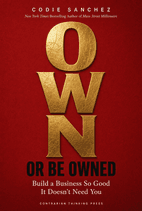
Codie Sanchez's Own or Be Owned walks owners through the pricing, positioning, and profitability traps that drain a company, from the Fear Tax to founder dependency. Built around named archetypes and the O.W.N. System, it's for busy founders whose businesses have quietly become jobs.
Feature
Insta.Page
Blinkist
Shortform
Own or Be Owned
✓
✕
✕
Summary Depth
Full Chapter-by-Chapter
15-min overview
Section-by-section guides
Audio Narration
✓
✓
✓
Visual Mindmaps
✓
✕
✕
AI Q&A
✓
✕
✕
Quizzes
✓
✕
✕
PDF Downloads
✓
✕
✓
Price
$89.99/yr
$146/yr (PRO)
$199/yr
*Competitor data last verified July 2026.
1 Page Summary
In Own or Be Owned, Codie Sanchez argues that the central challenge of ownership is not effort, demand, or even capital, but the set of choices owners avoid making: what to charge, whom to serve, what to sell, and whether the business can survive without them. Framed around the recurring tension between owning a business and being owned by it, the book walks through the pricing, positioning, and profitability traps that quietly drain a company—starting with what Sanchez calls the "Fear Tax," the cost of pricing by what competitors charge rather than what the work is actually worth. From there it moves through the discipline of choosing a specific buyer and a specific pain that pays, cutting products and services that don't fit, and paying yourself first instead of acting as the Martyr who absorbs every shortfall. Later chapters shift from money to mechanics: making the sale before the call so the offer sells itself, hiring people strong enough to replace you, promoting so customers come to you rather than renting demand through ads, and building systems—illustrated by the contrast between Sam Walton's personal touch and Walmart's IBM-driven reporting—that let the business run without the founder in the room. The closing arc asks owners to hunt their real bottleneck, choose deliberately between lifestyle, scale, or exit instead of chasing all three, and design a life before the business designs it for them.
What distinguishes the book is its diagnostic, pattern-based approach rather than a generic how-to. Sanchez organizes the material around named archetypes and failure modes—the One-Stop Shop, the Ball Hog, the Workhorse, the Optimist, the Lifer—so readers can recognize themselves in a specific trap rather than in vague advice. Each chapter pairs a recognizable owner story with a principle drawn from business history or practice, from Jeni Britton Bauer's four years of underpricing her ice cream to Jeff Bezos choosing one game at a time, Michael's glass shower company collapsing despite record growth, and Richard Branson's offer of time away that Sanchez herself declined. The tone is candid about the author's own limits: she admits she still reviews nearly every piece of content herself and says anyone claiming to have fully solved the founder-dependency problem is lying. The book also refuses to treat selling as shameful—closing is framed as the ultimate CEO skill—while insisting the goal is to be optional, not required. Notably, it does not present itself as a one-time read: the O.W.N. System begins with a score and a diagnosis of the two areas draining the business, and owners are expected to retake the diagnostic quarterly and run ninety-day sprints on their weakest areas, with the Austin gathering of a hundred owners cited as evidence the work continues past the final page.
The intended audience is owners and founders who are busy, needed everywhere, and still not making the money they expected—people whose businesses have quietly become jobs, and who may be paying themselves last while revenue climbs. It also speaks to those standing at a fork: the owner wanting lifestyle profits while reinvesting everything, the one wanting scale while protecting personal cash flow, or the one wanting an exit from a company that cannot function without them. What readers stand to gain is not a guarantee of ease but a framework for deciding what to charge, whom to serve, what to cut, and which path they have actually been choosing—measured, as Sanchez insists, by twelve months of behavior rather than stated intentions. The book's stated purpose is to make winning the ownership marathon on your own terms a little less hard, and it treats that marathon as worth running, with owners framed as a tribe of misfits who couldn't make it as employees. Its promise is conditional and honest: the system doesn't retire, and the work of diagnosing and fixing the business continues.
1. Stop Paying the Fear Tax | Pricing
Overview
Many owners get stuck between the price they think the market will accept and the profit their business needs. They stay busy. They may even be loved by customers. But money keeps leaking away. The real challenge is not effort or demand. It is deciding what to charge.
The Fear Tax
Jeni Britton Bauer opened an ice cream shop in Columbus, Ohio in 1996. She charged $5 a pint and $2 a scoop, just like the shops around her. Her flavors were unusual: cayenne chocolate, goat cheese with red cherries. For four straight years she paid herself $600 a month, under $10,000 a year. She closed in 2000. Then she ran the numbers. Each scoop of her ice cream cost four times as much to make as a regular shop's scoop. She was making high-end ice cream and selling it at fast-food prices. She reopened in November 2002. Same stall. Doubled prices. Her name on the door. Jeni's Splendid Ice Creams now does more than $100 million a year. Her mistake was assuming the shops around her knew what customers would pay.
Fear is the most expensive cost in a business. It never shows up on the books. Not raising prices because locals won't pay. Matching a competitor. Discounting to avoid losing customers. That is the Fear Tax. And it compounds. Pricing too low forces you to chase volume. You serve more people worse instead of fewer people deeper. According to the book, McKinsey found that 80 to 90 percent of mispriced products are priced too low. A 1 percent price increase lifts operating profit by an average of 11 percent.
Why Discounts Fail
Cutting price is a panic response. Push price down and customers arrive. But workload and risk go up. You make less money per customer. You need more customers. You do more service. Bed Bath & Beyond ran twenty years with no sales or gimmicks. Then a Fourth of July coupon test turned a 20 percent off coupon into an addiction. Revenue exploded. Margin collapsed. Bad management and late e-commerce finished it. But the coupon had eaten the margin first. Every store closed in 2023. The company went from a peak valuation of $17 billion to $0.
The Seven Deadly Pricing Sins
The first sin is imitation. You price within 10 percent of your competitors. The second is delusion. You use market rates, which are just what broke people agreed to charge each other. The third is surrender. You discount 30 percent or more. The fourth is hustle poverty. You are fully booked at 90 percent capacity or more, and you still cannot make rent. The fifth is hero complex. More than half your deals close only when you swoop in. The sixth is doormat work. Half your customers demand custom everything. The seventh is self-extraction. Revenue grows only when your hours do. If three or more of these apply to you, you have earned the right to raise prices.
Charlie's Golden Ticket
Charlie took a full-time media job for the insurance. He called it temporary. He stayed five years. His side business was a $5,000 coaching program for job hunters. He aimed for $500,000 a year. He cracked $50,000 and hated it. He had a publishing background. Yet he charged $10,000 to edit a book and $1,000 an hour to coach. Then an author asked for book help. He wrote a $40,000 flat-fee proposal. The author asked where to send the first payment. Eight more calls produced three yeses. They came in at $40,000, $100,000, and $250,000. More than $400,000 in weeks. He quit. He earned five times his salary in half the hours.
Value Split Pricing
Charging $1,000 a year to help people buy businesses made no sense. Forty percent of those clients had a seven-figure net worth outside their home. Value Split pricing starts with the value created and claims a slice.
Value Created x 10-20% = Your Price
Use 10 percent when unsure of the value you deliver. Use 20 percent when confident. The Compared-to-What framework answers sticker shock. An agency owner kept hearing too expensive at $5,000 a month. Then the pitch moved from effort to outcomes. From a leaking $100,000-a-year funnel to $8,000-$12,000 a month in recovered profit.
Ten Calls to 10x Your Pricing
Do not quietly raise website prices 15 percent. Here are five steps, in order.
First, set your floor and ceiling. The ceiling is the full value you create. The floor is double your current price. Your minimum benchmark ratio is 4 to 1 to 1. Of every $4 in revenue, $1 to acquire, $1 to fulfill, $2 profit.
Second, book ten calls this week. Start with your three best clients.
Third, ask three questions, then listen. Where do you want to be in twelve months? How far are you from that? What is not working, and what does it cost in dollars and hours?
Fourth, write a one-page proposal with two doors. A ceiling offer that makes your hand shake. A floor offer you want signed. Spread them 2-3x apart. Four sections: their problem, your solution, two prices, compared to what.
Fifth, send it within twenty-four hours. Follow up once after forty-eight. Do not defend the price. Ask whether too expensive means relative to expectations or to the problem. Offer Option B rather than a discount.
If all ten say no, adjust the offer and audience. Run ten more.
Key Takeaways
Underpricing is a cost you pay every month. It buys customers who each demand more of you. The problem gets worse the longer the price stays put.
The going rate in your market shows your competitors' nerve, not what buyers will accept. Set your number from the value the customer receives.
Score yourself against the seven sins. If three or more apply, take that as permission to charge more, not as a reason to work longer hours.
A discount permanently changes what you earn per customer. It adds workload and risk. Reach for a repriced offer before reaching for a coupon.
Work the ten-call sequence in order. Best clients first. A floor at double your current price. A ceiling at the full value you create. Two doors spread 2 to 3x apart. A one-page proposal inside a day. Option B instead of a discount when someone flinches.
Key concepts: 1. Stop Paying the Fear Tax | Pricing
Stop Paying the Fear Tax | Pricing
The Fear Tax
Fear is the most expensive cost in business, never on the books.
Pricing too low forces volume chasing and worse service.
80-90% of mispriced products are priced too low.
A 1% price increase lifts operating profit by 11% on average.
Why Discounts Fail
Cutting price is a panic response that increases workload and risk.
You make less per customer, need more customers, and do more service.
Bed Bath & Beyond's coupon addiction collapsed margin and led to closure.
Discounting can destroy a business even if revenue grows.
The Seven Deadly Pricing Sins
Imitation: pricing within 10% of competitors.
Delusion: using market rates set by broke people.
Surrender: discounting 30% or more.
Hustle poverty: fully booked but can't make rent.
Charlie's Golden Ticket
Charlie charged $10k to edit a book and $1k/hour to coach.
A $40k flat-fee proposal led to three yeses: $40k, $100k, $250k.
He earned five times his salary in half the hours.
Value-based pricing unlocked massive growth.
Value Split Pricing
Start with value created and claim a slice: Value Created x 10-20% = Your Price.
Use 10% when unsure, 20% when confident.
Compared-to-What framework answers sticker shock.
Shift pitch from effort to outcomes to justify higher prices.
Ten Calls to 10x Your Pricing
Set floor (double current price) and ceiling (full value created).
Minimum benchmark ratio: 4 to 1 to 1 ($4 revenue: $1 acquire, $1 fulfill, $2 profit).
Book ten calls this week, starting with three best clients.
Ask three questions: where in 12 months, how far, what's not working and cost.
The True Cost of Underpricing
Underpricing is a monthly tax that compounds over time.
It attracts demanding customers and increases workload.
The longer you delay raising prices, the worse it gets.
💡 Try clicking the AI chat button to ask questions about this book!
2. Target the 10 Buyer | Persona
Overview
Most owners serve whoever walks in, calls, or gets referred. Over time, the work becomes something they dread. They always had the choice of who gets access, but they never made it. That choice costs them, and the cost keeps growing.
The One-Stop Shop can do a little of everything for everyone, which is exactly why nobody thinks of it first. Steve Jobs said focusing is about saying no.
At seven, she threw fifty-cent steel washers at a sawed-off PVC pipe in a South Phoenix dirt park. Her grandpa told her everything costs money, and the trick is making it first. At twenty-four, in a thrift-store blazer, she sat across from a man whose watch cost more than her car. She talked to him like a person, not a wallet, and he hired her the next week.
You get to choose who you serve. A keynote review once complained the talk offered no step-by-step path for people with no money, no time, and no skills. That attendee chose to show up. An owner chooses who gets in. No prospect, no form-filler, no cousin's referral is owed access. When anyone who calls can become a client, running the business starts to feel like punishment.
Ray Dalio says assuming others think like you is one of the most common human mistakes. Owners assume buyers share their budget and their idea of what's expensive. Marketers asked what customers want just end up describing themselves. Your wallet is not your customer's wallet. That trap keeps you competing on price and hides premium buyers who will pay three to ten times more for privacy, exclusivity, or better service.
The Wallet Share Test divides what a customer spends with you by what they spend in your category overall. Below 20 percent almost always means you're underpriced. A gym owner who spends $400 a month on health but pays you $80 is underpriced. A bookkeeper who spends $1,000 a month and pays $600 is healthy.
Five signs you are targeting the wrong customer. You make excuses for them to your team. You dread their name on your phone. You play down, using about 30 percent of what you can do. They never thank you. They never refer anyone. Three or more of these means the problem is customer selection, not marketing.
Step one: define who you say no to. Charlie Munger, Buffett's partner for over forty years, made a fortune by asking what you should definitely not do, dodging the disasters, then seeing what is left. List last year's worst clients and name the patterns: the repeated complaints, the scope creep, the payment drama. Red flags include discount seekers who ask about price before value, one-time buyers who vanish, low-seriousness prospects who barter instead of paying, and boundary pushers who text at midnight and dispute charges.
Costco built a $400 billion business on refusals. A $60 annual membership just to shop. Roughly four thousand items, against a supermarket's ten to fifteen times more. And no curbside pickup, even though Sam's Club offers it.
Step two: identify your 10x customer. These customers already exist in your market. You've served a few by accident. Price is not what defines them, though they pay more. They make the business work better. They respect the work, commit, pay without drama, and refer people like themselves. Four tests decide the fit. Economic fit: they pay well and keep paying. Behavioral fit: they're easy and cheap to serve, concentrated, predictable. Results fit: they want your best work and use other vendors for the rest. Energy fit: they pay early, don't text at 9 p.m., and lift your team's day.
Premium buyers care about five things. Status: be the best, not the cheapest. Convenience: strip out friction. Exclusivity: restrict access, like TIGER 21 does by requiring $20 million to apply. Privacy: sell discretion. Scarcity: limit availability, like Ferrari making buyers wait years.
Ayman Al-Abdullah, former CEO of AppSumo, credits the 10x customer process with taking his company from $3 million to more than $80 million in annual revenue.
Step three: reject the repellents. Rejecting people is where owners choke, so keep scripts ready for four situations. Release a client with an honest note and a referral. Treat scope creep as outside the agreement and quote it separately. Answer haggling by noting the cheapest option is always available. Decline a bad-fit lead politely. The magnet avatar is ready, reliable, fitting, and energizing. The repellent is stretched, chaotic, and draining. The quickest source of more good customers is the good customers you already have.
Jon arrived at a workshop covered in stress hives. He was on his third business in five years, working eighty-hour weeks, and his marriage was coming apart. His home inspection company sold to anyone with a house key. The 12-Ps showed the Product was fine but the Persona was wrong. He renamed it Luxury Home Inspectors and led with discretion. He targeted the wealthy getting quietly divorced, executives doing quiet deals, and celebrities who did not want their names in a database. Within six months, high-end realtors and Real Housewives were calling. Revenue rose 45 percent in under a month. Margins doubled. The hives disappeared.
Key takeaways. Write your refusal list before your prospect list. Mine last year's worst engagements for the patterns. Make who you turn away a deliberate part of the business, not something that just happens to you. Price for your buyer's wallet, not your own. Design the offer around status, convenience, privacy, exclusivity, or scarcity so the premium client has a reason to pay several times what the bargain hunter will. Score your current accounts on economic, behavioral, results, and energy fit. Then shift capacity toward the few that pay cleanly, refer others like themselves, and leave your team better by the end of the day. Keep a script ready for each rejection. Release a mismatched client with an honest note and a referral. Quote scope creep separately instead of absorbing it. Answer haggling without discounting. Decline bad-fit leads politely. Ayman Al-Abdullah, the former CEO of AppSumo, ties this targeting process to growing annual revenue from $3 million to more than $80 million. That makes customer selection a growth lever, not a marketing chore.
Key concepts: 2. Target the 10 Buyer | Persona
Target the 10 Buyer | Persona
The Power of Choosing Your Customers
Most owners serve anyone, leading to dread and growing costs.
Focus means saying no, as Steve Jobs emphasized.
You choose who gets access; no one is owed your service.
Serving everyone makes business feel like punishment.
Avoiding the Assumption Trap
Owners wrongly assume buyers share their budget and values.
Your wallet is not your customer's wallet.
This trap hides premium buyers who pay 3-10x more.
Ray Dalio: assuming others think like you is a common mistake.
The Wallet Share Test
Divide customer spend with you by total category spend.
Below 20% almost always means you're underpriced.
Example: gym owner spending $400 but paying $80 is underpriced.
Healthy ratio: bookkeeper spending $1,000 and paying $600.
Signs You're Targeting Wrong Customers
You make excuses for them to your team.
You dread their name on your phone.
You play down, using only 30% of your abilities.
They never thank you or refer anyone.
Step 1: Define Who You Say No To
List last year's worst clients and identify patterns.
Red flags: discount seekers, one-time buyers, boundary pushers.
Charlie Munger: ask what you should definitely not do.
Costco built $400B on refusals: membership, limited items, no curbside.
Step 2: Identify Your 10x Customer
They pay more, respect work, commit, and refer similar people.
Four tests: economic, behavioral, results, and energy fit.
Premium buyers value status, convenience, exclusivity, privacy, scarcity.
Ayman Al-Abdullah: 10x process grew AppSumo from $3M to $80M+.
Step 3: Reject the Repellents
Keep scripts for releasing clients, scope creep, haggling, bad leads.
Best source of more good customers is your existing good customers.
3. Find the Pain That Pays | Problem
Overview
You can have a full roster of steady customers who need what you do and still not be the one they pay. Others have money to spare and no reason to hurry. The problem is telling apart the buyer who will act now from the one who never will.
A laundromat that could not sell clean clothes
The laundromat served hundreds of regular neighborhood customers at three dollars each, and not one of them actually needed it. They needed clean clothes. A delivery service aimed at wealthier customers brought in fifty to seventy-five dollars per customer per week while consuming gas, a truck and a driver.
Two thousand dollars a month in a nail salon
In a nail salon, he noticed mountains of rags and asked the owner whether she wanted to stop washing them herself. She laughed, then committed to two thousand dollars a month, priced by the pound and delivered daily. Her staff stayed after closing to do laundry, and without clean linens she could not open. She sent him to other salons, and the business doubled and then tripled. Persona gets you in the door; pain is what moves money.
The five dead ends
Owners choose the problem they enjoy solving. The market pays for something else.
Wrong wallet: the customer wants the fix, but whoever holds the money does not care.
Selling what they wish they wanted: you sell what they want to want.
Slow bleed: the cost piles up over months, so they will handle it next quarter.
Solved enough: a duct-tape fix already beats your better answer.
No receipts: neither side can show what the problem costs.
Pain you can put off and pain you cannot
Wealth is not urgency, and a larger wallet makes waiting affordable. Wanting something is not the same as needing it now, and wanting costs nothing. The real test is what breaks for the customer in the next thirty days. Pain you can put off can wait. Pain that stops the business cannot, and that is where the money is. Sell painkillers, not vitamins.
Oxygen and dessert
An oxygen business is one where the customer cannot function without you. Dessert is nice, but nobody rushes for it. For Beehiiv, a newsletter company, starting a newsletter someday is dessert. Losing eight hundred dollars a month to platform fees and churn by not migrating within thirty days is oxygen. If waiting thirty days costs cash, clout or sleep, you are selling oxygen. Show the growing cost of doing nothing in plain numbers.
Receipts: the buyer already paying
Bill Gurley, the investor behind Uber and OpenTable, told him you do not sell anyone anything; you find people who already want what you have. The hardest sale is to someone who has never spent money on the problem. The easiest is to someone already paying for a worse version of you. Three buyers:
The curious know the problem exists but hold no receipts; conversion takes months, and half never buy.
The burned tried something cheap that failed. Their receipts are small, and the first meetings undo someone else's damage.
The ready-to-pay are spending on this problem today, and the only question left is who gets next month's money.
Selection, not selling
Netflix did not sell movie night. It found people already spending on home entertainment who hated Blockbuster's late fees and thin selection, and they had receipts. Selection decides whether you are in winnable deals at all; technique wins the deals already in front of you. Two moves reposition most offers without changing the work:
Narrow the scope to where consequences are real. The laundromat's everyone gave way to commercial clients such as nail salons, spas and Airbnbs, whose operations depend on clean linens.
Find buyers who have already spent. Ask where your best customers came from and what they tried first.
What changes
Long sales cycles, heavy follow-up and constant discounting usually trace back to the problem chosen rather than the pitch. Persona says who to serve; problem says why they act. Codie Sanchez's line about poverty and delay makes the case for closing the distance between an idea and its execution. A closing worksheet puts a dollar figure on the weekly loss.
Key Takeaways
Test every prospective customer on what breaks in their world within the next thirty days if they do nothing, then put the growing weekly loss in front of them as a plain dollar figure.
Spend your selling time on buyers already paying for a worse version of what you offer; the merely curious convert slowly and the previously burned make you spend your first meetings undoing someone else's damage.
Keep narrowing the scope of the offer until failure has real consequences for the buyer, the way clean linens do for a salon that cannot open without them.
When cycles run long, discounts keep getting demanded, or follow-up never ends, change the problem you chose rather than rewriting the pitch.
Key concepts: 3. Find the Pain That Pays | Problem
Find the Pain That Pays | Problem
The Core Problem: Pain vs. Persona
Persona gets you in the door; pain is what moves money.
Wanting something is not the same as needing it now.
Test what breaks for the customer in the next 30 days.
Sell painkillers, not vitamins.
The Five Dead Ends
Wrong wallet: fix wanted, but money holder doesn't care.
Selling what they wish they wanted, not what they need.
Slow bleed: cost piles up over months, so they delay.
Solved enough: a duct-tape fix already beats your better answer.
Oxygen vs. Dessert
Oxygen business: customer cannot function without you.
Dessert is nice, but nobody rushes for it.
If waiting 30 days costs cash, clout, or sleep, it's oxygen.
Show the growing cost of doing nothing in plain numbers.
Receipts: The Buyer Already Paying
Find people who already want what you have; don't sell from scratch.
Easiest sale: someone already paying for a worse version of you.
Curious: no receipts, conversion takes months, half never buy.
Burned: small receipts, first meetings undo someone else's damage.
Selection, Not Selling
Selection decides if you're in winnable deals; technique wins deals in front of you.
Narrow scope to where consequences are real (e.g., commercial clients).
Find buyers who have already spent; ask where best customers came from.
Long cycles, discounts, and follow-up trace back to the problem chosen.
4. Cut the Menu | Product
Overview
You know exactly who you are for, what keeps them up at night, and what they would pay to fix tomorrow. Then you sit across from that buyer, and the sale still does not close. Everything about the pitch looks fine.
Dan once shut down a product that had already made customers many times their money back. He still got a lawsuit threat, angry messages, and one man tweeting about it five years later. Reopening it would teach everyone that screaming rewrites business decisions. Trying to make every customer happy fails. Cutting the dead weight and finding the product that fits is what keeps a company alive.
A tax consultant came to a workshop overwhelmed by clients. He was scaling by hiring advisors, and his margin kept shrinking. He insisted tax businesses don't scale. He was told he was slow, reactive, disorganized, and burying clients in fifty things they didn't want. So the community, the dinners, the events, and the yearlong program all went. What remained was a plan, updates, a concierge, and introductions to the client's CIO and attorney, at six figures a year. Fewer services and fewer clients took him from low five figures per client to more than $100,000, with profit up and owner hours down. What you charge follows from what you sell.
That story points to something bigger. So what is a product, really?
What a Product Really Is
The product is not the widget, the course, or the coaching. It is the promise that money makes a pain die or a pleasure spike. Every strong offer has five parts:
Promise: one sentence. "We'll double your savings from last year."
Scope: what is in, what is out.
Speed: how fast the pain stops.
Certainty: fuzzy products feel like a Fyre Festival ticket.
Trade-off: the best one makes the buyer say, "that's it?"
Principle #1: Kill Products in Decline
Dan owned a crypto trading platform, a gas station in another city, and a writing course. Two of them were unprofitable and still in beta. Several businesses under $10 million each is not a portfolio. It is a business that quietly drains your time and money while you could be building something better.
Here is how to sort them. If a product is growing, keep it and double down. If it is stable, keep it only if it is profitable and runs on systems. Otherwise, sell it or shut it down. If it is declining, end it now unless you have a turnaround plan you can execute within ninety days.
End a product when it takes 30 percent of leadership time for 10 percent of revenue, confuses your positioning, or demands a different culture or operational rhythm than the core. Google has shut down more than two hundred apps, devices, and services, Glass among them.
Principle #2: Make Speed a Guarantee
Tom Monaghan cut Domino's menu, redesigned the box to hold heat, and guaranteed thirty minutes or it's free. He was selling time, not pizza. Dropbox started as a demo video, made before the product existed.
Principle #3: Eliminate Features and Customization
McDonald's added wraps, espressos, and the McLobster through the 2010s. In 2020 it cut dozens of items, All-Day Breakfast among them, and drive-thru times fell by nearly a third. Apple's iDVD team presented weeks of work and watched Steve Jobs draw a rectangle reading "Drag your video here" plus a single BURN button.
Principle #4: Don't Be Better. Be Different.
Better exists only in comparison, so the buyer opens ten tabs and judges you alongside everyone else. A bookkeeper who serves only e-commerce brands and ships a daily profit dashboard is no longer comparable to anyone. Airbnb won because it was not a hotel. A NERF gun works by narrowing, expanding, removing, or flipping a default. Your product can do the same thing to how buyers see you.
Principle #5: Be Unscalable on Purpose
Taylor Swift runs the unscalable play better than any start-up. She studies Instagram for individual fans, learns their jokes and heartbreaks, and mails letters that reference something only that person would recognize. Small groups are invited into her homes for Secret Sessions: cookies, dancing, an unreleased album, Polaroids to take home. Those fans turn into evangelists, and their screenshots and stories scale her brand a thousandfold.
Unscalable actions are amplifiers, not the product. Handwritten notes and personal calls cut perceived risk and create moments people retell, but they only accelerate what a good product already does. If the problem is unsolved, personal touch will not hold the customer. You become the pleasant person who cannot deliver. The order is fixed:
A product that removes urgent pain, clearly and fast.
A differentiated model, the NERF gun.
Delivery that repeats, because if only you can do it, that is employment, not ownership.
Unscalable actions at the edges: the welcome moment, the first-win celebration, the unexpected check-in, the note when a milestone lands.
Magic Moments
Contrarian Thinking calls these magic moments, and they cost almost nothing. Take a pool company in its portfolio. It used to leave jargon-filled notes that clients threw away. Then it switched to a hot pool boy image with a rotating joke: "I missed you. Did you miss me?" Clients started posting the cards to Instagram.
Your Product Is the Foundation for Sales
Raising Cane's sells chicken fingers and nothing else, and has for twenty-seven years. The narrow menu makes speed, training, and margins easier. A teenager on day three can run the line. Todd Graves pitched the idea at LSU and got the lowest grade because professors said it was too narrow to work. It became a multibillion-dollar chain: roughly $5.1 billion in 2024 revenue, about $6.6 million per store, second only to Chick-fil-A in per-unit sales, according to the book. A tiny menu with monster sales per store.
PopUp Bagels runs the same subtraction: 105 shops of about 1,100 square feet, built for grab-and-go, selling hot bagels and schmear to rip and dip straight from the bag. No seats, no latte art, more than $50 million a year, and a franchise wait list said to be harder to get onto than Harvard's. When the offer is that specific, buyers stop comparing and start deciding. Sales becomes confirmation instead of combat.
Take Action, Then Hand It Off
Six things to lock in:
The offer in one sentence.
What is in and what is out, with nothing sneaking back in.
The days from yes to first relief, the moment the client thinks it is actually working.
The guarantee that makes doubt feel foolish.
The three offers being cut this quarter, removed rather than quietly deprecated.
The launch date and the first customer who sees the new offer.
The head of delivery then rebuilds onboarding so a client feels it is working within forty-eight to seventy-two hours. They also strip the cut offers from the website, proposals, and sales materials. The deliverable is a one-page onboarding flow naming hour-zero, day-one, and day-three milestones, due in five days.
The O.W.N. Checkpoint
The Orient phase is complete and its four Ps are scored. Phase two covers five more, and the lowest score is the chapter to open first:
Profit
Pitch
People
Promote
Process
Key Takeaways
Cut any offer that eats about a third of leadership attention for a tenth of revenue. Pull it from the website, proposals, and pitch materials instead of letting it linger half-alive.
Define each product as a one-sentence promise that names the pain it ends, its scope, how fast relief arrives, the guarantee that removes doubt, and the trade-off buyers accept. What you charge follows from what you sell.
Compete by being different rather than better, so buyers stop judging you side by side and start deciding.
Guarantee a delivery time and strip out customization until the menu is small enough that a new hire can run it. Speed and simplicity are what the customer is actually buying.
Save handwritten notes, calls, and surprise gifts for products that already work, and place them at first wins and milestones. Personal charm cannot cover for an unsolved problem.
Key concepts: 4. Cut the Menu | Product
Cut the Menu | Product
What a Product Really Is
Product is the promise that money makes a pain die or pleasure spike
Five parts: Promise, Scope, Speed, Certainty, Trade-off
Promise: one sentence that states the outcome
Trade-off: best one makes buyer say 'that's it?'
Principle #1: Kill Products in Decline
Growing: keep and double down; Stable: keep if profitable and systemized
Declining: end now unless 90-day turnaround plan exists
End if 30% leadership time for 10% revenue or confuses positioning
Google shut down 200+ apps, devices, and services
Principle #2: Make Speed a Guarantee
Domino's guaranteed 30 minutes or free, selling time not pizza
Dropbox started as a demo video before the product existed
Speed is how fast the pain stops
Principle #3: Eliminate Features and Customization
McDonald's cut dozens of items in 2020, drive-thru times fell by a third
Apple's iDVD simplified to 'Drag your video here' plus one BURN button
Fewer features make speed, training, and margins easier
Principle #4: Don't Be Better. Be Different.
Better invites comparison; different removes you from the comparison set
Bookkeeper for e-commerce only with daily profit dashboard is incomparable
Airbnb won because it was not a hotel
Use NERF gun: narrow, expand, remove, or flip a default
Principle #5: Be Unscalable on Purpose
Taylor Swift's Secret Sessions and handwritten notes create evangelists
Unscalable actions are amplifiers, not the product
Order: pain removal, differentiated model, repeatable delivery, then unscalable edges
Magic moments cost almost nothing and get retold
Your Product Is the Foundation for Sales
Raising Cane's sells only chicken fingers for 27 years
Narrow menu makes speed, training, and margins easier
Todd Graves got lowest grade at LSU; chain hit ~$5.1B in 2024
Second only to Chick-fil-A in per-unit sales
You've reached the end of the free chapters
Next chapter: “Pay Yourself First | Profit” is locked
Keep reading Own or Be Owned — and unlock all 600+ book summaries with audio, mindmaps and AI Q&A.
$0.00 due today · 7 days free, then $89.99/year ($7.49/mo) · Cancel anytime before day 7
Codie Sanchez is an investor, entrepreneur, and founder of Contrarian Thinking, a media and education company focused on helping people build wealth through unconventional investments like small businesses and "boring" cash-flow assets. She is the author of "Main Street Millionaire" (2024), a guide to buying and growing small businesses, and previously spent over a decade in finance, including roles at Goldman Sachs and as a partner at a private equity firm. She is also known for her newsletter and social media content on investing, business acquisitions, and financial independence.
Frequently Asked Questions about Own or Be Owned
What is Own or Be Owned about?
It is a practical guide for business owners who want to stop being owned by their company and start owning their time, profit, and future. Across chapters, it covers pricing without fear, choosing the right buyers, finding painful problems people pay to solve, cutting bloated offers, paying yourself first, and building sales, hiring, marketing, and process systems that work without the founder. Later sections help owners choose between lifestyle, scale, or exit, protect their personal lives, and use a diagnostic system to fix the weakest parts of the business in 90-day sprints.
Who is the author of Own or Be Owned?
Codie Sanchez is an entrepreneur and owner who draws on her own experience building and running companies, including a seven-figure business she admits she struggled to step away from. She shares stories from her work with owners, her travels for deals, and her conversations with figures like Richard Branson, and she is candid that she still reviews much of her own content. Her perspective comes from both personal scars and the patterns she has seen across many businesses.
Is Own or Be Owned worth reading?
It is worth reading for owners who feel busy but not profitable, because it turns vague stress into specific problems to diagnose: pricing fear, cash leaks, founder-dependent sales, and hiring that never delegates. The chapters mix memorable case studies with blunt questions and actionable frameworks, so readers can identify their weakest area and work on it immediately. If you want a business that runs without you—and a life that survives the building of it—this is a useful, direct guide.
What are the key lessons from Own or Be Owned?
Key lessons include charging based on the value and cost of what you actually deliver instead of copying competitors, and choosing a specific buyer whose painful problem is worth paying to solve now. Owners should cut services and products that drain focus, pay themselves first while plugging cash leaks, and build sales, hiring, and process systems that make the founder optional. The later chapters stress hunting the real bottleneck, choosing one path—lifestyle, scale, or exit—rather than chasing all three, and designing your personal life before the business consumes it. The O.W.N. System ties these together by scoring the business, diagnosing the two Ps that drain it, and running 90-day sprints to improve.
📚 Explore Our Book Summary Library
Discover more insightful book summaries from our collection