As an Amazon Associate, we earn from qualifying purchases.
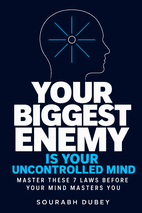
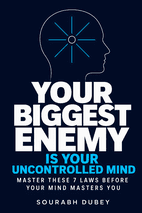
What is the book Your Biggest Enemy Is Your Uncontrolled Mind about?
Sourabh Dubey's Your Biggest Enemy Is Your Uncontrolled Mind maps seven laws—perception, belief, focus, discipline, emotional regulation, influence, and neuroplasticity—to show how the mind's unnoticed constructions create suffering, offering frameworks rather than quick fixes for readers stuck in the gap between knowing and doing.
Feature
Insta.Page
Blinkist
Shortform
Summary Depth
Full Chapter-by-Chapter
15-min overview
Section-by-section guides
Audio Narration
✓
✓
✓
Full access to all 700+ summaries
✓
✓
✓
Visual Mindmaps
✓
✕
✕
AI Q&A
✓
✕
✕
Missing a book? Request it, usually live within 48h
✓
✕
✕
Quizzes
✓
✕
✕
PDF Downloads
✓
✕
✓
Send to Kindle
✓
✓
✓
Price
$89.99/yr
$146/yr (PRO)
$199/yr
*Competitor data last verified July 2026.
1 Page Summary
Sourabh Dubey's Your Biggest Enemy Is Your Uncontrolled Mind argues that suffering and stagnation rarely come from external circumstances but from the mind's unnoticed constructions—the interpretations, beliefs, and habitual patterns it mistakes for reality. Across seven "laws," Dubey maps how perception filters experience (the Law of Perception, illustrated by the viral dress illusion and two coworkers who interpret identical jobs oppositely), how absorbed beliefs become self-fulfilling "performance scripts" (the Law of Belief), and how attention has become a scarce, engineered commodity (the Law of Focus). The remaining laws address why discipline fails when willpower is asked to overcome high startup costs, why emotions must be intercepted between bodily sensation and the story the mind invents (the Emotional Loop), how social environments silently reset what feels normal, and how neuroplasticity means the brain installs whatever is repeated rather than what is intended. The conclusion frames all seven as a single system, with awareness—seeing the construction as learned rather than fixed—as the only starting requirement.
What distinguishes the book is its insistence on mechanism over motivation. Rather than urging readers to try harder, Dubey repeatedly redirects blame away from character: distraction is a contested resource, not a willpower defect; emotional reactions are biology preceding thought, so intervening at the level of story is too late; and the marshmallow test's lesson is that delay is engineered, not inherited. The chapters lean on compact teaching stories and cultural touchstones—Arjuna's archery lesson on focus as subtraction, the dress photograph, the marshmallow experiments, a girl who lost a hemisphere and relearned to speak—to make each law concrete. The tone is diagnostic: the mind is presented as an automatic executor of scripts, and the reader's task is to see the machinery clearly enough to stop mistaking it for reality.
The intended audience is anyone who has resolved to change and found themselves returned to the same baseline—people frustrated by distraction, procrastination, emotional reactivity, or the gap between knowing and doing. The book offers frameworks rather than quick fixes, and its payoff is conceptual clarity: readers come away with a shared vocabulary (Performance Script, the Emotional Loop, startup cost) for spotting where change actually breaks down, along with the conclusion's sober emphasis that understanding is worthless without choosing what to do tomorrow. It is best suited to readers who want a structured, mechanism-focused account of self-mastery rather than inspiration alone.
1 The Law of Perception
Overview
People treat their perception as a direct report of reality, then suffer, argue, and make decisions as if their version were the only accurate one. The trouble is that certainty feels identical whether the view is clear or distorted, leaving no obvious way to tell which convictions are worth trusting.
Suffering usually comes less from events than from the meanings the mind assigns to them, and people defend those meanings as if they were facts. This is the Law of Perception: the mind reacts to how it interprets things, then treats that interpretation as reality.
The Dress and the Job
In 2015 a photograph of a dress split the internet between blue-and-black and white-and-gold viewers. The dress was blue and black, but many brains, working from the same pixels, inferred different lighting and therefore different colors. A first job offered a second test. Six months of misery made the boss seem like a nightmare, coworkers fake, and the work soul-crushing. Then Nikhil, who had started two months later at the same company, same title, same kind of projects, said he was learning a lot and liked his team. The raw material was shared; the interpretations were not.
Feedback became criticism or mentorship.
Professionalism became fakery or support.
Challenging work became proof of inadequacy or a chance to learn.
The mind had gathered evidence for the story it already believed. A week of noticing what had been filtered out changed the experience while the job stayed the same.
The Storytelling Brain
The brain does not record reality the way a camera does. It receives partial sensory data and fills gaps with assumptions, predictions, and past patterns. The optic nerve creates a blind spot, yet vision feels seamless because the brain invents what is missing. In the Invisible Gorilla experiment, viewers counted basketball passes while a person in a gorilla suit crossed the frame, beat their chest for nine seconds, and left. About 50 percent did not see it. Their eyes registered the gorilla, but the brain filtered it as irrelevant before conscious awareness. Perception deletes material and hides the deletion.
Perception Debt
Repeatedly assigning unchecked meaning creates Perception Debt. Each unexamined interpretation, each reaction to a story rather than an event, compounds quietly. People wake up anxious, resentful, or stuck and blame circumstances, when the load is years of built-up misunderstandings. Therapy is slow partly because the work is not just solving present problems but paying down those misunderstandings. There is no way to declare bankruptcy on perception; the debt is paid by questioning automatic meanings and learning to see differently.
The Emotional Hijack Threshold
The Emotional Hijack Threshold is where perception shifts from reporting to advocacy. Below it, a three-hour silence after a text can mean “they’re busy.” Above it, the same fact becomes “they’re ignoring me on purpose,” supported by selective memory and old hurts. Once emotion hijacks perception, the mind builds a case for the reaction, so logic cannot easily undo it. The useful move is to catch the crossing before it happens.
Catching the crossing before it happens still leaves a deeper question. Who installed the lens in the first place? The distortion is not only a private habit of interpretation. The lenses were put in place before the person could think independently, which is why perception feels personal and self-authored when it is neither. Belief is the program running underneath. That order is the practical point: before seeing the world differently, a person has to change what is believed about it.
The Lens You Did Not Choose
Perception presents itself as a direct readout of reality, so the equipment disappears from view. But the lens was not selected by the person using it. The question is less whether the lens distorts than who supplied it. This is a different problem from catching one biased reading. A headline such as being stuck, or whether people are for you or against you, filters everything noticed after it. An honest label for that headline is the first move toward deciding whether it was selected or received. Because the installation happened early, the resulting view feels like plain fact rather than a viewpoint. The task is not to replace one self-made story with a more flattering one. It is to recognize that the existing story arrived from somewhere else, and that its origin can be examined.
Someone Else Is Still Pressing Your Buttons
The internal voice that denies your capability did not begin with you. It has been heard so often that its owner stopped being noticeable. Repetition wears away the seam between what was said and what is now assumed, until an external message speaks in the first person. Hearing it again as a voice, with an origin outside the self, changes what can be done with it. The claim "you cannot" becomes a statement with a source rather than a report on reality. Once the source comes back into view, the claim can be questioned instead of obeyed, and the belief underneath perception can begin to change.
Key Takeaways
Your reaction answers your interpretation rather than the event, and the same facts can carry an opposite meaning for someone standing next to you.
What feels like a fresh present-day problem often carries years of unchallenged interpretation on top of it, so the anxiety or resentment is old weight carried forward, not a response to what is happening now.
Once emotion crosses into advocacy, reasoning only strengthens the case already built, which makes the moment before the crossing the only useful place to intervene.
The more consequential question about your lens is not whether it bends reality but who supplied it, because a view installed early presents itself as plain fact rather than as a viewpoint.
The internal voice that rules out your capability is a repeated external statement that lost its source; restoring the source turns it from a report on reality into a claim that can be disputed.
Key concepts: 1 The Law of Perception
1 The Law of Perception
The Law of Perception
Mind reacts to interpretations, then treats them as reality.
Certainty feels identical whether perception is clear or distorted.
Suffering comes from assigned meanings, not events themselves.
Same Input, Different Interpretations
The Dress: identical pixels, different perceived colors.
Same job, opposite experiences: nightmare vs. learning opportunity.
Mind gathers evidence for the story it already believes.
The Storytelling Brain
Brain fills sensory gaps with assumptions and past patterns.
Invisible Gorilla: about 50% missed the gorilla entirely.
Perception deletes material and hides the deletion.
Perception Debt
Unchecked interpretations compound quietly over years.
People blame circumstances for accumulated misunderstandings.
Debt is paid by questioning automatic meanings.
The Emotional Hijack Threshold
Above threshold, perception shifts from reporting to advocacy.
Emotion builds a case for the reaction, resisting logic.
Catch the crossing before it happens.
The Lens You Did Not Choose
Lens was installed early, before independent thought.
Internal critical voice originated outside the self.
Repetition blurs the seam between said and assumed.
Seeing the source lets the claim be questioned, not obeyed.
💡 Try clicking the AI chat button to ask questions about this book!
2 The Law of Belief
Overview
You can decide to change your results and still find yourself returned to the same baseline, again and again. What do you do when the obstacle is not the work in front of you but something already operating inside you that you cannot see clearly enough to name?
The voice that polices your limits is often not yours. It speaks in your tone, but its lines came from parents, teachers, a classmate's laugh, a boss, or a culture's rules about what people like you can do. Beliefs generate the behavior that makes them seem true.
The Performance Script
A Performance Script is a belief the mind executes as an instruction. Someone who believes public speaking is a weakness is not just holding an opinion. The mind:
scans for evidence that confirms the belief,
filters out evidence that contradicts it,
activates anxiety when speaking is required,
lowers confidence to match the expected performance,
produces behavior that fulfills the prediction.
The script runs automatically, so people keep changing results while the underlying instruction pulls them back to baseline.
The Dojo Test
A martial arts master switched the belts of two students: a beginner wore black, and a real black belt wore blue. For three weeks, the beginner in black received cautious respect; his strikes became cleaner, his confidence grew, and he learned faster. The actual black belt in blue was attacked more aggressively, began hesitating, and lost sharpness. The cloth did not change performance; belief did, including everyone else's. This is the expectancy effect: people rise or sink to their self-concept.
Langer's Time Machine
In 1979, psychologist Ellen Langer rebuilt 1959 inside a monastery and asked eight men in their seventies and eighties to live as their younger selves for seven days, discussing 1959 in the present tense and their careers as ongoing. Posture, flexibility, grip, memory, vision, and hearing improved; some walked without canes. No medication or therapy was involved. The change came from removing instructions that told their bodies to decline.
Three Lies
"I'm just being realistic" is selective noticing: it counts evidence for limitation and discounts evidence against it, then calls the conclusion wisdom.
"This is just how I am" converts a current habit into permanent identity, so any change feels like a contradiction.
"I know my limits" mistakes old boundaries for current truth. A teacher's "weak writing skills" note at fifteen became a seven-year belief that ended only at twenty-two.
The Belief Loop
Belief shapes what you notice and how you interpret it.
Interpretation drives thought and feeling.
Thought and feeling drive action.
Action produces results that confirm the belief.
A person who believes in bad luck notices setbacks, tries less, gets weaker results, and calls that proof. A person who believes action creates luck notices opportunities, takes more shots, and gets more confirmations. Beliefs cluster into a mindset, the filter through which everything is read. Stanford psychologist Carol Dweck calls a fixed mindset the belief that ability is set; a growth mindset treats ability as developable. Two coworkers passed over for promotion show the difference: one hears a verdict and withdraws, the other seeks feedback, builds missing skills, and is ready for the next opening.
Installed Scripts
Limiting beliefs are often installed before critical filters exist: a parent's line about money, a teacher's label, a partner's charge of oversensitivity. One professor's remark that the writing was "technically correct but lacks personality" governed the writing for years. The test is whether a sweeping judgment is true or merely someone's perception. An installed belief keeps running until it is replaced.
The installation method uses first-person, present-tense statements that describe concrete behavior rather than broad affirmations. A person might write that they begin difficult tasks within two minutes of sitting down. Nothing mystical is involved. The writing is timed to the brain state at sleep onset, when the subconscious is most open. Stanford sleep researcher Matthew Walker's work links memory consolidation and pattern installation most strongly to that transition, so new material goes in just before consolidation begins.
The Bridge to Focus
Every focus technique, every system, every attempt to remove distraction can fail under a single belief: that one is simply not a focused person. That belief sabotages the rest. Experience follows perception, and perception is filtered by belief, so changing experience requires changing belief first. Focus is not primarily technique or time management. It is directing attention toward what seems possible. If something does not seem possible, attention will not go there. If capability is doubted, focus will not survive difficulty. If the matter is judged unimportant, focus drifts.
Before the next chapter can help, name the beliefs about yourself that need to change. Record them, interrogate them, and swap them for better ones. The moment change becomes believable, change has begun. That is the Law of Belief.
Sit With These
What have you never attempted not because you tried and failed but because you decided in advance it was not for someone like you, and where did that decision come from? The question exposes certainty that masks a limiting belief.
What would you attempt, change, or pursue if failure were information rather than a verdict on your worth? Most people know what they want. The blocking belief makes failure mean something about identity, and separating desire from that belief makes it examinable.
Which beliefs about yourself formed during pain or humiliation, and have you checked whether that moment was a reliable source of truth? Beliefs formed in intense emotion are durable and often inaccurate because the brain encodes them as important, though importance is not accuracy.
If your most limiting belief turned out to be something someone else needed you to believe for their comfort or convenience, how would that change how you carry it? The question points to ceilings installed by people who benefited from your staying small, perhaps a parent who feared independence or a partner who needed you lesser. It asks whether the belief ever belonged to you.
Attention, Not Time
Time is not the resource that runs out. Attention is. Unlike time, attention has no visible clock and no record of where it went. It drains, and people blame themselves for laziness.
Key Takeaways
Name the belief behind any result you keep reproducing, and check whether its author was you or someone whose comfort depended on your limits.
Judge a self-belief by where it came from: a sweeping verdict delivered in a moment of humiliation, or handed to you before you could question it, is someone's perception rather than a fact about your capacity.
Swap the old instruction for a present-tense, first-person line describing one concrete behavior, and write it in the minutes before sleep, the window Matthew Walker identifies as when new material consolidates most readily.
Treat your self-concept as something other people read and react to, not a private opinion, so raising it changes how you are handled as well as how you perform.
Settle whether you are capable of focus before adopting any technique or system, because attention will not travel toward an outcome you have already ruled out.
Key concepts: 2 The Law of Belief
2 The Law of Belief
The Performance Script
Beliefs act as automatic instructions the mind executes.
Script scans for confirming evidence, filters out contradictions.
Activates anxiety and lowers confidence to match prediction.
Produces behavior that fulfills the belief, pulling back to baseline.
Expectancy Effect
Dojo test: swapped belts changed performance via belief.
People rise or sink to their self-concept.
Langer's Time Machine: men lived as younger selves, improved physically.
Change came from removing instructions that told bodies to decline.
Three Lies of Limitation
"I'm just being realistic" is selective noticing of limitations.
"This is just how I am" turns habit into permanent identity.
"I know my limits" mistakes old boundaries for current truth.
The Belief Loop
Belief shapes what you notice and how you interpret it.
Interpretation drives thought, feeling, and action.
Action produces results that confirm the belief.
Beliefs cluster into a mindset (fixed vs. growth).
Installed Scripts
Limiting beliefs installed before critical filters exist.
Test whether a sweeping judgment is true or someone's perception.
Replace with first-person, present-tense statements of concrete behavior.
Write at sleep onset when subconscious is most open.
Bridge to Focus
Belief that one is not focused sabotages all techniques.
Experience follows perception, filtered by belief.
Focus is directing attention toward what seems possible.
Name and swap beliefs before focus techniques can work.
Record, interrogate, and replace limiting beliefs.
The moment change becomes believable, change has begun.
3 The Law of Focus
Overview
Anyone who has tried to fix their distraction with more discipline has hit the same wall and blamed themselves. Something other than weak willpower is at work, and no amount of effort aimed at the wrong target will move it.
Focus is not a trait but a contested resource. Attention has been engineered into a market, and steady focus is now the scarce competitive edge. According to the book, the average person switches tasks every forty seconds and checks a phone more than a hundred times a day. Six months of genuine focus would put someone ahead of ninety-five percent of people, not because of intelligence but because consistency has become rare.
The Archer's Eye
The ancient Indian prince Arjuna trained under Dronacharya. Drona placed a wooden bird in a tree and asked each student what he saw before shooting. One saw the tree, branches, and bird. Another saw the bird and branch. Both were dismissed. Arjuna saw only the bird's black eye. He was not faster or stronger. He had learned to hold his mind on one thing and ignore the rest. Focus is subtraction, not accumulation.
The Attention Auction
When an app opens, data about a user's demographics, interests, location, and recent behavior goes to an ad exchange within milliseconds. Advertisers bid in real time, the winner pays the platform, and an ad appears. The user is not the buyer. The user is what gets sold. The book cites Facebook's average revenue per user in North America at about $60 a year. A former product designer described the intermittent reinforcement schedule borrowed from rat studies: predictable food pellets produce normal pressing, while random pellets produce compulsive pressing beyond hunger. Social feeds run on the same uncertainty. At a marketing conference, a case study showed that emotionally provocative content placed before targeted ads raised click-through rates by thirty-seven percent. Anger, fear, and anxiety helped because strong emotion lowers critical thinking. The book describes dopamine as a prediction-error signal, so anticipation, not the reward itself, drives the check.
Attention Debt
Interruptions cost more than their duration. UC Irvine researchers found that returning fully to a task takes an average of twenty-three minutes, because working memory and context must be rebuilt. Even expecting interruption worsens performance. In a personal test, a week with the phone in another room produced forty percent more work, and better quality, than a week with it face-down and silent on the desk. The monitoring load alone consumes attention. This compound cost is Attention Debt: recovery time, vigilance for future disruptions, and repeated practice at task-switching instead of sustained focus.
Willpower and Environment
Willpower is metabolically expensive. Ego depletion research finds that self-control in one domain reduces it in unrelated ones, and a nearby phone demands hundreds of micro-resistances per hour. The solution is environmental design: put devices in another room, use blockers, delete addictive apps, and remove access rather than resist it. Dan Ariely's research is cited for the pre-commitment letter, a three-sentence contract with a future self about the work, its importance, and the cost of quitting.
What Works
The prescription has three non-negotiable parts:
Seven-Day Neurochemical Reset: remove social media, recreational internet, video games, streaming, junk food, porn, and music, then replace them with reading, walking, work, cooking, conversation, and boredom. Withdrawal dominates days one to three. By days four to seven, ordinary activities regain interest as the dopamine baseline recalibrates.
Attention Monastery: physical separation, digital blockers, a location reserved for deep work, and output tracking rather than hours.
Kill Switch Protocol: social media only on weekends, desktop-only access, and no phone in the bedroom.
Minimum Requirements
No phone in the bedroom, ever: buy an alarm clock. This improves sleep and removes the first-morning dopamine hit that sets the day's tone. Notifications stay off except calls and texts from close contacts; a like or comment is attention capture wearing the costume of connection, not urgency. One ninety-minute focus block daily is scheduled and treated as unmissable, not left for spare time. These are minimum requirements for a functional attention system in the current environment, not suggestions. Without them, complaining about focus is not a problem being solved.
Implementation Intentions
Implementation Intentions replace deciding to focus with an if-then plan: if it is 7am and I am at my desk with coffee, then I open the document and write for ninety minutes without checking anything. Peter Gollwitzer's research at NYU, across 94 studies, found this raises follow-through by 200 to 300 percent over intention alone. The format pre-encodes an automatic response to a cue, so behavior fires before the brain negotiates. The start becomes automatic.
The Monthly Attention Audit
Once a month, run an Attention Audit. For one week, track where attention actually goes, not where it is assumed to go, using screen-time data or RescueTime. Most avoid this because they do not want to see their capture; they prefer believing they are reasonably good at focus to confronting 150 phone checks a day and an inability to sustain attention past twelve minutes. The audit is information, not punishment. Unseen patterns cannot be repaired.
The Decision
If implemented, focus stops being a battle and becomes the default. Work that demanded willpower becomes engaging, and attention gathers into directed capacity. Dozens who did the reset and built the monastery describe a shift so large they cannot believe the time they wasted. Most will nod and change nothing. Doing what works requires discomfort, and comfortable distraction wins. Steve Jobs's point was that focus is mostly refusal: saying no to the hundred other good ideas rather than yes to the one in front of you. If you will not act, stop pretending to care about focus. You are choosing distraction, so own it. If you are serious, the Law of Focus means understanding the mechanisms, removing the attack vectors, and taking attention back.
Bridge: Self-Discipline
Focus alone fails. You can design the perfect environment, remove every distraction, and build systems for deep work, then watch progress halt when novelty fades. Focus gives clarity about the path, not the engine to keep walking when it becomes boring, repetitive, or painful. Resistance spikes, monotony drifts attention, fatigue abandons the system. Focus manages immediate clarity; self-discipline manages consistency over time. Without internal mechanics to force action when motivation runs dry, perfect conditions produce nothing. The next law addresses how the brain discounts long-term rewards and how to execute when you do not feel like it.
Sit With These
If every minute of the last seven days were tracked, what would attention be building, and is that what you say you want? Behavior exposes the gap between priorities and attention; what you repeatedly attend to is what you build.
What one thing, given four uninterrupted hours a day for six months, would most change your life, and what has been getting those hours instead? Attention is always spent, so the trade-off is visible.
What does your environment make effortless that you wish it made harder, and hard that you wish it made effortless? It works for you or against you.
What would you stop consuming for thirty days so your mind could show its full capacity? Most mistake current fragmented thinking for a ceiling when it is a floor.
The Ghost Habit
The most dangerous habit is the one still being performed after belief has left. The motions continue, but conviction is gone. Your routine continues without you.
Key Takeaways
Treat attention as a resource you spend deliberately, not a personality trait you either have or lack; the environment around you determines most of where it goes.
Design your surroundings so that focus is the path of least resistance, because resisting a device within reach costs more willpower than most people can sustain across a day.
Pre-encode your focus blocks as if-then plans tied to a specific time and place, since Gollwitzer's research found this format raises follow-through by 200 to 300 percent over deciding to focus in the moment.
Schedule one ninety-minute block daily as unmissable and keep the phone out of the bedroom, then treat these as baseline requirements rather than aspirations.
Audit where your attention actually goes each month, because you cannot repair a pattern you have never seen measured.
Key concepts: 3 The Law of Focus
3 The Law of Focus
Focus as a Scarce Resource
Attention is a contested market, not a personal trait.
Average person switches tasks every 40 seconds, checks phone 100+ times daily.
Six months of genuine focus puts you ahead of 95% of people.
Consistency, not intelligence, is the competitive edge.
The Archer's Eye: Focus as Subtraction
Arjuna saw only the bird's eye, ignoring everything else.
Focus is subtraction, not accumulation.
Success comes from holding mind on one thing and ignoring rest.
The Attention Auction: How You Are Sold
User data is auctioned in milliseconds to advertisers.
Attention Monastery: physical separation, digital blockers, deep work location, output tracking.
Kill Switch Protocol: social media only on weekends, desktop-only, no phone in bedroom.
Minimum Requirements & Implementation
No phone in bedroom ever; buy an alarm clock.
Notifications off except calls/texts from close contacts.
One 90-minute focus block daily, scheduled and unmissable.
Implementation intentions (if-then plans) raise follow-through by 200-300%.
4 The Law of Self-Discipline
Overview
Almost everyone knows what they should be doing, and many can even carve out the attention to do it. The breakdown happens at the moment of starting: the work is uncomfortable, the reward is far away, and the will to push through turns out to run out quietly.
Focus Is Not Discipline
People act on what their surroundings, energy levels, and self-image make easiest, not on their intentions. Attention can be reclaimed, distractions removed, and still nothing important gets done. Focus directs attention; discipline directs it toward what is uncomfortable, boring, or slow to pay off and keeps it there. This isn't about being a good or bad person. Walter Mischel's Stanford marshmallow test in the 1960s showed children waiting 15 minutes for a second marshmallow did not simply out-willpower others. They covered their eyes or turned away. Follow-up found those children later had higher SAT scores, better health, careers, and relationships. The lesson: delay is engineered, not inherited.
The Discipline Equation
Every behavior carries a startup cost, the effort to begin and keep going. Scrolling is near zero; writing a difficult chapter is high; going to the gym when tired is very high. The brain compares effort with reward and heavily discounts delayed rewards; immediate rewards are valued roughly ten times more. Willpower loses to this calculation. Self-discipline means choosing the long-term want over the immediate one. The Discipline Equation is Likelihood of Action = (Perceived Reward - Effort Required) / Delay to Reward. Three levers move this equation: raise the perceived reward, lower the effort required, and shorten the delay to reward. Most people pull only the reward lever and fail.
What Blocks the Trade
Resistance often comes from the brain itself: the comfort zone treats anything unfamiliar as a threat. Dopamine conditioning from apps trains the brain to expect rewards in seconds. Procrastination is a con that preserves the feeling of commitment without the work. Fear of failure is a simulation that feels real. Perfectionism hides fear behind high standards. Inconsistency comes from willpower that runs out and systems that are missing.
Three Core Interventions
The Ten-Minute Rule: commit to ten minutes, then stop guilt-free. Starting is the hard part, and about 70% continue. It lowers the startup cost.
Temptation Bundling: pair a should with a want, only allowing the want during the should. Katherine Milkman's gym-and-audiobook study raised attendance by 51%.
Environment Design: move the phone, lay out gym clothes, keep junk food out. Make good behavior easy and bad behavior effortful.
A related exercise asks people to identify the exact moment their last five discipline failures stopped.
Identity and Energy
Outcome goals, such as losing 20 pounds, get discounted. Identity goals, such as "I am a writer," make the next action a question of alignment. But identity must be earned through action; it follows repeated behavior, not declaration. You can borrow a disciplined identity for 20 to 40 minutes by reading how a role model thinks before a task. Energy is the ceiling: according to the book, the brain uses 20% of the body's energy and the prefrontal cortex loses capacity as it depletes.
Peak hours (6-10 AM): most important work, phone elsewhere, no meetings or email.
Recovery hours (after 6 PM): no discipline-requiring tasks.
This protects the limited energy that discipline depends on.
Failure Is Part of the System
"Energy, not time, is the fundamental currency of high performance," in Tony Schwartz's phrase. Discipline likewise is not perfect execution on every goal but the capacity to do hard things when they matter, more often than not. Skipped gym sessions, abandoned projects and slides back into old patterns are expected, and they recur regularly rather than rarely. What has changed is that a single miss no longer wrecks the system: one missed morning is grounds for starting again the next day, not for abandoning the routine. Discipline, properly defined, is the ability to start again after failing, consistently, without drama or self-judgment. Most people assume it means never failing, so the first failure becomes proof of the verdict "I don't have discipline," and they quit entirely.
You Will Do What Is Easiest
This is the Law of Self-Discipline: you will do what your environment, energy and identity make easiest, not what you intend. So stop intending and start engineering. The three levers are the familiar ones: cut the startup cost, engineer immediate rewards, design the environment. Every day they go unused, the opposite lesson is being trained, that comfort outweighs goals, that ease beats meaning, that immediate pleasure trumps long-term fulfillment. The training never stops. The only question is what it is for.
Emotion Outranks the Systems
You can perceive clearly, believe powerfully, focus intensely and act with discipline, and still sabotage all of it through one unregulated system. Anger produces words you regret, fear avoids necessary risk, sadness paralyzes, anxiety scatters focus. When emotion takes over at the wrong moment, discipline evaporates. Emotion moves faster than thought, outranks belief and can override every system in seconds, which is why emotional regulation is the next law.
Five Questions
Where exactly does discipline break down: not the general reason but the precise moment it fails every time, and what single change to that moment would let everything else follow? Breakdowns are almost never about character; they land at a predictable point in a sequence, so locating the mechanical failure locates the fix.
Which goal has never received one irreversible move, and what does that reveal about wanting it versus liking the idea of it? Telling someone, paying for something, deleting the alternative: commitment shows in ways intention cannot.
What version of yourself do you keep promising is coming, and what evidence from the last 90 days shows it is actually on the way? The future self arrives through actions taken today, not through time passing.
Which comfort are you protecting so carefully that it is quietly costing you the life you say you want? Every undisciplined pattern shields something specific, sleep over the discomfort of morning, temporary peace over necessary conflict.
If the person you most want to become watched how you spent this week's time and energy, what would they think and what would they change first? The distance between present and intended self becomes information, and it slips past self-justification.
Suppression Changes the Exit Point
Suppression does not eliminate emotion. It relocates where the emotion comes out. What you refuse to feel does not vanish; it returns as anxiety, as numbness, as behavior you cannot explain, as an argument that had nothing to do with its stated subject.
Key Takeaways
Diagnose the precise point where a discipline routine collapses, then alter that moment instead of renewing a general vow to do better.
Lower the cost of starting, tie an obligation to something you actually want, and arrange the room so the right action takes fewer steps than the wrong one.
Place demanding work in your strongest energy hours and keep low-capacity hours for tasks that do not require much self-command.
Act your way into the identity you want, then audit the past ninety days for proof that the person you describe is actually being built.
Prepare to resume after a missed day without treating the miss as a verdict, and treat emotional regulation as part of the system, since a surge of anger or fear can undo every other safeguard.
Key concepts: 4 The Law of Self-Discipline
4 The Law of Self-Discipline
Focus vs. Discipline
Focus directs attention; discipline keeps it on uncomfortable, slow-reward tasks.
Marshmallow test: delay is engineered, not inherited.
Children who waited used strategies like covering eyes or turning away.
The Discipline Equation
Likelihood of Action = (Perceived Reward - Effort) / Delay to Reward.
Brain discounts delayed rewards; immediate rewards valued ~10x more.
Three levers: raise reward, lower effort, shorten delay.
What Blocks the Trade
Comfort zone treats unfamiliar as threat.
Dopamine conditioning from apps expects instant rewards.
Procrastination, fear of failure, perfectionism, and inconsistency undermine discipline.
Three Core Interventions
Ten-Minute Rule: commit to 10 minutes; ~70% continue.
Temptation Bundling: pair a should with a want; gym study raised attendance 51%.
Environment Design: make good behavior easy, bad behavior effortful.
Identity and Energy
Identity goals ('I am a writer') beat outcome goals.
Identity must be earned through repeated action.
Energy is the ceiling; schedule tasks by peak, mid, low, and recovery hours.
Failure and Redefinition
Discipline is the ability to start again after failing, without drama.
One missed morning is grounds to restart, not quit.
Energy, not time, is the fundamental currency of high performance.
The Law and Emotion
Law: you do what environment, energy, and identity make easiest.
Stop intending; start engineering the three levers.
Emotion outranks systems; regulation is the next law.
You've reached the end of the free chapters
Next chapter: “5 The Law of Emotional Regulation” is locked
Keep reading Your Biggest Enemy Is Your Uncontrolled Mind — and unlock all 700+ book summaries with audio, mindmaps and AI Q&A.
$0.00 due today · 7 days free, then $89.99/year ($7.49/mo) · Cancel anytime before day 7
plus sales tax where applicable
More ways to explore Your Biggest Enemy Is Your Uncontrolled Mind
Sourabh Dubey is an author and technology professional whose work focuses on software engineering, cloud computing, and modern development practices. He has written on topics such as DevOps, programming, and emerging technologies, drawing on his hands-on experience in the tech industry. His writing aims to make complex technical subjects accessible to developers and practitioners.
Frequently Asked Questions about Your Biggest Enemy Is Your Uncontrolled Mind
What is Your Biggest Enemy Is Your Uncontrolled Mind about?
It explores seven 'laws' that quietly shape how the mind works: perception, belief, focus, self-discipline, emotional regulation, influence and association, and neuroplasticity. Through stories like the blue-and-black dress, Arjuna's archery test, and the marshmallow experiment, it shows how the mind interprets events, absorbs outside beliefs, loses attention to engineered distractions, and repeats whatever it practices. The core argument is that people mistake this mental construction for reality, and that recognizing it as learned rather than fixed is the starting point for real change. The closing chapter ties the seven laws into a single system, with awareness as the one requirement for breaking out of old patterns.
Who is the author of Your Biggest Enemy Is Your Uncontrolled Mind?
Sourabh Dubey writes in a practical, story-driven style, drawing on everyday experiences such as a draining group chat, a miserable first job, and a friend who drifted into fitness culture. He blends these personal observations with research like Walter Mischel's Stanford marshmallow test and classical tales such as Arjuna and Dronacharya. The result is an approachable voice that explains psychological ideas through scenes readers can recognize in their own lives.
Is Your Biggest Enemy Is Your Uncontrolled Mind worth reading?
It is worth reading because it turns vague self-help advice into concrete mechanisms you can actually observe in yourself, from the performance scripts that keep pulling you back to baseline to the emotional loop that hijacks your reactions. The examples are memorable and grounded in ordinary life rather than abstract theory, making the ideas easy to apply the next day. Readers who feel stuck despite knowing what they should do will find a useful map of why, and a realistic place to start.
What are the key lessons from Your Biggest Enemy Is Your Uncontrolled Mind?
The mind is an interpreter, not a recorder, so suffering often comes from the meanings you assign to events rather than the events themselves. Beliefs act like scripts that generate the behavior confirming them, and the voice policing your limits usually originated with other people. Focus is subtraction rather than accumulation, and discipline is about lowering the startup cost of uncomfortable work instead of waiting for willpower. Lasting change comes from what you repeat, not what you intend, and your surroundings and associations reset what feels normal without your noticing.
📚 Explore Our Book Summary Library
Discover more insightful book summaries from our collection