Your Biggest Enemy Is Your Uncontrolled Mind Quotes
by Sourabh Dubey
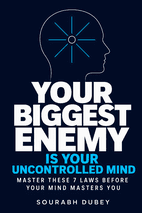
This page gathers lines from a book about the mind, meaning, attention, and the small choices that shape a life. You will find blunt observations on focus, discipline, emotions, environment, and the stories people mistake for reality. The writing is direct and practical, with a habit of naming the hidden process behind ordinary frustration.
What makes these lines shareable is how quickly they turn a vague feeling into a clear explanation. They do not ask you to become someone else overnight. They ask you to notice the meaning, habit, or environment already steering you. That mix of plain language and uncomfortable recognition is why readers keep returning to them.
Top Quotes from Your Biggest Enemy Is Your Uncontrolled Mind
“Most of your suffering comes from meanings you assigned in 0.3 seconds and then spent the next three hours defending.”
It follows the three-question Interruption Method as the summary of why the method matters.
It makes the abstract law concrete by showing how a split-second interpretation can dominate hours of thought.
“Because your beliefs don't describe your limits. They create them. You've been living inside walls that don't exist.”
The author explains how inherited beliefs create false boundaries.
It reframes belief as a creative force rather than a neutral description. The wall metaphor makes self-imposed limits feel both concrete and escapable.
“Self-discipline is choosing what you want most over what you want now.”
The author defines self-discipline in plain terms.
It gives readers a simple decision rule they can apply in any trade-off between present comfort and future goals.
“Your environment is stronger than your willpower. If you design your environment correctly, you don't need willpower at all.”
The author explains environment design as a way to make discipline automatic.
It shifts the solution from trying harder to designing surroundings, which is more reliable than willpower.
“Most people are letting it happen by accident. They are practicing anxiety without realizing they are practicing it. They are practicing distraction without realizing they are training their brain to be distracted. They are installing programs they never consciously chose, and then they call the results their personality.”
The author explains that the brain rewires automatically unless we deliberately direct the process.
It exposes how unconscious habits become mistaken for personality. The repeated phrasing makes the warning memorable and uncomfortable.
“You do not rise to your goals. You fall to your neural patterns. The goal is to make sure your patterns are worth falling to.”
This line closes the section on the Rewiring Loop.
It flips a common goal-setting idea into a statement about automatic behavior. It is compact and easy to remember.
“It is not the way you are. It is the way you have been practicing.”
The author uses this to separate fixed identity from learned patterns near the end of the chapter.
It offers a direct reframe of self-limiting beliefs. Its brevity makes it stick.
Themes Behind the Quotes
The central theme is that perception is not passive. The mind assigns meaning quickly, then treats that meaning as fact, and much of the book explores how those interpretations shape fear, identity, and behavior. Beliefs are presented as active instructions rather than harmless opinions, which explains why people can feel limited by walls they never actually built.
Another major thread is attention and environment. Distraction is treated as a structural problem, not a personal flaw, so focus depends on guarding attention and arranging surroundings deliberately. Discipline matters, but it works best when desire, identity, and environment support it. A final theme is neuroplasticity: repeated practice, not intention, builds the brain's defaults, so awareness becomes the first step toward changing what has been practiced.
Quotes by Chapter
1 The Law of Perception
“Your mind does not react to reality. It reacts to the meaning it assigns, and then defends that meaning as if it were truth.”
The chapter states this as the core definition of the Law of Perception.
It names the hidden step between events and emotions, making clear that the mind's interpretation—not circumstances—drives suffering.
“You're not seeing reality. You're seeing your mind's edited version of reality, filtered through your fears, your past, your assumptions, and your need to be right.”
It appears in the chapter's blunt summary of what the reader is avoiding.
It captures the chapter's core warning that certainty can be delusion and that perception is actively edited.
“Change your perception, and you don't change the world. You change what you see. And what you see determines everything you experience.”
This appears near the chapter's closing explanation of the Law of Perception.
It reframes change as an internal shift that alters experience rather than circumstances, which is the chapter's central promise.
2 The Law of Belief
“You're not performing according to your actual capability. You're performing according to the script your beliefs wrote.”
The author introduces The Performance Script to explain why beliefs shape results.
It separates real capability from the invisible script that actually drives behavior. Readers recognize the experience of sabotaging themselves without understanding why.
“The cloth didn't change you. What you believed about the cloth did.”
After swapping the students' belts, the martial arts master reveals the experiment's lesson.
It distills the chapter's core idea into a memorable contrast. The line shows that symbols and circumstances matter less than the belief we attach to them.
“Your beliefs aren't passive thoughts. They're commands your nervous system executes automatically.”
The author describes the physiological power of beliefs after discussing the Langer study.
It turns belief from an abstract opinion into a bodily command. The line makes auditing your thoughts feel urgent rather than optional.
3 The Law of Focus
“You think you have a focus problem. You don't. You have a robbery problem.”
The chapter opens by reframing distraction not as a personal failing but as theft.
It creates a memorable cognitive shift: the problem is external exploitation, not personal weakness.
“In a world engineered to fragment your attention, the ability to focus is the only competitive advantage that matters.”
The author states the core thesis of the Law of Focus.
It distills focus into the one advantage that compounds in a distraction-saturated world.
“You're not the customer in this transaction. You're the product being sold.”
The book explains how ad auctions turn users into inventory.
It exposes the attention economy in a blunt, unforgettable way.
“You are not weak for being constantly distracted; you are simply outgunned.”
After describing engineered attention capture, the author reassures the reader.
It replaces shame with a clear-eyed sense of the forces arrayed against attention.
4 The Law of Self-Discipline
“You will do what your environment, energy, and identity make easiest, not what you intend.”
This line appears as the chapter’s stated Law of Self-Discipline.
It reframes discipline as a systems outcome rather than a moral trait, making change feel more mechanical and achievable.
“Focus is the tool. Discipline is what picks up the tool and uses it even when you don't want to.”
The author contrasts focus with discipline after realizing focus alone did not produce action.
It captures the difference between having attention and actually using it on uncomfortable work.
5 The Law of Emotional Regulation
“Emotions cannot be controlled, only allowed and directed.”
The author states the chapter's central Law of Emotional Regulation.
It reframes regulation from suppression to direction, which is the chapter's most freeing insight.
“The only place you can actually intervene is between Sensation and Story. In that tiny gap before your brain decides what the sensation means, you have power.”
The author identifies the only point in the Emotional Loop where intervention works.
It shows that regulation is not about fighting a reaction after the fact but catching the moment before interpretation.
“That's when I truly understood: emotions are meant to be felt, not controlled. When you suppress them, they stay trapped inside, turning into chronic tension, anxiety, and eventual numbness.”
After grieving a breakup, the author names what he finally understood.
It captures the book's core paradox that feeling pain is the path through it, while suppression keeps it trapped.
“You do not need to be calm all the time to be effective. You just need to stop letting the child in your mind hijack the steering wheel every time the weather changes.”
The author defines what emotional regulation actually requires.
It relieves the pressure to feel calm constantly while vividly showing how reactivity takes over.
6 The Law of Influence
“The Law of Influence and Association is this: your brain automatically absorbs the beliefs, emotions, and behaviors of the people around you. Not selectively. Not only when you are paying attention. Automatically. Continuously. Without your permission and mostly without your awareness.”
The chapter states the core law after three examples of social influence.
It captures the chapter's central idea in a single, forceful definition. The repetition makes the automatic and unconscious nature of influence impossible to miss.
“The people you spend time with are not just people you enjoy or tolerate. They are inputs. Your brain is processing their behavior, their emotional states, their standards, and their definitions of what is normal every time you are near them, and it is quietly adjusting your own defaults to match.”
The chapter explains why social environment functions as an input to the brain.
It reframes relationships as active programming rather than mere companionship. This makes the reader rethink daily social exposure as something that shapes their defaults.
“You will not stop being influenced. The mechanism is structural, evolutionary, and not going away. Your brain will always be scanning its environment and adjusting toward whatever it finds there. That is not a problem to solve. It is a reality to manage.”
The chapter concludes that influence cannot be eliminated, only managed.
It offers a realistic and memorable frame for personal change. Rather than demanding immunity to influence, it asks for conscious management.
“Five years from now you will be noticeably different from who you are today. The question is whether the difference will be the result of the environment you drifted into or the environment you built deliberately.”
The chapter asks readers to consider the long-term effect of drift versus deliberate environment design.
It turns environment design into a high-stakes choice about identity. The contrast between drifting and building is clear and actionable.
7 The Law of Neuroplasticity
“The Law of Neuroplasticity is this: your brain becomes whatever you repeatedly practice. Not what you intend to practice. Not what you think about practicing. What you actually, consistently, repeatedly do.”
The chapter states the core law after contrasting Mora's recovery with the reader's fixed self-beliefs.
It defines neuroplasticity in plain, actionable terms. It makes clear that identity follows repeated action, not intention.
Conclusion
“The difference between people who stay stuck and people who change is not intelligence, talent, or even effort. It is awareness.”
This appears in the conclusion after the seven laws are summarized.
It reframes change as a matter of seeing clearly rather than innate ability, which feels both humbling and hopeful.
“The moment you can see the construction for what it is, a program and not a prison, you have the only thing you ever needed to begin.”
This follows the explanation that the mind constructs rather than records reality.
It turns self-awareness into an actionable turning point and reframes the mind as a program rather than a prison.