As an Amazon Associate, we earn from qualifying purchases.
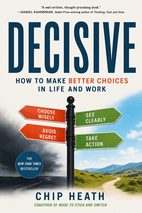
Chip Heath's Decisive diagnoses the four cognitive villains that sabotage decision-making and introduces the WRAP framework—multitracking options, testing assumptions, creating distance from emotion, and preparing for multiple futures—to counteract them. Written for executives, entrepreneurs, and anyone facing high-stakes career or personal choices, it offers a disciplined process for making wiser decisions that honor core priorities.
On Insta.page you also get an Apply This Book tool that lets you combine insights from up to 3 books to solve your specific situation.
Chapter mindmaps
Free preview: chapters 1–4 are fully interactive. Click any node to expand or collapse. Subscribe to unlock the rest.
Chapter 1: Introduction
Key concepts: Introduction
Introduction
The Spotlight Effect
Visible information dominates decisions
People form opinions from brief descriptions
Alternatives like reshaping roles go unconsidered
Kahneman: 'what you see is all there is'
Process Beats Analysis
83% of mergers create no shareholder value
60% of executives rate bad decisions common
Process outweighs analysis by factor of six
Rigorous analysis suppressed without fair process
Limits of Pros and Cons
Franklin's moral algebra remains standard approach
40 years of research shows inherent biases
Method appears neutral but inherits psychological flaws
Countermeasures must be built into procedure
Key Takeaways
Visible information crowds out unstated alternatives
Process quality determines if good reasoning is heard
Procedure to surface unpopular options beats analysis
Biases require built-in countermeasures, not judgment
Chapter 2: 1. The Four Villains of Decision Making
Key concepts: 1. The Four Villains of Decision Making