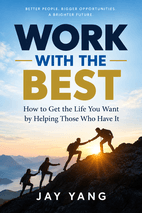
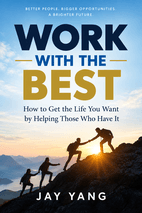
Jay Yang's Work With The Best lays out a tactical playbook for reaching opportunities guarded by closed doors, covering North Star definition, anti-goals, skill stacking, cold outreach, referrals, content, and the public pitch. Written for ambitious students, early-career professionals, and self-starters lacking traditional access.
Feature
Insta.Page
Blinkist
Shortform
Summary Depth
Full Chapter-by-Chapter
15-min overview
Section-by-section guides
Audio Narration
✓
✓
✓
Visual Mindmaps
✓
✕
✕
AI Q&A
✓
✕
✕
Quizzes
✓
✕
✕
PDF Downloads
✓
✕
✓
Price
$89.99/yr
$146/yr (PRO)
$199/yr
*Competitor data last verified July 2026.
1 Page Summary
Jay Yang's Work With The Best argues that the opportunities people most want are often guarded by closed doors and decision-makers who are pitched constantly, and that relationships—not credentials alone—are what open them. Building on the permissionless premise of his earlier book You Can Just Do Things, Yang lays out a step-by-step method for starting from nothing: define a clear "North Star," guard against Pyrrhic victories by setting anti-goals, identify your unfair advantage, reverse engineer the greats, and treat action like a mad scientist's experiments where failure is simply data. The book frames career growth as a matter of becoming undeniable through stacked, rare skills, and of placing yourself in environments—through strategic stress—that expect more of you than you currently expect of yourself.
What makes the book distinctive is its concrete, tactical playbook for reaching people who have no reason to say yes. Yang details a four-pillar framework (Learning, Earning, Network, Story) for evaluating opportunities, then moves into the mechanics of access: taking the "side door" with creative, personalized approaches; leveraging referrals and second-in-command gatekeepers; writing cold outreach that actually earns replies; building content as lasting positioning rather than noise; and using the bold public pitch to get noticed. These tactics are illustrated with real examples, from Sam Walton studying Sol Price's warehouse clubs to Nina Mufleh pitching herself as a product, grounding the advice in repeatable patterns rather than abstract encouragement.
The intended audience is ambitious self-starters—students, early-career professionals, and independent operators—who lack traditional access or leverage but are willing to do the uncomfortable work of reaching out. Readers will come away with a practical framework for choosing which opportunities to pursue, a set of outreach plays they can run without permission, and a mindset for turning reluctance and fear of looking foolish into action. As the closing chapter suggests, the real barrier is often not access but one's own excuses, and the book's promise is that the life you want is reachable by helping those who already have it.
Introduction
Overview
The work you want is often behind a closed door, and the people inside get pitched all day long. If you have no way in, how do you get in front of them? You know relationships matter. Nobody tells you how to start one from nothing.
The offer
A call from an unknown number came while he was lying in his college dorm bed. It was a copywriting job at Acquisition.com, the advisory and investment firm started by Alex and Leila Hormozi. He had watched Alex's business videos since his sophomore year of high school. Saying yes meant closing his marketing agency and telling more than half a dozen clients he was done. It meant moving across the country to a city where he knew no one, living alone for the first time. It meant calling his twin brother Max to say the apartment they had already signed for was off. He took the leap.
What the book promises
An earlier book, You Can Just Do Things, argued that you don't need permission to act. The default path is not the only path. This book gives you the actual steps he used to land dream jobs and clients and to build a profitable business at 19. Everyone knows it's who you know, not what you know. Nobody teaches you how.
Breaking into powerful circles.
Getting on the radar of people who get pitched all day and keep their guard up.
Building relationships with people worth admiring.
You get what you want by helping people who already have it.
The record
beehiiv had no job postings, so he sent a pitch deck of ideas by cold email to CEO Tyler Denk. Tyler replied the next morning, and an internship followed.
At 17, Noah Kagan of AppSumo wanted his newsletter grown. Fifty hours produced a 19-slide deck breaking down his marketing strategy, plus 9 free social posts to test. A trial turned into Head of Content, then work launching Million Dollar Weekend, a New York Times bestseller.
At 18, he pitched a ghostwriting and marketing agency using Google Slides decks researched for each prospect. He made six figures within a year as a full-time college student, working for 7-figure founders and 8-figure CEOs.
At 19, Acquisition.com called. He became Written Media Strategist. His work included launching Alex Hormozi's $700M Money Models. That launch set a Guinness World Record as the fastest-selling nonfiction book in under 24 hours.
No job portal, no posted opening, no resume. The method never changed: name the person, learn what they need, do the work before anyone asks, and put it in front of them.
The three parts
Part One, on figuring out what you want: the North Star that filters your decisions, the Pyrrhic Victory (a win that costs too much), and learning from the greats by running your own experiments.
Part Two, on creating value: the Four Pillar Framework, the Obsession Arc for building skills faster, and the #1 question to ask before a pitch.
Part Three, on delivering value: the TAG Method, the Contact Quadrant, and cold emails, content and pitch decks that create opportunities.
Come in ready to set aside what you think you already know. You need reminders more often than lessons, and most things are more achievable than they look.
Key Takeaways
Say yes to the role or the room, even when it means undoing what you already committed to. The cost of moving is usually smaller than the cost of waiting to be asked.
Pick one destination and let it veto everything else. That way you can turn down tempting distractions without agonizing over each one.
Assume you have more to unlearn than to learn. Expect reminders of the basics more often than new lessons, because most goals are closer than they appear.
Key concepts: Introduction
Introduction
The Offer
Accepted copywriting job at Acquisition.com from unknown call
Closed agency, moved across country, left signed apartment
Took leap despite undoing prior commitments
What the Book Promises
Provides actual steps to land dream jobs and clients
Teaches breaking into powerful circles and getting on radar
You get what you want by helping people who already have it
The Record
Cold emailed pitch deck to beehiiv CEO, got internship
Created 19-slide deck for Noah Kagan, became Head of Content
Built six-figure agency at 18, launched $700M Money Models at 19
The Three Parts
Part One: North Star, Pyrrhic Victory, learning from greats
Part Two: Four Pillar Framework, Obsession Arc, #1 question
Part Three: TAG Method, Contact Quadrant, cold emails and decks
Key Takeaways
Say yes to the room; cost of moving is smaller than waiting
Pick one destination and let it veto distractions
Assume more to unlearn; most goals are closer than they appear
💡 Try clicking the AI chat button to ask questions about this book!
1. Chapter 1: Define Your North Star
Overview
Most people rush toward goals they never clearly defined. They confuse motion with direction. What do they actually want? They keep it vague because vague is easier than facing the truth. But how do you hit a target you can't see?
Alice reaches a fork in the road and asks the Cheshire cat which way to go. He asks where she wants to go. She doesn't know. So it doesn't matter, since any path gets her there. Most people live that scene. They chase happiness, freedom, or a career without asking what those words mean to them. A target you can't see is hard to hit. Busyness is often what keeps people from what they want.
Answering honestly is scary at every stage. It means admitting you aren't where you want to be. Vagueness spares you from acting. Writing it down ends the evasion. The discomfort of an honest answer pushes you toward it. The perfect answer isn't the point. What you write will change. That's the point. The value is in the habit of reflecting.
The author wrote his own at twenty. He dated it. It describes a perfect Tuesday: meaningful work, something physically hard, and ending the day with people he cares about.
Wake at six or seven, make breakfast, read.
Get lost in writing a book.
Lift and run.
Write newsletter and social content.
Lunch, then a walk.
Interviews and calls.
Dinner, then friends and family.
He wants to live near ambitious friends so they can work together and push each other. One day, a house with basketball and pickleball courts. Close friends on a single cul-de-sac raising kids together. He wants to lift heavy, run fast, like his body. He can't wait to be a husband and father. A dad his kids look up to and can tell anything. High standards with high support. A husband who provides financially and emotionally, listens, stays present, keeps his word. A great relationship runs 1 + 1 = 11, not 0.5 + 0.5 = 1.
Work should be indoors, in long uninterrupted blocks, on his own schedule. An aimless noon walk. The gym at two with the retirees. A Thursday off. Money buys the freedom to refuse projects that steal his focus. It buys a great life for family and friends. Younger, he wanted his name known. Now he'd rather live a life he's proud of than chase a legacy. The pursuit of public greatness came from feeling not enough. Writing is the craft he wants to master. "Inspire" traces to the Latin inspirare, to breathe life into. He wants to be remembered as useful, someone who gave more than he took.
Write today's date and your age at the top of a notebook. Then answer:
A perfect ordinary Tuesday if money were no object, hour by hour, and who is with you.
Where you want to live, and how the environment looks and feels.
How you want your body to feel daily: looks, longevity, or flexibility.
What your inner circle looks like, and who you want to be to those closest to you.
Your ideal work environment: indoors or out, alone or among people, hands or mind.
What money does for your life, and what "enough" means.
What you want to get really good at. Chapter 3 returns to this.
What you want said at your eulogy: accomplishments, or that you showed up, were generous, present, honest, and made people feel seen.
Tuesday, not Friday, is the point. Friday is the highlight reel, when everyone's life looks good. Tuesday is the most ordinary day of the week. No one romanticizes it. A life you'd love only on Fridays and vacations is an escape, not a design.
Return to the document before big decisions. Return when daily life drifts from what you wrote. It evolves as you do. Keep one question live: closer to the life you want, or further from it? Writing it down opens a gap between the life you have and the life you described. Psychologists call the pressure that gap creates drive theory. When you lack something, you want it more. Food tastes better when you're hungry. Naval Ravikant called desire a contract you make with yourself to be unhappy until you get what you want. That's fuel, not a warning. Nobody running out of air underwater swims casually to the surface. But lack starts you. It doesn't sustain you. Chapter 3 covers cleaner fuel. Feeling stuck? Change your body first to change your mind. Take these questions on a walk with pen and notebook. No music, no scrolling.
A friend once joked that news companies exist to make everyone's problems your problem. The barrage feels constant. Stay in this job or leave? Am I saving enough? Will AI replace me? The Eisenhower Matrix sorts tasks by urgency and importance:
Do urgent, important tasks now.
Schedule important, not urgent tasks.
Delegate urgent, unimportant tasks.
Eliminate the rest.
Social media defeats it by making everything feel both. The way back to signal is a North Star filter: a question or set of questions you run every decision through. The author's is two: what do I want, and what inputs increase the odds of the output I want? Read backwards, it asks what has to be true for the outcome to arrive. Defining what you want on paper beats leaving it undefined. Learning from people who already have it beats figuring it out alone. Choosing habits deliberately beats leaving them to circumstance. One decision eliminates a thousand.
Sahil Bloom, author of The 5 Types of Wealth, keeps a notecard on his desk. It says he will coach his son's sports teams. He measures opportunities against what that kind of person would do. A role requiring 300 nights away a year usually gets refused or reshaped. Other filters:
Will this matter in 10 years?
What would I do if I knew I couldn't fail?
Is this a "hell yes" or a no?
What would the person I want to become do?
A North Star alone isn't enough. You also have to know what you'll sacrifice for it, and what you won't.
Key Takeaways
Write today's date and your age at the top of a notebook. Work through all eight prompts slowly: the ordinary Tuesday hour by hour and who shares it, where you live, how your body feels, your inner circle, your ideal work setting, what money is for, what you want to master, and what you want said at your eulogy.
Choose a Tuesday, not a Friday. The most unremarkable weekday is the one you'll actually be living most of the time. A life that only appeals on weekends and holidays is an escape, not a design.
Treat the first draft as disposable. The document will shift as you do. Returning to it before big decisions, or whenever daily life drifts, matters more than getting any single answer right.
Use the gap between your current life and the written one as pressure to move. But don't lean on it forever. When you feel stuck, change your body before your mind. Take the questions on a walk with pen and notebook. No music, no scrolling.
Run decisions through a short standing filter, like what you want and which inputs raise the odds of that outcome. Each choice gets settled once instead of relitigated every time it resurfaces.
Decide in advance what you'll sacrifice for the life you wrote down and what you won't. A direction with no stated price is still just a preference.
Key concepts: 1. Chapter 1: Define Your North Star
Chapter 1: Define Your North Star
The Danger of Vagueness
Most people chase undefined goals, confusing motion with direction.
Vagueness spares you from facing the truth and taking action.
Writing it down ends evasion and creates a gap that drives you.
The Perfect Tuesday Exercise
Describe an ordinary Tuesday hour by hour, not a highlight reel.
Include who is with you and what you're doing.
Tuesday reveals a life you'd love daily, not just on vacation.
Values: ambitious community, strong body, devoted husband and father.
Work on own schedule; money buys freedom to refuse distractions.
Drive Theory and Discomfort
The gap between current and desired life creates drive.
Lack starts you but doesn't sustain you; find cleaner fuel.
Feeling stuck? Change your body first to change your mind.
The North Star Filter
Run every decision through key questions: what do I want?
What inputs increase the odds of the output I want?
One decision eliminates a thousand; define what you'll sacrifice.
Decision Filters in Practice
Sahil Bloom's notecard: will this let me coach my son's teams?
Ask: will this matter in 10 years? Is it a hell yes?
What would the person I want to become do?
2. Chapter 2: Avoid The Pyrrhic Victory
Overview
Ambition can deliver every outcome you asked for while taking something you never agreed to trade. The tension is not between success and failure, but between the win you can measure and the loss you only notice later. How do you protect what matters before the cost becomes clear?
Pyrrhic Victory
Pyrrhus of Epirus beat Rome twice in 279 BC, and surveying his wrecked army said one more such victory would undo him completely. He won every battle and lost the war. A Pyrrhic victory is when winning costs more than the prize is worth.
An investment banker who made partner at 35 came home to a note from his wife saying she couldn't do it anymore.
An entrepreneur who sold a company worth tens of millions, having skipped meals, sleep and the gym for years.
An academic who spent 30 years on research that changed her field, and raised children who grew up with a stranger.
A goal set without limits around it is not merely unfinished; it is dangerous.
Anti-Goals
Andrew Wilkinson, who built a holding company worth over $300M, calls this an Anti-Goal: define not just what you want, but what you will not sacrifice to get it. Netflix co-founder Marc Randolph kept one rule for over 30 years: Tuesdays at 5pm he left work for the evening with his wife. What he is proudest of is not the companies he started but staying married to the same woman and raising kids who knew him.
North Star and South Pole
The author's North Star is a fit body, a calm mind, a house full of love, meaningful work, and enough wealth not to worry. The North Star marks where you want to go; the South Pole marks where you refuse to end up. Five questions:
At 80, what would you most regret neglecting?
What have you sacrificed and regretted?
Whose success do you admire but whose life you would not want?
What are your non-negotiables?
If you got everything and still felt miserable, why?
Wants and Don't-Wants
Applied to anything new: write out what you want, then what you don't want. Trite as it sounds, it works remarkably well. The author's list before college wanted a lean, strong 170-pound body, experience, a clearer sense of his own likes and dislikes, skills to rebuild wealth from scratch, a girlfriend, lifelong friends. It ruled out drinking, drugs and partying, a boring job, wasted time. Getting what he wanted without college, he dropped out. The destination and guardrails now set, the next question is the vehicle.
Key Takeaways
Before committing to any ambitious goal, write down both the destination you are aiming for and the outcome you refuse to accept, so the pursuit has limits built in from the start.
Work through the hard questions: what you would most regret neglecting at 80, what sacrifices you have already made and regretted, whose success you admire but whose daily life you would never want, and what you will not trade under any circumstances.
Test every new opportunity by listing what you want from it and what you do not want from it, then let the second list override the first whenever the two conflict.
Put the guardrails in your calendar as recurring, protected time with the people you love, and treat those commitments as fixed rather than negotiable when the goal starts demanding more.
Key concepts: 2. Chapter 2: Avoid The Pyrrhic Victory
Chapter 2: Avoid The Pyrrhic Victory
The Pyrrhic Victory Trap
Winning can cost more than the prize is worth
Pyrrhus won battles but lost the war
Examples: banker, entrepreneur, academic lost what mattered
A goal without limits is dangerous
Anti-Goals: Defining What You Won't Sacrifice
Anti-Goal: what you will not sacrifice to win
Andrew Wilkinson built $300M holding company with anti-goals
Marc Randolph's 30-year rule: Tuesdays at 5pm with wife
Proudest of staying married and raising kids who knew him
North Star and South Pole
North Star: fit body, calm mind, love, meaningful work, enough wealth
South Pole: where you refuse to end up
Five questions to clarify regrets, admired lives, non-negotiables
If you got everything and still felt miserable, why?
Wants and Don't-Wants Exercise
List what you want, then what you don't want
Let the don't-want list override the want list
Author's college list led to dropping out
Destination and guardrails set, then choose the vehicle
Key Takeaways
Write destination and refused outcome before committing
Ask hard questions about regrets and non-negotiables
Test opportunities with wants vs. don't-wants
Put guardrails in calendar as fixed, protected time
3. Chapter 3: Find Your Unfair Advantage
Overview
Everyone says find the one thing you are meant to do, then chase it with everything you have. But passion and money pull in different directions. And most people cannot yet name what they are naturally good at. The real question is: how do you find an edge that is actually yours?
A Game You Can Win
A high school junior was helping Z Fellows grow its social media. They flew him to San Francisco for a startup incubator. The room was full of impressive people, including someone building an AI personal shopper. He felt like he could not compete. Then he realized: you cannot beat people at their own game. So play yours. Warren Buffett put it this way: beat Bobby Fischer by playing him at anything except chess. So the junior doubled down on writing and content. The signs were there:
Speed
Quote collecting
Enjoyment
Friends praising his high insight-to-words ratio
His superpower is synthesizing ideas through written words. His following grew past half a million. That led to work with business heroes. Not because he was the smartest in the room, but because he found a game he could win.
Passion, Money, and Ikigai
Following passion alone is incomplete. So is following money. Passion without natural ability becomes a hobby. You get outworked by people who have both. Money first can land you a high-paying job you are not wired for. You end up drained and mediocre among people who enjoy it. The Japanese concept ikigai means roughly a reason for being. In the West, it is often drawn as four overlapping circles:
What you love
What you are good at
What the world needs
What you can be paid for
Their overlap is supposed to be life's purpose. But the diagram is cleaner than reality. Trying to optimize all four at once causes paralysis. Start with one: what you are naturally good at. Natural ability speeds learning. Learning produces progress. Progress produces enjoyment. Enjoyment produces consistency. Consistency produces mastery. And mastery produces money and fulfillment. Passion is the byproduct, not the starting point.
Combine Several Strengths
Advantage usually comes from an intersection, not one skill. Scott Adams advised two paths:
Become the best at one specific thing.
Become very good, top 25%, at two or more things.
The first is nearly impossible. Few reach the NBA or a platinum album. The second is fairly easy. Adams can draw better than most but is no artist. He is funnier than most but not a top comedian. Few people can draw well and write jokes. Adding his business background made his topic rare. The author combines writing, deep social media marketing, and online business. Do not force one thing. A few things is a better strategy.
Before the Tactics
A notebook exercise asks for three of ten prompts. None of the following tactics matter without first:
Defining what you are trying to achieve
Naming what you refuse to sacrifice
Identifying the unique strengths to build on
A later chapter shows where successful people left a blueprint and how to use it.
Key Takeaways
Choose the game where your particular combination of abilities puts you ahead, rather than entering a contest someone else is built to win.
Begin with what comes naturally. Faster learning compounds into mastery and money. Treat passion as what shows up along the way, not what you must find first.
Reach the top quarter in two or three areas instead of chasing world-class status in one. Rare intersections are easier to reach and harder for anyone to copy.
Settle what you are aiming for and what you will not give up before you learn a single tactic. A method without a target is just activity.
Inventory your strengths deliberately. The tactics only work once you know which assets you are compounding.
Key concepts: 3. Chapter 3: Find Your Unfair Advantage
Chapter 3: Find Your Unfair Advantage
Play Your Own Game
Don't compete in games others are built to win.
Identify your natural strengths and double down.
Example: high school junior's writing superpower led to success.
Start with Natural Ability
Passion alone is incomplete; natural ability accelerates learning.
Progress and enjoyment follow from leveraging strengths.
Passion is a byproduct, not the starting point.
Combine Strengths for Advantage
Become top 25% in two or more areas, not world-class in one.
Rare intersections are easier to reach and harder to copy.
Example: Scott Adams combines drawing, humor, and business.
Define Your Goals and Boundaries
Clarify what you aim to achieve.
Decide what you refuse to sacrifice.
Identify unique strengths to build on before tactics.
Key Takeaways
Choose a game where your abilities give you an edge.
Start with natural strengths; passion follows.
Combine strengths for a unique advantage.
Set goals and boundaries before tactics.
You've reached the end of the free chapters
Next chapter: “Chapter 4: Reverse Engineer The Greats” is locked
Keep reading Work With The Best — and unlock all 600+ book summaries with audio, mindmaps and AI Q&A.
$0.00 due today · 7 days free, then $89.99/year ($7.49/mo) · Cancel anytime before day 7
Jay Yang is a contemporary author and cultural critic known for his insightful explorations of modern Asian American identity and diaspora experiences. His notable works include the acclaimed essay collection "The Middle Distance" and the novel "Borrowed Ground," which examine themes of belonging and generational memory. Yang's writing is informed by his background in sociology and his work as a community organizer.
Frequently Asked Questions about Work With The Best
What is Work With The Best about?
This guide lays out a practical playbook for getting in front of decision-makers and landing opportunities when you have no connections or leverage. It covers defining a clear North Star, setting anti-goals to avoid wins that cost too much, finding your unfair advantage, reverse engineering greats, and testing options like a mad scientist. Readers learn to become undeniable through skill stacking, go where the action is, evaluate opportunities with the Four Pillars, and use side doors, referrals, cold outreach, content, and public pitches. The core idea is that you don't need permission to create your own path to meaningful work.
Who is the author of Work With The Best?
Jay Yang is the author, who took a leap by accepting a copywriting job at Acquisition.com after closing his marketing agency and moving across the country. He shares his personal story of leaving behind clients and a signed apartment to pursue an opportunity with Alex and Leila Hormozi's firm. He also wrote an earlier book, You Can Just Do Things, which argued you don't need permission to act.
Is Work With The Best worth reading?
This book is worth reading because it replaces vague advice with concrete frameworks and real-world examples, from Sam Walton learning from Sol Price to two entrepreneurs sneaking a pitch to Jesse Itzler in a wooden box. It offers actionable methods for cold outreach, referrals, content creation, and public pitches that anyone can use to reach influential people. The blend of personal narrative and practical strategy makes it a compelling guide for anyone who feels stuck outside closed doors.
What are the key lessons from Work With The Best?
Key lessons include defining your North Star honestly, setting anti-goals to avoid Pyrrhic victories, and finding an unfair advantage by playing a game you can win. Reverse engineer the greats, treat failure as data like a mad scientist, and stack skills to become undeniable. Evaluate opportunities using the Four Pillars—Learning, Earning, Network, and Story—and go where the action is, because environment shapes potential. Take the side door with a permissionless approach, use referrals and cold outreach effectively, and let content and public pitches build trust; free work is often the entry fee.
📚 Explore Our Book Summary Library
Discover more insightful book summaries from our collection