As an Amazon Associate, we earn from qualifying purchases.
What is the book Secrets for Success in Business about?
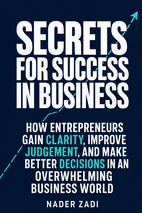
Nader Zadi's Secrets for Success in Business offers entrepreneurs and leaders a layered framework for deciding well under genuine uncertainty, distinguishing clarity from certainty and covering decision load, habit science, the Eisenhower Matrix, attention economics, second-order thinking, sunk costs, opportunity cost, and trade-offs, with practical tools like decision matrices and scheduled reviews.
Feature
Insta.Page
Blinkist
Shortform
Summary Depth
Full Chapter-by-Chapter
15-min overview
Section-by-section guides
Audio Narration
✓
✓
✓
Full access to all 700+ summaries
✓
✓
✓
Visual Mindmaps
✓
✕
✕
AI Q&A
✓
✕
✕
Missing a book? Request it, usually live within 48h
✓
✕
✕
Quizzes
✓
✕
✕
PDF Downloads
✓
✕
✓
Send to Kindle
✓
✓
✓
Price
$89.99/yr
$146/yr (PRO)
$199/yr
*Competitor data last verified July 2026.
1 Page Summary
Nader Zadi's Secrets for Success in Business argues that the central challenge of leadership is not deciding faster or appearing more confident, but developing the clarity to act well when the future is genuinely uncertain. Drawing a distinction between certainty, which is merely a feeling, and clarity, which is the practical ability to see what matters right now, the book frames decision-making as an often-invisible form of labor that grows heavier as responsibility increases. Through recurring examples—Sarah, whose burnout lifted once she shifted attention from daily tasks to a long-term plan, and Eduard, whose costly publishing errors stemmed from the sheer scale and frequency of his decisions rather than poor time management—Zadi shows how overloaded leaders slip into reactivity and how naming the real source of the strain restores focus.
What distinguishes the book is its systematic layering of frameworks rather than a single prescription. Zadi pairs habit science drawn from James Clear's Atomic Habits with the Eisenhower Matrix and attention economics, showing how busyness becomes a way of avoiding the real work and how systems and rules can remove the need to feel ready before acting. He examines false urgency and its costs to culture and deep work, encourages second-order thinking and Donella Meadows's leverage points—locating the greatest leverage in mindsets and mental models—and explores how identity, intuition, and fear (via Jonathan Haidt's rider-and-elephant model and the availability heuristic) shape verdicts before analysis begins. Later sections address trade-offs as the structure of success, the sunk cost fallacy, opportunity cost, and the discipline of prioritization, closing with gratitude as "contextual awareness" that keeps leaders from mistaking lucky wins for proof of skill.
The intended audience is entrepreneurs, business owners, and leaders at any level who face weighty decisions without reliable information and who feel the pull of reactivity, manufactured urgency, and self-justifying reasoning. Rather than promising confidence, the book offers readers practical direction: explicit and quantifiable trade-offs, decision matrices, scheduled reviews, and self-checks for false urgency, all aimed at helping them act honestly inside ambiguity—without pretending to know more than they do—and keep their judgment clear as responsibility grows.
Part 1 - Chapters 1 to 3
Overview
Every leader faces decisions that carry real weight, and the usual advice to be faster, clearer, and more confident does little when the right call is genuinely uncertain. It's hard to say what separates a sound judgment from a convenient one, especially for the person who has to live with the outcome.
Capable leaders often blame themselves for mental strain, comparing themselves to peers who decide without fear. Sarah sought help after high staff turnover pushed her toward burnout; she had taken on many employees' roles, lost boundaries and self-care, and reacted rather than responded to change. Shifting her attention from daily tasks to a long-term plan for operations, work-life balance, and health restored her clarity; she described making decisions with a stronger mindset and greater focus, no longer reactive.
Invisible Labor and Decision Load
Decision-making is a form of invisible labor that piles up. The higher a leader rises, the more weighty decisions and harder clarity becomes. Eduard, publisher of a luxury lifestyle magazine with high-end real estate advertisers, lost clients to small errors. A typo on the tenth-anniversary cover lines stemmed not from poor time management but from the scale and frequency of his decisions. Hundreds of small choices add up in the mind, showing up as fatigue, second-guessing, micromanagement, or reactivity. Chanie Wilschanski notes most work is unseen: intellectual effort, emotional struggle, and allocated time and resources. Delegating a decision also delegates those burdens.
Decision-making has five layers, starting with recognizing a decision is needed and then identifying options. The average person makes over 35,000 decisions a day (Onque 2025). Emotional costs include anxiety, fear, pressure, self-doubt, fear of criticism, and guilt. Time costs include research with no guaranteed outcome; new software can take days or weeks, leaving leaders busier and still deciding. Prioritization and self-regulation help; resisting advice-giving to every employee fosters self-leadership and avoids micromanagement.
Decision Fatigue
Decision fatigue occurs when more decisions drain a leader physically, mentally, and emotionally until quality drops (Choudhury and Saravanan 2026). Perception stays stable, but understanding and prediction decline. Fatigued people prefer low-risk, low-return options over high-risk, high-return ones (Jia, Lin, and Wang 2022). Causes include:
Time of day: later decisions are poorer.
Responsibility: decisions affecting others take more mental effort.
Complexity: complex tasks use up resources faster.
Breaks: breaks can ease fatigue and reduce caution.
Workload: many complex decisions in limited time raise the burden.
Weak culture: lack of support raises stress and mental load.
Options: more choices add mental burden.
Frequency: many decisions in a row drain mental resources.
Order: earlier decisions are higher quality than later ones.
Decision fatigue produces errors, cautious choices, and greater perceived complexity. To counter it:
Assign mentally demanding tasks to shift starts or right after breaks.
Use default options such as standard contract terms, pre-decided hiring criteria, and set meeting formats.
Replace appropriate decisions with rules and principles.
Narrowing and Sequencing
Reduce the number of options. When considering a new type of software, compare two candidates rather than five, so the trade-offs stay clear and the shortlist doesn't become another source of strain.
Separate the research stage from the decision stage. Understanding the material and selecting from it are different tasks, and mixing them lets unfinished analysis spill into the choice.
Build breaks into the process. Time away lets you and your team return to the work with a fresher perspective.
Embrace delegation. A decision can involve several stages, including research and weighing recommendations, so splitting up roles keeps one person from carrying all the unseen work.
Make one decision at a time. Block time for a key choice instead of making it while answering email and messages, which interrupts the flow of thought.
Agree on what level of evidence is enough. Perfectionism can keep you seeking certainty that can't be reached, so the effort spent gathering evidence should match the stakes.
The standard is whether the evidence fits the decision, not whether doubt is gone. That keeps the effort in line with what's at stake.
Reading Fatigue and Emotion
Pause often enough to notice when fatigue is setting in. The aim is to catch it before it narrows the range of choices you can see. Eduard simplified his routines, time-blocked his calendar, and prioritized more important decisions; that helped him concentrate on output rather than input early in his workday. Grouping similar decisions together is another way to preserve focus and avoid distraction from too many unrelated inputs. Eduard also defined his goals and values and chose actions aligned with them. Checking your emotional state reduces the emotional burden that decisions often carry, and it makes the pressure visible before it shapes the choice.
Fear and Self-Care
Jenna, who leads a growing legal and accountancy firm, describes herself as risk-averse and says fear can dominate her choices. Through coaching she learned to pause before an important decision and ask herself whether fear is steering it. She now sets time limits for key decisions to avoid overthinking and losing focus. Self-care remains harder. She aims to work out for at least half an hour a day and be in bed by 10 pm, and when she is too tired to exercise she tries not to be too hard on herself. She sometimes fails to keep those routines, and the point is not to turn them into another test she must pass. The routine supports judgment without becoming another standard she must meet perfectly.
Key Takeaways
Treat decision capacity as a resource that runs down over the day, and place your most consequential calls early or right after a break rather than at the end of a long sequence.
Shrink the field before you commit: hold live options to two or three so the trade-offs stay clear instead of turning the shortlist into a fresh source of strain.
Turn recurring choices into standing rules, default contract terms and fixed meeting formats, which frees judgment for the decisions that genuinely need it.
Key concepts: Part 1 - Chapters 1 to 3
Part 1 - Chapters 1 to 3
The Weight of Leadership Decisions
Standard advice to be faster and clearer fails under real uncertainty
Hard to distinguish sound judgment from convenient choices
Leaders wrongly blame themselves for decision strain
Sarah restored clarity by shifting from tasks to long-term planning
Invisible Labor and Decision Load
Decision-making is unseen labor that accumulates with rank
Hundreds of small choices surface as fatigue and reactivity
Most work is unseen: intellectual, emotional, and resource costs
Delegating a decision also delegates its hidden burdens
Understanding Decision Fatigue
Fatigue degrades understanding and prediction, not perception
Causes include time of day, responsibility, complexity, and workload
Weak culture and too many options raise mental load
Countering Fatigue Through Design
Schedule demanding tasks at shift starts or after breaks
Use defaults like standard terms and pre-decided criteria
Replace appropriate decisions with rules and principles
Fatigue produces errors and cautious, low-value choices
Narrowing and Sequencing Decisions
Compare two candidates rather than five to keep trade-offs clear
Separate research stage from the decision stage
Make one decision at a time in blocked time
Match evidence-gathering effort to the stakes involved
Reading Fatigue and Emotion
Pause to catch fatigue before it narrows visible choices
Eduard time-blocked his calendar and simplified routines
Group similar decisions to preserve focus
Check emotional state to surface pressure before it shapes choices
Delegation and Self-Leadership
Resist giving advice to every employee to avoid micromanagement
Split decision stages across roles to share unseen work
Build breaks into the process for fresher perspective
Align actions with defined goals and values
💡 Try clicking the AI chat button to ask questions about this book!
Part 2 - Chapters 4 to 8
Overview
Leaders who feel most in control often have the fullest calendars and the most complicated operations. Busy activity, doing things the same old way, and piling on new features can all look like progress while the business drifts further from what matters. The hard part is spotting which of these forces is really running the show.
Packed calendars, unread email, and a workday that never stops can become a way to avoid the real work. Constant busyness means reacting to whoever shouts loudest and measuring motion instead of real movement toward what matters. Getting real results comes down to purpose, focus, and staying true to your values and goals. It means prioritizing, including deciding what to cut, and having the confidence to say no to things that don't serve the business.
Habit Profit and Loss
James Clear's Atomic Habits (2018) treats each action as a vote for the person you want to become, and success as the product of daily habits rather than one big transformation. Getting 1 percent better every day for a year compounds to 365 percent better. To break a bad habit, Clear's four steps are:
Remove the cue, like deleting social media apps.
Make the habit unattractive by naming its cost, like an hour of lost work.
Make it harder, for example with website blockers.
Make it unsatisfying through a habit contract that imposes penalties.
Good habits follow the reverse route: make them present, attractive, easy, and satisfying.
A daily habit profit-and-loss statement makes those patterns visible. Profitable habits score +1,000 habit dollars; liability habits score -2,000. A negative total shows that harmful habits outweigh productive ones. Sanjay, CEO of a small tech startup, starts each quarter with one major objective, treats anything that doesn't serve it as a distraction, saves mornings for strategic work, and leaves meetings and messages for the afternoon. He puts his phone on Airplane Mode and checks messages only at midday and an hour before leaving; his team uses a scheduling app to protect high-focus work. He credits self-knowledge, removing triggers, daily focused work, and discipline rather than motivation or tricks.
Simplicity Against Complexity
Complexity creeps in slowly, and it does real damage. Software that once did one job well can become frustrating as developers keep adding features, and the same drift can make a product hard to explain, eat up support time, and push customers toward simpler competitors. Only 11 percent of large companies become lasting value creators, according to Kermisch and Fallis, and most businesses fail or get sold, according to the Commerce Institute. A coffee shop that keeps adding sizes, flavors, milk options, rewards, seasonal specials, and online ordering may lose track of which items actually make money and spend its strategy time on menu tweaks. To protect against this:
Set clear roles, goals, and procedures.
Use fewer decision makers and approval layers.
Define your core and your most profitable 20 percent.
Ask what can be eliminated.
Standardize delivery before adding anything new.
Sasha, founder of a two-branch wellness clinic, had expanded into sales, HR, customer service, and IT, but approval steps stalled simple decisions. Sales agents waited days for price proposals, and clients heard conflicting information from different team members. She let agents decide after one approval from the sales director and assigned each client to one customer service specialist.
The Compound Effect
Darren Hardy's The Compound Effect (2022) offers a choice between $3 million cash and a penny that doubles daily for 31 days; the penny yields over $10 million. Leaders put compounding to work by:
Taking consistent right action, like not checking mail after leaving the office.
Celebrating small wins and breaking big goals into smaller ones.
Gathering employee input, analyzing it, perhaps with a SWOT analysis, and acting on it.
Judging a decision by how it was made rather than how it turned out, because good decisions can feel slow while bad ones can feel productive.
Noise and Bias
Daniel Kahneman, Olivier Sibony, and Cass Sunstein's Noise: A Flaw in Human Judgment (2022) separates bias from noise:
Bias is systematic, predictable error, like a manager hiring only men for sales.
Noise is unwanted variability in judgment, like two managers giving the same employee very different ratings.
Bias makes decisions consistently wrong; noise makes them inconsistently wrong and is harder to eliminate. To reduce noise, leaders can:
Gather and analyze information in a structured way.
Break decisions into costs, risks, benefits, evidence, and skills.
Average other people's assessments.
Use the same norms, rules, or scales, like 1-10 ratings for skills, experience, cultural fit, and communication.
Make independent judgments before discussion.
Avoid premature judgment, confirmation bias, and piling onto what others already said.
Put discipline ahead of outcomes.
That's decision hygiene: judging the process rather than the result.
Key Takeaways
Measure your week by how far you move toward a few stated priorities, not by how full it looks. Decide what to drop, and decline work that doesn't serve the business.
Keep a daily tally of actions that build or erode the business, then change the trigger, friction, and payoff around the eroding ones so useful behaviors become the default.
Before expanding a product, team, or menu, identify the small set of offers and activities that actually make money, simplify how they're delivered, and remove steps that force customers or staff to wait.
Build routines that add up over time: repeat the right actions, mark modest gains, and feed staff suggestions back into visible changes. Judge a choice by how it was made, not just by how it turned out.
Treat inconsistent judgments as a separate problem from skewed judgments: gather evidence in a fixed order, rate people on shared criteria, record views before group discussion, and judge the procedure rather than the final result.
Key concepts: Part 2 - Chapters 4 to 8
Part 2 - Chapters 4 to 8
The Busyness Trap
Packed calendars and constant activity can mask avoidance of real work.
Measure progress by results, not motion or reacting to the loudest voice.
Prioritize ruthlessly and have confidence to say no to non-essential tasks.
Habit Profit and Loss
Atomic Habits: each action is a vote for the person you want to become.
1% daily improvement compounds to 365% better in a year.
Break bad habits: remove cue, make unattractive, harder, unsatisfying.
Standardize delivery before adding new features; ask what can be eliminated.
The Compound Effect
Small consistent actions compound dramatically over time (penny doubling example).
Celebrate small wins and break big goals into smaller steps.
Judge decisions by process, not outcome; good decisions can feel slow.
Noise and Bias in Decision Making
Bias is systematic error; noise is unwanted variability in judgment.
Reduce noise with structured information gathering and independent judgments.
Use consistent scales and norms; avoid premature judgment and confirmation bias.
Decision hygiene: judge the process, not the result.
Prioritize and Prune to Protect Focus
Judge the week by progress on stated priorities, not by busyness.
Decide what to drop and decline work that doesn't serve the business.
Identify the few offers and activities that actually make money.
Simplify delivery and remove steps that force customers or staff to wait.
Design Systems for Better Judgment
Track daily actions that build or erode the business.
Change trigger, friction, and payoff so useful behaviors become default.
Gather evidence in fixed order and rate people on shared criteria.
Record views before group discussion and judge the procedure, not just the outcome.
Part 3 - Chapters 9 to 16
Overview
When the future stops being predictable, leaders still have to make big choices, but the information that would make those choices feel safe is exactly what's missing. So they wait for certainty, even as the cost of waiting keeps piling up.
Clarity Without Certainty
Clarity means having a practical direction for action when the future can't be known. It is not a feeling of confidence. During the pandemic, auto dealer John and his wife Clara weighed opening a downtown branch and adding vehicle brands. A financial adviser predicted a quick recovery. Clara's brother-in-law Peter, who worked in finance, expected a long slump. Their numbers showed about eighteen months of survival in a slump but only six months with expansion, so they shelved it. Clara said that knowing where they stood gave them direction, even though she felt little confidence. Clarity doesn't remove risk. It lets leaders act without pretending to know more than they do.
Certainty is a feeling. Clarity is the ability to see what matters right now and act even when the future is unclear. Certainty looks for answers, while clarity finds direction. Certainty tries to remove ambiguity; clarity works inside it. Certainty feels comfortable, but clarity gets you moving even when you're uncomfortable. Certainty depends on knowing how your choices will play out. Clarity rests on a solid why and keeps you committed even without guaranteed demand.
Irreducible Uncertainty
Economist Frank Knight's Risk, Uncertainty, and Profit (1921) drew a line between known risk and uncertainty that no current action can reduce. Jeff Evans of TD Asset Management told MoneyTalk host Kim Parlee that markets faced this kind of uncertainty because of government debt, geopolitics, policy and tariffs. With so many moving parts, risk becomes impossible to measure. Entrepreneurs can panic into safe-looking outcomes that cut off growth. Toast, the restaurant point-of-sale and payment platform, pivoted to takeout and delivery during the pandemic and changed its model to meet demand. Small firms may feel uncertainty more sharply because they lack the infrastructure and experts of big companies. Evans suggested using AI to explore possibilities and stress-testing against three scenarios. First, inflation: model rent, supplier or wage increases and ask whether revenue survives a 20 percent cost rise. Second, recession: ask how you'd handle a revenue drop and which expenses you can cut while staying open. Third, growth: ask whether you have the funds for faster demand, which may mean more staff or equipment.
Garbage Can Decisions
Stanford professor James March's garbage can model from the early 1970s, published with Cohen and Olsen in 1972, treats organizations like bins receiving four things: problems, solutions, people, and moments when decisions get made. Problems are issues that need solutions, sometimes urgent and sometimes vague. Solutions are ideas people hold, whether or not they fit a problem. People get involved often simply because they're available. Decision moments are times when a choice is required, like meetings or deadlines. March held that choices are often based on identity: people ask what someone like them would do, not just which option has the best outcome. A coffee shop owner with falling sales may hear a customer want a loyalty app, another suggest a menu change, an accountant recommend higher prices, while he blames opening hours. A lease or payroll deadline can push him to extend hours and raise prices. Useful questions are: what would an effective leader in this position do, and which option has the highest expected outcome? Other questions to ask: What exactly is the problem? How could biases, like liking a solution, be swaying the direction? What influence are others having? What data could be shaping the decision?
Experiments, Experts, and Illusions
Amazon's Jeff Bezos draws a line between bold experiments that fail and operational failures from bad execution. The Fire Phone and Google+ illustrate the first. A badly built fulfillment center illustrates the second. A tiny Bing A/B test, comparing two headline versions, produced $100 million in extra annual revenue. Gary Klein's research on firefighters, military commanders, and intelligence analysts found they recognize situations through mental models and prototypes rather than scoring options. Intuition, in Sources of Power (1998), is experience plus sound mental models, improved by practice, feedback, and simulation. Kahneman's Thinking, Fast and Slow (2011) describes the illusion of validity. As an Israel Defense Forces psychology officer, he and his colleagues were sure their leaderless-group predictions were accurate, yet their forecasting was negligible, and their confidence persisted. Cause-and-effect stories can mislead, as when a sales jump is credited to advertising while a competitor's closure or a one-time order caused it. Here are some protections. Seek evidence that contradicts your feeling. Record predictions and check whether they came true. Separate emotion from data. Start small with expansion, price rises, or loans. Ask the team why a plan might fail, using SWOT analysis to weigh strengths, weaknesses, opportunities, and threats.
Motivation Is Not the Gatekeeper
At the 2026 Winter Olympics, gold medalist figure skater Alysa Liu told a reporter she didn't really need motivation and simply did what she does. Motivation directs behavior toward goals and can start action, but it fades. Willpower is the steadier force that carries people through sacrifice and delay. Questions to ask yourself: Do you talk yourself out of taking action? Are you noncommittal? Client Trent micromanaged despite feedback because he feared disappointing clients. His language ("I guess," "probably") exposed ambivalence. Identifying excuses creates distance from them.
Key Takeaways
Leave a decision conversation with a direction you can act on now and an honest boundary around what you cannot know. Don't wait for confidence to arrive before moving.
Test expansion, pricing or borrowing against cost increases, revenue declines and faster demand. Write down which costs or hires you would change in each case.
Separate the problem from the solution already gaining support. Ask how a capable peer would frame the choice and which option has the best expected result.
Try changes at small scale first, write down forecasts before acting, and look for evidence that would contradict your preferred conclusion.
Put routines in place that carry the work when enthusiasm fades, and name the excuses you use to delay or avoid commitment.
Key concepts: Part 3 - Chapters 9 to 16
Part 3 - Chapters 9 to 16
Clarity vs. Certainty
Clarity is practical direction; certainty is a feeling.
Clarity works within ambiguity; certainty tries to remove it.
Clarity rests on a solid why, not guaranteed outcomes.
Leaders can act without pretending to know the future.
Irreducible Uncertainty
Knight: distinguish known risk from unmeasurable uncertainty.
Uncertainty can't be reduced by current action.
Use AI and stress-test three scenarios: inflation, recession, growth.
Small firms feel uncertainty more sharply due to fewer resources.
Garbage Can Decisions
Organizations are bins of problems, solutions, people, and decision moments.
Choices often based on identity: what would someone like me do?
Ask: What is the problem? What biases influence? Who has sway?
Compare identity-based and outcome-based decision approaches.
Experiments and Experts
Distinguish bold experiments from operational failures.
Small A/B tests can yield large revenue gains.
Intuition is experience plus mental models, improved by feedback.
Experts recognize patterns rather than score options.
Illusions of Validity
Confidence can persist despite poor forecasting.
Cause-and-effect stories can mislead.
Seek contradictory evidence and record predictions.
Start small and use SWOT to test plans.
Motivation vs. Willpower
Motivation starts action but fades; willpower sustains effort.
Identify excuses to create distance from them.
Ambivalent language signals lack of commitment.
Ask: Do you talk yourself out of action?
Decide and Act Under Uncertainty
Leave decision talks with an actionable direction and honest boundary.
Don't wait for confidence; move before it arrives.
Separate the problem from the solution already gaining support.
Ask how a capable peer would frame the choice.
Part 4 - Chapters 17 to 21
Overview
Leaders are told to prioritize what matters and protect their focus, yet the day still breaks apart into urgent demands and endless incoming information. The harder question is whether attention can be directed at all when importance rarely announces itself and everything urgent does.
Systems, Urgency, Importance
Systems and rules remove the need to feel ready before acting. One rule delegates customer correspondence to a staff member who escalates only when needed. Another blocks three hours every morning for focus. Urgent activities demand attention because neglect has immediate consequences. Important activities align with long-term goals, vision, and values. The Eisenhower Matrix, named for Dwight D. Eisenhower, sorts tasks into four quadrants by urgency and importance. Its key quadrants include:
urgent and important: a critical customer complaint, time-sensitive filings
important but not urgent: a marketing strategy, supplier negotiations
The Economy of Attention
Attention is the resource that matters most. Herbert Simon theorized attention economics in 1971: information consumes attention, so an information-rich world creates a shortage of attention. Michael Goldhaber extended this in the 1990s, predicting that online systems would compete to capture and monetize attention. Algorithms give each person a different stream, reducing common ground and weakening relationships. Leaders manage attention: they filter low-value information and direct team focus. Attention also shapes perception. In a meeting with 20 variables, a leader may notice three and judge from them. Another may notice different ones and reach a different conclusion. Leaders choose by strategic relevance, how big the impact is, and whether a decision can be undone. They delegate specialist calls but step in when decisions cross finance, marketing, and recruitment.
Interruptions
Rudolph et al. find that excessive screen time is not the main reason decision quality erodes. The deeper force is how information is produced, distributed, and consumed. Two attention systems exist:
a reactive system for survival cues
a goal-focused system for sustained focus
Flicka Miracle Simarmata of Swiss German University notes that platforms constantly target the reactive system. Endless scroll on TikTok, Instagram, and YouTube supplies dopamine, tires the brain's focus center, and outcompetes focused creative work. Interruptions force mental restarts, and regaining prior depth takes several minutes.
Younger Generations and Hygiene
Younger generations struggle more with sustained focus, and Children and Screens links heavy device use to chronic attention deficits and lower academic performance. Attention hygiene can help:
monotasking in scheduled time frames
allocating device-free periods
working in a distraction-free environment
practicing mindfulness or meditation
Davis and Hayes find these strengthen the brain's focus center.
How Judgment Is Built
Judgment accumulates evidence until it crosses a threshold, as Shadlen and Newsome showed. Interruptions restart that gathering. Reorientation takes eight to twenty-five minutes, and UC Berkeley reports that 49 percent of tasks in private offices and 63 percent in open offices are interrupted daily.
Working Memory and Steps
Working memory adds another limit: Earl K. Miller finds adults hold about four pieces of information at once. Strategic decisions exceed it, so the brain simplifies and may decide too early. Steps help:
Move variables outside the brain: use mind maps, decision memos, and scenario planning.
Break problems into steps: ask about realistic options, each option's benefits and risks, required capabilities, and the systems needed to operate without you.
Take longer for complex decisions: add structured pauses and seek trusted advisors.
Select the most important variables: eliminate noise and focus on outcome drivers.
Rely on staff expertise: one person examines finance, another market research and strategy, a third operational impact.
The Leadership Tax
Time and focus spent on pointless meetings or tasks you could hand off is a leadership tax. Attention is finite: attending to one thing means ignoring another, and every action is a trade. Leaders can ask what they are paying attention to and redirect from unfruitful thought cycles. Marina, a chef who worked in restaurants from age 17 and opened a bistro at 29, traced kitchen mistakes to distraction. A dish overcooked and a staff error went unnoticed while she checked her phone during prep. A screen-time audit showed two hours of daily scrolling, plus email during kitchen time. She set boundaries for friends and kept the kitchen tech-free.
Key Takeaways
Build rules and calendars that make the right action the default: hand off routine correspondence with an escalation trigger, and reserve a recurring block for concentrated work before the day can consume it.
Decide by consequence rather than volume: move urgent commitments through quickly, shield the important work that has no deadline, and choose the few variables you will judge yourself while delegating narrow specialist calls.
Design complex decisions around the brain's limits: put variables into memos, maps, or scenarios, break the choice into explicit stages, add structured pauses, and give finance, market, and operational analysis to different people.
Treat attention as a limited resource: audit where it actually goes, cut low-value meetings, and set device-free periods for focused work; the minutes lost to scrolling or pointless rooms are minutes unavailable for work only you can do.
Key concepts: Part 4 - Chapters 17 to 21
Part 4 - Chapters 17 to 21
Systems and Prioritization
Use rules to delegate routine tasks with escalation triggers.
Block recurring focus time before the day fills up.
Eisenhower Matrix sorts tasks by urgency and importance.
Shield important non-urgent work from urgent demands.
Attention Economics
Attention is the scarcest resource in an information-rich world.
Algorithms compete to capture and monetize attention.
Leaders filter low-value information and direct team focus.
Attention shapes perception; choose variables by strategic relevance.
Interruptions and Focus
Platforms target the reactive attention system with endless scroll.
Interruptions force mental restarts, costing minutes to regain depth.
Nader Zadi is an author and literary scholar specializing in Persian literature, with a particular focus on the life and works of Sadegh Hedayat. His notable works include "Hedayat's World" and other critical studies that illuminate modern Persian fiction and Iranian literary history. His expertise has made him a respected voice among scholars and readers of twentieth-century Iranian literature.
Frequently Asked Questions about Secrets for Success in Business
What is Secrets for Success in Business about?
It is about how leaders can make sound judgments when the right call is genuinely uncertain, rather than simply faster or more confident. The chapters examine invisible decision load, busyness as avoidance, clarity without certainty, attention management, false urgency, and systems thinking. They also cover trade-offs, cognitive traps such as sunk costs and identity bias, opportunity cost, and gratitude as contextual awareness. Overall, it frames success as purposeful focus, explicit choices, and disciplined judgment under pressure.
Who is the author of Secrets for Success in Business?
Nader Zadi is the author of this work. The chapter content supplied here focuses on leadership decision-making and does not provide further biographical details, so readers seeking his background should look to the book’s author page or publisher materials.
Is Secrets for Success in Business worth reading?
It is worth reading for leaders who want practical ways to handle hard decisions without waiting for certainty. The chapters offer usable tools and ideas, including the Eisenhower Matrix, decision matrices, second-order thinking, self-checks for false urgency, and explicit trade-off analysis. Readers looking for a grounded approach to focus, attention, and judgment under pressure will find it useful.
What are the key lessons from Secrets for Success in Business?
One key lesson is that clarity is not the same as certainty: leaders can act with direction even when the future is unclear. Another is to protect attention and distinguish important work from false urgency, using rules, systems, and prioritization. The chapters also stress second-order thinking, explicit trade-offs, and guarding against biases such as sunk costs, identity filtering, and overconfidence. Finally, gratitude and contextual awareness help leaders interpret wins and losses more accurately and keep judgment balanced.
📚 Explore Our Book Summary Library
Discover more insightful book summaries from our collection