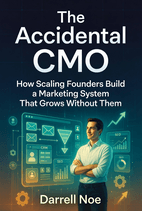
Darrell Noe's The Accidental CMO provides scaling founders with a framework to replace marketing chaos with a self-sustaining system, emphasizing architecture over activity and positioning over tactics. Written for those who unexpectedly inherited the CMO role, the book guides them to become intentional CEOs by building predictable, compounding growth infrastructure.
Feature
Insta.Page
Blinkist
Shortform
Summary Depth
Full Chapter-by-Chapter
15-min overview
Section-by-section guides
Audio Narration
✓
✓
✓
Visual Mindmaps
✓
✕
✕
AI Q&A
✓
✕
✕
Quizzes
✓
✕
✕
PDF Downloads
✓
✕
✓
Price
$89.99/yr
$146/yr (PRO)
$199/yr
*Competitor data last verified July 2026.
1 Page Summary
This book addresses the common predicament of founders who, as their companies scale, unexpectedly inherit the Chief Marketing Officer role by default. The central thesis is that the problem isn’t a lack of marketing talent, but a lack of marketing architecture. The author distinguishes between "activity" (tactical motion like running ads or posting content) and a functioning "system" that connects those efforts into predictable, repeatable growth. Founders are guided to shift from scrambling to build intentional infrastructure—including clear positioning, a converting website, and structured measurement—rather than relying on a scattered collection of tactics that produce chaos instead of compounding results.
The author’s approach is distinctive for its emphasis on structural thinking over tactical advice. Rather than offering a playbook of channel-specific hacks, the book focuses on sequencing: building a strong marketing foundation before adding fuel like paid ads or AI tools. A key insight is that AI, often seen as a silver bullet, is framed as a force multiplier that amplifies whatever system (or chaos) is already in place. The book also addresses the "vanity metrics trap," arguing that most marketing data measures what’s easy rather than what matters, and stresses the need for clear ownership and accountability to connect marketing activity directly to revenue.
The intended audience is scaling founders who did not plan to become marketing executives but find themselves making marketing decisions daily. These readers are likely frustrated by unpredictable revenue, fragmented efforts, and a sense that marketing is consuming time without producing reliable results. What they will gain is a framework for building a self-sustaining marketing system that operates without their constant involvement. The ultimate reward, as the book describes, is the transformation from an "accidental CMO," stuck in daily tactical decisions, to an "intentional CEO" who can focus on strategic opportunities while marketing operates as compounding infrastructure.
Introduction
Overview
You didn’t start your company to become a marketing executive. Yet here you are—somewhere between building a product and managing growth, marketing has landed on your desk like an uninvited houseguest. That’s the core premise of this introduction: founders often become accidental CMOs simply because no one else owns the full picture. The chapter frames marketing not as a collection of tactics but as a critical business function that, left to chance, creates chaos. The good news? You don’t need to become a marketing expert. You need to build a system where marketing can run correctly. That shift—from tactical scrambling to intentional infrastructure—is what this book aims to deliver.
The Weight of Unplanned Marketing Leadership
The moment a company starts scaling, the number of marketing decisions multiplies. Channels, agencies, metrics, AI tools—it all piles up. And because marketing rarely has a single accountable leader in early-stage companies, the founder inherits the role by default. This isn't a promotion you applied for; it's a responsibility that grows alongside the business. The frustration isn't incompetence—it's the sheer complexity of connecting scattered tactics into something coherent. The chapter normalizes that struggle, noting that almost every founder goes through it.
What a Marketing System Actually Looks Like
Instead of becoming an expert on ad platforms or algorithm updates, the book promises a different approach: treat marketing as infrastructure. A system where your website works like a salesperson, channels reinforce each other, reporting tells a clear story, and AI becomes leverage rather than a research project. Marketing stops being a slot machine and starts being a predictable machine. That predictability changes everything—sales conversations get easier, hiring gets less stressful, and founders can finally focus on running the business instead of untangling marketing problems.
The Hidden Cost of Staying on the Tactical Treadmill
Without intentional design, marketing degrades into disconnected experiments. Budgets grow, but results don't compound. Teams spend more time managing tools than building momentum. Meanwhile, companies that build structured marketing systems quietly pull ahead—not because they’re smarter, but because their efforts actually reinforce each other over time. The gap widens, and founders remain stuck as accidental CMOs. The chapter closes by reassuring readers that the messiness isn’t a sign of failure—it’s a natural byproduct of growth. The solution isn’t to do more; it’s to build a system that lets marketing work without you needing to own every detail.
Key Takeaways
Founders often become accidental CMOs because marketing leadership is assumed by default, not design.
You don’t need to master marketing tactics—you need to build a repeatable system.
Predictable growth comes from treating marketing as infrastructure, not a collection of experiments.
Without structure, marketing becomes chaotic, consumes leadership energy, and fails to compound.
The messiness of early marketing is normal; the fix is intentional design, not more effort.
Key concepts: Introduction
1. Introduction
The Accidental CMO Problem
Founders inherit marketing by default, not design
Marketing complexity grows faster than company size
No single accountable leader in early-stage companies
Marketing as Infrastructure
Treat marketing as a predictable system, not tactics
Website, channels, and reporting work together
AI becomes leverage, not a research project
Cost of Tactical Scrambling
Disconnected experiments waste time and budget
Results don't compound without structure
Founders remain stuck as accidental CMOs
The Solution: Intentional Design
Build a system that runs without you
Focus on infrastructure, not mastering tactics
Messiness is normal; fix with design, not effort
Predictable Growth Outcomes
Sales conversations become easier
Hiring and scaling become less stressful
Founders can focus on running the business
💡 Try clicking the AI chat button to ask questions about this book!
1. You Woke Up as the CMO
Overview
If your journey to Chief Marketing Officer felt less like a promotion and more like a surprise assignment, you’re in good company. This chapter names that experience—the accidental CMO—and unpacks why it happens in almost every growing company. It starts innocently enough. Early on, marketing feels simple: a referral here, a decent website there, and customers just show up. But as the business scales, the decisions multiply. You’re juggling hiring, operations, product roadmaps, and somewhere between “figure out payroll” and “why is the CRM broken again,” marketing lands on your desk.
Most founders default to what the author calls the “we’ll figure it out” phase. You hire a freelancer for social media, install an SEO plugin, run ads through an agency, and ask a friend to “take a look” at the website. Before long, you’ve assembled a pickup hockey team of marketing efforts—everyone has a position, but nobody has practiced together, and there’s no shared playbook. For a while, activity feels like progress. Until it doesn’t.
The underlying issue is structural. The kind of marketing that works at scale requires specialized roles: strategy, content, SEO, paid media, design, analytics, operations. But budgets are tied up in growth. So founders improvise, layering agencies, freelancers, and tools on top of each other, all while assuming marketing is “handled.” Eventually, the final decisions still land on the founder—the accidental CMO—who never trained for this. Marketing becomes a time sink, pulling leadership attention away from high-leverage decisions.
The hidden cost isn’t just poor performance. It’s the slow erosion of clarity. Founders often have a lightbulb moment in a routine meeting: they’re staring at dashboards full of charts, hearing smart people explain results, yet still unsure if any of it is actually working. The problem isn’t effort—it’s that marketing was never designed as a system. It was assembled, not architected. That recognition marks the turning point, and it’s the reason this book exists.
Key Takeaways
Accidental CMO is the norm: Most founders end up owning marketing by default, not design, because the business outgrew its original structure.
The “we’ll figure it out” phase has a shelf life: Improvising with freelancers, agencies, and tools works temporarily, but it creates a disconnected patchwork that eventually breaks down.
The real cost is leadership attention: When the CEO reviews ad copy or debates attribution models, strategic leverage is lost. Marketing becomes operational drag.
Clarity fades under complexity: More channels, more vendors, more opinions. Without a system, activity doesn't equal traction.
The fix is structural, not tactical: The goal isn’t to do more marketing—it’s to design the engine that connects strategy, execution, and measurement so it works without constant founder intervention.
Key concepts: 1. You Woke Up as the CMO
2. 1. You Woke Up as the CMO
The Accidental CMO Phenomenon
Most founders become CMO by default, not design
Business growth outpaces original marketing structure
Marketing lands on founder's desk amid other responsibilities
The 'We'll Figure It Out' Phase
Improvising with freelancers, agencies, and tools
Creates a disconnected patchwork of marketing efforts
Activity feels like progress but eventually breaks down
Structural Marketing Challenges
Scalable marketing requires specialized roles
Budgets tied to growth force improvisation
Final decisions still land on untrained founder
Hidden Costs of Accidental Marketing
Leadership attention diverted from high-leverage decisions
Clarity erodes under growing complexity
More channels and vendors don't equal traction
The Fix: Systemic Architecture
Design marketing as a system, not an assembly
Connect strategy, execution, and measurement
Create engine that works without constant founder input
2. Marketing Activity Without Marketing Architecture
Overview
Here's something nobody warns you about when a company starts scaling: marketing doesn’t fall apart all at once. It fragments quietly. One team runs ads, another publishes blog posts, a freelance designer rebuilds the homepage for the third time this year, and someone else sets up a dashboard that nobody quite knows how to interpret. From the outside, it looks like a busy, productive engine. From the inside, it feels like a group chat where everyone is talking and nobody is listening.
Ernest Hemingway summed it up in six words: “Never mistake motion for action.” Most growing companies don’t have a marketing problem—they have a motion problem. There’s plenty of activity, but no architecture to make any of it connect. That gap between motion and a functional system is the core of this chapter, and it’s worth sitting with.
The Trap of Tactics Masquerading as Strategy
The typical growth-stage meeting follows a predictable script. Someone suggests investing in SEO. Another person advocates for paid ads. A third recommends LinkedIn presence or more content. Then someone mentions AI, because of course they do. Suddenly, everyone has an opinion, and nobody has a conclusion.
None of those ideas is wrong. SEO, paid media, content, and AI can all drive real growth when executed with intention and aimed at the right audience. The problem isn’t the ideas—it’s when the ideas become the strategy. Tactics answer one question: “What should we do next?” Strategy answers a completely different one: “How is this supposed to work together?”
When you confuse the two, you end up with a lot of confident decisions that don’t add up to anything coherent. It’s like a construction site where every crew shows up ready to work, but nobody brought the blueprints. Concrete gets poured. Windows go in. Someone starts framing walls on the second floor. Impressive activity. Hard workers. But without a blueprint, there’s no guarantee any of it fits into an actual building.
Marketing can look exactly like that. Busy, productive, expensive, and quietly going nowhere.
The Channel Silo Problem
Once you see this pattern, you cannot unsee it. In most growing companies, different parts of marketing live in completely separate worlds. Each one does its own thing, measures its own success, and produces its own reports explaining why everything is going great.
The website was rebuilt eighteen months ago during a project that felt absolutely critical. It hasn’t been touched since, because everyone is afraid to open that can of worms again. Email campaigns run through a platform that maybe four people on the team fully understand, and two of them are on vacation. An agency handles paid ads, a freelancer manages social, and someone internally owns content when they can fit it between their eleven other responsibilities. A consultant set up a funnel six months ago that technically works, but nobody is quite sure how to read the results or which inbox the leads go to.
Individually, each effort makes some degree of sense. Collectively, they don’t talk to each other. At all.
This leads to one of the most quietly maddening experiences in business: the multi-vendor marketing review. You sit through back-to-back presentations. The SEO team shows improved rankings. The ad agency highlights rising impressions. The web developer walks through new features. The content team shares encouraging engagement numbers. Every single report shows progress.
And yet, somehow, you leave the meeting with more questions than you walked in with. That’s not a coincidence. That’s what happens when five people each play a different song at full volume and call it a band.
When Data Creates More Confusion
The natural response to all this chaos is to measure everything. More data means more clarity, right? Not exactly.
Modern marketing platforms make it embarrassingly easy to track clicks, impressions, bounce rates, scroll depth, time on page, conversion rates, open rates, and attribution models that six people built and exactly zero people fully understand. The result is reports stuffed with numbers that look important, sound important, and still don’t answer the one question leadership actually cares about.
Leadership isn’t losing sleep over click-through rates. They’re asking: “Is any of this actually driving growth or revenue?” That question tends to elicit uncomfortable silence.
The data exists, but the connection between marketing effort and business growth feels harder to explain than it should. It’s like getting a very detailed weather report that tells you wind speed, barometric pressure, humidity, and UV index—and still not knowing whether to bring an umbrella. More information with the same amount of confusion. The problem wasn’t a lack of data. It was a lack of context to put the data in. And context comes from structure.
AI: Amplifying the Chaos
Just when founders had almost figured out how to manage the existing chaos, AI showed up and turned the volume to eleven. Tools can now write blog posts, generate ad copy, build landing pages, analyze behavior, automate email sequences, and apparently do your taxes. The message is hard to miss: adopt AI immediately or get left behind.
So teams start experimenting. Someone uses AI to write content faster. Another person automates social posts. A consultant pitches an AI-powered system that will revolutionize everything for a reasonable monthly retainer.
Here’s the genuinely frustrating part: many of these tools are actually impressive. Used correctly, they can dramatically increase speed and efficiency. But this is the part that gets glossed over in every AI hype cycle: speed amplifies whatever system it’s layered on top of. When the system is solid, AI makes it faster and sharper. When the system is broken, AI just helps you scale the broken parts more efficiently. More content going nowhere. Campaigns missing the point. Dashboards showing activity that doesn’t connect to growth.
AI doesn’t fix a broken marketing system. It just helps you run into the same wall faster.
The Real Question: What Is This Costing?
Step back and look at the pattern. Tactics without strategy. Channels without connection. Data without context. AI without architecture. Every single one of these problems has the same root cause: marketing was built piece by piece rather than designed as a system.
Nobody made a bad decision. Nobody was cutting corners. The business grew, things got added, and somewhere in the middle of that forward momentum, the question of how it all fit together never made it to the top of the agenda. That’s how you end up with a marketing operation that looks busy, sounds productive, and still leaves you staring at the ceiling at 11 p.m., wondering why growth feels harder than it should.
Once you see that clearly, the question changes. It’s no longer “What should we try next?” It becomes: “What is this costing us?”
Key Takeaways
Activity is not action. A collection of tactics, no matter how impressive, is not a system.
When tactics become the strategy, you get confident decisions that don’t add up to anything coherent.
Channel silos create the illusion of progress: each vendor reports success, but nothing connects.
More data doesn’t help without context. Leadership needs to see marketing’s impact on growth, not isolated metrics.
AI amplifies whatever system it touches. It doesn’t fix broken architecture—it accelerates it.
The root cause is usually not bad decisions, but building piece by piece without a blueprint.
The real question is not “What should we try next?” but “What is the cost of operating without an architecture?”
Key concepts: 2. Marketing Activity Without Marketing Architecture
3. 2. Marketing Activity Without Marketing Architecture
Motion vs. Action
Marketing fragments quietly during scaling
Activity without architecture is motion, not action
Back-to-back presentations show individual progress
Yet leave more questions than answers
Like five songs at full volume called a band
Data Creating More Confusion
Measuring everything doesn't guarantee clarity
Reports stuffed with numbers, missing context
Leadership asks: 'Is this driving growth or revenue?'
AI Amplifying the Chaos
AI tools accelerate content and automation
Message: adopt AI immediately or get left behind
Experimentation adds to existing fragmentation
Need for Marketing Architecture
Gap between motion and functional system
Context comes from structure, not more data
Blueprints needed before any construction
3. When Marketing Chaos Starts Costing the Business
Overview
At first, the absence of marketing structure seems harmless. Revenue is growing, customers appear, and the chaos feels like a natural side effect of early momentum. But momentum and structure are not the same thing. Bursts of success—a strong referral, a lucky campaign, a piece of content that resonated—get mistaken for proof that the system is working. In reality, those wins are often unrepeatable. Growth becomes unpredictable. One quarter shines; the next goes quiet. The team pushes hard and results improve; when they ease up, momentum vanishes. Marketing becomes a treadmill, not a system. And the costs start piling up in ways that aren't immediately obvious.
Sales Feels the Problem First
The sales team is usually the first to notice the disconnect. Without a steady, predictable flow of opportunities, forecasting becomes guesswork and pipelines swing wildly between floods and droughts. Leads arrive with little context, messaging feels inconsistent, and the handoff between marketing and sales grows blurry. Marketing wonders why sales isn't closing more leads; sales wonders why leads aren't ready to buy. Neither side is wrong—they're just operating inside a system that was never fully designed to support them.
Budget Starts Disappearing
Without structure to guide decisions, marketing investments scatter. A little here for ads, a bit there for content, new AI tools added impulsively, consultants brought in for narrow problems. Each choice makes sense in isolation. Collectively, they quietly drain the budget without producing consistent growth. A year later, many of those tools sit unused, but the invoices keep arriving. The company ends up with a bloated stack and no clear sense of what actually moves the needle.
Leadership Attention Gets Pulled Away
The most insidious cost doesn't appear on any spreadsheet. It's the slow drain of the founder's attention. Marketing becomes another operational burden sitting on your desk. You're reviewing campaign ideas, weighing in on messaging, sitting through reports trying to separate signal from noise. Every new tactic demands a decision. Individually, none of these feels huge, but collectively they consume energy that should be spent on hiring, pricing, operations, or the next phase of growth. You start spending high-level energy on low-level decisions—and your role quietly shifts from leading the business to translating marketing. You become the person connecting dots between vendors, tools, and reports because no one else fully can. That is exhausting. Not dramatic exhaustion—the real kind that makes every marketing meeting feel heavier and creates low-grade frustration because you know you shouldn't be this involved just to keep the machine moving.
The Real Cost
The true price of becoming the Accidental CMO is not wasted budget or underperforming campaigns. It's what happens to you. Your day fragments, and marketing sneaks into parts of your life where it has no business. You sit down to think about the business's future, and instead you're debating ad spend or decoding an agency report full of colorful charts. The business keeps growing, but your attention gets trapped in a function that should have been built to support you—not consume you.
What This Means
Once a founder sees this clearly, the conversation changes. The question is no longer which tactic to try next. It becomes: Has marketing been designed to actually support growth, or is it just another pile of decisions the founder is forced to carry? That shift moves marketing from "things we need to keep trying" to "systems we need to build correctly." The goal stops being about keeping all the plates spinning and starts being about building something that works without the founder standing in the middle, arms flailing. That's where the conversation goes next.
Key Takeaways
Early growth can hide structural marketing problems; bursts of success are not proof of a sound system.
Sales teams first feel the chaos through inconsistent lead flow and unclear handoffs.
Marketing budgets get scattered across tools and tactics, draining resources without delivering predictable growth.
Leadership attention is the hidden cost—founders end up spending high-level energy on low-level marketing decisions.
The real goal is to move from chaotic activity to a structured system that supports growth without consuming the founder.
Key concepts: 3. When Marketing Chaos Starts Costing the Business
4. 3. When Marketing Chaos Starts Costing the Business
The Illusion of Success
Early growth hides structural marketing problems
Bursts of success are not proof of a sound system
Growth becomes unpredictable and unrepeatable
Marketing becomes a treadmill, not a system
Sales Feels the Disconnect First
Forecasting becomes guesswork without steady lead flow
Pipelines swing wildly between floods and droughts
Leads arrive with little context and inconsistent messaging
Marketing-sales handoff grows blurry and unproductive
Budget Drains Without Structure
Marketing investments scatter across tools and tactics
Each choice makes sense in isolation but drains collectively
Many tools sit unused while invoices keep arriving
No clear sense of what actually moves the needle
Leadership Attention Gets Trapped
Founder spends high-level energy on low-level decisions
Marketing becomes another operational burden on your desk
You shift from leading business to translating marketing
Low-grade frustration from being too involved in details
The Real Cost and the Shift Needed
True cost is founder's fragmented attention, not wasted budget
Marketing consumes you instead of supporting you
Goal shifts from tactics to building structured systems
System should work without founder standing in the middle
You've reached the end of the free chapters
Next chapter: “Growth Is a System” is locked
Keep reading The Accidental CMO — and unlock all 600+ book summaries with audio, mindmaps and AI Q&A.
$0.00 due today · 7 days free, then $89.99/year ($7.49/mo) · Cancel anytime before day 7
Darrell Noe is a writer and researcher specializing in military history and conspiracy theories. He is best known for his book *The Dark Side of the Moon: The Mountebank*, which explores secret space programs, and has contributed to alternative history publications. Noe's background includes extensive work in archival research and a focus on declassified government documents.
Frequently Asked Questions about The Accidental CMO
What is The Accidental CMO about?
The book addresses the common scenario where founders unexpectedly become chief marketing officers as their companies scale. It explains why marketing chaos happens when there is no structured system, and provides a framework to move from tactical scrambling to intentional marketing infrastructure. The book emphasizes building a foundation of positioning, visibility, measurement, and systems that make growth predictable and compounding.
Who is the author of The Accidental CMO?
Darrell Noe is the author who draws from his experience working with growth-stage companies and their marketing challenges. He understands the frustration founders face when inheriting marketing responsibilities without a background in the field. The book reflects his practical insights into creating marketing systems that work.
Is The Accidental CMO worth reading?
Yes, this book is worth reading for any founder or leader who finds themselves unexpectedly responsible for marketing. It provides a clear, actionable path from chaos to a compounding marketing system that reduces daily firefighting. The emphasis on building infrastructure rather than chasing tactics saves time and money while making revenue more predictable.
What are the key lessons from The Accidental CMO?
The most important lesson is that marketing chaos stems from a lack of architecture, not a lack of activity; founders must build a system that connects tactics. Another key takeaway is that foundational clarity—on positioning, website strategy, and conversion mechanics—must come before investing in growth channels. Finally, measurement should focus on revenue-connected metrics rather than vanity numbers, and AI should be used to amplify a solid foundation rather than create more noise.
📚 Explore Our Book Summary Library
Discover more insightful book summaries from our collection