The Accidental CMO Key Takeaways
by Darrell Noe
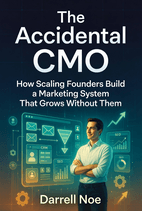
5 Main Takeaways from The Accidental CMO
Design marketing as a system, not a collection of tactics.
The book argues that most founders fall into the trap of assembling disconnected activities—freelancers, agencies, and tools—that create motion but not predictable growth. Instead of asking 'What should we try next?', you need to build an intentional growth system with four components: Attract, Engage, Convert, and Amplify. This structural shift turns marketing from a chaotic drain into an engine that runs without your constant involvement.
Fix your foundation before you spend on growth.
Before turning on paid media or chasing visibility, ensure your positioning is crystal clear and your website converts like a salesperson. If you can’t state who you help and why in one sentence, all additional traffic just accelerates wasted spend. The book emphasizes that every channel leads back to your site—so fix the conversion mechanics first, then add fuel.
Measurement needs a single owner connected to revenue.
Vanity metrics thrive because they are easy to measure, but they don’t show if the system is working. The accountability gap is fixed by assigning one person—not a reorg—to report on growth, not channels. Good reporting answers two questions: Is the system working, and where should I adjust? Everything else is decoration.
Use AI as an accelerant, not a replacement for system design.
AI amplifies whatever system it touches—so if your marketing architecture is broken, AI will only make it faster and messier. The winning approach is to build the system first (message, audience, channels), then layer AI for content velocity, insight generation, and personalization. Don’t let founders personally execute AI tasks; that signals no one owns the system.
Compounding comes from assets, not activity.
Campaigns produce spikes; a structured marketing system delivers consistency that builds on itself. The most valuable compound return is the founder’s time—freed from low-level marketing decisions to focus on strategic work only they can do. Intentional founders build assets that keep generating growth without requiring their daily presence.
Executive Analysis
The central argument of 'The Accidental CMO' is that founders who end up owning marketing by default must stop treating it as a collection of experiments and instead design a repeatable, intentional system. The five takeaways together form a roadmap: start by diagnosing the cost of chaos, build the structural foundation (positioning + website), create visibility with aligned channels, fix measurement with clear ownership, and then layer on AI as leverage. The book’s thesis is that predictable growth is an engineering problem, not a hero’s journey—and that the founder’s highest leverage move is to step out of day-to-day marketing decisions.
This book matters because it directly addresses a painful reality for thousands of startup founders and CEOs: the sinking feeling of being the default CMO with no time for strategy. It sits at the intersection of marketing operations, founder leadership, and business systems—offering a practical, step-by-step framework rather than just tactics. Unlike general marketing books, it names the specific burden of the Accidental CMO and gives a clear path to become an Intentional CEO. For any leader whose marketing feels like a leaky bucket, this book provides the blueprint to stop patching holes and build a pump.
Chapter-by-Chapter Key Takeaways
Introduction (Introduction)
Founders often become accidental CMOs because marketing leadership is assumed by default, not design.
You don’t need to master marketing tactics—you need to build a repeatable system.
Predictable growth comes from treating marketing as infrastructure, not a collection of experiments.
Without structure, marketing becomes chaotic, consumes leadership energy, and fails to compound.
The messiness of early marketing is normal; the fix is intentional design, not more effort.
Try this: Audit your current marketing activity and identify the single decision you make most often (e.g., approving ad copy); stop doing it and instead design a process that makes that decision without you.
1. You Woke Up as the CMO (Chapter 1)
Accidental CMO is the norm: Most founders end up owning marketing by default, not design, because the business outgrew its original structure.
The “we’ll figure it out” phase has a shelf life: Improvising with freelancers, agencies, and tools works temporarily, but it creates a disconnected patchwork that eventually breaks down.
The real cost is leadership attention: When the CEO reviews ad copy or debates attribution models, strategic leverage is lost. Marketing becomes operational drag.
Clarity fades under complexity: More channels, more vendors, more opinions. Without a system, activity doesn't equal traction.
The fix is structural, not tactical: The goal isn’t to do more marketing—it’s to design the engine that connects strategy, execution, and measurement so it works without constant founder intervention.
Try this: Map every marketing channel and vendor you currently use onto a single timeline or funnel diagram—if the connections are unclear, treat that as your top fix before adding anything new.
2. Marketing Activity Without Marketing Architecture (Chapter 2)
Activity is not action. A collection of tactics, no matter how impressive, is not a system.
When tactics become the strategy, you get confident decisions that don’t add up to anything coherent.
Channel silos create the illusion of progress: each vendor reports success, but nothing connects.
More data doesn’t help without context. Leadership needs to see marketing’s impact on growth, not isolated metrics.
AI amplifies whatever system it touches. It doesn’t fix broken architecture—it accelerates it.
The root cause is usually not bad decisions, but building piece by piece without a blueprint.
The real question is not “What should we try next?” but “What is the cost of operating without an architecture?”
Try this: Calculate the hidden cost of your marketing chaos by estimating how many hours per week you spend on tactical decisions, then multiply by your hourly rate; that number is your incentive to build architecture.
3. When Marketing Chaos Starts Costing the Business (Chapter 3)
Early growth can hide structural marketing problems; bursts of success are not proof of a sound system.
Sales teams first feel the chaos through inconsistent lead flow and unclear handoffs.
Marketing budgets get scattered across tools and tactics, draining resources without delivering predictable growth.
Leadership attention is the hidden cost—founders end up spending high-level energy on low-level marketing decisions.
The real goal is to move from chaotic activity to a structured system that supports growth without consuming the founder.
Try this: Write down the exact lead handoff process between marketing and sales, then run a real test with three leads—if the handoff fails, fix the handoff before spending more on lead generation.
Next chapter: “4. Growth Is a System” is locked
Keep learning from The Accidental CMO — and unlock all 600+ book summaries with audio, mindmaps and AI Q&A.
$0.00 due today · 7 days free, then $89.99/year ($7.49/mo) · Cancel anytime before day 7
plus sales tax where applicable