As an Amazon Associate, we earn from qualifying purchases.
What is the book Hooked about?
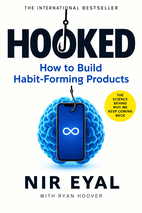
Nir Eyal's Hooked presents the Hooked Model—trigger, action, variable reward, investment—for building habit-forming products, drawing on Fogg, Skinner, and Ariely. Written for product designers, entrepreneurs, and builders, it includes habit-testing methods, the Manipulation Matrix, and case studies.
Feature
Insta.Page
Blinkist
Shortform
Summary Depth
Full Chapter-by-Chapter
15-min overview
Section-by-section guides
Audio Narration
✓
✓
✓
Full access to all 700+ summaries
✓
✓
✓
Visual Mindmaps
✓
✕
✕
AI Q&A
✓
✕
✕
Missing a book? Request it, usually live within 48h
✓
✕
✕
Quizzes
✓
✕
✕
PDF Downloads
✓
✕
✓
Send to Kindle
✓
✓
✓
Price
$89.99/yr
$146/yr (PRO)
$199/yr
*Competitor data last verified July 2026.
1 Page Summary
Nir Eyal's Hooked: How to Build Habit-Forming Products argues that the products which matter most are those people return to on their own, without prompting. Habits, which the book says make up nearly half of daily behavior and are stored in the brain's basal ganglia, give such products four advantages: customers stay longer and spend more, they compare prices less, growth accelerates through more frequent referral opportunities, and good routines can beat objectively better products—John Gourville found a new product must be nine times better to win. To explain how these habits are built, Eyal introduces the Hooked Model, a four-phase loop of trigger, action, variable reward, and investment. External triggers—paid, earned, relationship, and owned—tell people what to do next, while internal triggers, often negative emotions like boredom, loneliness, or stress, fire on their own once a product becomes linked to relieving that pain. Action follows B.J. Fogg's formula that behavior occurs only when motivation, ability, and a trigger converge at once, and variable reward keeps users coming back because, as Brian Knutson's gambling studies showed, the brain responds to the anticipation of relief rather than the reward itself. Finally, the investment phase asks users to put work into the product, since effort creates value—demonstrated by Dan Ariely's finding that people bid about five times more for origami they folded themselves, the so-called IKEA effect.
What distinguishes the book is Eyal's effort to treat habit formation as a practical, testable design method rather than a purely theoretical or manipulative exercise. He closes with a set of five diagnostic questions covering internal trigger, external trigger, action, variable reward, and investment, and offers a morality framework—the Manipulation Matrix—to help builders decide whether a hook should be attempted at all. Eyal acknowledges the ethical stakes directly, citing Ian Bogost's description of habit-forming tech as the "cigarette of this century," while noting that manipulation is not automatically deplorable, as programs like Weight Watchers demonstrate. He also provides a Habit Testing method shaped by the lean start-up cycle of "build, measure, learn," which reads usage data to identify devoted users, discover which elements form habits, and understand why, plus case studies of the Bible App and a fitness app that show the model operating in very different contexts.
The book is written for product designers, entrepreneurs, and builders who want to create experiences people return to without being prompted, and for anyone weighing the responsibility that comes with that power. Readers will gain a structured vocabulary for diagnosing where a product's habit loop breaks down—whether internal triggers rarely fire, external triggers arrive at the wrong moment, actions are too hard, rewards fail to satisfy, or investments fail to load the next trigger—along with a repeatable method for testing prototypes against real usage data. Rather than promising a formula for virality, Hooked offers a framework for recognizing habit-forming opportunities, measuring them honestly, and deciding, before building, whether a given hook serves users or exploits them.
1: The Habit Zone
Overview
Some products only matter if people come back on their own. No company can force that. The real test is the jump from using something once in a while to using it without thinking. That's where growth either builds or flatlines.
Running on autopilot
One evening, instead of his usual morning jog, a man greeted strangers with "Good morning." Later, he shaved in the shower. Habits are behaviors we do with little or no conscious thought. The brain stores them in the basal ganglia, which frees up attention for other things. The book says these automatic behaviors make up nearly half of what we do each day.
Why habits pay
When a product needs people to come back without being prompted, habits give it four advantages:
Customers stay longer and spend more over time.
People stop comparing prices as much. Buffett's investments in See's and Coca-Cola rested on that.
Growth speeds up because frequent use means more chances to refer others. Even cutting the time in half makes a huge difference.
Good routines can beat better products. John Gourville found a new product needs to be nine times better to win. That's why QWERTY outlasted the faster Dvorak keyboard.
New habits are fragile. They work like a stack of plates: the last one on top comes off first. That's why alcoholics and dieters often slip back. Frequency makes habits stronger. A University College London study on flossing found that repeating the action built a stronger habit.
The Habit Zone
The Habit Zone maps how often you do something against how useful you think it is. Enough of both makes it automatic. Doing something often can make up for it not feeling that useful. But if you rarely do it, it never becomes a habit. It can take weeks to more than five months to form one. This challenges the old investor rule that products should be painkillers, not vitamins. Facebook, Twitter, Instagram, and Pinterest don't relieve any obvious pain. But people use them so often that they become habits. A habit is something you feel a nagging pull to do.
Habit-forming products exist to relieve that nagging pull. Using them feels better than not using them. So should a product be a vitamin or a painkiller? Both. It starts as an optional vitamin. Once the routine forms, it becomes a painkiller. People avoid discomfort, so that discomfort pushes them toward a solution. The habit is the link between their problem and the product.
Habits are not addictions
Addiction means a compulsive dependence on something that harms you. It's self-destructive by definition. Building products that rely on addiction means deliberately hurting people. A habit, though, can make life better. Brushing your teeth, showering, saying thanks, even that misplaced "Good morning" on an evening jog, all happen without thinking. Healthy routines are everywhere. Products could help people exercise, work better, or stay close to the people they love. They come back on their own, without ads or spam.
The Hooked Model
The Hooked Model is the framework that connects a person's problem to a product's solution. The next chapters go through it step by step. It's not written for social media companies and game studios. They already know these tricks. It's for builders who want to help people do what they already mean to do but can't, because of bad design. Understanding how the mind works makes it more likely you'll build the right product sooner.
Key Takeaways
The goal is people using your product without being reminded. That's not a retention stat. It's the whole point. Nearly half of daily behavior runs on autopilot, and your product needs to live in that space long enough to become the default.
Focus on building a habit, not just getting someone to sign up once. Loyal users spend more over time, stop shopping around on price, refer others faster, and keep an okay product ahead of a rival that's nine times better.
Get your product into the Habit Zone by boosting both how often people use it and how useful they think it is. If they rarely use it, it never becomes automatic. But if they use it often, even a low-value vitamin can become a default behavior.
Don't choose between painkiller and vitamin. Launch as an optional extra. Then let the user's own routine turn it into the thing they reach for when they feel off without it.
Point the Hooked Model at things people already want to do, like exercising, working efficiently, or staying close to people they love. That builds healthy habits. Addiction would mean deliberately hurting the user.
Key concepts: 1: The Habit Zone
1: The Habit Zone
The Power of Habit
Habits are automatic behaviors stored in the basal ganglia, freeing attention.
Nearly half of daily actions are habitual, done with little conscious thought.
Products must become habits to drive unprompted, repeated use.
Why Habits Pay Off
Habitual users stay longer, spend more, and become less price-sensitive.
Frequent use accelerates growth through more referral opportunities.
Strong habits can beat superior products; new products need to be 9x better.
The Habit Zone
Habit formation requires sufficient frequency and perceived utility.
High frequency can compensate for low utility; low frequency prevents habits.
Products start as vitamins (optional) and become painkillers (relieving nagging pull).
Habits vs. Addiction
Addiction is compulsive, harmful dependence; habits can improve life.
Healthy routines like brushing teeth or exercising happen automatically.
Products should help users do what they already want to do, not exploit them.
The Hooked Model
Framework connecting user problems to product solutions.
Aims to help builders create products that form healthy habits.
Understanding mind mechanics leads to better products sooner.
💡 Try clicking the AI chat button to ask questions about this book!
2: Trigger
Overview
Why do some products become daily rituals while others are abandoned after a week? Usefulness and design alone don't explain it. Something harder to see decides whether a behavior sticks.
A habit is built, not created. A trigger starts the behavior, and repetition turns it into a routine.
External triggers tell people what to do next. There are four types:
Paid: advertising that brings in new users but can't keep them coming back.
Earned: press mentions and store features, free but fleeting.
Relationship: word of mouth and referrals; honest sharing spreads fast, but pressuring people to share destroys trust.
Owned: icons, notifications and newsletters users sign up for, reminding them to return until the habit forms.
Internal triggers
Internal triggers fire on their own. The next action is a link stored in memory. Negative emotions are the strongest cues: boredom, loneliness, stress, confusion and fear of missing a moment are small pains. A product that eases the pain gets linked to the feeling, and users come back without being prompted.
According to the book, one study tracked 216 undergraduates and tied depressive symptoms to heavier Internet use, reading it as relief-seeking.
Designing for triggers
The 5 Whys method, from Toyota's production system, asks why five times to get at the real emotion, like the fear behind checking e-mail.
Instagram shows the sequence: a friend's referral and owned notifications brought Yin in; then internal cues, fear that a special moment will vanish, boredom, and FOMO, kept her snapping.
Wild trigger ideas can lead to methods that turn out to be far more practical than they first sound. New technologies will create cue points we can't picture yet.
Key Takeaways
Match the trigger to the job: paid and earned triggers bring in new users, while owned and relationship triggers keep them returning long enough to form a habit.
Negative emotions are the most reliable internal triggers. Find the relief your product offers and make it immediate, so the feeling itself becomes the cue to return.
Run the 5 Whys when mapping a habit. The surface reason is rarely the real one; keep digging to find the emotion underneath behaviors like inbox checking.
A trigger idea that seems impractical today can become ordinary tomorrow. Keep brainstorming, and watch for new devices that make new cue points possible.
Key concepts: 2: Trigger
2: Trigger
The Role of Triggers in Habit Formation
Habits are built through repetition, not created instantly.
A trigger initiates behavior; repetition turns it into routine.
Usefulness and design alone don't explain why habits stick.
External Triggers
Paid: advertising brings new users but can't retain them.
Earned: press mentions and store features are free but fleeting.
Relationship: word of mouth spreads fast; pressuring destroys trust.
Owned: icons, notifications, newsletters remind users to return.
Internal Triggers
Internal triggers fire automatically from memory links.
Negative emotions like boredom, loneliness, stress are strongest cues.
Products easing pain get linked to feelings, prompting unprompted returns.
Study links depressive symptoms to heavier Internet use as relief-seeking.
Designing for Triggers
5 Whys method digs to real emotion behind behaviors like email checking.
Instagram example: referrals and notifications led to internal cues like FOMO.
Wild trigger ideas can become practical; new tech creates new cue points.
Key Takeaways
Match trigger to job: paid/earned acquire, owned/relationship retain.
Negative emotions are reliable internal triggers; make relief immediate.
Run 5 Whys to find underlying emotions; surface reasons are rarely real.
Impractical trigger ideas can become ordinary; keep brainstorming.
3: Action
Overview
A trigger only matters if the user acts. But many designed experiences stall right at that moment. Something beyond prompting decides whether behavior happens, and product designers need to know what that something is before habits can form.
A trigger that leads to no action does nothing. The Hooked Model's action phase requires real behavior. Habits run with little or no conscious thought, so doing has to be easier than thinking.
B. J. Fogg runs Stanford's Persuasive Technology Lab. He says behavior happens when three things come together: motivation, ability, and a trigger. All three have to be there at once. If any one is missing, the user won't act. Think of a phone call you ignore. A phone buried in a bag limits ability. An unwanted caller kills motivation. A silenced ringer removes the trigger.
Psychologist Edward Deci calls motivation the energy for action. Fogg boils it down to three Core Motivators, each with two sides: pleasure and pain, hope and fear, acceptance and rejection. Obama's 2008 Shepard Fairey poster sold hope. A motorcycle helmet ad sold fear. Different people respond to different levers, so knowing your users matters.
Denis J. Hauptly says innovation means removing steps. Understand why people use the product. Lay out the customer's steps from intention to outcome. Then remove steps until the simplest process remains.
Evan Williams, cofounder of Blogger, Twitter, and Medium, says the same thing. Find a lasting human desire and use technology to take out steps. Fogg's six elements of simplicity are time, money, physical effort, brain cycles, social deviance, and non-routine. Designers should focus on whatever resource is scarcest for the user at that moment. Removing friction usually beats raising motivation. Facebook Login, Google's clean page, the iPhone lock-screen camera, and Pinterest's infinite scroll all reduced friction. Twitter's home page traded 2009's dense motivational copy for 2012's near-empty sign-in page. Kahneman's behavioral economics adds a caveat: even demand's response to price is a tendency, not an absolute.
Heuristics are mental shortcuts people use to form opinions and make decisions without thinking hard. They make users predictable even when no one notices them. Four are especially important.
In 1975, Stephen Worchel, Jerry Lee, and Akanbi Adewole placed identical cookies in two jars, one holding ten and one holding two. People rated cookies in the near-empty jar higher. Scarce cookies seemed more valuable. When eight cookies were added to a once-scarce jar, its cookies fell below the value of cookies that had never been scarce. Amazon uses the same cue with "only 14 left in stock" notices.
Joshua Bell, a violinist who can fill Carnegie Hall, drew few listeners when he busked in a Washington subway. In a 2007 fMRI study, wine tasters were told prices rising from $5 to $90. Reported enjoyment and brain pleasure signals rose with the stated price, yet the wine tasted was identical. The price tag shaped the experience, not the wine.
A discounted three-pack of Jockey undershirts marked "buy one, get one half off" was priced at $29.50. A five-pack of Fruit of the Loom cost $34. The unmarked five-pack won per shirt, but the sale tag anchored the shopper's quick judgment.
Pre-punched car wash cards show the endowed progress effect. Customers who started with a ten-space card containing two free punches completed purchases at an 82 percent higher rate than customers facing a blank eight-space card, though every customer paid for eight washes. LinkedIn's profile strength bar gives new users visible progress that isn't earned yet, so completion feels reachable.
These are just a few of hundreds of cognitive biases that shape split-second choices. Product designers use them to boost ability and motivation during the Hooked Model's second phase, leading to the reward users came for.
Before optimizing anything else, check that your users have motivation, ability, and a trigger all at once. If any one is missing, they won't act.
Treat step removal as your core design tactic. Map the user's journey from intention to outcome. Ask what lasting desire drives them. Then cut steps until only the simplest flow remains.
Focus your simplification on whatever resource is scarcest for that user in that moment. Removing friction usually beats motivational appeals that cost a lot and get ignored.
Choose just one lever from the core motivators that your specific audience feels most strongly, whether pain or pleasure, hope or fear, acceptance or rejection.
Use scarcity, framing, anchoring, and endowed progress to steer split-second decisions. But remember these cues work by shifting what people think something is worth rather than adding real value.
Key concepts: 3: Action
3: Action
Fogg Behavior Model
Behavior occurs when motivation, ability, and trigger converge simultaneously.
Missing any one element prevents action.
Motivation: energy for action; ability: ease of performing behavior.
Trigger: cue that prompts the behavior.
Core Motivators
Three pairs: pleasure/pain, hope/fear, acceptance/rejection.
Different people respond to different motivational levers.
Know your audience to choose the right motivator.
Example: Obama poster sold hope; helmet ad sold fear.
Simplicity and Friction Reduction
Innovation means removing steps from intention to outcome.
Fogg's six elements: time, money, physical effort, brain cycles, social deviance, non-routine.
Focus on the scarcest resource for the user at that moment.
Removing friction usually beats raising motivation.
Heuristics and Cognitive Biases
Mental shortcuts make users predictable.
Scarcity: scarce items seem more valuable (cookie study).
Framing: price tag shapes experience (wine study).
Anchoring: sale tags anchor quick judgments.
Design Principles for Action
Ensure motivation, ability, and trigger are present before optimizing.
Treat step removal as core design tactic.
Simplify based on scarcest resource.
Choose one core motivator lever for your audience.
4: Variable Reward
Overview
Once a product reliably solves a problem, users take it for granted. Predictable rewards stop holding attention. Adding unpredictability keeps people coming back, but the challenge is sustaining engagement without abusing that vulnerability.
The biology of reward
The third step in the Hooked Model is unpredictable reward: solving the user's problem reinforces the action just taken. In the 1940s James Olds and Peter Milner implanted electrodes in the brains of lab mice. The animals crossed electrified grids and gave up food and water for the chance to press the lever. They believed they had found the brain's pleasure center. Brian Knutson's gambling studies corrected this. The brain region lit up when people expected a payout, not when they got one. What drives us is the craving for relief, not the pleasure itself.
Unpredictability
Rewards have to stay surprising. Babies giggle at a dog because its next move is uncertain, then lose interest once it becomes predictable. The brain turns predictable cause-and-effect patterns into habits to save attention. Something new forces it to pay attention again. B.F. Skinner's pigeons pecked far more often when pellets arrived on a random schedule. The same dopamine charge shows up in humans.
Three reward types
Habit-forming products draw on one or more of these drives. The tribe is about social acceptance, inclusion, and importance. The hunt is about reaching for resources and information. The self is about mastery and completion.
Rewards of the tribe
Social rewards follow Albert Bandura's research: people adopt behavior after watching others like themselves get rewarded. Stack Overflow runs on this. Software engineers answer hard questions because votes, points, and badges arrive unpredictably and turn contribution into peer esteem.
Rewards of the hunt
Harvard biologist Daniel Lieberman traces the type to persistence hunting. San hunters of South Africa run a kudu until it collapses because a quadruped can't gallop and pant at once. Pinterest triggers the same pursuit digitally. Its feed cuts off images at the bottom of the screen, so the user has to scroll to see the whole picture.
Rewards of the self
Edward Deci and Richard Ryan identified internal motivation, the kind that comes from inside a person. Codecademy builds it into coding lessons: immediate feedback, varied success and failure, steady visible progress.
The limits of rewards
Giving rewards does not guarantee a habit. Mahalo Answers, launched in May 2007, tried a financial incentive for posting questions and answers.
Bounties versus social rewards
Mahalo's mistake was paying. Its Mahalo Dollars bounties, redeemable for cash, drew 14.1 million monthly users at their peak, but engagement collapsed because monetary rewards did not match why people ask questions. Quora, launched in 2010 by two former Facebook employees, paid nothing. Its upvotes and peer recognition, showing up often and visibly, proved stronger than cash. Gamification, the use of game-like elements outside games, works only when it scratches a user's existing itch. Rewards have to fit the product's story and the user's internal triggers.
Autonomy
Quora itself blundered in 2012 by introducing Views, which revealed visitors' identities, and enrolling users automatically. The revolt forced an opt-in policy. Psychologists call resistance to constrained choice reactance. In a French study, adding "But you are free to accept or refuse" doubled bus fare donations. A review of 42 studies with over 22,000 participants confirmed the effect. Affirming a person's freedom defuses reactance.
The same principle separates successful habit products from chores. The author quit MyFitnessPal because tracking calories felt forced; one missed meal spoiled the day. Fitocracy worked for him by replicating gym conversation. After his first run he received kudos, and he answered a user's question about knee pain. Social acceptance is a first step into a new routine. Products that change behavior present an implicit choice between an old routine and a better alternative, and people must want to use the service, not feel obligated.
When novelty runs out, and when it doesn't
Entertainment like Breaking Bad depends on unresolved conflicts; the story is engaging until it ends. Once the plot is known, re-watching is less exciting. Zynga is a clear example of novelty running out. FarmVille reached 83.8 million monthly users and produced $36 million in 2010 revenue, and the company was valued above $10 billion in March 2012. By November it had lost over 80 percent of its value because copycat games were predictable. A limited set of surprises eventually becomes routine. Endless surprise keeps going, as with World of Warcraft, where people change the game, and user-generated content sites like Dribbble, YouTube, and Facebook.
When the product is already unpredictable
Products operating in conditions that are already unpredictable should not add uncertainty. Google search and Uber rides are already variable; users want control. Uber's interface lets riders locate the car and estimate arrival, offering control over traffic they cannot control. Email uses all three rewards: obligation to respond (tribe), curiosity about its content (hunt), and clearing unread messages (self). After unpredictable reward comes the final phase, investment.
Unpredictable reward must not exhaust itself in a single use. It has to satisfy the user's immediate need and, at the same time, leave the user wanting to return and engage again.
The product team can test this principle with three exercises. First, conduct open-ended interviews with five customers, asking what they find enjoyable, encouraging, or satisfying about the product, and watch for moments of delight or surprise. Second, map the steps a customer takes toward habitual use, identify the reward that relieves the user's pain, then judge whether that reward is fulfilling yet leaves the user wanting more. Third, brainstorm one way each to heighten the user's search for rewards drawn from three categories. Rewards of the tribe come from other people. Rewards of the hunt come from material goods, money, or information. Rewards of the self come from mastery, completion, competency, or consistency.
Key Takeaways
Vary the reward schedule. Unpredictable outcomes keep the behavior alive because anticipation, not payout, drives craving. Once the pattern becomes routine, engagement fades.
Match the reward to one of three existing drives: tribe for peer recognition, hunt for resources or information, or self for mastery and completion. Don't invent a motivation the product cannot sustain.
Avoid handing out cash or generic game points unless the user already cares about them. Paid bounties attract activity but collapse when the reward has nothing to do with why the user came.
Protect voluntary use. Forced features and exposed choices trigger reactance and make the product feel like an obligation. An open choice turns the new routine into a better alternative.
Prefer endless surprise to a limited sequence of novelty. Predictable stories and copycat mechanics lose their draw, so let users, content, or changing conditions renew the interaction.
Key concepts: 4: Variable Reward
4: Variable Reward
Biology of Reward
Olds and Milner's mice pressed levers over food and water
Knutson: brain lights up when expecting payout, not receiving it
Craving for relief drives us, not pleasure itself
Unpredictability
Predictable rewards become habits; brain saves attention
Skinner's pigeons pecked more with random pellet schedules
Surprise forces attention; same dopamine charge in humans
Nir Eyal is an author, lecturer, and investor who teaches at Stanford Graduate School of Business and the Hasso Plattner Institute of Design. He is best known for his bestselling books Hooked: How to Build Habit-Forming Products and Indistractable: How to Control Your Attention and Choose Your Life. His work focuses on behavioral design, consumer psychology, and the intersection of technology and human behavior.
Frequently Asked Questions about Hooked
What is Hooked about?
The book presents the Hooked Model, a four-step loop of trigger, action, variable reward, and investment that companies use to build habit-forming products. It explains how habits form in the brain, why they give businesses advantages like faster growth and less price sensitivity, and how to design products that users return to without conscious thought. It also tackles ethical questions about manipulation, offers case studies of apps like the Bible App, and provides a habit-testing method to evaluate and improve products.
Who is the author of Hooked?
The author is Nir Eyal. He draws on behavioral science and product design research to present a practical framework for creating habit-forming products.
Is Hooked worth reading?
Yes, it is worth reading for product designers, entrepreneurs, and marketers who want to understand what makes people come back to a product automatically. The book gives a clear, actionable model backed by research and real-world examples, while also prompting important reflection on when persuasion crosses into manipulation.
What are the key lessons from Hooked?
The core lessons are the four phases of the Hooked Model: external and internal triggers, actions that require motivation, ability, and a trigger, variable rewards that keep users curious, and investments that make users value the product and load the next trigger. Habits are automatic behaviors that make up nearly half of daily actions, and they can give products a powerful edge over competitors. Builders should test their ideas with real users, use habit testing to find devoted users and weak points, and apply the manipulation matrix to ensure they are building healthy habits rather than exploiting users.
📚 Explore Our Book Summary Library
Discover more insightful book summaries from our collection