Hooked Quotes
by Nir Eyal
As an Amazon Associate, we earn from qualifying purchases.
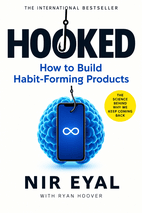
This page gathers lines from Nir Eyal's Hooked that stick with you after you close the book. You will find crisp observations about habits, triggers, cravings, and the small design choices that shape repeated behavior. Some lines are practical, some are philosophical, and a few ask uncomfortable questions about responsibility.
What makes these quotes worth sharing is how they compress big product ideas into plain language. They work whether you build apps, run a business, or just wonder why certain routines feel so hard to break. The book is quotable because it names familiar experiences and then turns them into a lens for better decisions.
Top Quotes from Hooked
“A habit is when not doing an action causes a bit of discomfort.”
Near the end of the chapter, Eyal defines habit in the context of vitamins versus painkillers.
It gives a simple, visceral test for habit: absence creates an itch-like discomfort.
“To initiate action, doing must be easier than thinking.”
The chapter introduces the action phase of the Hooked Model.
It captures the core design principle that friction must be lower than thought for a habit to form.
“The study revealed that what draws us to act is not the sensation we receive from the reward itself, but the need to alleviate the craving for that reward.”
The author summarizes Brian Knutson's fMRI study on anticipation versus reward.
It reframes engagement as a craving loop rather than simple pleasure. This helps explain why anticipation can be more compelling than the reward itself.
“The more users invest time and effort into a product or service, the more they value it. In fact, there is ample evidence to suggest that our labor leads to love.”
The chapter introduces the investment phase and the escalation of commitment.
It states the core psychological payoff of user investment in one memorable line. 'Labor leads to love' is the chapter's thesis.
“The Hooked Model is fundamentally about changing people's behaviors, but the power to build persuasive products should be used with caution. Creating habits can be a force for good, but it can also be used for nefarious purposes.”
The author introduces the Manipulation Matrix section by questioning the ethics of building habit-forming products.
It names the dual-use power of persuasive design, reminding builders that habit formation is never morally neutral.
“The matrix seeks to help you answer not “Can I hook my users?” but instead “Should I attempt to?””
The author introduces the Manipulation Matrix as a decision-support tool for entrepreneurs and product makers.
It reframes ethics from technical capability to intentional choice, making the core question memorable.
“Instead of asking ‘what problem should I solve?’ ask ‘what problem do I wish someone else would solve for me?”
Paul Graham advises entrepreneurs to build for their own needs.
It reframes startup ideation as personal problem-solving, making the resulting product more likely to feel essential.
Themes Behind the Quotes
A major theme is the loop that turns a product into a habit. A cue appears, an action feels easy, a reward arrives with some unpredictability, and the user invests more over time. Each step makes the next one feel more natural, until the behavior starts to run with little deliberate attention.
Another theme is the double edge of persuasive design. The same techniques that help people build useful routines can also create harmful dependence, so builders face questions about intent, transparency, and care. Underneath it all is a practical challenge: solve a real desire, reduce effort, and ask what you would want someone to build for you.
Quotes by Chapter
1: The Habit Zone
“Such is the nature of ingrained habits— behaviors done with little or no conscious thought—which, by some estimates, guide nearly half of our daily actions.”
The author reflects on how a shifted run led him to unconsciously greet people and shave in the evening.
It captures how much of daily life runs on autopilot and makes habit’s invisible influence feel measurable.
“Habit-forming products change user behavior and create unprompted user engagement.”
Eyal introduces the business value of habits in the section “Why Habits Are Good for Business.”
It distills the core commercial promise of habit-forming design in one sentence.
“User habits are a competitive advantage. Products that change customer routines are less susceptible to attacks from other companies.”
In the “Sharpening the Competitive Edge” section, Eyal explains why habits protect products from rivals.
It frames habits as a moat: once customers’ routines change, competitors must overcome inertia, not just features.
2: Trigger
“Habits are like pearls. Oysters create natural pearls by accumulating layer upon layer of a nacre called mother-of-pearl, eventually forming the smooth treasure over several years.”
The chapter introduces the idea that habits are built over time, using an oyster-and-pearl metaphor.
It turns a complex behavioral process into a vivid image, making the gradual, layered nature of habit formation easy to remember.
“A trigger is the actuator of behavior—the grit in the oyster that precipitates the pearl.”
The author defines the role of a trigger in behavior.
It crystallizes the trigger’s function as the small but essential catalyst that sets behavior in motion.
“When a product becomes tightly coupled with a thought, an emotion, or a preexisting routine, it leverages an internal trigger.”
The chapter explains what it means when a product becomes tied to an internal trigger.
It defines internal triggers in a way that shows how products become woven into thoughts, feelings, and routines.
“Emotions, particularly negative ones, are powerful internal triggers and greatly influence our daily routines.”
The author describes how emotions act as internal triggers in daily life.
It highlights the emotional roots of habitual behavior and why negative feelings are so powerful in driving action.
3: Action
“The more effort—either physical or mental—required to perform the desired action, the less likely it is to occur.”
The chapter explains why effort prevents habit-forming actions.
It makes the cost of friction concrete: even small physical or mental burdens reduce behavior.
“Fogg posits that there are three ingredients required to initiate any and all behaviors: (1) the user must have sufficient motivation; (2) the user must have the ability to complete the desired action; and (3) a trigger must be present to activate the behavior.”
The chapter introduces Dr. B. J. Fogg’s behavior model.
It encapsulates the three conditions that must coincide for any action to happen.
“Take a human desire, preferably one that has been around for a really long time... . Identify that desire and use modern technology to take out steps.”
Evan Williams, cofounder of Blogger, Twitter, and Medium, describes his approach to building successful companies.
It captures a repeatable innovation strategy: find a longstanding human desire and remove steps from fulfilling it.
4: Variable Reward
“To form the learned associations we discussed in chapter 2, the trigger phase, users must come to depend on the product as a reliable solution to their problem—the salve for the itch they came to scratch.”
The author explains what must happen before variable rewards can create habitual use.
It captures the foundation of habit formation: a product must first feel like a dependable fix. Only then can variable rewards deepen the relationship.
“Without variability we are like children in that once we figure out what will happen next, we become less excited by the experience.”
The author uses a child's reaction to a dog to illustrate why predictability dulls attention.
It explains why novelty is essential for sustained engagement. Predictable experiences quickly lose their power to hold us.
“The dogged determination that keeps San hunters chasing kudu is the same mechanism that keeps us wanting and buying.”
The author connects persistence hunting to modern consumer behavior.
It links an ancient survival drive to contemporary habits like shopping and scrolling. The line makes the evolutionary basis of desire feel vivid and immediate.
5: Investment
“The big idea behind the investment phase is to leverage the user's understanding that the service will get better with use (and personal investment). Like a good friendship, the more effort people put in, the more both parties benefit.”
The chapter summarizes the rationale for the investment phase after discussing reciprocity.
It frames product investment as a relationship that compounds with use. The friendship analogy makes the abstract retention mechanic memorable.
“In the investment phase, however, asking users to do a bit of work comes after users have received variable rewards, not before. The timing of asking for user investment is critically important.”
The chapter contrasts the investment phase with the action phase and explains when to ask for effort.
It captures a counterintuitive design rule: friction works best after reward. The timing turns user effort into commitment rather than a barrier.
“Unlike in the action phase of the Hook discussed in chapter 3, investments are about the anticipation of longer-term rewards, not immediate gratification.”
The chapter defines the investment phase within the Hooked Model.
It distinguishes investment from immediate action and explains why users keep returning. Long-term anticipation is the engine of habit.
6: What Are You Going to Do with This?
“Let's admit it: We are all in the persuasion business.1 Innovators build products meant to persuade people to do what we want them to do. We call these people users and even if we don't say it aloud, we secretly wish every one of them would become fiendishly hooked to whatever we're making.”
In the opening of “The Morality of Manipulation,” the author implicates product makers in the business of persuasion.
It exposes the uncomfortable truth that creators quietly want users to become hooked, making the ethical question personal.
“Companies building habit-forming technologies have a moral obligation—and perhaps someday a legal mandate—to inform and protect users who are forming unhealthy attachments to their products.”
While discussing users who form unhealthy dependencies, the author assigns responsibility to makers of habit-forming technology.
It turns corporate responsibility into a concrete duty to identify and protect vulnerable users.
7: Case Studies
“If you only build for fame or fortune, you will likely find neither. Build for meaning, though, and you can't go wrong.”
Opening advice in the chapter about aligning work with purpose and meaning.
It reframes success as a byproduct of meaning rather than a goal, making it a memorable entrepreneurial creed.
“It's not often an app has the power to keep someone out of a strip club.”
The chapter introduces YouVersion's Bible App with a humorous anecdote about a user entering a strip club.
The line is funny, vivid, and instantly dramatizes how a well-timed notification can shape behavior.
“I just walked into a strip club—and, man—the Bible just texted me!”
Bobby Gruenewald recounts a user's reaction to receiving a Bible App notification at an inopportune moment.
It captures how a digital trigger can feel uncannily personal and divine.
“When people see a verse, they see wisdom or truth they can apply to their lives or a situation they're going through.”
Gruenewald explains the emotional connection readers have with scripture in the Bible App.
It expresses why the app's habit loop feels meaningful rather than manipulative.
8: Habit Testing and Where to Look for Habit-Forming Opportunities
“Therefore, the first place for the entrepreneur or designer to look for new opportunities is in the mirror.”
Eyal argues that creators should start by solving problems they personally experience.
It makes self-observation a practical first step for finding authentic, habit-forming opportunities.