Hooked Interactive Mindmaps for Hooked (Free)

Hooked — Interactive Mindmaps

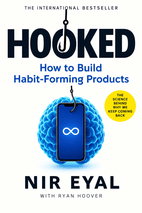
Hooked by Nir Eyal Book Cover

by Nir Eyal

Nir Eyal's Hooked presents the Hooked Model—trigger, action, variable reward, investment—for building habit-forming products, drawing on Fogg, Skinner, and Ariely. Written for product designers, entrepreneurs, and builders, it includes habit-testing methods, the Manipulation Matrix, and case studies.

On Insta.page you also get an Apply This Book tool that lets you combine insights from up to 3 books to solve your specific situation.

Chapter mindmaps

Free preview: chapters 1–4 are fully interactive. Click any node to expand or collapse. Subscribe to unlock the rest.

Chapter 1: 1: The Habit Zone

Key concepts: 1: The Habit Zone

1: The Habit Zone

The Power of Habit

  • Habits are automatic behaviors stored in the basal ganglia, freeing attention.
  • Nearly half of daily actions are habitual, done with little conscious thought.
  • Products must become habits to drive unprompted, repeated use.

Why Habits Pay Off

  • Habitual users stay longer, spend more, and become less price-sensitive.
  • Frequent use accelerates growth through more referral opportunities.
  • Strong habits can beat superior products; new products need to be 9x better.

The Habit Zone

  • Habit formation requires sufficient frequency and perceived utility.
  • High frequency can compensate for low utility; low frequency prevents habits.
  • Products start as vitamins (optional) and become painkillers (relieving nagging pull).

Habits vs. Addiction

  • Addiction is compulsive, harmful dependence; habits can improve life.
  • Healthy routines like brushing teeth or exercising happen automatically.
  • Products should help users do what they already want to do, not exploit them.

The Hooked Model

  • Framework connecting user problems to product solutions.
  • Aims to help builders create products that form healthy habits.
  • Understanding mind mechanics leads to better products sooner.

Chapter 2: 2: Trigger

Key concepts: 2: Trigger

2: Trigger

The Role of Triggers in Habit Formation

  • Habits are built through repetition, not created instantly.
  • A trigger initiates behavior; repetition turns it into routine.
  • Usefulness and design alone don't explain why habits stick.

External Triggers

  • Paid: advertising brings new users but can't retain them.
  • Earned: press mentions and store features are free but fleeting.
  • Relationship: word of mouth spreads fast; pressuring destroys trust.
  • Owned: icons, notifications, newsletters remind users to return.

Internal Triggers

  • Internal triggers fire automatically from memory links.
  • Negative emotions like boredom, loneliness, stress are strongest cues.
  • Products easing pain get linked to feelings, prompting unprompted returns.
  • Study links depressive symptoms to heavier Internet use as relief-seeking.

Designing for Triggers

  • 5 Whys method digs to real emotion behind behaviors like email checking.
  • Instagram example: referrals and notifications led to internal cues like FOMO.
  • Wild trigger ideas can become practical; new tech creates new cue points.

Key Takeaways

  • Match trigger to job: paid/earned acquire, owned/relationship retain.
  • Negative emotions are reliable internal triggers; make relief immediate.
  • Run 5 Whys to find underlying emotions; surface reasons are rarely real.
  • Impractical trigger ideas can become ordinary; keep brainstorming.

Chapter 3: 3: Action

Key concepts: 3: Action

3: Action

Fogg Behavior Model

  • Behavior occurs when motivation, ability, and trigger converge simultaneously.
  • Missing any one element prevents action.
  • Motivation: energy for action; ability: ease of performing behavior.
  • Trigger: cue that prompts the behavior.

Core Motivators

  • Three pairs: pleasure/pain, hope/fear, acceptance/rejection.
  • Different people respond to different motivational levers.
  • Know your audience to choose the right motivator.
  • Example: Obama poster sold hope; helmet ad sold fear.

Simplicity and Friction Reduction

  • Innovation means removing steps from intention to outcome.
  • Fogg's six elements: time, money, physical effort, brain cycles, social deviance, non-routine.
  • Focus on the scarcest resource for the user at that moment.
  • Removing friction usually beats raising motivation.

Heuristics and Cognitive Biases

  • Mental shortcuts make users predictable.
  • Scarcity: scarce items seem more valuable (cookie study).
  • Framing: price tag shapes experience (wine study).
  • Anchoring: sale tags anchor quick judgments.

Design Principles for Action

  • Ensure motivation, ability, and trigger are present before optimizing.
  • Treat step removal as core design tactic.
  • Simplify based on scarcest resource.
  • Choose one core motivator lever for your audience.

Chapter 4: 4: Variable Reward

Key concepts: 4: Variable Reward

4: Variable Reward

Biology of Reward

  • Olds and Milner's mice pressed levers over food and water
  • Knutson: brain lights up when expecting payout, not receiving it
  • Craving for relief drives us, not pleasure itself

Unpredictability

  • Predictable rewards become habits; brain saves attention
  • Skinner's pigeons pecked more with random pellet schedules
  • Surprise forces attention; same dopamine charge in humans

Three Reward Types

  • Tribe: social acceptance, inclusion, importance
  • Hunt: reaching for resources and information
  • Self: mastery and completion

Rewards of Tribe, Hunt, Self

  • Tribe: Stack Overflow votes, points, badges build peer esteem
  • Hunt: Pinterest feed cuts images to trigger scrolling pursuit
  • Self: Codecademy gives feedback, varied success, visible progress

Bounties vs. Social Rewards

  • Mahalo paid cash bounties; engagement collapsed
  • Quora's upvotes and peer recognition beat cash
  • Gamification works only when it scratches an existing itch

Autonomy and Reactance

  • Quora's Views revolt forced opt-in policy
  • Affirming freedom doubles compliance (bus fare study)
  • Products must feel chosen, not forced; Fitocracy vs. MyFitnessPal

Novelty Limits and Unpredictable Products

  • Zynga lost 80% value as copycat games became predictable
  • Endless surprise: WoW, YouTube, Facebook via user content
  • Google, Uber already variable; don't add uncertainty, offer control
You've reached the end of the free mindmaps

Next chapter: “5: Investment” is locked

See every chapter of Hooked as an interactive mindmap — and unlock all 500+ book summaries with audio and AI Q&A.

$0.00 due today · 7 days free, then $89.99/year ($7.49/mo) · Cancel anytime before day 7

Continue exploring Hooked