Designing Your Life Interactive Mindmaps for Designing Your Life (Free)

Designing Your Life — Interactive Mindmaps

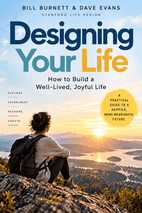
Designing Your Life by Bill Burnett Book Cover

by Bill Burnett

Bill Burnett's Designing Your Life applies design thinking to career and life decisions, teaching readers to reframe dysfunctional beliefs, build a Workview and Lifeview compass, and use tools like the Good Time Journal, mind maps, and Odyssey Plans. For anyone feeling stuck, bored, or lost at any career stage.

On Insta.page you also get an Apply This Book tool that lets you combine insights from up to 3 books to solve your specific situation.

Chapter mindmaps

Free preview: chapters 1–4 are fully interactive. Click any node to expand or collapse. Subscribe to unlock the rest.

Chapter 1: 1. Start Where You Are

Key concepts: 1. Start Where You Are

Start Where You Are

Start Where You Are

  • You Are Here sign clarifies: past jobs don't decide what's next
  • You are not too late or too early; move forward from now
  • First know where you are and what problem you're solving

Wicked Problems and the Wrong Problem

  • Wicked problems never get fully solved; being stuck is a fine start
  • Problem finding matters as much as problem solving
  • Problems usually framed as something missing: add or remove
  • Choosing the wrong problem can cost years or a lifetime

Dave's Two-and-a-Half-Year Detour

  • Dave chased marine biology for 2.5 years over a two-week realization
  • Cousteau and Mrs. Strauss inspired him for the wrong reasons
  • He mistook liking a teacher for liking the subject
  • TAs warned him; he stayed stuck on the wrong problem

Failure, Success, and a Beginner's Mind

  • Lucky ones fail fast and get forced onto better problems
  • Unlucky smart ones succeed, then wake up unhappy years later
  • A beginner's mind asks questions before assuming answers
  • Dave should have explored what marine biologists actually do

Key Takeaways

  • Name the real problem before solving; avoid 'missing' framing
  • Treat history and current job as a starting point, not a verdict
  • Test a field by its daily work, not its heroes or teachers
  • Read failure as cheap correction; beware early success you dislike

Chapter 2: Introduction: Life by Design

Key concepts: Introduction: Life by Design

Introduction: Life by Design

Gravity Problems vs. Real Problems

  • If it's not actionable, it's not a problem—it's a situation.
  • People fight reality and lose; accept what cannot be changed.
  • Distinguish circumstances to accept from problems to design.
  • Fight injustice, but aim effort at strategy, not reality.

The Life Design Dashboard

  • Four gauges: Health, Work, Play, Love—each read 0 to Full.
  • Health: well in mind, body, and spirit.
  • Work: any part of the shared human project, paid or not.
  • Play: joy in the pure doing; Love: affection, community, desire—both ways.

Acceptance: The Starting Point

  • You Are Here is where designers begin.
  • You can't know where you're going until you know where you are.
  • Read your gauges before deciding what to redesign.
  • The assessment is an exercise to perform, not a question to sit with.

Compass Over Map

  • The future cannot be predicted; no perfect life design exists in advance.
  • Designing opens some paths and closes others.
  • You can only know your starting point, not the whole journey.
  • Use a compass to get pointed in the right direction, not a map.

Reframing Dysfunctional Beliefs

  • Don't let a seventeen-year-old decide your life's work.
  • A marriage problem won't be solved at the office.
  • You don't need to know your destination to start designing.
  • Stop defending a first idea; investigate what actually works.

Chapter 3: 2. Building a Compass

Key concepts: 2. Building a Compass

Building a Compass

The Quest Question

  • Most know their name; few can name their quest
  • Worrying and analyzing leave you going in circles
  • Core questions: what is the good life, why am I here

Workview and Lifeview

  • Workview: your philosophy of what work is for
  • Lifeview: how the world works and what gives meaning
  • Both views evolve, so build the compass for now

Borrowed Compasses

  • Parker Palmer lived someone else's life successfully but unhappily
  • Keep others' goals but replace imitation with authenticity
  • Powerful voices tell you who to be; state your own views

Coherency and True North

  • Coherency connects who you are with what you do
  • Conscious trade-offs are fine; unconscious ones breed discontent
  • Workview plus Lifeview together form your True North

Writing and Checking the Compass

  • Write each view in 30 minutes, about 250 words
  • Note where they complement, clash, or drive each other
  • Recheck direction yearly and before any major change

Chapter 4: 3. Wayfinding

Key concepts: 3. Wayfinding

Wayfinding

Wayfinding vs. Map-Following

  • Life has no single destination; a compass beats a map
  • Lewis and Clark mapped 140 maps while heading into the unknown
  • Watch for clues instead of forcing a predetermined plan
  • Michael's mother's plan left him bored and miserable at 34

Engagement and the Good Time Journal

  • Log what you're doing when bored, restless, or unhappy
  • Log when excited, focused, and having a good time
  • Catches you in the act of enjoying yourself
  • Log daily or twice weekly for three weeks, then reflect

Flow: Intensified Engagement

  • Time stops; challenge matches skill; full absorption
  • Discovered by Mihaly Csikszentmihalyi, researched since the 1970s
  • Reports include euphoria, inner clarity, calm, time standing still
  • Can occur in almost any physical or mental activity

Energy as the Second Clue

  • Energy can go negative; some engaging activities drain you
  • Boredom drains but is easier to recover from than de-energizing work
  • Michael thrived on complex problems alone, drained by admin and difficult people
  • Work is fun when you lean into strengths and feel energized

Purpose, Workview, and Lifeview

  • Purpose comes from your Workview and Lifeview
  • Engagement and energy are only clues, not the whole answer
  • A career adds up to 90,000–125,000 hours
  • Enjoyment guides you toward the right work

Zooming In with AEIOU

  • Activities: What were you doing?
  • Environments: Where were you, and how did it feel?
  • Interactions: People or machines, formal or informal?
  • Objects and Users: What was present, and who else was there?

Mining the Past and Enjoying the Journey

  • Historical journal works for those with too little present experience
  • Write big moments as stories, not bullet points
  • Honesty required; don't rewrite your own history
  • Notice how things actually feel, not what others think
You've reached the end of the free mindmaps

Next chapter: “4. Getting Unstuck” is locked

See every chapter of Designing Your Life as an interactive mindmap — and unlock all 600+ book summaries with audio and AI Q&A.

$0.00 due today · 7 days free, then $89.99/year ($7.49/mo) · Cancel anytime before day 7

plus sales tax where applicable

Continue exploring Designing Your Life