Action Before Clarity Quotes
by Vincent Uppelschoten
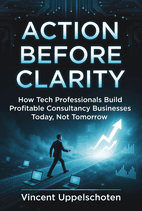
This collection pulls together the most memorable lines from Vincent Uppelschoten's book on moving before you have all the answers. You will find quotes that challenge the urge to wait for clarity, that push you to act on what you already know, and that make the case for starting small and specific.
What makes these quotes stick is their blunt honesty. They do not waste words. Each one lands like a sharp reminder that overthinking is a trap, that your ordinary skills have real value, and that the best way forward is often just to go. They are the kind of lines you underline, screenshot, and come back to when doubt creeps in.
Top Quotes from Action Before Clarity
“You do not have to work for a large company to build a good life. Sometimes you just go. The clarity comes after.”
The author's message to his children in the acknowledgements.
It encapsulates the core philosophy of the book—action before clarity—and reassures readers that they don't need a perfect plan to start.
“You don’t need clarity to start. You need to start to get clarity.”
The author states the core idea of the book.
This line flips conventional wisdom on its head, empowering readers to take imperfect action instead of waiting for certainty.
“The fear you feel now is based on a version of you that has not tried yet.”
Author explains how the brain overestimates risk before any action is taken.
It directly addresses the psychological barrier of fear, offering a rational and hopeful reframe that reduces the perceived threat.
“The thing you can do with your eyes closed is the thing someone else will pay for.”
Opening line of the chapter.
It flips the common assumption that only difficult skills are valuable, immediately challenging the reader's perception of their own expertise.
“Broad means invisible. Specific means findable.”
Opening of the chapter, stating the core principle.
It encapsulates the entire chapter's thesis in a memorable, contrasting phrase that is easy to recall and apply.
“The most valuable thing a competitor's website tells you is what isn’t on it.”
Opening line of the chapter.
It flips the typical competitor analysis from copying to finding gaps, a core insight.
“Two offers gives your client a decision. Ten gives them a reason to walk away.”
Opening statement of the chapter on offer design.
It encapsulates the core principle of limiting choices to reduce decision paralysis and move the sale forward.
Themes Behind the Quotes
One core theme is the reversal of conventional wisdom: clarity follows action instead of leading it. Again and again the quotes argue that waiting for the perfect plan keeps you stuck. The only way to find the right path is to take a step, even a messy one, and let the path reveal itself through doing.
Another theme is the power of specificity and self awareness. The book pushes you to recognize what you already do well, often without realizing it, and to position yourself narrowly rather than broadly. It warns against competing on vague terms and instead encourages owning a clear, memorable niche. Alongside this runs a quiet critique of procrastination hiding as preparation, urging you to stop refining and start offering.
Quotes by Chapter
Cover
“Whatever you are building, I hope this book shortens the distance between where you are now and where you want to be. That is the only reason it exists.”
From the author's acknowledgements section.
This line captures the author's genuine mission and resonates with readers who feel stuck between their current state and their aspirations.
Introduction
“Having doubts is normal, the outcome is better if you act than if you don’t.”
Opening line of the chapter, possibly the author's life philosophy.
It distills the book’s core message into a simple, actionable truth, encouraging readers to embrace uncertainty and take action.
“A small Cessna, a clear morning, just the two of us. That was it. The decision was made before we landed.”
The author describes the decisive moment during his first flight that set him on the path to becoming a pilot.
The vivid, minimalist imagery captures the sudden clarity of a life-changing decision, making it instantly relatable and memorable.
“A birth defect, present since birth, caught late.”
After a medical exam reveals an unknown partial deafness that threatens his pilot ambitions.
The stark brevity and irony of the sentence underscore how life can quietly undermine our plans, adding a layer of poignant realism.
You’ve been thinking about it
“Clarity arrives after the action, not before it.”
The author reflects on his experience after failing to become a pilot and taking the next step without a plan.
It is the central thesis of the chapter, challenging the common belief that one must have clarity before taking action.
“The plan was gone and life was already moving.”
The author describes the moment his original plan to join the air force collapsed.
It is a succinct, poetic reminder that life continues despite disrupted plans, encouraging readers to move forward.
“You've been thinking about starting your own consulting business for longer than you'd care to admit.”
The author directly addresses the reader's procrastination regarding starting a consulting business.
It instantly resonates with anyone stuck in planning mode, calling out the reader's hesitation with relatable specificity.
“All of it is real. All of it is a reason to move.”
After listing legitimate fears and obligations that hold people back.
It validates the reader's genuine concerns while reframing them as fuel for action, not excuses for inaction.
Take the first step anyway
“The thing you're sitting on probably isn’t hidden either. It’s probably so familiar you've stopped seeing it.”
The author reflects on how people overlook their own expertise.
It resonates because many undervalue their deep knowledge, and this line prompts a powerful realization about hidden assets.
“Consistency does something that planning never can.”
The author compares his daily running habit to building a consulting business.
This succinctly captures the value of persistent action over perfect preparation, a memorable mantra for anyone stuck in analysis paralysis.
“That the detail you think you need before you start will reveal itself once you move.”
The author summarizes a key takeaway about starting before having full clarity.
It reassures readers that the missing pieces will appear through action, reducing the fear of beginning.
Action Before Clarity
“The compound effect of consistent small actions is not dramatic to look at (it doesn't feel like much at the time) but it accumulates in ways that intensity followed by inaction never does.”
Author contrasts a single large effort with daily small actions.
It reframes success as a product of steady discipline, making the path feel more achievable and sustainable.
“Clarity is not the thing you find before you start. It's what you build by starting.”
Near the end of the chapter, summarizing the core lesson.
This memorable restatement reinforces the book's central message and empowers readers to take the first step.
Your Consulting Offer Is Already There
“The knowledge you've been building for two decades has done something unusual to you. It's made you worse at seeing its own value.”
Author explaining why experts undervalue their own knowledge.
This highlights the paradox of expertise—the closer you are to your skill, the harder it is to recognize its worth, which is a central barrier to consulting.
“The gap between what you know and what your future clients know is significant. But you're standing so close to your own knowledge that you can’t see the gap.”
Author describing the disconnect between expert and client perspectives.
It clarifies that the real value lies in the difference between what the expert knows and what the client lacks, making the consulting offer obvious once you see it.
“If something comes easily to you, it doesn't feel worth charging for. Effort equals value is the assumption underneath it.”
Author discussing the 'effort equals value' trap.
This pinpoints a psychological block that stops experts from pricing their natural strengths, and reframes the value as speed and effectiveness rather than effort.
The One (1)
“If someone can’t remember your framework after one conversation, it won't do the work you need it to do.”
The author recounts advice from mentors about simplifying frameworks.
It highlights the practical test of whether a framework is truly useful—memorability—making it a sharp, actionable insight.
“Specificity is the mechanism that makes someone stop scrolling and think: this person is talking to me.”
Section contrasting vague versus specific client descriptions.
It explains why specificity grabs attention, resonating with anyone trying to stand out in a crowded market.
“When you're specific, you're not competing with everyone. You're competing with the very small number of people who have defined themselves as precisely as you have.”
From the subsection 'Why Broad Is the Enemy'.
It reframes niching as a competitive advantage, encouraging readers to embrace focus rather than fear it.
The Five (5)
“Fifteen is procrastination wearing the costume of diligence.”
Author argues that reviewing more than five competitors is counterproductive.
It's a sharp, memorable phrase that exposes the comfort of over-researching.
“When a client hires you, they get you. The person who understands their specific situation, who has worked in their space, who will pick up the phone. That is not a consolation prize for not being KPMG. It is a different and often better product for the right client.”
Author describes the boutique positioning advantage.
This reframes the solo consultant's limitation as a distinct competitive advantage, empowering and resonant.
“The exercise is not about presenting the most impressive version of yourself. It is about placing yourself accurately in the landscape you are entering.”
When explaining the self-assessment column.
It encourages honest self-awareness over ego, a crucial mindset for positioning.
The Two (2)
“The question changes from “should I do this?” to “which of these works best for me?””
Explaining the psychological shift when presenting two options instead of one.
It shows how a simple structural change transforms a binary yes/no into an easier comparative decision, reducing resistance.