Action Before Clarity Key Takeaways
by Vincent Uppelschoten
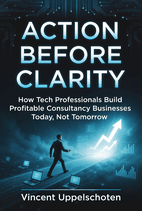
5 Main Takeaways from Action Before Clarity
Act First, Clarity Will Follow
Overthinking is the biggest barrier to starting a consulting business. Taking even a small, imperfect step generates real learning and reveals the path forward, while waiting for perfect clarity keeps you stuck in analysis paralysis.
Your Consulting Offer Already Exists
You don't need a brand-new idea. Your existing expertise—problems you've solved repeatedly at work—is your offer. Package it into a simple sentence: 'I help [X] with [Y] so that [Z]' and test it with a real conversation.
Specificity Makes You Findable
A broad client description makes you invisible; a precise one makes a real person think 'that's for me.' Use at least two of five lenses (geography, industry, business stage, problem type, size) to define your ideal client and outposition competitors.
Price Based on Value, Not Cost
Shift the conversation from 'how much do you cost?' to 'what return do you deliver?' Build an ROI case with cost savings, incremental revenue, your fee, and client-side costs. Aim for payback under 12 months to align with B2B buying cycles.
Consistency Beats Intensity Every Time
Small, daily actions compound into momentum that no amount of planning can match. Pick three outreach channels (warm, LinkedIn, content), commit to weekly time blocks, and run them for 90 days before judging results. Imperfect action trumps perfect inaction.
Executive Analysis
These five takeaways form the book's central argument: that clarity and success in building a consulting practice are outcomes of iterative action, not prerequisites for it. Uppelschoten dismantles the myth that you need a complete plan, a unique idea, or perfect confidence before starting. Instead, he provides a structured but flexible methodology—from surfacing your hidden offer to pricing by value and reverse-benchmarking competitors—that turns overthinking into doing.
This book matters because it directly addresses the paralysis that experienced tech professionals face when considering entrepreneurship. It offers a practical, step-by-step path with concrete tools (one-sentence offers, competitor grids, ROI calculators) and real-world proof (£250K revenue). In a genre crowded with motivational advice, 'Action Before Clarity' stands out as a grounded, tactical playbook for turning corporate expertise into a scalable consulting business—starting today, not when you feel ready.
Chapter-by-Chapter Key Takeaways
Cover (Chapter 1)
Action before clarity is the core philosophy: Overthinking is the biggest barrier; taking even a small step generates real learning.
Your consulting offer already exists: You don’t need a brand-new idea—just package what you already know and do.
The book is written for experienced tech professionals who feel stuck in corporate roles but have the expertise to build something of their own.
Real client results are used as proof of method, not hype: £250K revenue, clear pricing, scalable client acquisition.
The author’s own story mirrors the reader’s: decades in corporate, then a leap into entrepreneurship—so the advice comes from lived experience, not a textbook.
Try this: Identify one problem you've solved repeatedly in your career and write it down as your starting offer, then take one small step to test it.
Introduction (Introduction)
Certainty can dissolve in a moment. A lifelong dream can be interrupted by something as quiet as a missed frequency on a hearing test.
Doubts are normal, but waiting for perfect clarity before acting often costs more than acting with imperfect information.
Unexpected discoveries—even unwelcome ones—can reshape a story before you've fully written it.
Try this: Acknowledge your doubts but recognize that waiting for perfect clarity costs more than acting with imperfect information; schedule one conversation this week.
You’ve been thinking about it (Chapter 2)
Clarity emerges from action, not from waiting for the perfect plan.
The “Sunday evening loop” is a self-reinforcing cycle of analysis paralysis—break it by moving, not by thinking harder.
The reasons you haven’t started feel legitimate, but they are also the same reasons everyone stays stuck.
Your current situation is not your only option. You can move, even without a perfect picture of where you’re going.
The author’s own failed side projects prove that even experienced professionals fall into the same trap—knowing and doing are different things.
Try this: Break the 'Sunday evening loop' of analysis paralysis by committing to a single, small action today—such as writing down one idea you've been thinking about.
Take the first step anyway (Chapter 3)
Your most valuable business idea is probably the one you've stopped seeing because it's too obvious—your existing, hard-won expertise in a field where most others lack one side of the equation.
Clarity is an outcome of action, not a prerequisite for it. Start before you feel ready, and the path will become visible.
Consistency outperforms planning. Small, repeated steps build momentum that no amount of preparation can match.
The first step doesn't need to be perfect; it just needs to be taken.
Try this: Take the first step before you feel ready by defining the one problem you solve for someone else; clarity will emerge from the action.
Action Before Clarity (Chapter 4)
Planning beyond a certain point becomes procrastination. For long-term, unpredictable outcomes, the next action teaches you more than the next hour of research.
You can't think your way into readiness. Readiness comes from doing, not from preparation.
Consistency beats intensity. Small, daily actions compound in ways that occasional big pushes never can.
The risk feels bigger than it is because your brain weights losses twice as heavily as gains. Make the downside specific, and you'll likely find your safety net is stronger than you think.
Your first action is not to build the perfect offer—it's to write down the one problem you solve for someone else. That single sentence is the foundation for everything that follows.
Try this: Limit your planning to the next immediate action; stop researching and start doing—write your one-sentence offer now.
Your Consulting Offer Is Already There (Chapter 5)
Your consulting offer is already in the work you've done—you just can't see it clearly because of proximity and the effort-equals-value trap.
Answer three questions to surface your offer: what problem have you solved repeatedly? What do you gravitate toward, and what do others say about you? What does it cost them not to have it solved?
Your clients are not your peers. Don't compare your knowledge to theirs; compare it to your future clients' needs.
The offer you start with will evolve. Embrace version one—you can't get to version four without it.
Try this: Answer three questions to surface your hidden offer: what problem have you solved repeatedly, what do others ask you for, and what is the cost of not solving it?
The One (1) (Chapter 6)
Specificity is findability. A broad client description makes you invisible; a precise one makes a real person think “that’s for me.”
Use two or three of the five lenses (geography, industry vertical, business stage, problem type, size) to create a concrete definition.
Check affordability: if your ideal client can’t pay for professional work at a professional price, the combination is wrong.
Write one sentence by Sunday using the “I help [X] with [Y] so that [Z]” format. Test it, then refine based on real conversations.
Try this: Write a one-sentence offer in the format 'I help [X] with [Y] so that [Z]' and test it in a conversation this week—specificity is findability.
The Five (5) (Chapter 7)
Research five competitors, no more. Beyond that, you’re procrastinating.
Mix tiers: two large, one to two regional, one to two boutique.
Answer four questions per competitor in 15 minutes each.
Add yourself as the sixth column and be honest about your gaps.
The gaps you find—what competitors consistently avoid—are your positioning opportunity.
Your advantages as a specialist (speed, direct access, specific knowledge, flexibility) are real differentiators against large firms.
Try this: Research exactly five competitors across tiers, map their gaps using a grid, and identify where you can uniquely position yourself.
The Two (2) (Chapter 8)
Two offers create momentum; one offer creates hesitation; ten offers create paralysis
Lead with the full engagement first to anchor value, then present the entry offer as a logical starting point
The entry engagement is a paid stepping stone, not a discount version of your work
Overdeliver on the first engagement — it's your most efficient marketing spend
Consulting scales; contracting doesn't. Document your process so the practice can run without your direct presence
Write your offers down in plain language before you have a single real conversation
Try this: Create two engagement offers—a full anchor and an entry stepping stone—and write them in plain language before any client conversation.
Reverse Benchmarking (Chapter 9)
Reverse benchmarking means looking for what your competitors consistently fail to do, not what they do well. Their blind spots are your opportunity.
The method uses the same five competitors from Chapter 4, but goes deeper: map every feature, capability, and language pattern to reveal the white space.
Build a grid with at least 20 rows. Mark which competitors offer each item. Add yourself honestly. Then add rows from client frustrations and unmet needs.
Your positioning lives in the gaps: rows where most competitors have an empty column and you have a tick. Those are your anchor points.
Run this process at least once a year, or whenever the market shifts. It keeps your offer ahead of where the market is going, not behind where it has been.
Try this: Run a reverse benchmarking grid with at least 20 rows comparing competitors' blind spots, and update it annually to stay ahead of market shifts.
Pricing Strategy and Return on Investment (Chapter 10)
Value pricing transforms the conversation from “how much do you cost?” to “what return do you deliver?”
Four numbers drive every ROI case: cost savings, incremental revenue, your fee, and client-side costs.
Name the fourth number (client costs) before they ask—it builds trust.
Qualitative benefits still matter; name them even when you can’t quantify perfectly.
Payback under 12 months is the B2B sweet spot; structure offers for quick wins if needed.
Understand CAPEX vs. OPEX to match the client’s approval path.
Reach decision-makers before procurement; help them build the business case.
Most price objections are value objections—go back to the ROI conversation before discounting.
Try this: When pricing, build a simple ROI case with four numbers: cost savings, incremental revenue, your fee, and client-side costs—target a payback under 12 months.
Getting in Front of Clients (Chapter 11)
Warm network is the fastest start; use it to practice your pitch with zero stakes.
Pick three channels (warm, LinkedIn, content) and run them consistently in parallel.
Build a weekly structure with time blocks; campaigns burst, structures compound.
Track the numbers at the top of the funnel—volume and ratios are the levers you can pull.
Start before you need the pipeline; anxiety distorts outreach. Consistency over 90 days produces results you can’t yet see.
Try this: Choose three outreach channels (warm, LinkedIn, content) and dedicate weekly time blocks to them consistently for 90 days before evaluating results.
Your First Move Starts Today (Chapter 12)
The only missing piece is a paying client. Everything else is already in place.
You need 5–10 focused hours per week, not a full-time commitment.
Do nothing and you pay the cumulative cost of another year of inertia.
Your one action today: write down one problem you solved twice that someone would pay for, and message one person to have a conversation about it.
In 90 days, you can have a first client or a clear diagnosis of what to fix.
Doubt is normal. Act anyway. Imperfect action beats perfect planning every time.
Try this: Write down one problem you solved twice that someone would pay for, and message one person to have a conversation about it—act now, doubt later.