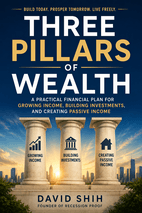
David Shih's Three Pillars of Wealth presents a structured monthly system connecting Job Income, Investments, and Passive Income, with practical tools like SMART Money Targets and a Cash-Flow Baseline. Written for professionals seeking a repeatable financial plan that moves beyond vague advice to actionable steps.
Feature
Insta.Page
Blinkist
Shortform
Summary Depth
Full Chapter-by-Chapter
15-min overview
Section-by-section guides
Audio Narration
✓
✓
✓
Visual Mindmaps
✓
✕
✕
AI Q&A
✓
✕
✕
Quizzes
✓
✕
✕
PDF Downloads
✓
✕
✓
Price
$89.99/yr
$146/yr (PRO)
$199/yr
*Competitor data last verified July 2026.
1 Page Summary
This book presents a structured, three-part financial system designed to work in a fixed, repeatable order each month, moving beyond the idea of a single "big win" to focus on three distinct money engines: Job Income, Investments, and Passive Income. The author defines passive income practically, not as effortless "money while you sleep," but as income requiring significantly less time than a job, supported by systems and templates that reduce hourly dependence. The central insight is that these pillars must be connected and managed as a process, with money flowing between them according to a deliberate plan, beginning with a clear understanding of your monthly cash-flow baseline before moving to investment and passive income goals.
The author's approach is distinctive for its step-by-step, tactical methodology, emphasizing systems over theory. It provides concrete tools like the SMART Money Targets for setting deadlines, the Cash-Flow Baseline for eliminating budgeting guesswork, and a personalized Three-Rung Emergency Fund Ladder that scales to the risk of your income streams. Crucially, the book addresses the behavioral side of finance, using examples like Grace (who mismatched her investment timeline) and Claire (whose risk tolerance was revealed by her past behavior) to show that investment choices should be driven by time horizons and real behavioral clues, not personality quizzes. The process also includes practical guides on automating contributions, rebalancing via strict thresholds, and using a simple weekly review to keep the three pillars aligned.
This book is for anyone seeking a practical, repeatable financial plan, from early-career professionals to those near retirement, who want to move beyond vague advice. The intended reader is someone ready to build a system that survives life’s distractions, whether that involves optimizing job income with a "leverage loop," finding a passive income model that matches their energy (from dividends to digital products), or avoiding the common "silent leaks" that slowly erode savings. Readers will gain not just financial concepts, but a toolkit of actionable steps—including goal-setting calendars, validation cycles for passive income offers, and a "Wealth Leak Prevention Kit"—to build sustainable wealth from all three pillars.
The Three-Pillar Wealth Map
Overview
The second half of the wealth-building framework introduces the Passive Income pillar and then connects all three pillars into a single, repeatable process. The core insight: wealth isn’t about one big win—it’s about designing three distinct money engines that work together in a fixed order, month after month.
The Passive Income Pillar: Less Time, Not Zero Time
Passive income often gets misunderstood as “money while you sleep with no work at all.” Here, the definition is more grounded: income that requires significantly less time than your job income, supported by systems that keep it flowing as you focus on other things. It’s not instant and it’s not effortless—it’s deliberately engineered to reduce your hourly dependence.
The chapter uses Talia as a concrete example. She runs an operations service for local businesses. Instead of reinventing the wheel each month, she builds templates, standardizes packages, and creates a simple onboarding process. That upfront design work means she can sell and deliver the service with fewer hours per client. Revenue stays steadier, and she stops chasing the next project every week.
The Connection Rule: A Fixed Monthly Order
The three pillars only work when money moves between them in a disciplined sequence. The rule is simple:
Fund essentials first – cover your baseline stability.
Contribute to Investments – build long-term growth.
Build Passive Income last – but still fund it, even if the amount is small.
That order protects stability (Job Income pillar) while still pushing growth forward (Investments) and gradually reducing your reliance on time (Passive Income). Talia’s map succeeds because she sticks to this sequence. When a month gets tight, she knows exactly which pillar to protect first and which number to dial back temporarily. The clarity cuts stress and keeps momentum from stalling.
The Takeaway: Treat Your Money Engines Like a Schedule
The chapter closes with a distillation of the whole map: wealth builds when you treat your three money flows as a recurring schedule. Job Income buys stability, Investments buy future growth, and Passive Income buys freedom from the hour-for-dollar trade. When you connect all three in one map, you stop waiting for the “right time” to start—and you begin compounding your progress month by month.
Key Takeaways
Passive Income is designed, not wished for – It requires upfront system-building (templates, packages, automation) to reduce ongoing time input.
The funding order is non-negotiable – Essentials → Investments → Passive Income. That sequence protects stability while still advancing your other pillars.
When money gets tight, prioritize the pillar that keeps you afloat – Reduce Passive Income contributions first, never the essentials.
Wealth compounds when all three engines are running together – Each pillar supports the others, and consistency beats perfect timing.
Key concepts: The Three-Pillar Wealth Map
1. The Three-Pillar Wealth Map
Passive Income Pillar
Requires significantly less time than job income
Built through upfront system design and templates
Not effortless—deliberately engineered to reduce hourly dependence
Revenue becomes steadier with standardized processes
Fixed Monthly Funding Order
Fund essentials first for baseline stability
Contribute to Investments for long-term growth
Build Passive Income last, even with small amounts
Order protects stability while advancing all pillars
Managing Tight Months
Reduce Passive Income contributions first
Never cut essentials or stability funding
Clarity reduces stress and maintains momentum
Know which pillar to protect in any situation
Three Engines Working Together
Job Income buys stability and security
Investments buy future growth and wealth
Passive Income buys freedom from time-for-money trade
Each pillar supports and compounds the others
Consistency Over Perfect Timing
Treat money flows as a recurring schedule
Stop waiting for the 'right time' to start
Progress compounds month by month
Discipline in sequence beats perfect execution
💡 Try clicking the AI chat button to ask questions about this book!
Set SMART Money Targets
Overview
Setting a financial goal without a deadline is like aiming at a target in the dark—you might be pointing in the right direction, but you’ll never know when you’ve hit it. That’s where the “Time-bound” element of SMART targets comes alive. In this section, we watch how one saver, Darius, pins his passive income goal to a concrete 24-month horizon. He doesn’t just mark a date on the calendar and hope for the best; he builds a rhythm of review anchored to real events. Every quarter, he checks his dividend deposits against his plan, and if those payouts are dragging, he adjusts his investing pace accordingly. This turns a vague wish into a self-correcting system.
But a timeline alone isn’t enough. Darius takes the next logical step: converting his target into what he calls a “numbers map” by layering it onto a calendar. He identifies three specific checkpoints. Week 2 is a job-income progress check—are the day‑job earnings on track to support the saving needed? Month 3 shifts focus to investment contributions—have the monthly deposits into dividend‑paying assets actually happened? And at the quarter end, he reviews his passive‑income payout check, the actual dividends that have landed in his account. This staggered approach prevents paralysis by big picture and turns a two‑year goal into a series of manageable, measurable beats.
Key Takeaways
Attaching a specific deadline (here, 24 months) transforms a general ambition into a bounded commitment.
Regular checkpoints prevent drift: weekly for income, monthly for contributions, quarterly for results.
Adjusting pace based on actual payouts keeps the plan responsive, not rigid.
Key concepts: Set SMART Money Targets
2. Set SMART Money Targets
Time-Bound Commitment
24-month deadline transforms ambition into commitment
Deadline prevents aimless saving without direction
Builds a self-correcting system with regular reviews
Staggered Checkpoints
Week 2: job-income progress check
Month 3: investment contribution review
Quarter end: passive-income payout check
Responsive Adjustment
Adjust investing pace based on actual payouts
Prevents paralysis by breaking big goal into beats
Keeps plan flexible, not rigid
Build Your Cash-Flow Baseline
Overview
Budgeting is complicated, but this chapter strips it all away and hands you a single, reliable number: your cash-flow baseline. The idea is straightforward—know exactly how much money flows into your accounts each month that you can count on, and exactly how much must flow out for the bills that won't go away. Once you pin down this number, you can make smarter decisions about spending, saving, and investing without the monthly guesswork.
Steps to Build Your Baseline
The process is deceptively simple, but the discipline is in the details.
1. List every inflow you can count on. Start with your regular job income—paychecks that hit your account on a predictable schedule. If you have consistent income from a side hustle or part-time work, include those deposits too. The key word is count on. One-time windfalls like a tax refund or a large gift don't belong in this baseline. Keep them separate so they don't inflate your view of what's normal.
2. List every outflow you must pay. Write down each recurring expense you expect to pay next month and every month after: housing, utilities, groceries (if you shop monthly), transportation, insurance premiums, minimum debt payments, and any subscription or auto-pay that runs regularly. Be honest—don't leave out the small stuff that drains your account without you noticing.
Common Mistakes to Avoid
The text calls out two traps that derail a clean baseline.
Blending one-time money into your monthly inflow total. That surprise bonus or gift feels great, but it's not part of your ongoing cash flow. Mix it in and you'll overestimate what you can spend or invest every month.
Hiding surprise expenses inside variable essentials. When your car breaks down or the water heater dies, it's tempting to lump that cost into a "variable essentials" category and call it even. That inflates your baseline and masks the real pattern of your spending. Instead, create a separate tracker for surprise outflows, at least for the first three months. Label it clearly and keep it out of your baseline math.
The chapter also warns against tossing every expense into a single "monthly spending" pile and hoping the math tells the truth. That approach leaves you blind to where the money actually goes.
Quick Warning Signs to Watch For
Even after you set your baseline, stay alert for signals that something is off:
You regularly miss a bill right after you set your investment amount.
Your financial life feels fine one month and then panicked the next without a clear reason.
You can't explain why your available cash changed without pointing to a specific inflow or outflow move.
These signs mean your baseline might be off—either too aggressive, too vague, or missing a recurring expense you forgot to list.
Key Takeaways
Build a baseline using only countable monthly inflows and must-pay outflows.
Isolate one-time income and surprise expenses—they don't belong in your core number.
Keep expense categories clean and separate to avoid distortion.
Watch for warning signs like missed bills or unexplained cash swings; they reveal a flawed baseline.
Key concepts: Build Your Cash-Flow Baseline
3. Build Your Cash-Flow Baseline
Core Concept of Cash-Flow Baseline
Single reliable number for monthly finances
Countable inflows minus must-pay outflows
Eliminates monthly guesswork for decisions
Steps to Build Your Baseline
List every inflow you can count on
Include regular job and consistent side income
List every recurring outflow you must pay
Be honest about small unnoticed expenses
Common Mistakes to Avoid
Don't blend one-time money into monthly inflow
Keep surprise expenses out of variable essentials
Create separate tracker for surprise outflows
Avoid lumping all expenses into one pile
Warning Signs of a Flawed Baseline
Regularly missing bills after setting investments
Financial life swings between fine and panicked
Can't explain cash changes without specific moves
Baseline may be too aggressive or missing expenses
Key Takeaways for Success
Use only countable inflows and must-pay outflows
Isolate one-time income and surprise expenses
Keep expense categories clean and separate
Watch warning signs to reveal baseline flaws
Emergency Fund and Risk Buffer
Overview
Think of your emergency fund not as a dull savings account, but as a carefully calibrated shock absorber for your passive income engine. The core insight here is that the type of income you earn determines how much cushion you actually need. If your passive income depends on customer demand—say, a digital product that sells month-to-month—that’s a real risk factor, and you’ll need to fund your safety rungs more aggressively. But if your income comes from steady, contract-based sources like a long-term lease or royalty agreement, you can afford to build those rungs more gradually. This chapter shifts the conversation from “just save three months of expenses” to a smarter, personalized ladder that protects your income without suffocating your growth.
The Three-Rung Ladder
The emergency fund isn’t one big pile of cash; it’s a stairway with three distinct treads, each with a clear job. Rung one is your short-term safety net—use it for emergencies that would otherwise force you to make late payments on bills or debts. Rung two handles medium shocks: home repairs, insurance deductibles, or those “planned-but-unexpected” bills that always seem to land at the worst time. Rung three is the heavy lifter, reserved for prolonged income disruption—a client loss, a market downturn, or a health crisis that stops your passive income cold. The beauty of this ladder is that you never dip into a deeper rung when a shallower one would do, which prevents you from burning through your entire safety net on a minor hiccup.
One Rule to Prevent Pillar Cross-Draining
It’s easy to fool yourself in the moment: “I’ll just use my emergency money to cover this month’s investment contribution, and I’ll make it up next month.” That’s a slippery slope. The chapter lays down a single, non-negotiable rule: never use ladder money to cover the investment contributions you planned to make that month. This protects your investments from being sold at a bad time (sequence-of-return risk is real) and it saves your passive income plan from becoming a “whenever money is left over” afterthought. Write down these payment rules before you need them, not when you’re panicking.
Create a “Risk Buffer Category List”
Finally, don’t just guess what counts as an emergency. Build a concrete list of categories that qualify for each rung of the ladder. For example: medical deductibles, car repairs, urgent home maintenance, job loss gap funding. By defining these ahead of time, you remove the emotional negotiation that happens when money gets tight. You also avoid the temptation to treat a vacation or a “good deal” on a new gadget as an emergency. This list becomes your financial guardrails, keeping your risk buffer clean and ready for the moments it was designed to handle.
Key Takeaways
Fund your emergency rungs more fully if your passive income depends on volatile customer demand, more gradually if it’s contract-based and steady.
Use three distinct rungs: short-term bills, medium shocks, and prolonged disruptions—never mix their purposes.
Protect your investments by never using emergency money to cover planned contributions.
Write down your payment rules and a risk buffer category list in advance to remove guesswork and emotional decisions.
Key concepts: Emergency Fund and Risk Buffer
4. Emergency Fund and Risk Buffer
Personalized Fund Sizing
Volatile income needs more aggressive funding
Steady contract income allows gradual building
Type of income determines cushion depth
Three-Rung Ladder Structure
Rung one: short-term bill emergencies
Rung two: medium shocks like repairs
Rung three: prolonged income disruption
Never dip deeper than necessary
Protect Investments Rule
Never use ladder money for planned contributions
Prevents selling investments at bad times
Saves passive income from being afterthought
Write payment rules before panic
Risk Buffer Category List
Define qualifying emergencies for each rung
Include medical, car, home, job loss
Remove emotional negotiation in tight times
Avoid treating wants as emergencies
Key Takeaways
Fund rungs based on income volatility
Use three distinct rungs with clear purposes
Protect investments from emergency drain
Predefine rules and categories in advance
You've reached the end of the free chapters
Next chapter: “Optimize Job Income Leverage” is locked
Keep reading Three Pillars of Wealth — and unlock all 600+ book summaries with audio, mindmaps and AI Q&A.
$0.00 due today · 7 days free, then $89.99/year ($7.49/mo) · Cancel anytime before day 7
David Shih is a scholar specializing in Asian American literature and cultural studies. He is the author of *The Red Letter* (a novel) and co-editor of the essay collection *Race and Displacement in 20th-Century American Writing*. An associate professor at Marquette University, his work often explores race, immigration, and identity in American culture.
Frequently Asked Questions about Three Pillars of Wealth
What is Three Pillars of Wealth about?
This book presents a comprehensive framework for building wealth through three interconnected pillars: Job Income, Investments, and Passive Income. It provides a step-by-step system for setting SMART financial targets, establishing a cash-flow baseline, building an emergency fund, and optimizing your job income. The guide also covers investing strategies aligned with your time horizon, diversification without complexity, tax-efficient asset placement, and a repeatable method for creating and scaling passive income streams. The process is designed to be sustainable, with a weekly review to keep all pillars aligned and avoid common planning mistakes.
Who is the author of Three Pillars of Wealth?
David Shih is the author of this financial guide, which outlines a structured approach to wealth building using three distinct money engines. The book draws on practical examples and systems to help readers implement the framework in their own lives.
Is Three Pillars of Wealth worth reading?
Yes, this book is worth reading for anyone seeking a clear, actionable system to build sustainable wealth. It moves beyond generic advice by offering a repeatable process that integrates job income, investments, and passive income into a single, self-correcting plan. The step-by-step methods for setting targets, automating contributions, and choosing the right passive income models make it a practical resource for both beginners and experienced savers.
What are the key lessons from Three Pillars of Wealth?
The core lesson is that wealth is built by designing three separate yet interconnected money engines—Job Income, Investments, and Passive Income—that work together in a fixed monthly order. Setting SMART money targets with specific checkpoints and converting them into a numbers map turns vague wishes into a self-correcting system. Automating contributions to each pillar removes daily decision fatigue and ensures consistent progress. Additionally, risk tolerance is best understood by observing your actual behavior during market discomfort rather than through personality quizzes, and tax-efficient placement of investments can significantly boost after-tax returns.
📚 Explore Our Book Summary Library
Discover more insightful book summaries from our collection