Three Pillars of Wealth Key Takeaways — Chapter-by-Chapter Lessons | Insta.Page

Three Pillars of Wealth Key Takeaways

by David Shih
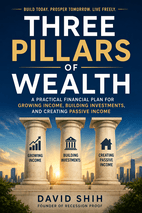
Three Pillars of Wealth by David Shih Book Cover

5 Main Takeaways from Three Pillars of Wealth

Build wealth on three non-negotiable pillars: essentials, investments, passive income.

Your financial life rests on three interdependent engines: covering your must-pay costs, growing your assets through smart investing, and creating income that flows without daily effort. The book insists you fund them in that exact order—essentials first, then investments, then passive income—so stability always comes before speculation. When money gets tight, cut passive income contributions first, never the essentials.

Automate contributions and reviews to remove emotion from money decisions.

Set up bank auto-transfers to your investment and passive-income accounts so you never have to decide each month whether to save. Then schedule a weekly review (market change = ending value – starting value – contributions) that isolates your actions from market noise. Automation turns good intentions into default behavior, and the weekly check keeps you from drifting off course.

Validate passive income with a minimum offer before building a full product.

Don’t invest months crafting a digital product or service until you know people will actually pay. Test demand with a small, specific offer—a single page, a low price, a clear deliverable. The only metric that matters is whether someone hands over money; if they don’t, adjust or stop. This saves time, money, and the heartbreak of building something nobody wants.

Match your investment risk to each goal’s timeline, not the market’s mood.

Use separate buckets for different financial goals: stock funds for horizons longer than ten years, cash or bonds for short-term needs. Automate contributions to each bucket and rebalance only when drift exceeds a preset threshold (e.g., 55% for a 50% target). Let the calendar dictate moves, not fear or greed—this protects your plan from emotional whiplash.

Use a weekly action review to integrate all three pillars and prevent drift.

Every week, compare your expected vs. actual numbers for income, contributions, and spending. That simple six-minute check turns abstract goals into concrete decisions: fix a failed transfer, rebalance a drifting allocation, or debug a slow passive income pipeline. The review isn’t a report—it’s a decision point that keeps your three engines running together.

Executive Analysis

These five takeaways form a unified system: first protect your stability (essentials), then grow your assets (investments), then engineer income that works without you (passive income). The book emphasizes that wealth is not a single number but a synchronized process where automated contributions, disciplined rebalancing, and demand validation prevent costly mistakes. The weekly review acts as the glue, ensuring every pillar stays aligned and responsive to real-world changes.

This book matters because it replaces vague financial advice with a repeatable, step-by-step playbook for the average professional who wants to escape the paycheck-to-paycheck cycle. It stands out in the personal finance genre by treating passive income not as a lottery ticket but as a designed system, and by insisting on a strict funding order that prioritizes survival before speculation. For readers tired of generic 'invest more' platitudes, David Shih offers concrete rules, checklists, and a clear sequence that reduces anxiety and builds lasting wealth.

Chapter-by-Chapter Key Takeaways

The Three-Pillar Wealth Map (Chapter 1)

  • Passive Income is designed, not wished for – It requires upfront system-building (templates, packages, automation) to reduce ongoing time input.

  • The funding order is non-negotiable – Essentials → Investments → Passive Income. That sequence protects stability while still advancing your other pillars.

  • When money gets tight, prioritize the pillar that keeps you afloat – Reduce Passive Income contributions first, never the essentials.

  • Wealth compounds when all three engines are running together – Each pillar supports the others, and consistency beats perfect timing.

Try this: Design your passive income system upfront with templates and automation so that it requires minimal ongoing time—treat it as an engineering project, not a side hustle.

Set SMART Money Targets (Chapter 2)

  • Attaching a specific deadline (here, 24 months) transforms a general ambition into a bounded commitment.

  • Regular checkpoints prevent drift: weekly for income, monthly for contributions, quarterly for results.

  • Adjusting pace based on actual payouts keeps the plan responsive, not rigid.

Try this: Set a 24-month deadline for your next financial target and schedule weekly income checks, monthly contribution reviews, and quarterly result audits to prevent drift.

Build Your Cash-Flow Baseline (Chapter 3)

  • Build a baseline using only countable monthly inflows and must-pay outflows.

  • Isolate one-time income and surprise expenses—they don't belong in your core number.

  • Keep expense categories clean and separate to avoid distortion.

  • Watch for warning signs like missed bills or unexplained cash swings; they reveal a flawed baseline.

Try this: Calculate your cash-flow baseline using only countable monthly inflows and must-pay outflows, and exclude one-time income and surprise expenses from that core number.

Emergency Fund and Risk Buffer (Chapter 4)

  • Fund your emergency rungs more fully if your passive income depends on volatile customer demand, more gradually if it’s contract-based and steady.

  • Use three distinct rungs: short-term bills, medium shocks, and prolonged disruptions—never mix their purposes.

  • Protect your investments by never using emergency money to cover planned contributions.

  • Write down your payment rules and a risk buffer category list in advance to remove guesswork and emotional decisions.

Try this: Build three distinct emergency rungs (short-term bills, medium shocks, prolonged disruptions) and write down payment rules so you never use emergency money for planned investments.

Optimize Job Income Leverage (Chapter 5)

  • Run the Job Income Leverage Loop on a schedule: increase value, document results, negotiate before feeling underpaid.

  • Pick work that boosts reliability, cuts risk, or saves visible time—avoid random projects.

  • Know your current compensation and keep a running list of outcomes, even if rough.

  • Leverage grows even without an immediate raise, as long as you show an organized pattern of improvement.

Try this: Run the Job Income Leverage Loop every quarter: increase your value, document results, and negotiate before you feel underpaid—track outcomes even if they’re rough.

Create a Skills-to-Salary Plan (Chapter 6)

  • Map your proof to tiers: Start with mid-tier roles, then build stronger evidence to climb to higher salary bands.

  • Do an alignment check before applying: Compare your resume and portfolio against the top five requirements in the job posting. Adjust until every requirement is met.

  • Treat job search like a production pipeline: Set a weekly cadence for updating materials, submitting applications, and practicing interviews. Consistency beats sporadic bursts of effort.

  • Stop hoping to be discovered: Hiring managers look for evidence, not potential. Build the proof that aligns with the specific role you want.

Try this: Treat your job search like a production pipeline with a weekly cadence for updating materials, applying, and practicing interviews, and align every resume bullet to the top five requirements in the job posting.

Automate Pillar Contributions (Chapter 7)

  • Automation eliminates the need to decide every month, turning contributions into a default behavior.

  • Bank scheduled transfers are the simplest and most accessible option for most people.

  • Weekly monitoring is essential—fix any failed transfer the same day to prevent plan drift.

  • Use an “increase trigger” (raise, debt payoff, or income jump) to grow contributions automatically over time.

  • A well-designed system runs on its own, freeing you to focus on living instead of managing money.

Try this: Automate your pillar contributions with bank scheduled transfers, monitor them weekly, and set an 'increase trigger' (raise, debt payoff, income jump) to grow contributions automatically.

Choose an Investment Time Horizon (Chapter 8)

  • Match risk to deadline: Stock funds belong in buckets with a ten-year plus horizon; short-term goals need cash or bonds.

  • Use separate buckets for separate goals: One portfolio for everything invites disaster when timing conflicts.

  • Automate contributions: Pre-set allocations prevent emotional decisions and keep each bucket on its own path.

  • The calendar, not the market, should dictate moves: A plan built around your schedule survives volatility better than one chasing returns.

Try this: Match investment risk to your deadline: use stock funds only for buckets with a ten-year-plus horizon, keep short-term goals in cash or bonds, and let the calendar—not the market—dictate moves.

Diversification Without Complexity (Chapter 9)

  • Begin with a cash reserve covering at least three months of expenses plus near‑term bills to prevent forced selling.

  • Build a core portfolio using just two or three broad market funds, aiming for a growth‑stability split that suits your timeline (e.g., 70/30).

  • Allow a small satellite allocation (up to 15%) for more active or thematic investments, ensuring the core stays simple and dominant.

Try this: Start by building a cash reserve covering three months of expenses, then construct a core portfolio with just two or three broad market funds (e.g., 70/30 growth/stability) and allow up to 15% for satellite investments.

Asset Allocation for Each Goal (Chapter 11)

  • Asset allocation isn’t a one-number answer; it’s a tailored recipe for each specific goal.

  • Shorter timelines and higher priority call for more conservative mixes (cash and bonds over stocks).

  • Longer timelines and adjustable goals allow you to take on more stock exposure for potential growth.

  • Even within the same “bond layer,” you can tilt toward safety or growth based on how much flexibility you have.

Try this: Tailor asset allocation to each specific goal: shorter timelines and higher priority call for more cash and bonds; longer timelines allow more stocks, even within the same bond layer you can tilt toward safety or growth.

Rebalancing Rules That Stick (Chapter 12)

  • Rebalancing is about maintaining your target allocation across the three pillars, not about timing the market.

  • Thresholds are pre-set drift limits (e.g., 55% for a 50% target) that trigger a rebalancing action.

  • The rulebook uses an if-then structure: if a threshold is breached, redirect new money first; if that’s not enough, sell and buy.

  • A simple one-sentence log transforms decision-making from emotional to mechanical, providing proof that you stuck to your plan.

  • Emotional rebalancing—reacting to fear, greed, or procrastination—defeats the purpose; rules protect you from yourself.

Try this: Rebalance only when a pre-set drift limit (e.g., 55% for a 50% target) is breached, using new contributions first, then selling and buying if needed, and log the decision in one sentence to stay mechanical.

Tax-Efficient Investing Basics (Chapter 13)

  • Account placement matters more than most investors realize. Tax-inefficient assets belong in retirement accounts, while tax-efficient ones stay in taxable accounts.

  • Reduce friction by choosing ETFs over mutual funds and turning off automatic dividend reinvestment in taxable accounts.

  • Let cash flow guide rebalancing. New contributions and lump sums are natural moments to correct drift without incurring taxes.

  • Keep it simple. A quarterly check-in and a handful of low-cost ETFs can deliver better after-tax returns than a complex, hands-on strategy.

Try this: Place tax-inefficient assets in retirement accounts, tax-efficient ones in taxable accounts, use ETFs over mutual funds, and turn off automatic dividend reinvestment in taxable accounts to reduce friction.

Build Passive Income Pipeline (Chapter 14)

  • Use a strict sprint timetable (1–2–1 weeks) to prevent option paralysis and weak justification.

  • Separate idea validation (does it work?) from market validation (will people pay or act?).

  • Test repeatability once you have a winner—don’t assume one success means a lasting pipeline.

  • Keep offers simple and iterate based on real feedback from the first customers.

  • Batch your maintenance tasks (template updates, follow-up emails) so the pipeline runs without daily attention.

Try this: Use a strict 1–2–1 week sprint timetable for idea validation, separate idea viability from market willingness to pay, and batch maintenance tasks so your pipeline runs without daily attention.

Pick Passive Income Models (Chapter 15)

  • Every passive income model has a distinct work profile—upfront, ongoing, or both. Ignoring this leads to painful fixes later.

  • Dividends require smart selection from the start; royalties demand meticulous contract tracking; digital products need a concentrated launch phase.

  • Real estate offers inflation hedge but operational risks (repairs, vacancy, compliance) can’t be ignored.

  • Match your cash comfort and ability to do focused building to the model’s demands for a sustainable income stream.

Try this: Match your chosen passive income model (dividends, royalties, digital products, real estate) to the work profile you can sustain—upfront, ongoing, or both—based on your cash comfort and ability to focus.

Validate With a Minimum Offer (Chapter 16)

  • A Minimum Offer Validation tests demand with a small, specific offer before you build a full product.

  • Collect repeated buyer requests to create a ranked list of improvements—this becomes your product roadmap.

  • Document every element (copy, deliverables, price, launch schedule) so you can repeat the process efficiently.

  • The only metric that matters initially is whether people actually pay. A purchase validates real demand; no purchases tells you to adjust or stop.

Try this: Validate demand with a minimum offer—build a small, specific product and see if people actually pay; if they do, collect their feedback to create a ranked roadmap for improvements.

Pricing and Profit for Passive Offers (Chapter 17)

  • Price from costs, not competition. Start with the unavoidable variable costs per order. If you don’t know them, you’ll either underprice yourself into a loss or guess too high and scare buyers away.

  • Break variable costs into tiny, auditable pieces. Payment processing, support time, delivery overhead—every line matters. Tomas’s $6 support cost shows how easily labor can dwarf other expenses.

  • The floor does not flex. Even if sales slow down, your per-order costs stay the same. Build your pricing model assuming the worst‑case conversion rate so you’re not caught off guard.

  • Profit is a decision, not a byproduct. After covering every cost, add the profit you want before finalizing the price. That ensures every sale is worth your time.

Try this: Price your passive offer by starting with every variable cost per order (including hidden labor like support time), set a profit floor that works even at the worst conversion rate, and add your desired profit before finalizing the price.

Marketing System for Passive Growth (Chapter 18)

  • Assign exactly one job to each marketing page: capture intent, explain the offer, or send to the next step—never all three.

  • Replace multiple‑link scattering with a single hub page that channels visitors toward one clear call‑to‑action.

  • Monitor handoff metrics (click‑to‑signup, click‑to‑purchase) as early warning signs of a broken flywheel.

  • When conversions plateau, check whether your hub page matches the promise that drove the click—any mismatch kills momentum.

Try this: Assign each marketing page a single job (capture intent, explain the offer, or send to next step), replace multiple links with a single hub page, and monitor click-to-purchase metrics to catch broken flywheels.

Integrate Pillars With a Weekly Review (Chapter 19)

  • Market change = Ending value – Starting value – Contributions. This separates your actions from market performance.

  • A weekly action column keeps the review practical and prevents drift.

  • Ravi’s example shows how expected vs. actual numbers create clear triggers.

  • The review is not a report; it’s a decision point.

Try this: Each week, calculate market change as ending value minus starting value minus contributions, compare expected vs. actual numbers, and use that review as a decision point—not a report.

Avoid Common Planning Mistakes (Chapter 20)

  • Check your bank account first. A shrinking cash balance is often the earliest warning of a planning leak, even when investments look solid.

  • Overconcentration is subtle. You don’t have to sell everything—just start sending new money to different places to slowly rebalance.

  • Pair spending increases with savings increases. The “no automatic raise” rule turns lifestyle creep into a forced savings habit.

  • Stress-test passive income. Always subtract fees and assume a slow start; base your plan on the lowest reasonable scenario, not the rosy marketing number.

  • Use the Wealth Leak Prevention Kit. Detect → Name → Fix. It turns vague anxiety into a concrete action plan.

Try this: Check your bank account first to catch planning leaks, gradually rebalance overconcentration by sending new money elsewhere, pair every spending increase with a savings increase, and stress-test passive income by subtracting fees and assuming a slow start.

Continue Exploring